

When Do Parents Need a Lawyer for School Bullying?
Most bullying cases do not need a lawyer. Some clearly do. Knowing the difference before you act matters more than most parents realize. The decision
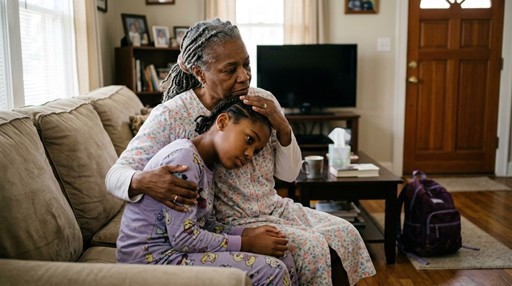
There is a moment many parents reach — after the sleepless nights, after the school meetings that went nowhere, after watching their child fall apart Sunday after Sunday — where keeping them home starts to feel less like giving up and more like the only humane option left.
You are not wrong to feel that way. And you are not alone in feeling it.
But keeping a child home from school because of bullying is a decision that carries real consequences if it is not handled carefully. Attendance laws exist. The school may push back. And depending on how long the absence stretches, your child’s access to education — and the school’s accountability for what caused the problem — can both be affected.
This article gives you a straight answer about what parents can and cannot do, how to protect your child in the short term without losing ground in the larger fight, and what the school is still required to do even when your child is not in the building.
Yes — you can keep your child home. Parents are not legally required to send a child to school on any given day, and short-term absences for legitimate reasons, including a mental health crisis, are generally protected under most state attendance laws.
But there are limits, and they matter. Extended absence without documentation and without a clear plan creates new problems — truancy concerns, gaps in learning, and the loss of the school’s accountability for what drove your child out of the building in the first place.
The goal is not just to get your child through today. The goal is to use this moment to trigger the response the school should have provided already — and to do it in a way that protects your child’s access to education while forcing the school to address what made that education inaccessible.
When a parent reaches the point of considering keeping their child home because of bullying, the situation has almost always been building for longer than anyone outside the family realizes.
The school has typically been made aware. In most cases, parents who reach this point have already reported the bullying at some level. The absence is not the first signal — it is often a signal the school has missed or minimized several times already.
The child’s distress is real and visible. Parents do not reach this decision lightly. By the time a parent is seriously considering keeping their child home, the child is usually showing clear signs — emotional withdrawal, physical symptoms, anxiety, school refusal, or statements that suggest their sense of safety has been significantly damaged.
The parent is caught between two systems. Attendance law pulls in one direction. The child’s immediate wellbeing pulls in another. Most parents have no clear information about where the line is — or how to document the situation in a way that protects them on both sides.
The school’s obligation does not stop because the child is absent. This is one of the most important things parents do not know: if bullying has made your child’s school environment unsafe or inaccessible, the school may still have obligations to provide educational services — and the absence itself may be documentation of the harm the school failed to prevent.

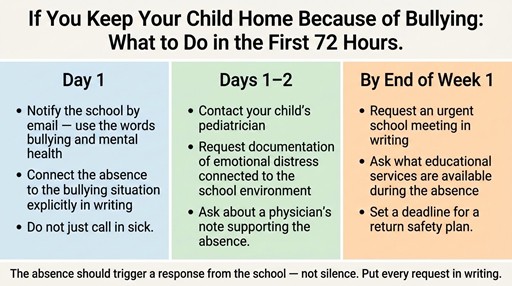
Keeping your child home is a protective measure — but it should also accelerate the school’s accountability, not replace it. Escalation may be warranted if:
Keeping your child home is not a failure. In some situations, it is the most protective decision a parent can make. But it works best when it is paired with immediate written action — toward the school, toward a doctor, and toward a clear plan for what comes next. If you are trying to manage all of that at once while also holding your child together, outside support can help you hold both tracks without losing ground on either one.
Truancy laws vary by state, but in most cases a short-term absence supported by legitimate documentation — such as a physician's note or written documentation connecting the absence to a mental health concern — is not treated the same way as unexplained truancy. The risk generally increases when absences become prolonged without documentation or communication. This is why notifying the school in writing immediately, connecting the absence to the bullying concerns, and involving your child’s pediatrician or therapist early are important steps. If the school threatens truancy action despite documented concerns tied to bullying and mental health, that response itself may warrant escalation.
Some families encounter this response, but a school’s responsibility to address reported bullying does not begin only when the student physically returns to campus. If the school conditions its response on your child returning to an environment they believe is unsafe, ask for that position in writing and consider escalating the matter to the district level. Schools are generally expected to investigate reported concerns and work toward a safe educational environment regardless of whether the student is currently attending in person.
Yes. Parents can ask about alternative educational access during an absence connected to a mental health concern. Depending on state law and district policy, options may include homebound instruction, remote assignments, virtual participation, or a modified schedule. If your child has an IEP or Section 504 plan, the school’s obligations regarding continued educational access during extended absences may be more clearly defined. Make requests in writing and keep copies of all responses.
Careful documentation is important from the beginning. Notify the school in writing as soon as the absence starts, explaining that it relates to bullying concerns and your child’s mental health. Obtain medical or psychological documentation when appropriate. Request meetings, safety planning, or evaluations in writing, and keep records of all communication with the school. Maintaining a consistent position that you are seeking a safe and supported return to school — rather than withdrawing indefinitely — helps establish that the absence is connected to documented concerns about your child’s well-being and educational access.
If you want student harm treated like a school safety and civil rights issue—start with SANI at https://saninstitute.net
Most bullying cases do not need a lawyer. Some clearly do. Knowing the difference before you act matters more than most parents realize. The decision

There is a point in many bullying cases where the parent has done everything right — and it still is not working. The emails are

You have three minutes. Make them the most organized three minutes the board has heard on this topic. Speaking at a school board meeting is

Patience with a school that isn’t responding isn’t a virtue. At some point it becomes a cost your child is paying. Most parents start at