

Do I Need an Educational Advocate for a Bullying Case?
There is a point in many bullying cases where the parent has done everything right — and it still is not working. The emails are

The decision to consult an attorney in a school bullying case is not one most parents make lightly. It follows months — sometimes years — of trying to make the system work through the proper channels. Emails. Meetings. Escalations. OCR complaints. State filings.
And still, nothing adequate.
At that point, the question of whether to consult a lawyer is less about whether you are angry enough and more about whether your situation has the specific elements that make legal action viable — and whether the potential outcomes justify the cost, the time, and the emotional investment.
This article does not tell you whether to hire a lawyer. It tells you how to think about that question clearly — what conditions generally make legal consultation worthwhile, what types of attorneys handle education cases, and what you should know before you make that call.
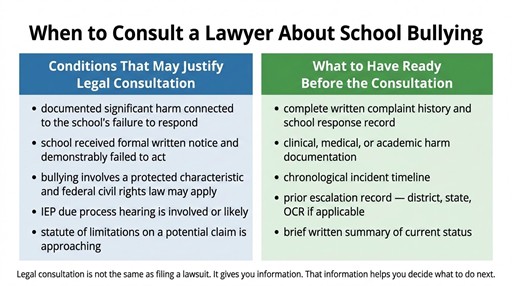
A lawyer may be appropriate when the bullying has caused documented, significant harm to your child; when the school has received formal notice and demonstrably failed to respond; when the bullying involves a protected characteristic that implicates federal civil rights law; when an IEP due process hearing is involved; or when you have exhausted administrative remedies and believe a legal claim may be viable.
Legal consultation is not the same as filing a lawsuit. An initial consultation with an education law attorney helps you understand whether your situation has the elements that would support a claim, what the process would involve, and what realistic outcomes look like. Many families consult an attorney and decide not to proceed with litigation — but leave the consultation with a clearer understanding of their position and their options.
The threshold for legal action is higher than the threshold for feeling wronged. Both things can be true: the school behaved badly, and a viable legal claim may or may not exist based on the specific facts, the applicable law, and the evidence available.
Parents who reach the question of legal representation have almost always been through a recognizable and exhausting process — and understanding what stage they are actually at helps clarify whether legal consultation is the right next step or whether something else should come first.
The administrative process has been genuinely exhausted. A parent who has filed formal written complaints at the school and district level, escalated to the state department of education, and potentially filed an OCR complaint — and has received inadequate responses at every level — has a documented record of institutional failure. That record is the foundation of any legal claim. A parent who is considering a lawyer before completing those steps may be moving too fast.
The harm to the child is documented and significant. Legal claims require proof of harm — not just that bullying occurred, but that the school’s failure to respond caused or allowed harm that is documented in some form: clinical records, medical records, academic records showing decline, records of school withdrawal. The stronger and more specific the harm documentation, the stronger the foundation for a legal claim.
The situation involves a protected characteristic. Federal civil rights statutes — Title VI, Title IX, Section 504 — create the clearest basis for school liability in bullying cases. When bullying is connected to race, sex, disability, or religion, and the school has failed to respond despite formal notice, an attorney with civil rights or education law experience can assess whether the situation meets the relevant legal standard. Without a protected characteristic connection, the legal framework is narrower and often state-specific.
There is a due process proceeding involved. Parents of children with IEPs have access to IDEA’s due process hearing procedure when they believe the school has failed to provide FAPE. A due process hearing is a formal administrative proceeding that typically requires legal representation or at minimum a thorough understanding of the procedural rules. An attorney with special education law experience is the appropriate support for this process.
The statute of limitations is approaching. Every legal claim has a filing deadline. Federal civil rights claims have specific windows — often 180 days for OCR complaints, with different timelines for court filings. State law claims have their own deadlines. If you have been considering legal action for a significant period of time, the deadline question is urgent. Consult an attorney now to understand whether your window is still open — not after you have organized your documentation perfectly.

Do I have to file an OCR complaint before I can sue the school?
No — filing an OCR complaint is not a legal prerequisite to filing a lawsuit. The two processes are separate. However, an OCR complaint is generally faster, free, and may produce results that make litigation unnecessary. Many attorneys recommend pursuing administrative remedies — including an OCR complaint — either before or simultaneously with legal action, because the administrative record strengthens a subsequent legal claim. An attorney can advise you on the right sequencing for your specific situation.
What is the statute of limitations for a school bullying lawsuit?
The statute of limitations varies depending on the type of claim and the state. Federal civil rights claims brought under Title IX, Title VI, and Section 504 borrow the statute of limitations from the state’s personal injury law — which ranges from one to three years in most states, running from the date of the discriminatory act. OCR complaints have their own deadline — generally 180 calendar days from the most recent incident. State law claims have state-specific deadlines. If you are considering legal action, ask an attorney about applicable deadlines as your first question. Missing a deadline can permanently foreclose options that would otherwise have been available.
Can I get money damages from a school bullying lawsuit?
Potentially, yes — but this is not guaranteed, and the circumstances are specific. Under federal civil rights law, courts have allowed damages in cases where the school was deliberately indifferent to peer harassment — meaning the school knew about the harassment and responded in a clearly unreasonable way. The damages available, and the likelihood of obtaining them, depend on the strength of the evidence, the applicable legal standard, and the specific facts of the case. An attorney with civil rights or education law experience can give you a realistic assessment based on your specific situation. Do not enter this process expecting a particular financial outcome.
What if I cannot afford an attorney?
Several options may be available depending on your situation. Civil rights cases are sometimes taken on contingency — the attorney is paid from any recovery, not upfront. Legal aid organizations in some areas handle education civil rights cases for low-income families. Law school clinics with education law programs sometimes take cases. State bar association referral services can connect you with attorneys who offer reduced-fee consultations. If cost is a barrier, ask specifically about contingency arrangements and reduced-fee options when you make initial contact. Do not assume cost eliminates the option before you have asked.
No. Filing an OCR complaint is not a legal requirement before filing a lawsuit. The two processes are independent: OCR is an administrative federal process, while a lawsuit is a court action. That said, an OCR complaint can still be strategically useful because it is free, creates a formal record, and may result in corrective action that resolves the issue without litigation.
In some cases, attorneys may recommend pursuing both tracks at the same time, or using the OCR process first to build documentation that can later support a legal claim. The appropriate sequence depends on the facts of the case and should be discussed with a qualified education or civil rights attorney.
The statute of limitations depends on the type of claim and the state where the events occurred. For federal civil rights claims such as those under Title IX, Title VI, or Section 504, courts generally apply the state’s personal injury statute of limitations, which is typically between one and three years. The clock usually begins running from the date of the alleged discriminatory act or last incident in a pattern of conduct.
Administrative complaints have different deadlines. For example, OCR complaints generally must be filed within 180 calendar days of the most recent incident, although extensions may be possible in limited circumstances. State-level claims also have separate filing deadlines that vary widely.
Because deadlines can permanently affect your legal options, it is important to consult an attorney as early as possible if you are considering formal action.
In some cases, yes — but it depends heavily on the facts and legal standard. Under federal civil rights law, courts may award damages where a school had actual knowledge of harassment and responded with deliberate indifference, meaning its response was clearly unreasonable under the circumstances.
Whether damages are available, and in what amount, depends on the strength of the evidence, the severity of harm, and how the law applies in your jurisdiction. Some cases result in injunctive relief (changes in policy or school action) rather than monetary compensation. An attorney can help assess what remedies may realistically apply in your specific situation.
There are several possible options depending on your location and case. Some education and civil rights attorneys take cases on contingency, meaning they are only paid if there is a recovery. Others may offer reduced-fee consultations or limited-scope representation.
Legal aid organizations, civil rights nonprofits, and law school clinics may also assist families in certain situations. State bar associations can often provide referral services to attorneys who offer flexible fee structures.
If cost is a concern, it is still worth asking directly about contingency arrangements, sliding-scale fees, or limited consultation options before assuming legal help is out of reach.
If you want student harm treated like a school safety and civil rights issue—start with SANI at https://saninstitute.net
There is a point in many bullying cases where the parent has done everything right — and it still is not working. The emails are

You have three minutes. Make them the most organized three minutes the board has heard on this topic. Speaking at a school board meeting is

Patience with a school that isn’t responding isn’t a virtue. At some point it becomes a cost your child is paying. Most parents start at
You tried the school. You tried the district. You documented everything. And your child was still harmed. This is the question that parents arrive at