

When Do Parents Need a Lawyer for School Bullying?
Most bullying cases do not need a lawyer. Some clearly do. Knowing the difference before you act matters more than most parents realize. The decision
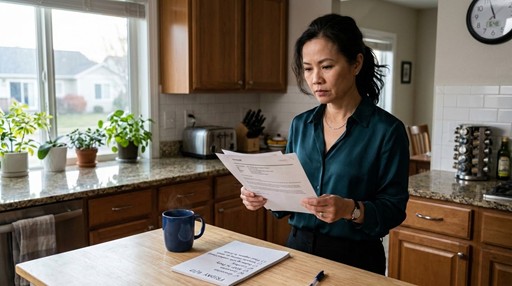
Most parents start at the building level because that is where the problem is. They report to the teacher. Then the principal. They follow up. They give it time. They follow up again.
And at some point — not because they wanted to escalate, but because they had no choice — they start asking whether there is someone above the principal who actually has to respond.
There is. And knowing when to contact them, how to do it, and what to bring when you do is the difference between an escalation that changes something and one that produces another round of polite non-response.
A parent should go above the principal when the principal has received a formal written bullying complaint and has not responded adequately within a reasonable timeframe — typically ten to fifteen school days — or when the school’s response has been so minimal that it cannot reasonably be called an investigation.
Going above the principal means contacting the district superintendent in writing, with your documentation attached. That contact moves the situation from the building level to the district level, where administrative authority is broader and the accountability structure is different.
But timing and framing matter. An escalation that is organized, documented, and factual is significantly more effective than one that is reactive, emotional, or premature. The goal is not to make a scene above the principal’s head. It is to find the level of the institution that has both the authority and the obligation to respond — and give them a specific, documented reason to do so.
Parents who reach the point of needing to go above the principal are almost always in one of a few recognizable situations — and the strategy for each is slightly different.
The principal has gone quiet. The most common situation: a parent filed a complaint, received an initial acknowledgment or a vague promise of follow-up, and then heard nothing. No investigation update. No outcome communication. No change in the bullying situation. The principal has effectively filed the complaint and moved on. This is the clearest signal that escalation is appropriate.
The principal responded but the response was inadequate. A response that says ‘we spoke to both students’ or ‘we are monitoring the situation’ without any documented investigation, any protective measures, or any written outcome is not an adequate response to a formal bullying complaint. The school has technically replied — but has not met its policy obligations. That gap is the basis for escalation.
The principal relabeled the situation. If the school has characterized the situation as peer conflict, a misunderstanding, or a one-time event despite a documented pattern of targeting, the school has made a policy determination that can and should be challenged. If the written challenge to that characterization has not produced a change, escalation to the district is the next step.
The situation is urgent. Some situations cannot wait for the standard escalation sequence. If your child is being physically harmed, expressing thoughts of self-harm, or unable to attend school because of an immediate safety concern — the district level should be contacted immediately, in parallel with or instead of waiting for the building-level process to complete.
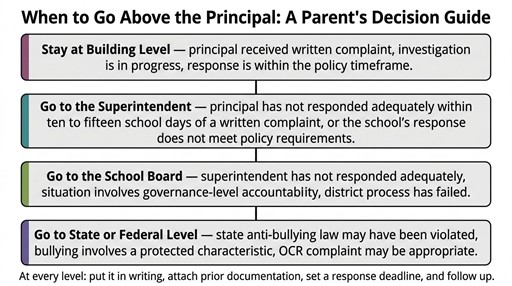
Most situations benefit from the measured escalation sequence above — giving each level a defined window to respond before moving to the next. But some situations call for faster movement. Do not wait for the standard timeline if:
Going above the principal is a procedural step, not a dramatic one. It is simply the next level of an institution that has an obligation to your child — and a way of finding the person within that institution who has both the authority and the accountability to act. If you want help determining whether your documentation is ready for this step, drafting the superintendent email, or planning your escalation strategy, outside support can help you move forward effectively.
After a formal written complaint, ten to fifteen school days is a reasonable window — enough time for the principal to take meaningful action without allowing the situation to stall indefinitely. If the bullying is ongoing or your child is in distress, you do not need to wait the full period before escalating. If the school acknowledges your complaint and provides a clear investigation timeline, you can reasonably follow that timeline — but you should still follow up in writing if deadlines pass without a documented outcome. The key factor is the impact on your child, not an arbitrary waiting period.
In most cases, escalating beyond the principal does not result in retaliation, and schools are legally prohibited from punishing students or families for making formal complaints. However, the way you escalate matters. A factual, calm, and well-documented message helps keep attention on the issue rather than on personal conflict. If you notice any change in your child’s treatment after escalation, document it immediately, including dates, details, and any witnesses, and include it in your next communication to the district.
Document the referral and treat it as part of your escalation record. If you have already made a formal written complaint at the building level, a simple redirect without review does not resolve the issue. Respond in writing, stating that you previously escalated after no meaningful resolution at the building level and are requesting a district-level review. If the superintendent continues to deflect without engaging substantively, your next step may be a formal complaint to your state department of education.
In most cases, no. The superintendent is the appropriate first escalation step after the principal because they have direct administrative authority over district operations. School boards generally provide oversight rather than handling individual student issues directly. Going to the board before the superintendent can sometimes complicate resolution or appear to bypass standard channels. If the superintendent fails to respond meaningfully, then contacting a school board representative becomes a reasonable next step.
If you want student harm treated like a school safety and civil rights issue—start with SANI at https://saninstitute.net
Most bullying cases do not need a lawyer. Some clearly do. Knowing the difference before you act matters more than most parents realize. The decision

There is a point in many bullying cases where the parent has done everything right — and it still is not working. The emails are

You have three minutes. Make them the most organized three minutes the board has heard on this topic. Speaking at a school board meeting is
You tried the school. You tried the district. You documented everything. And your child was still harmed. This is the question that parents arrive at