

When Do Parents Need a Lawyer for School Bullying?
Most bullying cases do not need a lawyer. Some clearly do. Knowing the difference before you act matters more than most parents realize. The decision

Most parents who reach the question of an OCR complaint have been through a long and exhausting process before they get there. They have filed complaints. They have attended meetings. They have escalated to the superintendent. They have documented everything. And the situation has still not been resolved.
The Office for Civil Rights — the federal agency that enforces civil rights laws in schools — is not where every bullying case ends up. But for some families, it is the most powerful option still available. And understanding when it applies, and when it does not, is the difference between a complaint that carries real weight and one that goes nowhere.
This article gives parents a clear-eyed look at what the OCR handles, what conditions may justify a complaint, and how to think about this step before taking it.
The Office for Civil Rights enforces federal civil rights laws in schools that receive federal funding — which includes virtually all public schools. An OCR complaint may be appropriate when bullying targets a student’s protected characteristic — race, color, national origin, sex, disability, or religion — and the school has failed to respond adequately despite being put on notice.
An OCR complaint is not appropriate for every bullying situation. If the conduct does not involve a protected characteristic, or if the school has genuinely addressed the situation, OCR is unlikely to have jurisdiction. The protected characteristic connection is essential — it is what brings the federal civil rights framework into the picture.
Filing an OCR complaint does not require a lawyer, does not cost money, and does not commit you to any legal proceeding. It is an administrative complaint — a formal request for a federal agency to review whether a school violated its civil rights obligations. The outcome is not a court judgment. It is an investigation, and if a violation is found, a resolution agreement that the school is required to implement.
When parents start seriously considering an OCR complaint, their situation almost always shares a recognizable set of features — and understanding those features helps clarify whether OCR is the right next step or whether something else should come first.
The bullying targets something protected. The most common scenarios that may justify an OCR complaint involve bullying based on race or national origin — covered under Title VI; sex or gender — covered under Title IX; or disability — covered under Section 504 and the Americans with Disabilities Act. When a child is targeted specifically because of who they are in one of these categories, the school’s failure to respond may implicate federal law, not just district policy.
The school was clearly put on notice and did not act. OCR is not designed to substitute for the school complaint process — it is designed to hold schools accountable when that process has failed. A school that received a formal written complaint, had the opportunity to respond, and failed to do so meaningfully is in a different position than one that has never been formally notified. Your prior complaint history is essential to an OCR filing.
The harassment was severe, pervasive, or persistent enough to affect the child’s access to education. This is a key legal threshold. A single incident, while harmful, may not meet the standard OCR applies. A pattern of harassment that affected your child’s ability to attend school, participate in activities, or access their educational environment is more likely to meet that threshold.
District-level escalation has already been attempted. While OCR does not strictly require that you exhaust all school-level options first, a complaint supported by a documented history of school and district non-response is significantly stronger than one filed without that foundation. OCR reviewers look at what the school knew and when — and what they did with that knowledge.

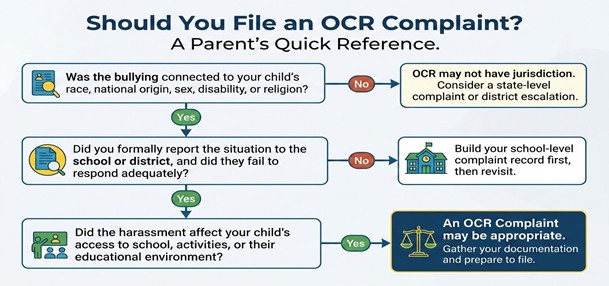
complaint may be appropriate. File within 180 days of the most recent incident.’ No leads to ‘Review your situation with an advocate before filing.’ Footer note: ‘Filing an OCR complaint is free, does not require a lawyer, and does not commit you to legal action.’ Clean three-box decision tree, one accent color, no decorative elements.
Not every bullying situation reaches the OCR threshold — but some clearly do. An OCR complaint may be warranted when:
In situations that may involve an OCR complaint, a consultation with an educational advocate or attorney before filing may help you frame the complaint accurately, ensure you are within the filing window, and avoid language that could narrow the scope of the investigation unnecessarily.
An OCR complaint is one of the most serious tools available to a parent who has exhausted school and district options. It carries real weight — but it also requires careful preparation. If you are considering this step and want to make sure your situation qualifies, your documentation is strong, and your complaint is framed correctly, outside support can make a meaningful difference in how the process unfolds.
The Office for Civil Rights (OCR) is a federal agency within the U.S. Department of Education that enforces federal civil rights laws in schools receiving federal funding. This includes Title VI (race and national origin), Title IX (sex), Section 504 of the Rehabilitation Act (disability), and related protections. When a school fails to respond appropriately to harassment connected to a protected category, parents can file a complaint requesting a federal investigation. OCR does not award money damages. Instead, it investigates and, if it finds a violation, works with the school to implement corrective actions through a resolution agreement.
No. An OCR complaint is an administrative complaint filed with a federal agency, not a lawsuit or court filing. It does not go to court, does not require legal representation, and does not result in a judge issuing a ruling or awarding damages. Instead, it can trigger a federal investigation and, if a violation is found, a resolution agreement requiring the school to make corrective changes. Some families pursue legal action separately, but filing with OCR does not commit you to litigation.
Yes — and in many cases, this is the most effective approach. An OCR investigation can take months, and filing does not prevent you from continuing to escalate within the school or district. You can still request meetings, submit written complaints, pursue evaluations under Section 504 or IDEA, and request safety measures. In some situations, continued documentation and escalation at the local level can prompt faster action than the federal process alone. Both tracks can run in parallel.
If OCR determines it does not have jurisdiction, it will notify you in writing and explain the reason (for example, insufficient connection to a protected characteristic or timing issues). This does not mean you have no options. You may still be able to pursue remedies through your state department of education, the school district’s complaint process, or through legal or advocacy channels depending on your situation. A jurisdictional dismissal is not the end of the process — it is a signal to redirect to another available pathway.
If you want student harm treated like a school safety and civil rights issue—start with SANI at https://saninstitute.net
Most bullying cases do not need a lawyer. Some clearly do. Knowing the difference before you act matters more than most parents realize. The decision

There is a point in many bullying cases where the parent has done everything right — and it still is not working. The emails are

You have three minutes. Make them the most organized three minutes the board has heard on this topic. Speaking at a school board meeting is

Patience with a school that isn’t responding isn’t a virtue. At some point it becomes a cost your child is paying. Most parents start at