
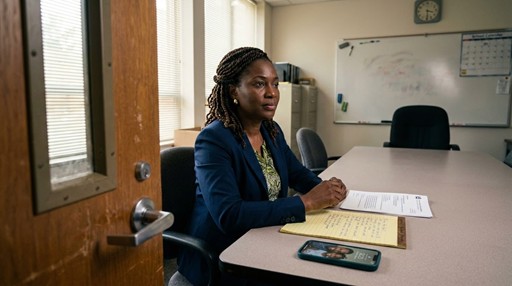
You have been in that office. You know how meetings like this go — what gets said, what gets denied later, what never makes it into anyone’s notes.
The principal says one thing in the meeting and another in the follow-up email. Commitments made verbally evaporate. Statements that would change everything if they were on the record stay conveniently off it.
It is not paranoia that makes a parent want to record a school meeting. It is experience.
The question of whether you can record a meeting with the principal is one of the most practical questions a parent in a bullying situation can ask — because the answer affects both your evidence strategy and your legal exposure. And the answer is not the same in every state.
The Short Answer
Whether you can legally record a meeting with the principal depends primarily on which state you are in and whether that state requires all-party consent or only one-party consent for recorded conversations.
In one-party consent states — which include the majority of U.S. states — you can legally record a conversation you are participating in without telling the other person. In all-party consent states — sometimes called two-party consent states — you are generally required to inform all participants before recording, and recording without consent may violate state wiretapping or eavesdropping laws.
This is not a minor distinction. Recording a meeting without consent in an all-party consent state could create legal exposure for you and could potentially make the recording inadmissible or complicate your situation in ways that outweigh the benefit.
Before you record anything, you need to know which category your state falls into. This article walks you through how to think about that — and what to do if recording is complicated or unavailable to you.
What This Usually Means
Parents who want to record a meeting with the principal are almost always in a situation where the verbal record has already failed them — and they are trying to prevent that from happening again.
They have experienced the meeting that produced no written follow-up. The principal said something significant — a commitment, an acknowledgment, an explanation — and it was never confirmed in writing. When the parent referenced it later, the administrator had no memory of saying it or characterized it differently.
They are heading into a meeting that feels high-stakes. They expect the school to say things that could matter — either because the school might make commitments they want documented, or because the school might say something that contradicts their prior position. Either way, having an accurate record feels essential.
They do not trust that the school’s notes will be complete or accurate. School meeting notes, when they exist at all, are produced by school staff. They reflect what the school wants on record — not necessarily everything that was said. A parent who relies only on the school’s documentation is operating with incomplete information.
Here is the critical thing many parents do not realize: even in states where recording without consent is legally permitted, doing so covertly may damage the relationship with the school in ways that complicate everything that follows. And there is almost always a better alternative — one that creates an equally strong record without the legal and relational risks.
What to Do Now
- Find out whether your state is a one-party or all-party consent state before the meeting. Do not guess. Search your state name plus ‘recording consent law’ or ‘one-party consent.’ Most state attorneys general websites and reputable legal reference sites have plain-language summaries. Know the rule for your state before you make any recording decision.
- If your state requires all-party consent, ask permission to record openly before the meeting begins. You can do this by email in advance — something as direct as: ‘I find it helpful to record meetings so I can review what was discussed accurately. Is that acceptable to you?’ Some principals will agree. Some will decline. If they decline, you have your answer — and you have a written record that you asked. Do not record secretly in an all-party consent state. The legal and strategic risk is not worth it.
- Whether or not you record, use a written follow-up email as your primary documentation tool. This is the strategy that almost always produces the strongest record — and it requires no legal analysis at all. Within 24 hours of any meeting, send an email to the principal that says: ‘I am writing to summarize what was discussed in our meeting today.’ Then list, point by point, every significant thing that was said, every commitment made, and every outcome agreed to. Ask the principal to correct anything you have recorded inaccurately. Their response — or their silence — becomes part of your documentation. A written summary that goes uncorrected is a strong record.
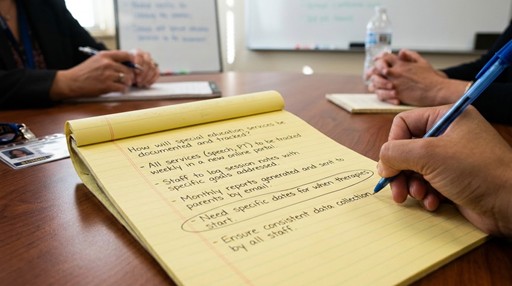
- Bring a written list of questions to the meeting and take notes during it. Written notes taken during the meeting are contemporaneous documentation — they were created at the time, not reconstructed afterward. A parent who arrives with prepared questions on a legal pad and writes down responses during the meeting has a credible contemporaneous record of what was said, even without a recording.
- Consider bringing a support person to the meeting. A second person present at the meeting — a spouse, a family member, a trusted advocate — provides a second witness to what was said. Two people’s consistent accounts of a meeting are more credible than one. IDEA specifically protects the right of parents of students with IEPs to bring a person of their choosing to meetings. Even for general education parents, bringing a supportive witness is almost always appropriate.
- If you do record openly and the principal agrees, tell them clearly at the start of the meeting that you are recording and where the device is. Keep the recording device in plain sight. Do not attempt to obscure it or create any impression that the recording is hidden. An open, disclosed recording is clean documentation. A covert recording — even in a one-party consent state — creates unnecessary complications if it ever becomes relevant in a dispute.
- Save any recording immediately after the meeting and back it up to a second location. A recording that exists only on your phone is vulnerable to loss. Email it to yourself, upload it to a cloud folder, or transfer it to a computer the same day. Label it with the date, location, and participants. If the recording is ever needed — for a district complaint, an advocacy proceeding, or a legal matter — you need to be able to produce it cleanly.
What Not to Do
- Do not record secretly in an all-party consent state. The legal consequences — potential criminal liability under wiretapping statutes, civil liability, and the possibility that the recording cannot be used — far outweigh any evidentiary benefit. If your state requires all-party consent, ask permission or use written documentation instead.
- Do not assume that a recording is the most powerful form of documentation available to you. A written follow-up email summarizing the meeting — sent within 24 hours and left uncorrected by the school — is often more useful in practice than a recording. It is clean, it is unambiguous, and it does not raise legal questions about consent or admissibility.
- Do not use the recording as a confrontation tool in the meeting itself. A parent who produces a phone mid-meeting to announce they are recording — after the meeting has begun, without prior notice, in a way that feels like a gotcha moment — typically damages the relationship and puts the administrator on the defensive in ways that make the rest of the meeting less productive.
- Do not neglect written notes in favor of recording. Even if you are recording, take written notes during the meeting. If the recording is ever lost, corrupted, or contested, your contemporaneous handwritten notes are a second form of documentation. Use both.
- Do not let the meeting end without a clear summary of next steps. Whether or not you have a recording, the most important thing you can produce from a school meeting is a documented list of what was agreed to, who is responsible for each item, and by what date. Ask for that summary out loud at the end of the meeting. Then confirm it in your written follow-up email the next day.
When Documentation Concerns Signal It Is Time to Escalate
The desire to record a meeting is often a signal that something deeper is wrong — that the parent has lost confidence in the school’s good faith and needs external protection for their record. That signal is worth paying attention to. Consider escalating if:
- The school has already made verbal commitments that it subsequently denied or failed to honor. A pattern of that kind suggests the building-level process is not operating in good faith — and that escalation to the district level may be more productive than continued meetings at the school.
- You feel you need a recording specifically because you do not trust the school to accurately document what was said. That level of distrust, if founded, may be a sign that the situation needs district-level oversight or outside advocacy support.
- The school refuses to provide any written follow-up after meetings, despite your requests. A school that will not confirm meeting outcomes in writing may be managing its record carefully in ways that are not in your child’s interest. That pattern belongs in your escalation documentation.
- You have attended multiple meetings that produced assurances but no documented outcomes or follow-through. Multiple meetings without written results are not a sign that the process is working. They are a sign that it is not.
Take the Next Step
Whether or not you record a school meeting, what matters most is that you leave it with a clear, documented record of what was said and what was agreed to. If you want help preparing for a difficult meeting with the school — knowing what questions to ask, how to take notes that hold up, and how to write a follow-up summary that becomes real documentation — outside support can make a meaningful difference.
- Schedule a free consultation with Jerry Green: If you have a school meeting coming up and want help preparing your questions, your documentation strategy, and your follow-up plan — a free consultation can help you walk in ready and walk out with a record that matters. https://calendly.com/jerrylgreen2011
- Take the Student Protection Readiness Checklist: A practical first step to assess where your documentation stands right now — what the school has put in writing, what has only been said verbally, and what gaps need to be filled before or after your next meeting. https://sprchecklist.abacusai.app
FAQs
How do I find out if my state is a one-party or all-party consent state?
Search your state name along with terms like “recording consent law” or “wiretapping consent.” Most state attorney general websites provide plain-language explanations of their recording laws, and several legal reference organizations maintain updated state-by-state guides. Because these laws can change, avoid relying on outdated summaries. If you are uncertain about the law in your state, the safest approach is to ask for permission before recording any meeting or conversation.
What if the principal refuses to let me record the meeting?
In states that require all parties to consent, a refusal generally means the meeting cannot legally be recorded. In one-party consent states, recording laws may still technically permit recording, but secretly recording after an objection can create trust and credibility problems that may outweigh any practical benefit. A strong alternative is to take detailed notes and send a written summary after the meeting stating what was discussed, what commitments were made, and what follow-up was requested. If the school does not correct that summary, it becomes valuable documentation.
Can the school refuse to meet with me if I insist on recording?
Schools generally still have obligations to communicate and meet with parents regarding student welfare, safety, and educational access. If a school refuses to meet solely because of a recording request, document that refusal in writing, including the date, the individuals involved, and what was said. In many cases, schools will instead propose continuing the meeting without recording rather than refusing to meet altogether. If communication breaks down entirely, escalating to district administration may be appropriate.
Is a written meeting summary as useful as a recording?
In many situations, yes. A well-written summary sent shortly after the meeting can be easier to reference and share than a lengthy recording. Effective summaries focus on the important points: who attended, what concerns were discussed, what actions the school agreed to take, and any timelines or follow-up commitments. Recordings can be valuable when exact wording matters, but written summaries are often more practical, create fewer legal concerns, and still provide a strong documented record when preserved consistently over time.
Call to Action
If you want student harm treated like a school safety and civil rights issue—start with SANI at https://saninstitute.net