

When Do Parents Need a Lawyer for School Bullying?
Most bullying cases do not need a lawyer. Some clearly do. Knowing the difference before you act matters more than most parents realize. The decision

Most parents send their bullying complaint to one person — the principal. That is the right starting point. But it is often not enough on its own.
When you copy additional recipients on a bullying email, you do two things simultaneously. You create a wider record — more people who have formally been put on notice — and you signal to the school that you are organized, that you understand how institutions work, and that this complaint will not disappear quietly into one administrator’s inbox.
Schools respond differently to emails that are copied to multiple relevant parties than they do to emails addressed to a single person. The difference is not always dramatic — but it is consistent. A complaint that sits with one administrator is easier to manage slowly. A complaint that sits with four is harder to ignore.
This article tells you exactly who to copy, when to add each person, and how your copy strategy should change as the situation escalates.
For a first formal bullying complaint, copy the school counselor in addition to the principal. That gives you two people at the building level who are formally on notice and cannot later claim they did not know.
If the complaint is a follow-up after no response, copy the district superintendent. If the situation involves your child’s IEP or 504 plan, copy the special education coordinator or director. If the situation has escalated significantly, copy your school board representative.
The copy list grows as the situation escalates. Start focused. Expand strategically. And never copy people just to create pressure — copy people because their role gives them a legitimate stake in the situation and a reason to be on the record.
When parents ask who to copy on a bullying email, they are usually at one of two points: sending the first formal complaint and wanting to do it right, or escalating after the school has failed to respond and wanting to add pressure. The answer is different for each situation — and understanding why helps you make smarter decisions about the copy list.
Copying is about accountability, not intimidation. The goal is not to embarrass the principal or create unnecessary conflict. The goal is to ensure that the right people in the institution have formal notice of the situation — and that the school’s response, or lack of response, is visible to more than one person. That visibility is accountability.
Each person you copy has a different role and a different reason for being on the email. The school counselor is involved because student welfare is their job. The special education coordinator is involved because IEP compliance is their responsibility. The superintendent is involved because district policy and accountability are their domain. Copying the right people means understanding what each person is responsible for and whether the situation involves that responsibility.
The copy list also signals where you are in the process. A first complaint copied only to the principal and counselor signals that you are working within the building. A follow-up complaint copied to the superintendent signals that the building has failed and you are escalating. A complaint copied to the district’s civil rights coordinator signals that you believe the situation may have civil rights implications. Each copy choice tells a story about where the situation stands.
First Formal Complaint — Building Level
Primary recipient: the school principal, addressed by name.
Copy: the school counselor. The counselor is a logical second recipient at the building level because student welfare is their specific responsibility. Copying them creates a second point of contact and a second person who is formally on notice.
Optional copy at this stage: your child’s homeroom teacher or primary classroom teacher, if the bullying is occurring primarily in or around that classroom. This is situational — use judgment based on whether the teacher’s awareness is relevant.
Follow-Up After No Response — Escalating to District
Primary recipient: the district superintendent, addressed by name.
Copy: the principal — so they know the situation has moved to the district level. Copy the district’s director of student services or student affairs if that role exists in your district. This person typically has oversight of building-level student welfare responses.
Attach your prior complaint email to this message. The prior email is documentation. The follow-up email is the escalation. Both together tell the story.
If Your Child Has an IEP or 504 Plan
Add to any complaint at any level: the school’s special education coordinator or case manager. If escalating to the district, also copy the district’s director of special education.
These recipients are relevant because bullying that affects a student with a disability may implicate the school’s FAPE obligations — and the people responsible for IEP compliance need to be on the formal record.
If the Situation Involves a Protected Characteristic
Add: the district’s civil rights compliance officer or Title IX coordinator, depending on the protected characteristic involved. Most districts have a designated civil rights or Title IX coordinator — their contact information is typically on the district website. Copying them signals that you understand the civil rights dimension of the situation and that the school’s response will be reviewed against civil rights obligations, not just anti-bullying policy.
If Escalating to the School Board Level
Add: your school board representative. Board members are elected officials in most districts and have constituent accountability. A well-documented complaint copied to a board representative creates visibility at the governance level of the institution — above the superintendent’s daily operations.
Use this step when district-level escalation has already been attempted and has not produced a meaningful response. Do not copy board members on a first complaint — it is disproportionate to the stage of the process and may reduce your credibility.
What Not to Add to the Copy Field
Do not copy other parents, community members, or local media. Copying outside parties before the institutional process has been exhausted can create legal complications, make the school defensive, and shift the conversation from your child’s specific situation to a public dispute. Keep the copy list inside the institution until you have exhausted institutional options.
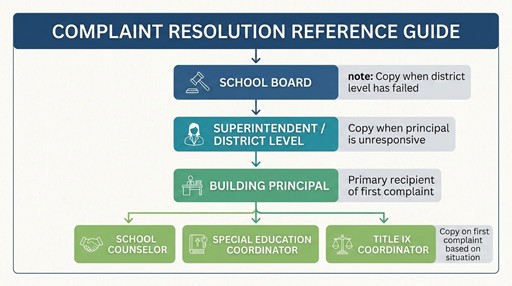
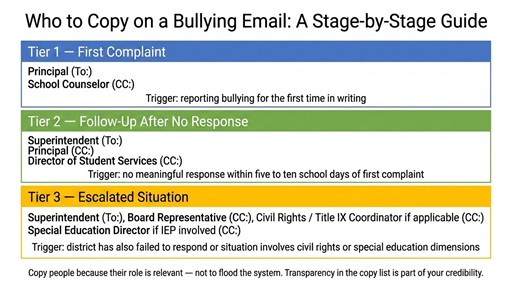
Your copy list is a reflection of where you are in the escalation process. If you started at the building level and are now copying the superintendent, you have moved to the district phase. If you are copying the superintendent and also the board representative, you have moved to the governance phase. If you are copying the civil rights coordinator, you are signaling potential civil rights implications.
Pay attention to when the copy list needs to expand — it usually means:
Getting the copy list right is one of the small decisions that shapes how seriously your complaint is taken — and how difficult it becomes to quietly ignore. If you want help mapping out the right recipients for your specific situation, understanding what stage of the escalation process you are in, or making sure your documentation and email strategy are as strong as they can be, outside support can make a meaningful difference.
In most cases, yes — especially for an initial written complaint at the school level. School counselors are responsible for student well-being and often play a direct role in addressing peer conflict, safety concerns, and support planning. Including them creates an additional formal point of notice within the building and can sometimes prompt faster attention to the issue. If the counselor has already been involved and has not responded appropriately or has contributed to dismissing the concern, copying them may not add value and can be reconsidered.
The superintendent’s contact information is typically listed on the district’s official website under leadership, administration, or contact pages. If it is not publicly visible, the district office can provide it upon request. Avoid sending escalation emails to generic district inboxes when possible, as they may be routed back to the school level. Using the superintendent’s direct email ensures the message reaches the appropriate authority and is more likely to be formally logged.
Yes. Including too many recipients or copying individuals without a clear institutional role can dilute the seriousness of the complaint and make communication harder to manage. It can also shift focus away from the substance of the issue toward the tone or structure of the message. A targeted list — typically those directly responsible for student safety, supervision, or oversight — is more effective than a broad distribution. Each recipient should have a clear reason for being included.
No. You do not need to announce escalation in advance. When you include the superintendent in the CC field, the principal will see that automatically. The effectiveness of escalation often comes from the visibility of that additional oversight, not from prior warning. Sending the email directly with the appropriate CC list in place is generally more effective than signaling escalation beforehand.
If you want student harm treated like a school safety and civil rights issue—start with SANI at https://saninstitute.net
Most bullying cases do not need a lawyer. Some clearly do. Knowing the difference before you act matters more than most parents realize. The decision

There is a point in many bullying cases where the parent has done everything right — and it still is not working. The emails are

You have three minutes. Make them the most organized three minutes the board has heard on this topic. Speaking at a school board meeting is

Patience with a school that isn’t responding isn’t a virtue. At some point it becomes a cost your child is paying. Most parents start at