

When Do Parents Need a Lawyer for School Bullying?
Most bullying cases do not need a lawyer. Some clearly do. Knowing the difference before you act matters more than most parents realize. The decision

Most parents who are fighting a school bullying situation have a general sense that the school should be doing something — that there must be rules, obligations, a process. But the specifics are often unclear, and schools sometimes count on that uncertainty to avoid explaining what they are actually required to do.
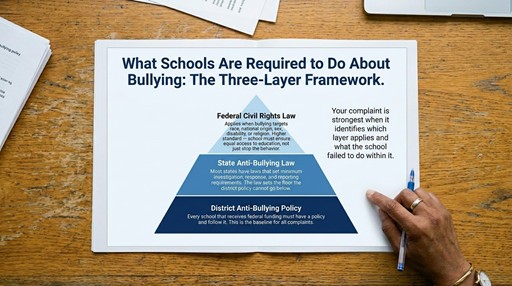
The reality is more nuanced than most parents expect. There is no single federal law that mandates a specific bullying response in every school. What exists instead is a layered framework — federal civil rights obligations in specific circumstances, state anti-bullying laws that vary significantly, and district-level policies that every school is required to follow.
Understanding that framework does not require a law degree. It requires knowing which layer applies to your situation — and what each layer actually demands from the school.
Every public school that receives federal funding is required to have an anti-bullying policy — and is required to follow it. That policy is the baseline. It typically includes a definition of bullying, a process for reporting and investigating complaints, a timeline for response, and a requirement to notify parents of outcomes.
Beyond the district’s own policy, state anti-bullying laws impose additional obligations in most states. These laws vary — some are highly specific, some are general — but most require schools to investigate bullying complaints, take corrective action, and in some cases report incidents to district officials.
And above state law, federal civil rights statutes impose their own obligations when bullying targets a protected characteristic. When bullying is based on race, national origin, sex, disability, or religion, schools have federal civil rights obligations that go beyond any bullying policy — and the consequences for failing to meet those obligations are more significant.
The school’s obligation, in plain terms: investigate, respond, document, and take steps to prevent recurrence. What that looks like in practice depends on the policy, the state, and the nature of the bullying. But the obligation exists — and it is enforceable.
When parents try to understand what the school is required to do, they are usually doing so because the school does not appear to be doing it. The gap between what schools are obligated to do and what they actually do is real — and understanding it precisely is what allows a parent to push back effectively.
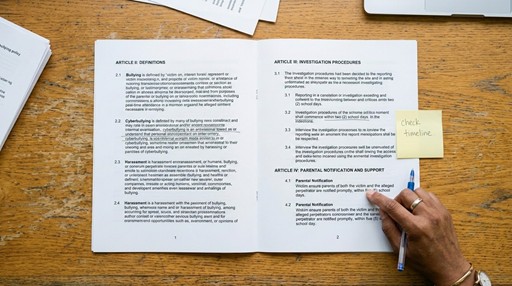
The school’s own policy is the starting point. Request a copy of the district’s anti-bullying policy. Read the section on investigation procedures, timelines, and parent notification. If the school is not following its own policy — not investigating within the stated timeframe, not notifying you of outcomes, not taking documented action — that is a compliance failure, not just a disappointment.
State law adds a floor that the district policy cannot go below. Most states have anti-bullying statutes that set minimum requirements for school response — including investigation obligations, timelines, and in some states, mandatory reporting to district-level officials. Your state’s department of education website typically has information about what the law requires.
Federal civil rights law adds a different layer when protected characteristics are involved. Title VI covers race and national origin. Title IX covers sex. Section 504 and the ADA cover disability. When bullying targets these characteristics, the school’s obligation is not just to stop the bullying — it is to ensure the student’s equal access to education. That is a higher and more specific standard than the general duty to have a bullying policy.
The school’s obligation begins when it has notice. A critical detail: schools generally are not obligated to respond to bullying they did not know about. Their obligation is triggered by notice — which is why putting your complaint in writing matters so much. A verbal concern may not constitute formal notice. A written email using the word bullying does. The moment the school receives formal written notice, its obligation to investigate and respond is activated.
Once you know what the school is required to do, you can identify specifically when it is not doing it — and that specificity is what makes an escalation effective. Consider escalating when:
Knowing what the school is required to do — and being able to document the gap between that requirement and what the school has actually done — is one of the most powerful positions a parent can be in. If you want help understanding the specific obligations that apply to your situation, reviewing your district’s policy against the school’s actual response, or building a compliance-based escalation strategy, outside support can help you get there efficiently.
There is no single federal law requiring every school to investigate every bullying complaint in all circumstances. At the federal level, the strongest obligations arise when bullying is connected to a protected characteristic such as race, sex, disability, or national origin under laws like Title VI, Title IX, and Section 504. For general bullying concerns not tied to a protected category, investigation requirements usually come from state anti-bullying laws and the school district’s own policies. This is why identifying whether a protected characteristic is involved can significantly affect the school’s legal obligations.
A district policy generally cannot provide less protection than state law requires. If your state’s anti-bullying law sets specific standards or timelines, those standards typically control even if the district policy is less specific. When policies are vague, careful documentation becomes especially important. Request investigation updates and outcomes in writing, track timelines yourself, and compare the school’s actions to both the policy language and any applicable state requirements. Concerns about whether a district policy complies with state law can often be raised through a state department of education complaint process.
Usually no. Federal student privacy protections under FERPA generally prevent schools from disclosing another student’s disciplinary records or specific consequences. Schools can often confirm that an investigation occurred, that action was taken, or that safety measures have been implemented for your child, but they typically cannot disclose the exact discipline imposed on another student. If the harmful behavior continues despite the school claiming it addressed the issue, continue documenting incidents and raise those concerns in writing.
Not always. Public schools are generally subject to federal civil rights laws, state education laws, and district policy requirements because they are government-operated and receive public funding. Private schools may operate under different legal frameworks depending on whether they receive federal funding and the laws of the state where they operate. However, many private schools still maintain anti-bullying policies and contractual obligations through enrollment agreements and student handbooks. Families dealing with bullying in a private school should review those documents carefully to understand what protections and procedures apply.
If you want student harm treated like a school safety and civil rights issue—start with SANI at https://saninstitute.net
Most bullying cases do not need a lawyer. Some clearly do. Knowing the difference before you act matters more than most parents realize. The decision

There is a point in many bullying cases where the parent has done everything right — and it still is not working. The emails are

You have three minutes. Make them the most organized three minutes the board has heard on this topic. Speaking at a school board meeting is

Patience with a school that isn’t responding isn’t a virtue. At some point it becomes a cost your child is paying. Most parents start at