
The difference between a complaint the school sets aside and one they cannot ignore is almost entirely in how it is written.
Most parents report bullying the same way: a phone call, a visit to the office, an emotional conversation with whoever will listen. They describe what happened. They ask for help. They leave feeling like something might finally change.
And then the week passes. And nothing does.
This is not always because the school does not care. It is often because a verbal report — no matter how clearly delivered or how obviously urgent — does not create the kind of record that triggers a formal institutional response. Schools respond to documentation. They respond to written records they cannot later claim they never received. They respond to complaints that invoke specific language, reference specific policies, and make specific asks.
A bullying complaint that is written correctly is a different kind of document than an upset email dashed off after a bad week. This article shows you exactly what goes into one — and how to write it in a way that is difficult for a principal to file quietly and forget.
The Short Answer
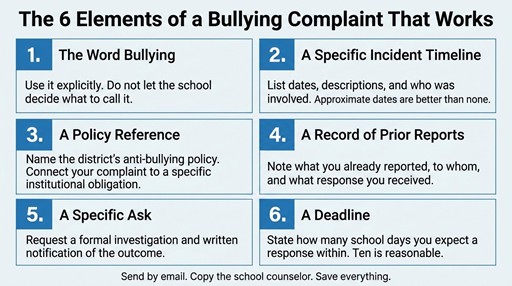
A bullying complaint that gets taken seriously has six core elements: the word bullying used explicitly, a factual timeline of specific incidents, a reference to the school’s own anti-bullying policy, a clear statement of prior reports and the school’s response, a specific ask for documented action, and a reasonable deadline for response.
It should be sent by email — not handed in as a printout, not delivered in a meeting — so that it creates a timestamped written record that belongs to you, not to the school’s intake process. And it should be addressed to the principal with a copy to the school counselor, so that more than one person at the building level is formally on notice.
Length is less important than structure. A focused, specific complaint of three to five paragraphs will outperform a long, emotional letter every time.
What This Usually Means
When a parent sits down to write a bullying complaint for the first time, a few things typically get in the way of the document working as well as it should.
The complaint focuses on emotion rather than evidence. Parents understandably write from a place of hurt and frustration — and those feelings are completely valid. But a complaint that reads primarily as an expression of distress gives the school permission to respond with sympathy rather than action. The document needs to be factual first, emotional second, if at all.
The complaint is vague about what happened. Phrases like ‘ongoing harassment’ or ‘this has been going on for months’ do not give the school a specific incident to investigate. A useful complaint names dates, describes specific conduct, and identifies who was involved. Even approximate dates are better than none.
The complaint does not use the word bullying. This sounds almost too simple — but it matters. Many schools distinguish procedurally between a ‘concern,’ a ‘conflict,’ and a ‘bullying report.’ If the word bullying does not appear in your complaint, the school may process it as a general concern rather than as a formal bullying report requiring investigation under their policy.
The complaint does not reference the school’s own policy. Every school district that receives federal funding is required to have an anti-bullying policy. When your complaint references that policy by name and asks the school to respond under it, you have connected your complaint to a specific institutional obligation rather than leaving it as a general request for help.
The complaint does not make a specific ask. ‘I want this to stop’ is not a request the school can document, fulfill, and confirm in writing. ‘I am requesting a formal bullying investigation under your district’s anti-bullying policy and written notification of the outcome within ten school days’ is.
What to Do Now
- Gather your materials before you write a single sentence. You need: a list of every incident you are aware of, with approximate dates; a description of what happened in each incident — what was said or done, where it happened, who was present; any screenshots, messages, or physical evidence you have saved; notes on any prior verbal or written reports you have made to the school and what response you received; and a copy of your school district’s anti-bullying policy, which you can usually find in the student handbook or on the district website.
- Open the complaint with a clear, factual first paragraph. State your child’s name, grade, and school. State that you are filing a formal bullying complaint. Use the word bullying. Do not open with an emotional statement or a general expression of frustration — open with a clear statement of what this document is and why you are sending it.
- Write a factual incident summary in the body of the complaint. List the incidents in chronological order. For each one, include the approximate date, a brief description of what occurred, and — where you know it — who was involved. Keep each incident description to two to four sentences. You are building a record, not writing a narrative essay. Specificity matters more than length.
- Reference the school’s anti-bullying policy by name. Something as simple as: ‘I am requesting that this complaint be processed as a formal bullying report under [District Name]’s anti-bullying policy.’ If you know the policy number or the section of the student handbook, include it. This connects your complaint to a specific institutional obligation.
- Note your prior reports and the school’s response. If you have already contacted the school — verbally or in writing — state that clearly. Include the approximate dates and who you spoke with or emailed. If the school’s response was inadequate or nonexistent, say so plainly: ‘I reported this situation to [name] on [approximate date] and did not receive a documented response.’
- Make a specific ask with a specific timeframe. Close the complaint with a clear request: a formal investigation under the school’s bullying policy, a written response confirming receipt of your complaint, and notification of the investigation outcome within a defined window. Ten school days is reasonable. State the timeframe explicitly.
- Send the complaint by email and save a copy immediately. Address it to the principal. Copy the school counselor. Save the sent email in a folder you can find again. If you want to be certain the complaint was received, send a follow-up email the next school day confirming receipt — something as brief as ‘I want to confirm you received my bullying complaint sent yesterday. Please let me know if you need any additional information.’

What Not to Do
- Do not send the complaint as a text message, a voicemail, or a verbal statement in a meeting. All of those formats leave the record in the school’s hands, not yours. Email creates a timestamped copy you own and control. Use email.
- Do not make the complaint primarily emotional. You are allowed to express that your child has been harmed — but lead with facts. A complaint that is organized around documented incidents will be taken more seriously than one organized around how badly the situation has affected your family, even if both things are equally true.
- Do not include demands about what should happen to the student who did the bullying. Your complaint is about your child and the school’s obligation to your child. Specifying what discipline another student should receive is outside the scope of what this document is designed to do and may complicate the school’s response.
- Do not send it on a Friday afternoon if you can avoid it. A complaint received Friday afternoon enters a weekend and may not be seen until Monday. If timing matters — and it usually does — send on a Tuesday or Wednesday morning so the principal reads it at the start of a full work week.
- Do not write it once and never follow up. A complaint sent and then left without follow-up can drift. If you have not heard anything within three to five school days, send a brief follow-up email asking for confirmation that the complaint was received and requesting a status update on the investigation timeline.
When to Escalate
A well-written bullying complaint sent to the principal is the right first formal step — but it is not always the last one needed. Consider escalating if:
- The school does not acknowledge your complaint within three to five school days. Send a written follow-up. If there is still no response after another five days, escalate to the district superintendent in writing, attaching your original complaint.
- The school acknowledges the complaint but provides no investigation timeline, no investigation outcome, or a response that essentially relabels the situation as peer conflict or a minor misunderstanding. Document that response and escalate to the district.
- The bullying continues after the complaint has been filed and the school claims to have investigated. File a new complaint documenting the new incidents and noting that the prior complaint did not produce an effective result.
- The conduct in your complaint involves race, disability, religion, sex, or national origin — which may trigger civil rights obligations beyond the school’s standard anti-bullying policy. In those situations, consider whether a Notice of Harassment or an OCR complaint may be the appropriate next escalation step.
- The school’s response to your complaint is so inadequate that you believe outside help is needed. A consultation with an educational advocate can help you assess whether your complaint was handled appropriately and what your options are going forward.
Take the Next Step
A bullying complaint that is written correctly is one of the most powerful tools a parent has — and it costs nothing but time and care. If you want help making sure your complaint hits every element it needs to, or if you are not sure yet whether you have enough documentation to file one effectively, outside support can help you get there faster.
- Schedule a free consultation with Jerry Green: If you want help reviewing what you have, structuring your complaint, or deciding whether your situation is ready for a formal filing — a free consultation can help you move forward with confidence. https://calendly.com/jerrylgreen2011
- Take the Student Protection Readiness Checklist: A practical first step to understand where your documentation stands, what gaps exist, and whether you are ready to write a complaint that will hold up under scrutiny. https://sprchecklist.abacusai.app
FAQs
Does a bullying complaint have to be a formal letter, or can it be an email?
An email is generally preferable to a formal letter for one important reason: it creates a timestamped record that you control. A paper letter handed to a school office can be misplaced, delayed, or acknowledged inconsistently. An email sent to the principal — ideally with relevant staff copied and a copy saved in your sent folder — creates a clear record of what was reported and when. Format is less important than clarity. A well-structured email that clearly states the concern and facts is more effective than a formal letter that is vague or overly emotional.
What if I do not know the exact dates of every incident?
Approximate dates are still useful and often sufficient. If you can narrow it down to a week, month, or school event (“before winter break” or “during the second week of October”), include that. A pattern described over time is often more credible than a single precise incident without context. You can also reconstruct details by checking text messages, emails, calendars, or notes from the time period — many parents find more documentation than they initially realize.
Should I mention other students by name in the complaint?
Yes, you may include the names of students involved if you know them. Specific details make the report clearer and harder to dismiss as general or vague. However, schools are generally not permitted to share disciplinary outcomes or actions taken against other students due to privacy protections under FERPA. Including names in your complaint is appropriate, but you should not expect detailed information about consequences for other students in return.
What if the school responds to my complaint by calling it peer conflict?
You should respond in writing and correct the record. State clearly that you do not agree with the characterization and that you are maintaining your report as a bullying concern under the district’s anti-bullying policy. Request that a formal investigation proceed. If the school continues to repeatedly reframe the situation as “peer conflict” despite your written objection, that pattern of reframing — documented over time — can become relevant evidence of an inadequate response and may support escalation to the district level or beyond.
Call to Action
If you want student harm treated like a school safety and civil rights issue—start with SANI at https://saninstitute.net