

When Do Parents Need a Lawyer for School Bullying?
Most bullying cases do not need a lawyer. Some clearly do. Knowing the difference before you act matters more than most parents realize. The decision

Parents of children with IEPs already know what it means to navigate a complicated institutional system. They know the meetings, the documentation, the careful language, the annual reviews. They have spent years making sure their child’s needs are on the record and that the school is following through.
And then the bullying starts.
For most parents, the first instinct is to treat it as a separate problem — a bullying issue and an IEP issue, running on parallel tracks. But the law does not always see it that way. When bullying affects a child’s ability to access their education, benefit from their IEP services, or function in the school environment the IEP was designed to support, the school’s obligations under federal special education law may be directly implicated.
This article explains what that means in plain language — and what parents of children with IEPs need to know that parents of general education students do not.
Yes — bullying can become a significantly larger school problem when the child being bullied has an IEP. The reason is FAPE: the Free Appropriate Public Education that schools are required by federal law to provide to every student with a disability under the Individuals with Disabilities Education Act, known as IDEA.
When bullying interferes with a child’s ability to receive FAPE — by disrupting their access to services, causing regression in IEP goals, affecting attendance, or damaging the learning environment the IEP was built to support — the school may be in violation of its federal special education obligations. That is a different and more serious category than a standard bullying response.
The school does not get to treat the bullying as a general discipline matter and the IEP as a separate conversation. When the two are connected, they need to be addressed together — and the IEP team may need to be involved in determining what the school’s response should include.
When parents of IEP students encounter bullying, several patterns tend to appear — and understanding them helps clarify what to watch for and what to document.
The school treats the bullying as a general education issue. Administrators respond to the bullying complaint through the standard school discipline process without ever consulting the IEP team or considering how the situation relates to the child’s disability-related needs. This is a missed obligation. The IEP team should be part of the response when the bullying affects the child’s educational access or IEP implementation.
The child’s IEP goals are quietly being missed. A child who is being bullied may start avoiding the classroom, the lunch room, or therapy sessions that happen in certain parts of the building. Services that require interaction with other students may become inaccessible. The IEP document may look unchanged on paper while the actual delivery of services has been significantly disrupted. Parents often notice this before the school acknowledges it.
The bullying is connected to the child’s disability. When a child is targeted specifically because of their disability — because of how they communicate, how they move, how they regulate, or how they differ from neurotypical peers — the civil rights dimension of the situation becomes relevant. Section 504 and Title II of the Americans with Disabilities Act prohibit disability-based harassment in schools receiving federal funding. The school’s obligation in that situation is not just to stop the bullying — it is to ensure the child’s equal access to education.
Regression is being attributed to the disability rather than the environment. Schools sometimes explain a child’s declining performance, withdrawal, or emotional dysregulation as a feature of their disability rather than a response to the school environment. Parents who know their child well often know the difference. That difference needs to be documented and brought into the IEP conversation.
The IEP team has never discussed the bullying. In many cases, parents raise the bullying at the school level, get a standard response, and never bring it into an IEP meeting. If the bullying is affecting the child’s ability to benefit from their IEP, it belongs in an IEP meeting — and a parent has the right to request one at any time, not just at the annual review.

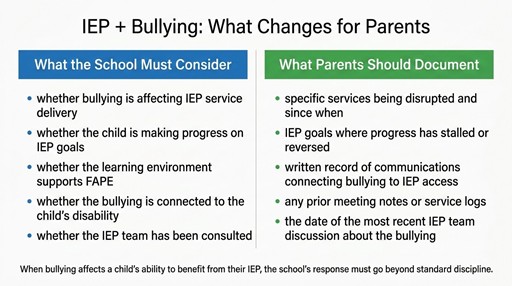
The combination of an IEP and a bullying situation creates a faster escalation path than general education bullying alone. Consider escalating if:
Parents of IEP students have access to procedural safeguards under IDEA that general education parents do not — including the right to an impartial due process hearing if they believe the school has failed to provide FAPE. That is a significant step, but it is a real one — and consulting with a special education advocate before deciding whether to pursue it is strongly recommended.
When bullying and an IEP intersect, the situation is more complex than either issue alone — and the school’s obligations are larger than most building-level administrators fully recognize. If you are trying to navigate both tracks at once and are not getting adequate responses on either one, outside support from someone who understands both the IEP system and the bullying escalation process can make a significant difference.
FAPE stands for Free Appropriate Public Education. It is the federal requirement under the Individuals with Disabilities Education Act (IDEA) that students with disabilities receive an educational program tailored to their unique needs, at no cost to the family. When bullying interferes with a student’s ability to access services, make meaningful progress on IEP goals, or safely participate in school, it can raise a FAPE issue. In those cases, the problem is not only about bullying policy — it may also be a special education compliance issue that triggers additional legal obligations and remedies.
Yes. Parents can request an IEP meeting at any time and are not limited to annual review timelines. If bullying is affecting your child’s access to services, progress on goals, or overall educational experience, it is a valid reason to request a meeting. The request should be made in writing, clearly state the concern, and ask for the team to convene within a reasonable timeframe. Schools are generally required to respond to a parent’s written request for an IEP meeting.
You are not required to accept that conclusion without review. If the bullying is connected to how your child’s disability presents — such as communication style, behavior regulation, social interaction differences, or other disability-related characteristics — that connection should be explicitly addressed. You can request that the IEP team document their reasoning in writing. If you disagree with their determination, you have the right to record your disagreement and seek an independent evaluation or outside professional input.
Yes. In addition to standard school and district complaint processes, families of students with IEPs can use special education-specific remedies. Most states provide a state special education complaint process through the department of education. Under IDEA, parents may also request mediation or file for a due process hearing if they believe the school has failed to provide FAPE. These processes are more formal and legal in nature and often involve stricter timelines and procedures, so many families choose to consult a special education advocate or attorney before pursuing them.
If you want student harm treated like a school safety and civil rights issue—start with SANI at https://saninstitute.net
Most bullying cases do not need a lawyer. Some clearly do. Knowing the difference before you act matters more than most parents realize. The decision

There is a point in many bullying cases where the parent has done everything right — and it still is not working. The emails are

You have three minutes. Make them the most organized three minutes the board has heard on this topic. Speaking at a school board meeting is

Patience with a school that isn’t responding isn’t a virtue. At some point it becomes a cost your child is paying. Most parents start at