
You gave the principal every reasonable chance. The situation did not improve. Now you need to know what comes next.
Most parents start where they are supposed to start. They contact the teacher. They email the principal. They sit in that office and explain, in careful detail, what their child has been going through. They follow up. They wait.
And then they wait some more.
At some point, waiting stops being patience and starts being a mistake. The bullying continues. Your child is still suffering. The school has either done nothing, done something minimal and called it resolved, or given you vague reassurances that have not translated into any real change.
The question is not whether you have been patient enough. You have. The question is: what is the right next move — and who do you contact when the principal is not the answer?
The Short Answer
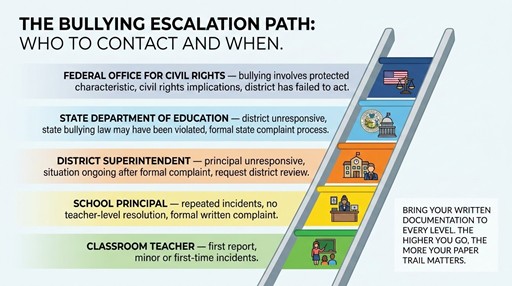
There is a clear escalation path above the building principal, and parents are entitled to use it. The next level is typically the district superintendent or assistant superintendent. Above that is your local school board. And beyond the district are state and federal options — including your state’s department of education and, in cases involving protected characteristics, the federal Office for Civil Rights.
The key is not just knowing who to contact — it is knowing when to escalate, how to escalate in writing, and what to bring to each level of that conversation. An escalation that is organized and documented is far more effective than one that is loud and emotional.
Going above the principal is not a dramatic move. It is a procedural one. And in many cases, it is the move that finally produces a real response.
What This Usually Means
When parents find themselves stuck at the principal level, a recognizable pattern is usually in place — and understanding it helps clarify what kind of escalation is needed.
The principal is managing the situation, not resolving it. There is a difference between a school administrator who is actively working to address a bullying problem and one who is responding just enough to make the complaint go quiet. Vague updates, repeated “we’re monitoring the situation” responses, and promises of follow-up that never materialize are signs of the latter.
The principal may not have full authority to resolve the situation alone. Some decisions — particularly those involving disciplinary action, policy changes, special education obligations, or formal investigations — require district-level involvement. A principal who is genuinely constrained may not say so clearly, but escalating to the district may unlock action that the school building cannot authorize on its own.
The school has normalized the situation. When bullying has been ongoing and the school has repeatedly classified it as minor, peer conflict, or resolved, it can become institutionally invisible. A new set of eyes — at the district or state level — sometimes breaks that pattern.
Your documentation is now your leverage. The longer this has gone on, the more important your written record becomes. Every email you sent, every date you noted, every phone call you followed up in writing — that record is what makes an escalation credible and difficult to dismiss.
What to Do Now
- Confirm your paper trail is complete before escalating. Before you contact anyone above the principal, make sure you have a documented record of every step you have already taken at the school level — dates of reports, emails sent, meetings held, outcomes promised, and outcomes not delivered. This record is the foundation of your escalation. Without it, you are asking a district official to take your word against a principal’s. With it, you are presenting a documented pattern.
- Send a written summary to the district superintendent. Email is appropriate. Address it to the superintendent directly — not a general district inbox. Identify yourself, your child’s school and grade, and state clearly that you have reported a bullying situation at the school level and that the situation has not been adequately resolved. Attach or summarize the key documentation. Ask specifically what the district’s process is for reviewing unresolved bullying complaints and request a response in writing within a specific timeframe — ten school days is reasonable.
- Use calm, factual language throughout. An escalation letter that reads as organized and precise will be taken more seriously than one that reads as emotional or accusatory. State what happened, when it happened, what you reported, to whom, and what the outcome was — or was not. Let the facts carry the weight.
- Copy the right people. When escalating to the superintendent, consider copying the district’s director of student services, the director of special education if your child has an IEP or 504 plan, and your school board representative if you know who that is. Copying additional parties signals that you are not going to accept another round of quiet inaction.
- Request a formal meeting at the district level if the written response is inadequate. A district-level meeting puts the conversation on record in a way that a phone call does not. Ask for the meeting in writing, confirm attendance in writing, and follow up with a written summary of what was discussed and what was agreed to.
- Know the next level above the district. If the district does not respond meaningfully, your state’s department of education typically has a complaint process for families who believe a school district has failed to follow state bullying laws or policies. Look up your state’s process and have it ready — knowing it exists strengthens your position even if you do not use it immediately.
- If the bullying involves race, disability, sex, religion, or national origin, the federal Office for Civil Rights is also an option. An OCR complaint is a formal step, but it is a legitimate one — and it carries weight that a district-level complaint does not. Filing an OCR complaint does not require a lawyer, though consulting one before doing so may be worth considering.
What Not to Do
- Do not escalate before you have a written record at the school level. Walking into the superintendent’s office with only verbal complaints and no documented history puts you at a significant disadvantage. Build the paper trail at the building level first, even if that means sending a retroactive summary email to the principal before you escalate.
- Do not make the escalation emotional or accusatory in tone. The goal is to be taken seriously by someone with more authority than the principal — and that requires being organized and precise, not loud. An escalation letter that sounds like a complaint about a specific principal as a person is less effective than one that documents a pattern of inadequate institutional response.
- Do not skip levels without reason. Going straight from the principal to the school board or a state agency — without first attempting district-level resolution — can make you appear unreasonable and may undercut your credibility. Follow the chain in order unless there is a specific reason to jump a level, such as a civil rights issue or an urgent safety concern.
- Do not accept verbal responses at the district level any more than at the school level. If the superintendent calls you, listen — then follow up with an email summarizing the conversation and asking for written confirmation of any commitments made. The same rules that apply at the school level apply above it.
- Do not escalate and then go quiet. An escalation that is not followed up on sends a signal that you will eventually stop pushing. Set a specific follow-up date in your own calendar and hold to it. If the district does not respond within the timeframe you requested, send a follow-up in writing.
When to Escalate — And How Fast
Most situations warrant moving to the district level after two to three weeks of documented non-response or inadequate response at the school level. But some situations call for faster movement. Consider escalating to the district immediately — without waiting — if:
- Your child is in immediate physical danger or has been physically harmed and the school has not taken protective action.
- The bullying involves a threat that has not been addressed by the school.
- Your child is experiencing a mental health crisis — including expressions of self-harm or hopelessness — connected to the bullying situation.
- The school has explicitly told you they will not investigate or that the situation does not meet their definition of bullying, and you have that in writing or can document it.
- The bullying involves a protected characteristic and the school’s response suggests they are not taking the civil rights dimensions seriously.
In any of these situations, waiting for the school-level process to run its course may not be appropriate. Escalating faster is not an overreaction — it is a calibrated response to a situation that requires more urgency than the standard timeline allows.
Take the Next Step
Going above the principal is not about making enemies or burning bridges. It is about finding the level of the system that has both the authority and the obligation to respond — and giving them a clear, documented reason to do so. If you are not sure whether you are ready to escalate, or how to do it in a way that protects your position, outside support can help you get that clarity before you make your next move.
- Schedule a free consultation with Jerry Green: If you have already tried the school level and are ready to escalate — or if you are not sure yet whether that time has come — a free consultation can help you assess your documentation, identify your next step, and approach the district level with a clear strategy. https://calendly.com/jerrylgreen2011
- Take the Student Protection Readiness Checklist: A practical tool that helps you see where your child’s situation stands right now — what is documented, what is missing, and how prepared you are to escalate effectively. https://sprchecklist.abacusai.app
FAQs
How long should I wait before going above the principal?
There is no fixed rule, but many parents consider escalating after two to three weeks if there has been no meaningful documented response to a formal written complaint. In more urgent situations — such as ongoing bullying, safety concerns, or visible emotional distress — escalation may be appropriate sooner. The decision should be guided by the seriousness of the situation and the school’s responsiveness, not by an expectation that families must wait indefinitely.
Will escalating to the superintendent make things worse for my child at school?
Many parents worry about this, and it is understandable to be cautious. In most situations, a professional, factual escalation focused on concerns and documentation does not lead to retaliation. Schools are generally prohibited from retaliating against students or families for making formal complaints. Keeping communications calm, specific, and evidence-based often helps reduce unnecessary conflict while still making clear that the concerns are serious.
Do I need a lawyer to go above the principal?
No. Parents can contact district administrators, file district-level complaints, and submit state complaints without legal representation. However, if the matter involves significant harm, disability-related issues, or potential civil rights concerns, some families choose to consult an educational advocate or attorney for guidance on documentation and strategy before escalating further.
What if the superintendent is also unresponsive?
If the district does not respond meaningfully within a reasonable timeframe, families may consider escalating to the state department of education or another oversight agency. Most states have complaint processes related to bullying procedures, discrimination, or special education compliance. It is helpful to include copies of your prior written complaints and escalation attempts. If the situation involves a protected characteristic such as race, sex, or disability, a complaint to the Office for Civil Rights may also be an available option.
Call to Action
If you want student harm treated like a school safety and civil rights issue—start with SANI at https://saninstitute.net