

When Do Parents Need a Lawyer for School Bullying?
Most bullying cases do not need a lawyer. Some clearly do. Knowing the difference before you act matters more than most parents realize. The decision
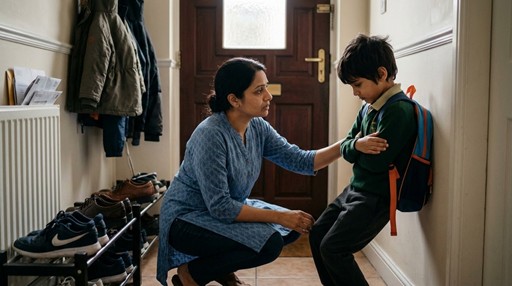
It rarely starts with a full refusal. It starts with stomachaches on Sunday nights. With headaches that appear exactly at 7 a.m. and vanish by noon. With a child who used to love school and now goes quiet every time you mention it.
And then one morning, they just won’t go.
Parents in this moment often hear the same things: give it time, it’s probably anxiety, try to be firm. What they hear less often is this: school refusal in a child who is being bullied is not a behavior problem. It is a warning signal. And it may warrant more than encouragement and a firm hand at the front door.
One of the questions parents start asking — quietly, sometimes reluctantly — is whether a psychological evaluation is the right next step. This article answers that question directly.
Not every child who refuses school needs a psychological evaluation. But some do — and in bullying cases specifically, an evaluation can serve two important purposes at once.
First, it gives the child access to professional support that goes beyond what a parent or school counselor can provide. When a child has been targeted repeatedly, the emotional impact can be significant — anxiety, depression, trauma responses, and a damaged sense of safety that does not just go away when the bullying stops.
Second, a psychological evaluation creates a documented clinical record. That record can support the family’s case with the school, establish a baseline of the child’s functioning before and during the bullying period, and in some situations, open the door to school-based accommodations or additional protections under a 504 plan.
The question is not whether an evaluation is dramatic. The question is whether your child needs more support than they are currently getting — and whether documentation of that need would help protect them going forward.
When a child begins refusing school in the context of bullying, a few things are usually happening beneath the surface — and most of them are not visible from the outside.
The child has reached a threshold. School refusal rarely appears without a buildup. By the time a child is physically unable to walk through the door, they have usually been managing fear, dread, or humiliation for weeks or months. The refusal is not the beginning of the problem. It is the point where the child can no longer hold it together.
The anxiety has become self-reinforcing. Once a child avoids school — even for a day or two — avoidance itself becomes easier than return. Each day missed makes going back feel harder. This cycle can move quickly and is difficult to break without structured support.
The school may be treating this as an attendance problem. Some schools respond to school refusal with pressure, attendance warnings, or suggestions that the parent needs to be firmer. This response misses the cause entirely and can deepen a child’s sense that no adult understands what is happening.
There may be an underlying condition being amplified. Some children have pre-existing anxiety, sensory sensitivities, or processing differences that bullying pushes past a manageable threshold. An evaluation can identify whether something like this is present — and whether it qualifies the child for additional support under an IEP or 504 plan.
The emotional impact may be more significant than the child is showing. Children who have been bullied often minimize what they have experienced — either because they have been told to toughen up, because they feel ashamed, or because they have learned that adults do not always respond in ways that help. An evaluation gives a trained professional the tools to assess what the child is actually carrying.
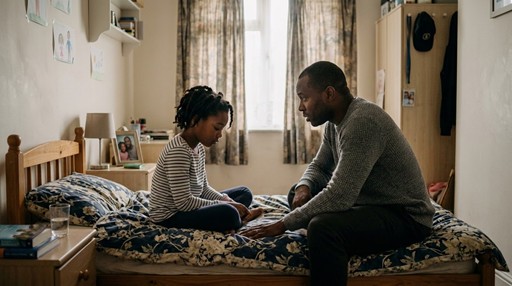
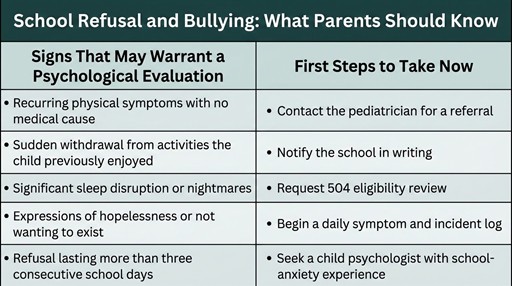
School refusal connected to bullying may warrant faster or more serious action in certain situations. Consider escalating your response if:
If your child is in immediate distress or expressing thoughts of self-harm, do not wait for a school meeting or a scheduled appointment. Contact your pediatrician, a crisis line, or an emergency mental health service the same day. Documentation and school accountability can be pursued in parallel — but safety is the first priority.
When a child stops being able to go to school, parents need two things moving at the same time: clinical support for the child and documented accountability from the school. Neither one replaces the other. If you are trying to figure out how to do both without letting one fall behind, outside support can help you hold both tracks at once.
Patterns are often more important than any single event. If the refusal began around the same time as bullying concerns, or if your child connects their distress to specific people, locations, or situations at school, the school environment may be contributing significantly even if your child struggles to explain it clearly. A licensed psychologist or therapist can help distinguish between generalized anxiety, school avoidance, and a situational response connected to bullying or peer harm.
Yes. Parents can request a school-based psychological evaluation to determine whether a child may qualify for special education services or accommodations under Section 504. The request should be made in writing. Schools are generally required to respond formally and, if they agree to evaluate, complete the process within timelines established by state and federal law. If the school refuses the request, they should explain the reason in writing and provide information about your procedural rights.
A private evaluation obtained independently is controlled by the family and does not automatically become part of the school record unless you choose to share it. Evaluations conducted by the school are generally included in the student’s educational file. In most situations, evaluations are used to determine eligibility for supports, accommodations, or services rather than to limit opportunities. Families can decide strategically what information to share and when.
Mental health concerns and school conditions are often interconnected. If anxiety appears connected to the school environment, peer conduct, or unresolved bullying concerns, the school may still have responsibilities related to support, accommodations, and educational access. It is helpful to document statements made by the school, continue seeking clinical support, and consider whether the documented impact on attendance or functioning may support a request for evaluation or accommodations under Section 504 or special education law.
If you want student harm treated like a school safety and civil rights issue—start with SANI at https://saninstitute.net
Most bullying cases do not need a lawyer. Some clearly do. Knowing the difference before you act matters more than most parents realize. The decision

There is a point in many bullying cases where the parent has done everything right — and it still is not working. The emails are

You have three minutes. Make them the most organized three minutes the board has heard on this topic. Speaking at a school board meeting is

Patience with a school that isn’t responding isn’t a virtue. At some point it becomes a cost your child is paying. Most parents start at