
When Do Parents Need a Lawyer for School Bullying?
Most bullying cases do not need a lawyer. Some clearly do. Knowing the difference before you act matters more than most parents realize. The decision
1. Audio
2. Definition
3. Video
4. Core Thesis
9. Action Steps
10. FAQs
11. Call to Action
12. Sources
13. Signature
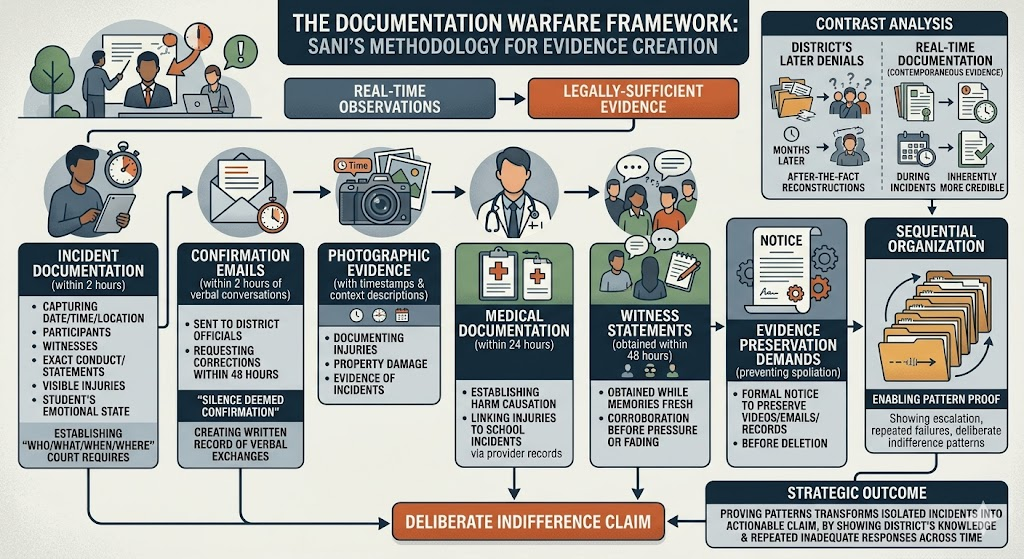
The Documentation Warfare Framework is SANI’s methodology for converting real-time observations into legally-sufficient evidence through systematic documentation practices preventing district denial and manipulation—requiring creation of contemporaneous evidence meeting evidentiary standards: incident documentation within two hours capturing date/time/location/participants/witnesses/exact conduct/exact statements/visible injuries/student’s emotional state (establishing who/what/when/where elements courts require), confirmation emails sent within two hours of every verbal conversation requesting corrections within 48 hours with silence deemed confirmation (creating written record of verbal exchanges districts later deny), photographic evidence with timestamps and context descriptions (documenting injuries, property damage, evidence of incidents), medical documentation within 24 hours establishing harm causation (linking injuries to specific school incidents through provider records), witness statements obtained within 48 hours while memories fresh (corroboration before witnesses pressured or memories fade), evidence preservation demands preventing spoliation (formal notice requiring preservation of videos/emails/records before deletion), and sequential organization enabling pattern proof (chronological documentation showing escalation, repeated failures, deliberate indifference patterns)—with framework establishing that real-time documentation defeats district’s later denials because contemporaneous evidence created during incidents is inherently more credible than district’s after-the-fact reconstructions months later when litigation threatened, and systematic documentation proving patterns transforms isolated incidents into actionable deliberate indifference claims by showing district’s knowledge and repeated inadequate responses across time.
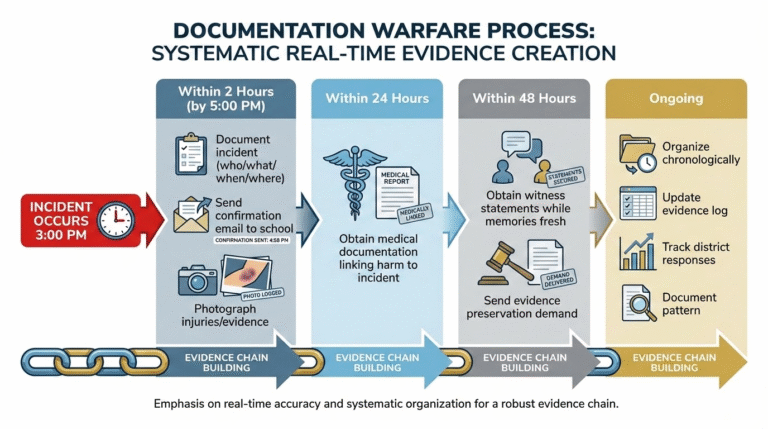
Districts defeat most complaints through strategic denial—incident you reported never happened (no documentation proving it did), conversation where administrator promised intervention never occurred (no written record), injuries your child sustained weren’t school-related (no contemporaneous medical documentation linking to incident), witnesses don’t remember what they saw (no statements obtained while memories fresh)—but systematic real-time documentation following legal evidentiary standards eliminates district’s ability to deny, minimize, or rewrite history by creating contemporaneous evidence more credible than district’s later reconstructions because evidence created during events defeats narrative created after litigation threatened. We convert trauma into code by transforming chaotic traumatic incidents into legally-formatted documentation within hours: incident occurs → document within 2 hours capturing who/what/when/where/how with legal precision → send confirmation email within 2 hours documenting what was reported/discussed → photograph injuries/evidence immediately with timestamps → obtain medical documentation within 24 hours → secure witness statements within 48 hours while memories fresh → send preservation demand preventing evidence destruction → organize chronologically proving escalation patterns—creating evidence chain districts cannot break through denial because every element contemporaneously documented, witnessed, medically verified, and legally preserved. Selective enforcement IS discrimination when documentation reveals pattern: white families’ complaints generating immediate thorough responses with district creating extensive documentation of interventions, while identical complaints from families of color met with no documentation, no follow-up, no intervention—documentation warfare exposing selective response patterns proving discrimination through comparative evidence analysis.
High school student in Sacramento attacked by another student during lunch. Pushed into locker, punched multiple times, visible injuries.
Parent’s typical response (inadequate):
Calls school next day: “My son was attacked yesterday.”
Principal: “We’ll look into it.”
Week later, parent follows up. Principal: “We investigated. No evidence of attack. Your son may have misinterpreted normal rough play.”
Parent: “But he had bruises, witnesses saw it.”
Principal: “Our investigation found no corroboration.”
No documentation. District denies. Case closed.
Same scenario—Parent using SANI Documentation Warfare Framework:
Day 1, Incident occurs 12:30 PM during lunch:
12:45 PM (15 minutes after): Student texts parent: “Got attacked at lunch. Hurt. Need you.”
1:00 PM: Parent arrives school, documents injuries:
1:30 PM: Meeting with principal.
3:00 PM (within 2 hours of meeting): Parent sends confirmation email:
“Dear Principal [Name],
This confirms our meeting today January 15, 2025, 1:30-2:00 PM regarding attack on my son [Student] during lunch period 12:30 PM.
Facts I reported:
Your stated response:
If any of the above is inaccurate, please respond within 48 hours with corrections. Silence will be deemed confirmation of accuracy.
[Parent name], [Date/Time sent]”
4:00 PM: Emergency room visit.
Medical documentation obtained:
Day 2, 8:00 AM: Parent contacts identified witnesses’ families, obtains statements:
Witness A statement (written, signed, dated): “I, [Witness A], witnessed incident January 15, 2025, approximately 12:30 PM in hallway outside cafeteria. I saw [Attacker] push [Student] into locker, then punch him multiple times in face and body. [Student] tried to defend himself but [Attacker] kept hitting him. I heard [Attacker] say [specific threats]. [Student] was bleeding from mouth when [Attacker] stopped. I reported to [Staff member] immediately. This statement is true and accurate. [Signature, date]”
Witnesses B, C, D provide similar statements.
Day 2, 10:00 AM: Evidence preservation demand sent via certified mail and email:
“Dear Superintendent/General Counsel,
EVIDENCE PRESERVATION DEMAND
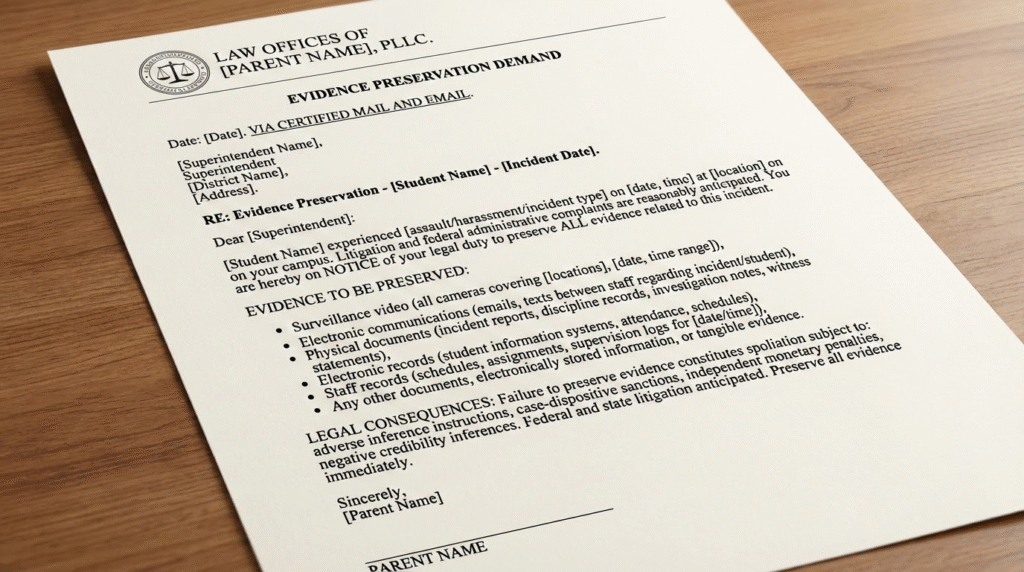
[Student] was assaulted January 15, 2025, 12:30 PM on your campus. Pursuant to California law and federal regulations, you are on NOTICE to preserve all evidence related to this incident, including but not limited to:
FAILURE TO PRESERVE EVIDENCE constitutes spoliation with severe legal consequences including adverse inference instructions and independent sanctions.
Litigation and federal complaints anticipated. Preserve all evidence immediately.
[Parent name], [Date]”
Day 3: District still hasn’t responded to confirmation email (48-hour deadline passed).
Parent notes: “Silence = confirmation per email terms. District confirmed facts as stated.”
Week 2: Principal contacts parent: “Our investigation found insufficient evidence of assault. [Attacker] states it was mutual confrontation. We’re suspending both students.”
Parent’s response (using documentation warfare evidence):
“Your findings contradict contemporaneous evidence:
Incident documentation: [Student’s] same-day account (video recorded 1:00 PM January 15) describing unprovoked attack
Photographic evidence: Injuries photographed 1:00 PM January 15 with timestamps showing facial trauma, split lip, defensive wounds—inconsistent with ‘mutual confrontation’
Medical documentation: ER records January 15, 4:00 PM documenting ‘assault injuries consistent with blunt force trauma’—medical provider linked injuries to school incident
Witness statements: Four witnesses (attached, obtained January 16) provide consistent accounts of unprovoked attack by [Attacker]—all state [Student] was victim defending himself
Video evidence: Your campus surveillance (which you’re legally obligated to preserve per January 16 preservation demand) will corroborate witnesses
Your confirmed facts: Your silence to my January 15 confirmation email (48-hour deadline expired) constitutes confirmation of facts I reported including unprovoked attack and identified witnesses
Your investigation defects: You interviewed [Attacker] but apparently none of four identified witnesses—investigative collapse
Contemporaneous evidence created within hours of incident is more credible than your investigation completed week later. Evidence proves unprovoked attack, not mutual confrontation.
Suspending victim violates Title IX (retaliatory discipline), IDEA (if applicable), and state law.
Withdraw [Student’s] suspension immediately or face federal complaints documenting this evidence showing deliberate indifference and retaliation.
All evidence preserved for litigation.”
District withdraws victim’s suspension, disciplines attacker, implements safety plan.
Documentation warfare prevented denial and forced accountability through irrefutable contemporaneous evidence.
The Documentation Warfare Framework is SANI’s systematic approach to evidence creation—not passive note-taking but active strategic documentation defeating district denial.
Framework’s core principle: Real-time evidence created during incidents defeats narrative created after litigation threatened.
Why documentation warfare works:
Timing credibility: Evidence created contemporaneously (within hours of incident) is inherently more credible than district’s reconstructions created months later when facing complaints—courts recognize contemporaneous documentation as more reliable.
Denial elimination: Detailed contemporaneous documentation leaves no room for “it didn’t happen” or “we don’t remember” defenses—evidence proves it happened, when, how, who witnessed.
Pattern proof: Systematic documentation across multiple incidents proves patterns—not isolated incident but pattern of inadequate responses establishing deliberate indifference.
Spoliation prevention: Early preservation demands prevent district from “accidentally” deleting video, emails, records—creates legal duty to preserve and consequences for destruction.
SANI’s documentation warfare protocol (systematic evidence creation):
Document incident while fresh:
Create written record capturing:
Format: Typed or handwritten, dated, timed, signed—create permanent contemporaneous record.
Send confirmation email within 2 hours of any verbal report/conversation:
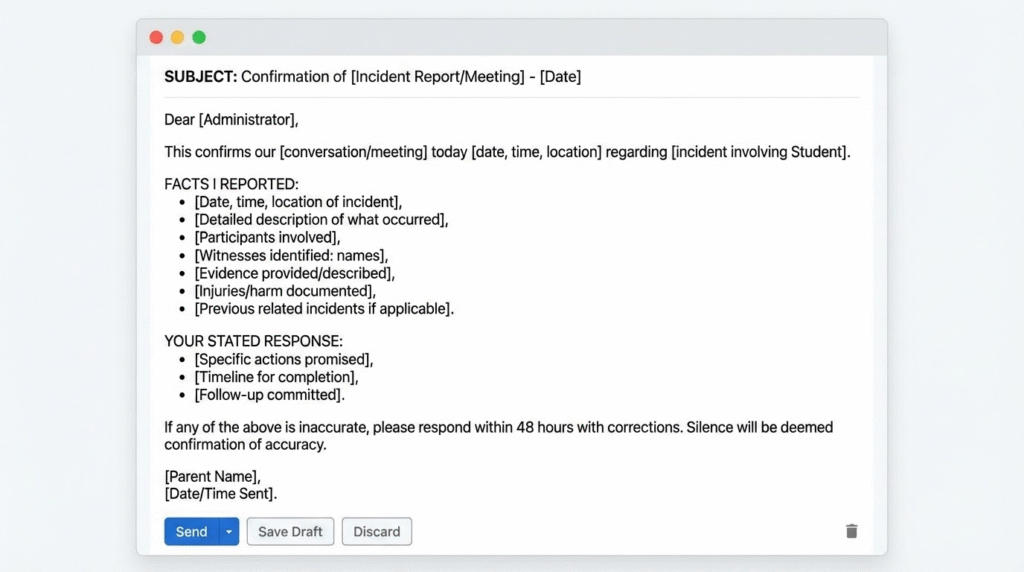
Template:
“Dear [Administrator],
This confirms [conversation/report] today [date, time, location].
Facts I reported: [Bulleted list of everything reported—incident details, witnesses, evidence, student’s state]
Your stated response: [What administrator promised to do, by when]
If any of the above is inaccurate, please respond within 48 hours with corrections. Silence will be deemed confirmation of accuracy.
[Name, date/time sent]”
Purpose: Creates written record of verbal exchanges districts later deny. Silence = confirmation binding district to facts.
Photograph immediately:
Take photos with timestamps of:
Caption each photo: Date, time, what it shows, context
Video statement (if student willing):
Record student describing:
Timestamp: Video metadata shows when recorded (contemporaneous)
Medical documentation within 24 hours:
Take student to doctor/ER:
Purpose: Medical records created within 24 hours link injuries to specific incident—defeats district’s later claims injuries came from elsewhere.
Contact witnesses immediately:
Obtain written statements while memories fresh:
Template:
“I, [Witness name], witnessed the following on [date, time, location]:
[Detailed description of what witness saw/heard in their own words]
This statement is true and accurate to the best of my knowledge.
[Signature, date]”
Why 48 hours: Memories fade, witnesses get pressured by school/peers, details become unclear—immediate statements preserve accurate accounts.
Minor witnesses: Obtain parent permission when possible; if not, document student’s willingness to provide statement (preserved for later formal collection).
Formal preservation notice:
Send via certified mail and email to superintendent, general counsel, principal:
“EVIDENCE PRESERVATION DEMAND
[Student] [experienced incident type] on [date] at [location].
You are on NOTICE to preserve all evidence related to this incident:
Litigation and federal complaints anticipated. Failure to preserve constitutes spoliation with severe consequences.
[Name, date]”
Legal effect: Creates duty to preserve. Destruction after notice = spoliation sanctions (adverse inference, dismissal, independent damages).
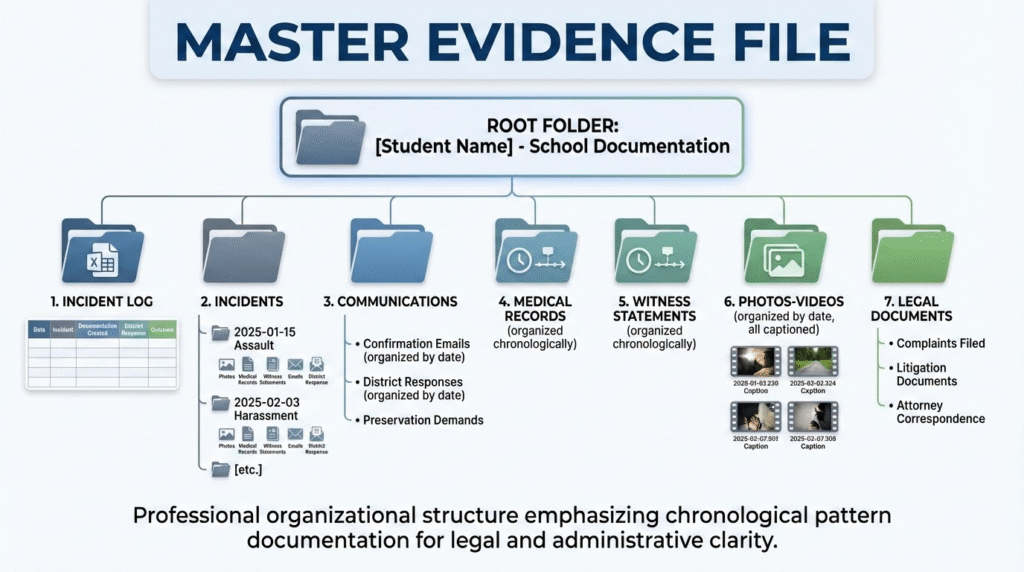
Create master evidence file:
Organize all documentation chronologically:
Pattern tracking: Chronological organization shows escalation, repeated failures, pattern of inadequate responses—transforms isolated incidents into deliberate indifference proof.
SANI’s documentation warfare prevents district’s common denial tactics:
Tactic 1: “Incident never happened”
Defense: Contemporaneous documentation (written within 2 hours), photos (timestamped), medical records (injuries documented within 24 hours), witness statements (obtained within 48 hours)—irrefutable proof incident occurred.
Tactic 2: “Parent never reported it”
Defense: Confirmation email sent within 2 hours of verbal report, dated/timed—written record proves report made.
Tactic 3: “We responded appropriately”
Defense: Confirmation email documents exactly what district promised—if they didn’t do it, contemporaneous record proves broken promises.
Tactic 4: “No witnesses corroborate”
Defense: Witness statements obtained within 48 hours—district’s failure to interview doesn’t mean witnesses don’t exist.
Tactic 5: “Video doesn’t exist anymore” / “Emails were deleted”
Defense: Preservation demand sent within 48 hours—deletion after notice = spoliation with severe sanctions.
Tactic 6: “Injuries came from somewhere else”
Defense: Medical records linking injuries to specific school incident within 24 hours—causation documented contemporaneously.
Federal Rules of Evidence principles (applicable in §1983 litigation):
Rule 803(1) – Present Sense Impression: Statement describing event made while or immediately after perceiving it—inherently reliable because no time for fabrication.
Courts prefer contemporaneous evidence: Documentation created during/immediately after events more credible than recollections months/years later during litigation.
Example:
Rule 803(2) – Excited Utterance: Statement relating to startling event made while declarant under stress of excitement—reliable because emotional state prevents fabrication.
Courts value immediate post-incident statements: Student’s video statement 1 hour after attack (crying, showing injuries) = excited utterance (highly credible).
Rule 803(4) – Statement for Medical Diagnosis: Statements made to medical provider for diagnosis/treatment—reliable because patient has incentive for truthfulness.
Medical documentation establishes causation: ER records documenting “patient reports assault at school today, injuries consistent with blunt force trauma” link injuries to incident—defeats district’s “injuries came from elsewhere” defense.
Pattern evidence / FRE 404(b): Evidence of other acts admissible to prove pattern, knowledge, absence of mistake.
Chronological documentation proves patterns: Sequential incident documentation showing repeated inadequate responses establishes deliberate indifference pattern—not isolated incident but systemic failure.
Problem: Most critical conversations with administrators are verbal (meetings, phone calls). Districts later deny: “That conversation never happened,” “I never said that,” “Parent never reported that.”
Solution: Confirmation email within 2 hours converting verbal to written with silence = confirmation mechanism.
Legal principle: Silence in response to written communication can constitute admission/confirmation when recipient has duty to correct inaccuracies.
Template structure:
Subject: Clear reference to what’s being confirmed
Body paragraph 1: “This confirms our [meeting/call] [date, time, location]”
Body paragraph 2: “Facts I reported:” [Detailed bulleted list of everything said]
Body paragraph 3: “Your stated response:” [What administrator promised, by when]
Body paragraph 4: “If any of the above is inaccurate, please respond within 48 hours with corrections. Silence will be deemed confirmation of accuracy.“
Signature: Name, date/time sent
Why this works:
Creates written record: Verbal conversation → written documentation sent same day
Shifts burden: District must respond to correct inaccuracies or facts are confirmed
48-hour window: Reasonable time for response, short enough that silence is meaningful
Silence = confirmation clause: Explicitly states legal effect of non-response
Timestamps prove contemporaneity: Email metadata shows sent within hours of conversation—contemporaneous, not fabricated later
Use cases:
Incident reports: After verbal report to principal, send confirmation email documenting facts reported and promised response
IEP meetings: After meeting, send confirmation email documenting what was agreed, services promised, timelines
Discipline meetings: After suspension meeting, send confirmation documenting what district claimed, what parent contested, what was decided
Investigation updates: After verbal update on investigation, send confirmation documenting what district reported about findings, next steps
Every verbal conversation → confirmation email within 2 hours
In litigation/complaints:
“District claims parent never reported incident. Contemporaneous email sent January 15, 2025, 3:00 PM [Exhibit A] proves report made 2 hours after incident, documents facts reported and district’s promised response. District never responded correcting inaccuracies—silence constitutes confirmation of facts reported. District’s denial contradicts its own confirmed facts.”
What to photograph immediately:
Injuries: All visible injuries from multiple angles with timestamps
Clothing/property: Torn clothing, damaged books/belongings, vandalized locker
Location: Where incident occurred (if accessible/safe)
Evidence: Written notes/threats, damaged property, relevant objects
Best practices:
Timestamp: Use device with date/time stamp enabled (metadata proves when taken)
Context photos: Wide shot showing location, then close-ups of specific injuries/damage
Multiple angles: Different angles of same injury show extent better than single photo
Ruler/scale: Include object for size reference when relevant (coin next to bruise showing diameter)
Captions: Immediately caption each photo: date, time, what it shows, context
Storage: Save original full-resolution images with metadata intact (don’t edit—preserves authenticity)
Medical setting photos: Medical providers can photograph injuries for records—medical context adds credibility
In complaints/litigation:
“Photographic evidence [Exhibits B1-B8] taken January 15, 2025, 1:00 PM (contemporaneous—within 1 hour of incident) shows: facial bruising (B1-B3), split lip requiring medical closure (B4), defensive wounds on forearms (B5-B7), torn shirt (B8). Photos’ timestamps and metadata prove contemporaneous documentation—created during incident, not fabricated later.”
Why medical records matter:
Causation link: Medical provider documents patient’s account linking injuries to specific incident—third-party professional confirmation
Injury documentation: Provider’s examination findings describe injuries objectively—more credible than parent’s description
Timing: Records created within 24 hours establish injuries existed contemporaneously—defeats “injuries came later from elsewhere”
Provider credibility: Medical professionals have no stake in outcome—neutral third-party observers
How to obtain proper medical documentation:
Visit within 24 hours: ER or doctor visit same day or next day after incident
Report to provider: “My child was attacked at school [date, time, location]”
Provider documents:
Request records: Written medical records documenting above
In complaints/litigation:
“Medical records [Exhibit C] from [Provider], [date] document: patient reported ‘assault at school [date, time],’ provider examination found ‘facial contusions consistent with blunt force trauma, split lip, defensive bruising consistent with blocking,’ diagnosis ‘assault injuries.’ Medical provider linked injuries to specific school incident within 24 hours—establishes causation and defeats district’s claim injuries came from elsewhere.”
Why immediate witness statements critical:
Memory preservation: Memories fade—details lost within days
Before pressure: Witnesses (especially students) get pressured by school, peers, parents not to talk—immediate statements capture account before pressure applied
Corroboration: Multiple consistent witness statements prove incident occurred as reported—defeats “no corroboration” defense
Best practices:
Within 48 hours: Contact witnesses immediately while memories fresh
Written format: Even if brief, written statement more powerful than verbal recollection later
Template:
“I, [name], witnessed the following on [date, approximate time, location]:
[In witness’s own words, what they saw/heard]
This statement is true and accurate.
[Signature, date]”
Minor witnesses: Obtain with parent permission when possible; if not, document student’s willingness (can formalize later if needed)
Multiple witnesses: Obtain separately (prevents groupthink—independent accounts more credible)
Preserve: Keep original signed statements (don’t rely on verbal promises to testify later—life happens, witnesses move, become unavailable)
In complaints/litigation:
“Four witness statements [Exhibits D1-D4] obtained January 16, 2025 (within 48 hours while memories fresh) provide consistent accounts: [Witness A] states ‘[excerpt],’ [Witness B] states ‘[excerpt],’ [Witness C] states ‘[excerpt],’ [Witness D] states ‘[excerpt].’ All describe unprovoked attack by [perpetrator] on [victim]. Statements obtained before witnesses could be pressured—contemporaneous corroboration proving incident occurred as reported.”
Spoliation: Destruction of evidence after litigation reasonably anticipated.
Consequences:
How to prevent:
Preservation demand immediately:
Send within 48-72 hours of incident via certified mail + email to:
Content:
“EVIDENCE PRESERVATION DEMAND
[Student] [experienced X] on [date] at [location].
You are on NOTICE that litigation and federal complaints are anticipated.
You have legal duty to preserve ALL evidence related to this incident:
Failure to preserve constitutes spoliation with severe legal consequences including adverse inference, sanctions, and independent liability.
Preserve immediately.
[Name, date]”
Legal effect:
Creates duty: District now on formal notice—destruction after notice = spoliation
Anticipation established: Letter proves litigation anticipated—triggers preservation duty
Scope defined: Specific list prevents “we didn’t know we had to preserve that” excuse
Consequences warned: District on notice that destruction = serious consequences
In litigation when evidence destroyed:
“Plaintiff sent evidence preservation demand [Exhibit E] January 16, 2025 to Superintendent and General Counsel specifying surveillance video must be preserved. District deleted video February 1, 2025 claiming ‘routine 30-day deletion.’ Deletion occurred 15 days AFTER preservation demand—spoliation. Request adverse inference instruction that video would have shown assault as reported and district’s inadequate response.”
Immediately after incident (within 2 hours maximum): create detailed written incident documentation capturing date/time (specific), location (exact), participants (who involved), witnesses (who present with names/descriptions), conduct (exactly what happened in objective detail—not “bullying” but “pushed against locker, punched 5 times in face, said ‘[exact words]'”), statements (verbatim quotes), injuries (visible injuries described specifically), student’s state (emotional/physical condition), aftermath (who student told, who responded, what happened next). If verbal report made to school, send confirmation email within 2 hours: “This confirms [meeting/call] [date, time]. Facts I reported: [detailed bullets]. Your stated response: [promised actions, timeline]. If inaccurate, respond within 48 hours. Silence = confirmation.” Documentation created within hours is contemporaneous evidence more credible than later recollections.
Same day or next day maximum: photograph all visible injuries (multiple angles, timestamped, captioned with date/time/context), damaged clothing/property, location if accessible. Save original full-resolution with metadata intact. Visit doctor/ER within 24 hours reporting: “[Student] was [assaulted/harmed] at school [date, time].” Provider documents: patient’s account, examination findings (injuries described objectively), causation statement (“injuries consistent with reported assault/blunt force trauma”), diagnosis. Request written medical records. Medical documentation within 24 hours links injuries to specific school incident contemporaneously—defeats “injuries came from elsewhere” defense. Photos provide visual proof; medical records provide third-party professional confirmation and causation link.
Contact all witnesses immediately (within 48 hours maximum while memories detailed and before witnesses pressured by school/peers). Obtain written statements: “I, [witness name], witnessed [description in own words] on [date, approximate time, location]. This statement is true and accurate. [Signature, date].” For student witnesses, obtain with parent permission when possible; if not, document student’s willingness to provide statement (can formalize later). Obtain statements separately from each witness (independent accounts more credible than group recollection). Keep original signed statements—don’t rely on verbal promises to testify later. Immediate statements preserve accurate accounts and provide corroboration before witnesses become unavailable or memories fade.
Send via certified mail AND email to superintendent, general counsel (if exists), principal, board president: “EVIDENCE PRESERVATION DEMAND. [Student] [experienced X] on [date] at [location]. Litigation and federal complaints anticipated. You have legal duty to preserve ALL evidence: surveillance video (all cameras, [date/time range]), emails/communications between staff, incident reports/discipline records/investigation documents, witness statements/interview notes, staff schedules/assignments, student records, any other documents/ESI/tangible evidence. Failure to preserve = spoliation with severe consequences: adverse inference, sanctions, independent liability. Preserve immediately. [Name, date].” Formal preservation demand creates legal duty—destruction after notice = spoliation with serious consequences. Prevents district’s “routine deletion” excuse. Establishes litigation anticipation triggering preservation obligations.
Create organized evidence system: incident log (spreadsheet tracking date, incident description, documentation created, district response, outcome), evidence folders (organized by incident/date with subfolders: photos, medical records, witness statements, emails, district responses), chronological organization (all evidence date-labeled enabling pattern demonstration). Update continuously as new incidents occur and new documentation created. Chronological organization proves escalation patterns and repeated inadequate responses—transforms isolated incidents into pattern evidence establishing deliberate indifference. Master file enables efficient deployment across all enforcement channels (OCR, litigation, criminal, media)—format once, deploy everywhere with consistent evidence base.
Before any incident: create documentation template ready to complete immediately ensuring nothing forgotten: “INCIDENT DOCUMENTATION. Date/Time: [exact date, approximate time]. Location: [specific location on campus]. Incident Type: [assault, harassment, threat, etc.]. Participants: [names of students involved]. Witnesses: [names/descriptions of all present]. Detailed Description: [exactly what happened—who did what, in what order, exact words spoken, physical actions]. Injuries/Harm: [visible injuries described, emotional state]. Evidence: [photos taken, items preserved, other documentation]. Immediate Aftermath: [who student reported to, their response, what happened next]. Parent Actions: [when learned, what done immediately]. Template filed, ready to complete within 2 hours any incident. Also create confirmation email template ready to customize and send within 2 hours verbal conversations.
Clock starts when incident occurs or when you learn of it. Within 2 hours maximum: complete incident documentation template with all details while fresh, photograph any visible injuries/evidence immediately (timestamp enabled, caption each), if verbal report made to school, send confirmation email immediately: “This confirms [meeting/call] [date, time, location]. Facts I reported: [detailed bullets of everything said]. Your stated response: [exactly what promised, timeline]. If inaccurate, respond within 48 hours with corrections. Silence = confirmation. [Name, date/time sent].” Two-hour window critical—contemporaneous documentation created during/immediately after events is legally powerful “present sense impression” evidence, while later documentation raises questions about accuracy/fabrication. Real-time documentation defeats district’s later denials.
If any physical injuries (even minor): schedule doctor/ER visit within 24 hours. When reporting to provider: “[Student] was [assaulted/attacked/harmed] at school [date, time, location].” Ensure provider documents in records: chief complaint (patient reports school incident), history of present illness (patient’s account of what happened), physical examination findings (objective injury descriptions), assessment (causation statement—”injuries consistent with reported assault/blunt force trauma”), diagnosis (“assault injuries,” “trauma,” etc.). After visit, request written medical records. Medical documentation within 24 hours establishes: injuries existed contemporaneously, injuries linked to specific school incident (causation), third-party professional confirmation. Defeats district’s later claims: “injuries came from home,” “happened outside school,” “unrelated medical condition.” Provider records are powerful evidence.
Identify all witnesses (anyone who saw/heard incident). Contact within 48 hours maximum: “Would you provide brief written statement describing what you witnessed [date, location]?” Provide template: “I, [name], witnessed the following on [date, approximate time, location]: [description in own words]. This statement is true and accurate. [Signature, date].” For student witnesses: request parent permission when possible; if parent refuses, document student’s willingness (can formalize later with subpoena if needed). Obtain each witness’s statement separately (independent accounts more credible). Keep original signed statements in evidence file. Within 48 hours critical because: memories fade rapidly (details lost within days), witnesses get pressured (by school, peers, parents) not to talk, witnesses become unavailable (move, change minds, become uncooperative). Immediate statements preserve accurate accounts.
Draft preservation demand (use template): identifies incident, states litigation/complaints anticipated, lists specific evidence to preserve (video surveillance, emails, records, documents), warns of spoliation consequences. Send via certified mail AND email to: superintendent, general counsel, principal, board president. Track delivery. Simultaneously, organize all documentation into master evidence file: create incident log spreadsheet, create dated folders for each incident containing all evidence (photos, medical, witness statements, emails, district responses), organize chronologically proving pattern. Update continuously as new incidents/documentation occur. Organized chronological documentation transforms isolated incidents into pattern evidence proving deliberate indifference—shows escalation, repeated failures, district knowledge and inadequate responses over time. Master file enables efficient deployment across all enforcement channels from single evidence base.
Documentation created immediately or shortly after an event is generally considered more reliable because it reflects details while they are still fresh and less likely to be influenced by memory gaps or later interpretation. Prompt documentation helps preserve accuracy, establishes a clear timeline, and can serve as strong supporting evidence if accounts are later disputed.
Sending a written summary after a meeting or conversation can help create a clear record of what was discussed. Including key points—such as facts reported and any agreed actions—helps ensure there is shared understanding. If corrections are needed, they can be made promptly, which improves accuracy and reduces the likelihood of misunderstandings later.
It can be helpful to document observable details such as injuries, property damage, or the location of the incident, when safe and appropriate. Photographs, notes, and timestamps can provide objective context. Keeping original files and recording when and where the documentation was created can help maintain reliability.
Gathering information from witnesses soon after an incident can improve accuracy, as details are more likely to be remembered clearly. Early documentation can also help ensure that accounts are recorded independently and consistently, which can be useful when reviewing events later.
If there is concern about preservation of relevant information, it may be helpful to make a written request that records be retained. Clear communication about the types of information involved and the timing of the request can help ensure that relevant materials are available for review if needed.
If you want student harm treated like a school safety and civil rights issue—start with SANI at https://saninstitute.net
Most bullying cases do not need a lawyer. Some clearly do. Knowing the difference before you act matters more than most parents realize. The decision

There is a point in many bullying cases where the parent has done everything right — and it still is not working. The emails are

You have three minutes. Make them the most organized three minutes the board has heard on this topic. Speaking at a school board meeting is

Patience with a school that isn’t responding isn’t a virtue. At some point it becomes a cost your child is paying. Most parents start at