
When Do Parents Need a Lawyer for School Bullying?
Most bullying cases do not need a lawyer. Some clearly do. Knowing the difference before you act matters more than most parents realize. The decision
1. Audio
2. Definition
3. Video
4. Core Thesis
9. Action Steps
10. FAQs
11. Call to Action
12. Sources
13. Signature
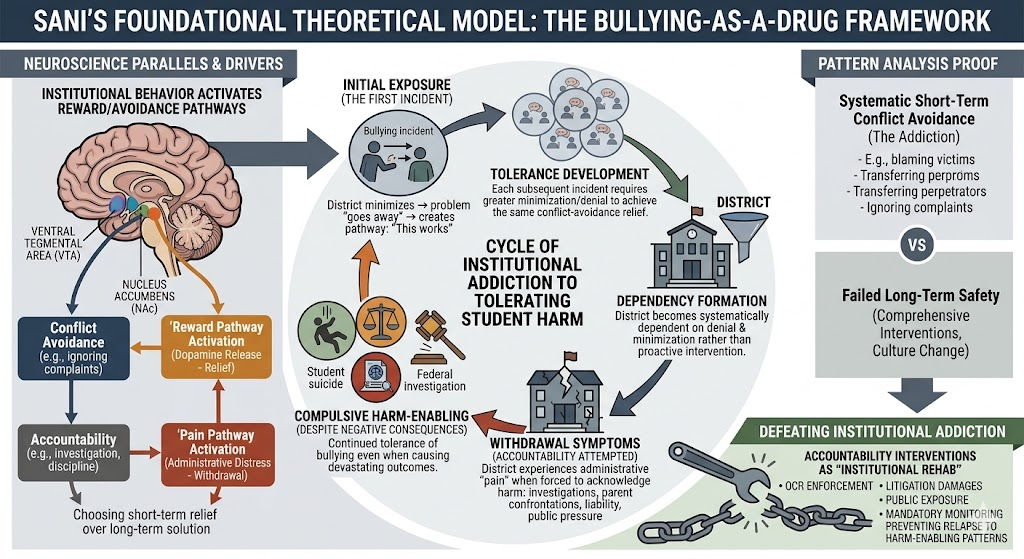
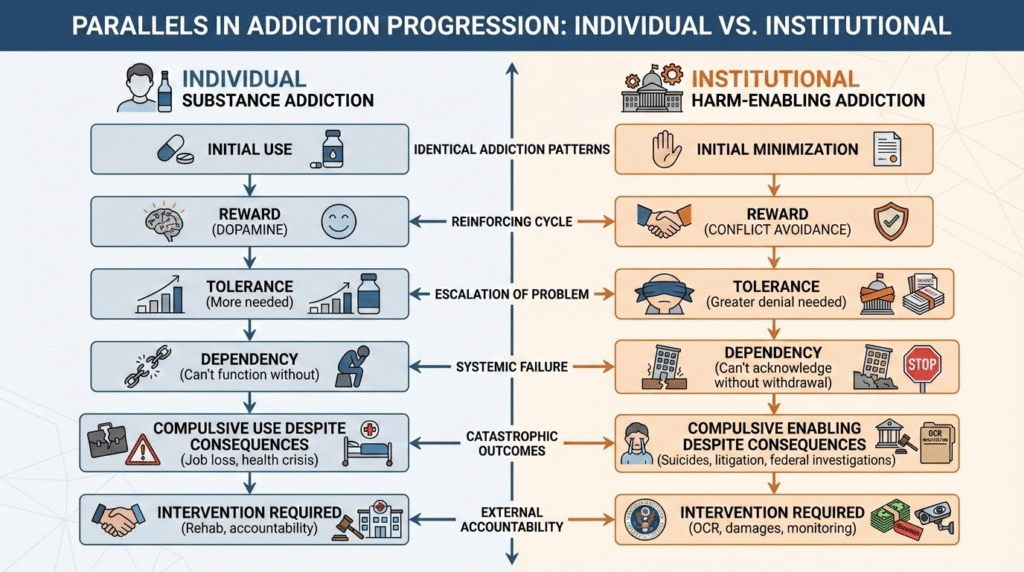
The Bullying-as-a-Drug Framework is SANI’s foundational theoretical model explaining how school districts develop institutional addiction to tolerating student harm through predictable behavioral patterns mirroring substance dependency: initial exposure (first bullying incident district minimizes creates neural pathway of “this works—problem went away”), tolerance development (each subsequent incident requires greater minimization to achieve same conflict-avoidance effect), dependency formation (district becomes institutionally dependent on denial/minimization rather than intervention), withdrawal symptoms when accountability attempted (district experiences administrative “pain” when forced to acknowledge harm—investigations, discipline, parent confrontations, potential liability), and compulsive harm-enabling despite negative consequences (continued tolerance of bullying even when causing student suicide, litigation, federal investigations)—with framework established through neuroscience parallels showing institutional behavior activates same reward/avoidance pathways as chemical addiction, documented through pattern analysis proving districts systematically choose short-term conflict avoidance (ignoring complaints, blaming victims, transferring perpetrators) over long-term safety (comprehensive interventions, accountability, culture change), and defeated through accountability interventions functioning as “institutional rehab” forcing districts to experience consequences breaking addiction cycle (OCR enforcement, litigation damages, public exposure, mandatory monitoring preventing relapse to harm-enabling patterns).
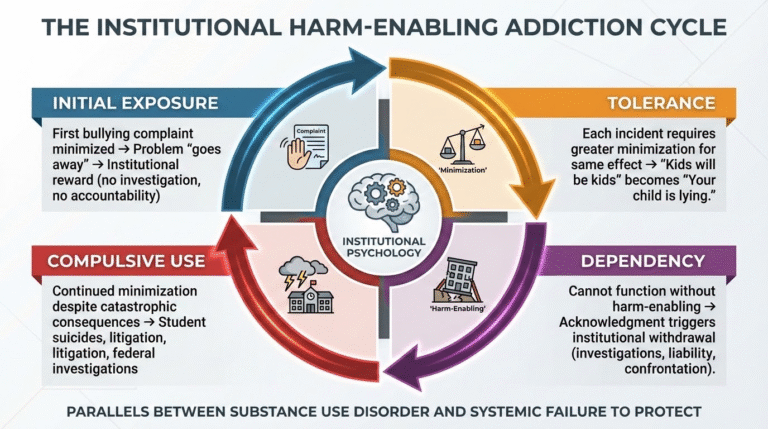
School districts don’t just tolerate bullying through negligence—they develop institutional addiction to harm-enabling behaviors following identical neurological and behavioral patterns as substance dependency, with initial minimization of first incident creating institutional “reward” (complaint goes away, no investigation needed, no discipline controversy, no parent confrontation, no liability exposure—problem “solved” through denial), leading to tolerance development where each subsequent incident requires greater minimization to achieve same conflict-avoidance effect (first incident: “kids will be kids,” tenth incident: “your child is too sensitive,” hundredth incident: “this is normal peer interaction”), progressing to full dependency where district cannot function without harm-enabling (truthful acknowledgment of bullying triggers institutional “withdrawal”—investigations, accountability, potential liability—causing administrative pain district avoids through continued denial), resulting in compulsive harm-enabling despite catastrophic consequences (student suicides, federal investigations, massive litigation, public outrage—yet district continues minimizing because addiction demands it). We convert trauma into code by documenting institutional addiction patterns (first complaint minimized, second complaint blamed on victim, third complaint ignored, pattern proving escalating tolerance), mapping district’s harm-enabling progression through addiction cycle stages, and implementing accountability interventions functioning as “institutional rehab”—OCR enforcement, litigation, monitoring, public exposure—forcing district to experience consequences that break addiction cycle making continued harm-enabling more painful than acknowledgment and intervention. Selective enforcement IS discrimination when districts’ institutional addiction manifests selectively—immediately intervening when white students bullied (breaking addiction pattern) while enabling harm against students of color (feeding addiction)—proving addiction is weaponized based on whose suffering districts find rewarding to ignore.
Middle school in San Jose. Seventh-grade student with autism experiences severe bullying starting September. Mother reports to counselor.
September (First Complaint – Initial Exposure):
Mother: “My son is being bullied. Students mock his stims, push him, exclude him deliberately.”
Counselor: “Kids tease each other. Let’s not label it bullying. We’ll talk to the students about kindness.”
Counselor’s brief conversation with perpetrators: “Be nice to everyone.”
No investigation. No discipline. No documentation.
Institutional reward: Complaint “resolved” without investigation, accountability, or parent confrontation. Mother satisfied with promise of intervention. Problem went away easily.
District’s institutional brain: “This worked. Minimization eliminates problem without administrative pain.”
October (Tolerance Development – Greater Minimization Required):
Bullying escalates. Physical assaults. Mother reports again.
Principal: “Boys are rough. Your son needs thicker skin. We can’t monitor every interaction.”
No investigation. No discipline.
Institutional reward: Again, complaint “resolved” through minimization. But required greater denial than first incident to achieve same conflict-avoidance effect.
November (Dependency Formation):
Bullying intensifies. Student pushed down stairs. Mother demands action.
Vice Principal: “Your son provokes other students with his behaviors. Have you considered he contributes to conflicts?”
Victim-blaming. No investigation. No discipline.
Institutional reward: Problem still “resolved” through denial, now requiring victim-blaming to avoid accountability.
District institutionally dependent on minimization—cannot acknowledge bullying without triggering “withdrawal” (investigation, discipline, potential liability, parent confrontation creating administrative pain).
December-February (Compulsive Harm-Enabling):
Mother reports weekly. Bullying escalates to daily physical assaults, sexual harassment, mob attacks. Student becomes suicidal.
District’s responses progressively more extreme denial:
March (Catastrophic Consequences – Yet Addiction Continues):
Student attempts suicide. Hospitalized.
Mother files police report. OCR complaint. Lawsuit.
Even facing federal investigation and litigation, district continues minimizing:
District’s legal response: “Student’s mental health issues pre-existed alleged bullying. No evidence of harassment. Family’s claims exaggerated.”
Addiction so severe district cannot stop harm-enabling even when facing catastrophic consequences.
Attorney’s expert conducts pattern analysis:
Reviews emails, incident reports, witness statements documenting bullying from September-March.
Findings:
September: Incident clearly met legal bullying definition. District minimized to avoid investigation.
October-November: Escalating violence. District denied, blamed victim.
December-February: Overwhelming evidence of severe sustained harassment. District’s denials increasingly detached from reality.
March: Even with student’s suicide attempt, district could not acknowledge bullying—addiction to denial too powerful.
Expert testimony:
“District exhibits classic institutional addiction pattern. Initial minimization created reward (problem disappeared without administrative effort). Each subsequent incident required greater denial to achieve same conflict-avoidance. District became dependent on harm-enabling—truthful acknowledgment would trigger institutional ‘withdrawal’ (investigations, accountability, liability). Like substance addict continuing use despite job loss, health crisis, family destruction—district continued harm-enabling despite student’s suicide attempt, federal investigation, litigation. Compulsive behavior despite catastrophic consequences defines addiction.”
Settlement:
Significant damages, comprehensive anti-bullying program, independent monitor (functioning as “institutional rehab”), OCR monitoring, policy requiring immediate intervention (breaking minimization pattern), quarterly reporting on bullying responses (preventing relapse).
Case establishes: Institutional harm-enabling as addiction pattern requiring accountability interventions to break cycle.
The Bullying-as-a-Drug Framework is SANI’s foundational theoretical model—the core intellectual framework upon which all SANI methodologies are built.
Framework explains WHY districts systematically enable harm:
Not isolated negligence. Not individual bad actors. Institutional addiction.
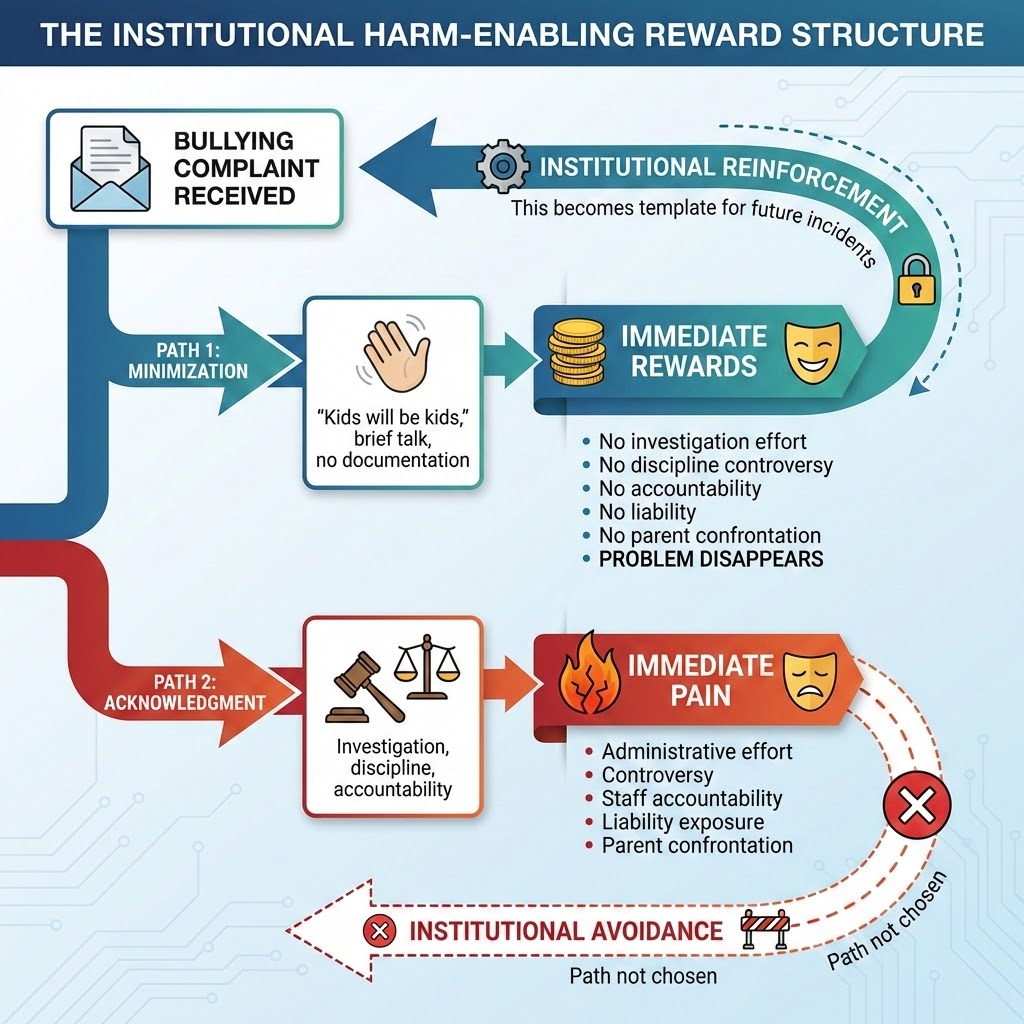
Districts become psychologically and operationally dependent on harm-enabling behaviors because minimization delivers immediate institutional rewards:
Reward 1: Complaint disappears without investigation effort
Reward 2: No discipline controversy (parents, unions, students)
Reward 3: No accountability for staff who failed to prevent/address
Reward 4: No liability exposure from acknowledging harm
Reward 5: No administrative confrontation with angry parents
These rewards create neural pathways (organizational habit patterns) reinforcing minimization as “solution.”
Addiction cycle progression:
First bullying complaint arrives. Administrator has choice: thorough investigation (administrative effort, potential controversy, accountability) OR minimization (“kids will be kids,” brief conversation, no documentation).
Minimization chosen. Complaint “resolved” quickly. Parent mollified temporarily.
Institutional reward experienced: Problem disappeared without pain. This becomes template.
Second complaint arrives. Same minimization approach—but this time parent pushes back. Requires greater denial (“your child is sensitive”) to achieve same conflict-avoidance effect.
Third complaint: Greater minimization needed (“your child contributes to conflicts”).
Fourth complaint: Victim-blaming required (“have you considered your child provokes others?”).
Tolerance pattern: Each incident requires escalating denial to produce same institutional reward (complaint disappearance).
After months of minimization creating rewards, district becomes institutionally dependent. Truthful acknowledgment of bullying now triggers institutional withdrawal:
These consequences are “painful”—district avoids through continued harm-enabling like addict avoids withdrawal through continued use.
Student attempts suicide. Federal investigation opens. Litigation filed. Media coverage. Public outrage.
Yet district continues minimizing because addiction has progressed beyond conscious choice—institutional compulsion.
Like substance addict who loses job, family, health but continues using—district experiencing catastrophic consequences but cannot stop harm-enabling behavior.
SANI’s intervention: Accountability functions as institutional rehab.
Breaking addiction requires making harm-enabling MORE painful than acknowledgment:
Intervention 1: OCR Enforcement
Federal investigation finding violations, mandatory corrective action, monitoring. Harm-enabling now triggers federal consequences worse than acknowledgment would have been.
Intervention 2: Litigation Damages
Multi-million dollar verdicts. Harm-enabling now triggers financial catastrophe worse than investigation/intervention costs.
Intervention 3: Public Exposure
Media coverage, community outrage, board member recall campaigns. Harm-enabling now triggers political consequences worse than addressing bullying.
Intervention 4: Mandatory Monitoring
Court-appointed monitors, OCR oversight preventing relapse to minimization patterns. Like addict in supervised recovery—external accountability prevents return to addiction.
These interventions reverse reward structure:
Before: Minimization = reward (problem disappears), Acknowledgment = pain (investigation/accountability)
After: Minimization = severe pain (federal violations, damages, public outrage), Acknowledgment = less pain (compliance, resolution)
Framework’s power: Explains seemingly inexplicable district behavior. Why continue enabling harm despite student suicides, lawsuits, investigations? Addiction. Compulsive institutional behavior beyond rational choice.
Addiction defined: Compulsive behavior despite negative consequences, driven by reward pathways overriding rational decision-making.
Individual addiction: Person experiences reward (dopamine release) from substance use, creating neural pathways reinforcing use-seeking behavior, progressing to dependency where brain cannot function normally without substance, leading to compulsive use despite catastrophic consequences (job loss, health crisis, family destruction).
Institutional addiction parallel: Organization experiences reward (problem resolution, conflict avoidance) from harmful behavior (minimization, denial), creating organizational pathways reinforcing harm-enabling, progressing to dependency where institution cannot function normally without minimization, leading to compulsive harm-enabling despite catastrophic consequences (student suicides, litigation, federal investigations).
Neural pathway formation:
Individual: Substance use → Dopamine release → Brain learns “this solves problem” → Pathway reinforced through repetition → Compulsive seeking
Institutional: Minimization → Administrative relief → Organization learns “this solves problem” → Pathway reinforced through repetition → Compulsive harm-enabling
Key similarity: Both override rational decision-making through reward-driven compulsion.
Pattern: First bullying incident minimized creates foundational reward experience.
Example:
Parent reports bullying. Administrator responds: “Kids tease each other. Let’s not overreact. I’ll talk to them about kindness.”
Brief conversation with perpetrators. No investigation. No documentation.
Result: Complaint disappears. Parent satisfied (temporarily). Problem “solved” with minimal administrative effort.
Institutional reward: Conflict avoidance achieved through minimization. This experience creates template—”minimization works.”
Neural pathway formed: Bullying complaint → Minimization → Problem disappearance → Reward (relief, efficiency, conflict avoidance)
This becomes learned response reinforced through organizational memory and practice.
Pattern: Repeated incidents require escalating minimization to achieve same conflict-avoidance effect.
Progression:
Incident 1: “Kids will be kids” → Problem disappears
Incident 2: “Your child needs thicker skin” → Problem disappears (but required more denial than Incident 1)
Incident 3: “Your child is too sensitive” → Problem disappears (required victim-blaming, greater denial)
Incident 4: “Your child provokes others with behaviors” → Problem disappears (required explicit victim-blaming)
Incident 5: “Have you considered different school might be better fit?” → Attempting to eliminate complaint source through constructive dismissal
Tolerance pattern: Each incident requires greater denial/victim-blaming to produce same institutional reward (complaint resolution without accountability).
Like substance tolerance where increasing doses needed for same effect—institutional tolerance requires escalating minimization for same conflict-avoidance.
Pattern: Institution becomes dependent on harm-enabling—cannot function without it. Acknowledgment triggers institutional “withdrawal.”
Dependency indicators:
Indicator 1: Automatic minimization
Bullying complaints automatically minimized regardless of evidence—reflexive institutional response like addict’s automatic substance-seeking.
Indicator 2: Inability to acknowledge harm
Even when evidence overwhelming, institution cannot truthfully acknowledge bullying—acknowledgment triggers “withdrawal pain” (investigation, accountability, liability).
Indicator 3: Institutional distress when forced to acknowledge
When external pressure forces acknowledgment (OCR investigation, litigation, media), institution experiences severe distress—like addict in withdrawal.
Indicator 4: Organizational structure protects dependency
Policies, practices, culture all structured to enable continued minimization—like addict’s life structured around substance access.
Withdrawal symptoms when acknowledgment attempted:
These “symptoms” are so painful institution continues harm-enabling to avoid them—dependency complete.
Pattern: Institution continues minimizing even when facing devastating consequences—defining characteristic of addiction.
Examples:
Student suicide: Even after student’s suicide directly linked to bullying, district continues denying bullying occurred—”mental health issues pre-existed”
Federal investigation: OCR investigating, district still minimizing to investigators rather than acknowledging failures
Litigation: Multi-million dollar lawsuit, district’s legal strategy still denying bullying occurred rather than acknowledging and settling
Media exposure: Public outrage, community demanding accountability, district still making denial statements to press
Pattern recognition: Like alcoholic who continues drinking after losing job, family, health—district continues harm-enabling after student deaths, federal violations, financial catastrophes.
Compulsive behavior beyond rational choice—addiction’s hallmark.
Traditional approach: Training, policies, awareness programs
Why these fail with addicted institutions:
Training tells addicted institution “you should stop minimizing” → Like telling alcoholic “you should stop drinking”
Knowledge isn’t the problem—compulsion is.
Institution knows bullying is harmful. Knows intervention required. Knows consequences are catastrophic.
But addiction overrides rational knowledge through compulsive behavior driven by reward-seeking and withdrawal-avoidance.
Analogy: Alcoholic knows drinking destroys health, relationships, career. Knowledge doesn’t stop addiction. Consequences must become severe enough to override compulsion.
Breaking addiction requires: Making harmful behavior more painful than withdrawal.
For substance addict: Arrest, job loss, health crisis, family intervention creating pain exceeding withdrawal pain → Motivation for sobriety.
For addicted institution: Federal enforcement, litigation damages, public exposure, monitoring creating pain exceeding acknowledgment pain → Motivation for accountability.
Intervention mechanisms:
OCR Enforcement: Federal violations finding, mandatory corrective action, monitoring. Harm-enabling now triggers federal consequences, public record of violations, ongoing oversight. Pain of continued minimization exceeds pain of acknowledgment.
Litigation Damages: Multi-million dollar verdicts publicizing failures. Financial catastrophe from continued harm-enabling exceeds cost of intervention programs.
Public Exposure: Media coverage, community outrage, board member recalls. Political/reputational destruction from minimization exceeds confrontation pain of acknowledgment.
Mandatory Monitoring: Court/OCR monitors preventing relapse. Like supervised sobriety—external accountability prevents return to addiction patterns.
These interventions reverse institutional reward structure:
Before accountability: Minimization = reward, Acknowledgment = pain
After accountability: Minimization = severe pain (violations/damages/exposure), Acknowledgment = less pain (compliance)
Result: Institutional behavior shifts when pain calculus reverses—not from training or awareness, but from consequences.
Early intervention critical: Preventing addiction easier than breaking established dependency.
First complaint is critical juncture:
If investigated thoroughly → Institutional pathway forms: Complaint → Investigation → Accountability → Problem resolution through intervention (not minimization)
If minimized → Institutional pathway forms: Complaint → Minimization → Problem disappearance → Reward reinforcing minimization
Prevention requires: Mandating thorough investigation/accountability from first incident—preventing reward pathway formation that creates addiction.
Policy interventions:
These prevent addiction development by eliminating minimization rewards and creating accountability consequences from outset.
Track district’s responses across multiple bullying complaints showing tolerance pattern: First complaint: “Kids will be kids” (minimal minimization), Second: “Your child is sensitive” (moderate minimization), Third: “Your child contributes to conflicts” (victim-blaming), Fourth: “Have you considered different school?” (constructive dismissal). Create timeline showing escalating denial required to achieve same conflict-avoidance—proves tolerance development characteristic of addiction. Include exact quotes from administrators, dates, comparison showing progression. This establishes district’s institutional addiction pattern not isolated negligence.
Document what district “gains” from minimization: complaints disappear without investigation effort, no discipline controversy with families, no staff accountability/liability exposure, no confrontational parent meetings, administrative relief/efficiency. Show district repeatedly chooses minimization despite evidence because it delivers immediate institutional rewards. Compare to acknowledged incidents (rare) where district experienced “pain”—investigation effort, controversy, accountability, confrontation. Pattern proves district addicted to harm-enabling because minimization delivers rewards while acknowledgment triggers institutional withdrawal (pain). This explains seemingly irrational continued minimization.
Document district’s continued minimization even when facing devastating consequences: student suicide attempts yet district still denying bullying, OCR investigation opened yet district minimizing to federal investigators, litigation filed yet legal strategy still denying rather than settling, media coverage yet district making denial statements publicly. This compulsive behavior despite catastrophic consequences definitively proves addiction—rational actor would stop harmful behavior when facing such consequences, but addicted institution cannot stop compulsion. Include evidence of consequences and simultaneous continued minimization proving behavior beyond rational choice.
Break addiction cycle through consequences making harm-enabling more painful than acknowledgment: File OCR complaint triggering federal enforcement (violations finding, mandatory corrective action, ongoing monitoring making future minimization federally-prohibited), File litigation seeking substantial damages (financial catastrophe from continued enabling exceeding intervention costs), Generate public exposure (media coverage, community organizing, board pressure creating political pain from minimization), Demand mandatory monitoring (court/OCR oversight preventing relapse to minimization patterns). These interventions reverse reward structure—minimization now triggers severe pain while acknowledgment offers path to resolution. Forces institutional behavior change through pain reversal not education.
After initial interventions break addiction cycle, prevent relapse through: Independent monitor reviewing all bullying complaints ensuring proper investigation (eliminates minimization option), Quarterly public reporting on bullying responses with community oversight (transparency prevents hidden minimization), OCR/court monitoring with violation consequences (external accountability preventing return to enabling), Policy requiring immediate thorough investigation from first complaint (prevents reward pathway reformation), Administrator accountability for minimization (personal consequences preventing individual enablers). Like addiction recovery requiring ongoing support preventing relapse—institutional accountability requires permanent structural changes preventing return to harm-enabling patterns once broken.
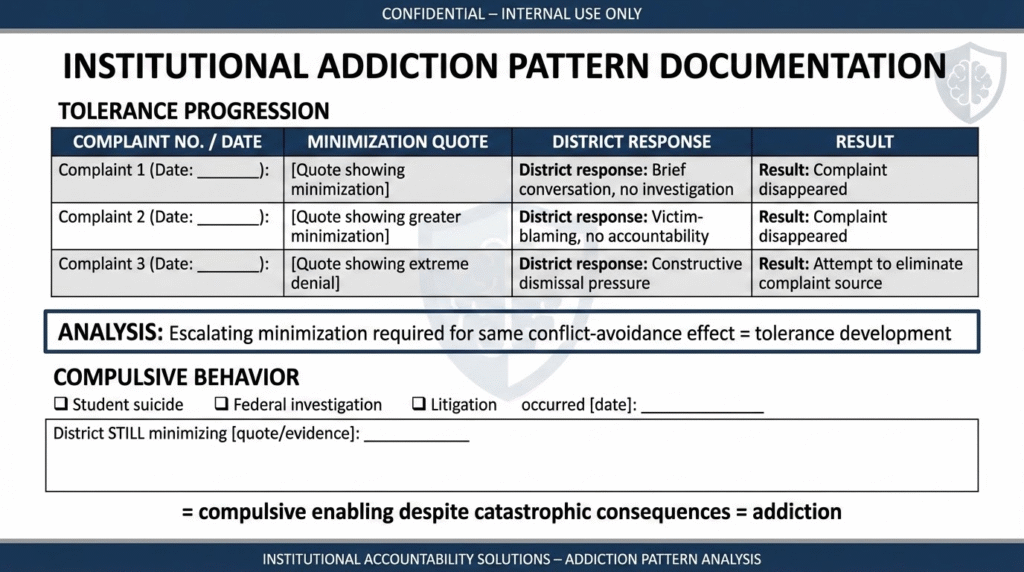
From first bullying complaint forward: document date, what you reported (specific incidents), district’s response (exact quotes from administrators), outcome (investigation/none, discipline/none, problem resolution/continued). Show progression: early complaints met with minimal denial (“kids tease each other”), later complaints requiring greater minimization (“your child is sensitive”), eventually victim-blaming (“your child provokes others”), ultimately constructive dismissal attempts (“maybe different school better fit”). Timeline proving escalating denial needed to achieve same conflict-avoidance demonstrates tolerance development—addiction characteristic. Include all written communications, meeting notes, incident reports showing pattern.
Analyze what district achieves through minimization: complaints disappear without investigation resources/effort, no discipline creating controversy with perpetrator families, no staff accountability preventing liability exposure, no confrontational meetings with angry parents demanding action, administrative efficiency/relief from avoiding thorough response. Compare to rare acknowledged incidents showing district experienced “pain”—investigation effort, discipline controversy, potential liability, parent confrontations. Chart showing: “Minimization = Institutional Rewards (efficiency, conflict avoidance, no accountability), Acknowledgment = Institutional Pain (effort, controversy, liability risk, confrontation).” Proves district addicted to minimization delivering rewards while acknowledgment triggers withdrawal.
Document district’s continued minimization even when facing devastating outcomes: student became suicidal/hospitalized yet district still denying bullying caused harm, OCR investigation opened yet district minimizing to federal investigators rather than acknowledging failures, litigation filed seeking damages yet district’s legal strategy still denying bullying occurred rather than settling, media coverage generating public outrage yet district making denial statements to press. This compulsive behavior despite catastrophic consequences definitively establishes addiction—rational institution would modify behavior when facing such consequences, but addicted institution cannot stop compulsion regardless of devastation. Collect evidence of consequences and simultaneous minimization proving beyond rational control.
Break addiction through interventions making minimization more painful than acknowledgment: OCR Title IX/disability complaint (federal investigation, violations findings, mandatory corrective action, ongoing monitoring making future minimization federally-prohibited triggering more severe consequences), Federal/state civil rights lawsuit (multi-million dollar damage exposure making continued enabling financially catastrophic exceeding intervention costs), Public exposure campaign (media contacts, community organizing, board meeting testimony, social media creating political pain from minimization exceeding confrontation pain of acknowledgment), Demand court/OCR-appointed monitor (external oversight preventing relapse by eliminating minimization option). These interventions reverse reward structure—minimization now severe pain, acknowledgment less painful path. Forces institutional behavior change.
After interventions break initial addiction cycle, prevent relapse through settlement/resolution requiring: Independent monitor reviewing ALL bullying complaints ensuring proper investigation (eliminates minimization option going forward), Quarterly public reporting to board/community on bullying responses with data (transparency prevents hidden minimization resurrection), OCR/court monitoring minimum 3-5 years with violation consequences (external accountability preventing return to enabling once oversight ends), Policy mandating immediate thorough investigation from first complaint with administrator accountability for minimization (prevents reward pathway reformation), Community oversight committee reviewing compliance (ongoing external pressure preventing relapse). Like addiction recovery requiring permanent lifestyle/support changes—institutional accountability requires permanent structural reforms preventing return to harm-enabling once broken.
The “Bullying-as-a-Drug” framework is a conceptual way of understanding how organizations may repeatedly rely on short-term responses—such as minimizing or avoiding difficult issues—rather than addressing underlying problems. It highlights how patterns of behavior can become reinforced over time, especially when those responses reduce immediate conflict or pressure. Understanding these patterns can help explain why issues may persist despite policies or training, and why more structured accountability measures are sometimes necessary to drive meaningful change.
Look for consistent patterns in how concerns are handled over time. This may include repeated minimization of incidents, shifting explanations, or responses that focus on the reporting party rather than the issue itself. Documenting timelines, communications, and outcomes across multiple incidents can help identify whether responses are consistent, escalating, or recurring in ways that may indicate systemic challenges.
In some cases, organizations may continue using familiar response patterns even when outcomes are serious. This can occur when existing processes prioritize short-term resolution over long-term accountability, or when systems are not structured to respond effectively to complex situations. Recognizing these patterns can help inform more effective approaches to oversight and reform.
Accountability can be strengthened through clear procedures, consistent documentation, independent review processes, and transparency. External oversight, defined timelines for response, and clear expectations for addressing concerns can help ensure that issues are handled consistently and in alignment with applicable policies and legal requirements.
Sustained improvement often requires ongoing monitoring, clear policies, and regular review of how concerns are handled. This may include periodic reporting, independent oversight, and mechanisms for feedback. Establishing consistent processes and maintaining transparency can help ensure that improvements continue over time.
If you want student harm treated like a school safety and civil rights issue—start with SANI at https://saninstitute.net
Most bullying cases do not need a lawyer. Some clearly do. Knowing the difference before you act matters more than most parents realize. The decision

There is a point in many bullying cases where the parent has done everything right — and it still is not working. The emails are

You have three minutes. Make them the most organized three minutes the board has heard on this topic. Speaking at a school board meeting is

Patience with a school that isn’t responding isn’t a virtue. At some point it becomes a cost your child is paying. Most parents start at