

When Do Parents Need a Lawyer for School Bullying?
Most bullying cases do not need a lawyer. Some clearly do. Knowing the difference before you act matters more than most parents realize. The decision
1. Audio
2. Definition
3. Video
4. Core Thesis
9. Action Steps
10. FAQs
11. Call to Action
12. Sources
13. Signature
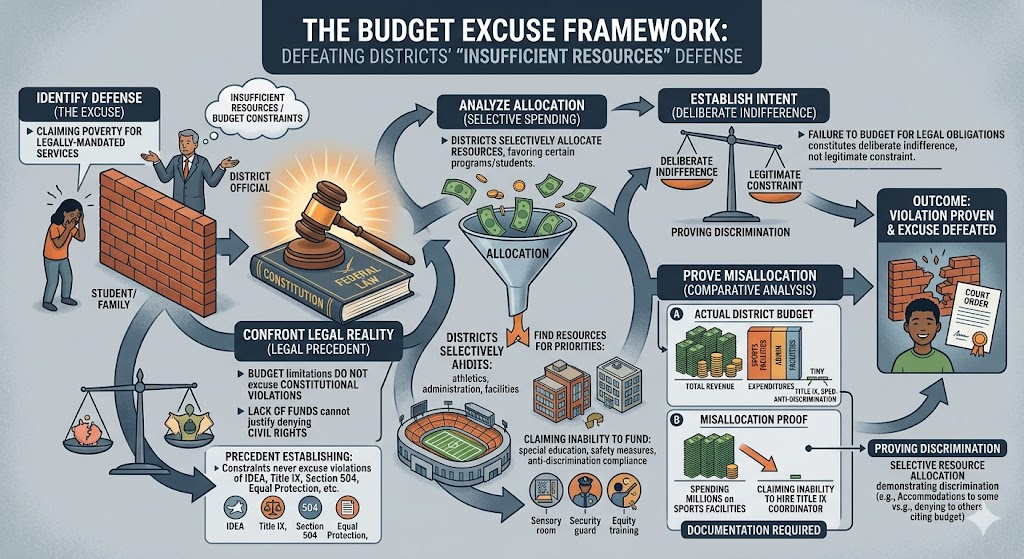
The Budget Excuse Framework is SANI’s methodology for defeating districts’ most common defense to civil rights violations—claiming “insufficient resources” or “budget constraints” prevent compliance with legal obligations—by exposing that: (1) budget limitations do not excuse constitutional violations or federal law compliance (courts consistently hold lack of funds cannot justify denying civil rights), (2) districts selectively allocate resources favoring certain programs/students while claiming poverty for legally-mandated services, (3) districts find resources for priorities (athletics, administration, facilities) while claiming inability to fund special education, safety measures, or anti-discrimination compliance, and (4) failure to budget for legal obligations constitutes deliberate indifference not legitimate constraint—establishing framework requiring documentation of: district’s actual budget showing total revenue and expenditures, comparative spending analysis proving resources exist but are misallocated (spending millions on sports facilities while claiming inability to hire Title IX coordinator), selective resource allocation demonstrating discrimination (providing accommodations to some disabled students while denying identical accommodations to others citing budget), and legal precedent establishing budget constraints never excuse violations of IDEA, Title IX, Section 504, Equal Protection, or other federal mandates.
Districts invoke “budget constraints” as universal excuse for civil rights violations—parent demands IDEA-required services, district responds “we can’t afford that,” student needs Title IX investigation, district claims “limited staffing prevents timely response,” family requests safety measures, district says “budget cuts eliminated security personnel”—but federal law is clear: poverty does not excuse civil rights violations, with Supreme Court establishing in multiple contexts that lack of resources cannot justify denying constitutional rights or violating federal statutes, and SANI’s Budget Excuse Framework proving districts claiming poverty simultaneously spend lavishly on non-mandated priorities (athletics, administrative salaries, facilities upgrades) while selectively denying legally-required services to vulnerable students, transforming budget excuse from legitimate constraint into evidence of discriminatory resource allocation. We convert trauma into code by obtaining district budgets through Public Records Act, creating comparative spending analyses showing millions spent on discretionary programs while claiming inability to fund $50,000 special education services, documenting selective allocation patterns (providing accommodations to some students while denying identical accommodations to others supposedly due to budget), and citing binding precedent establishing budget constraints never excuse IDEA, Title IX, Section 504, or Equal Protection violations—forcing districts to either reallocate resources to comply with law or admit budget excuse is pretextual discrimination. Selective enforcement IS discrimination when budget constraints miraculously appear only for services benefiting students of color or students with disabilities while resources flow freely to programs serving predominantly white, non-disabled student populations—proving budget excuse is weapon of discrimination not legitimate financial limitation.
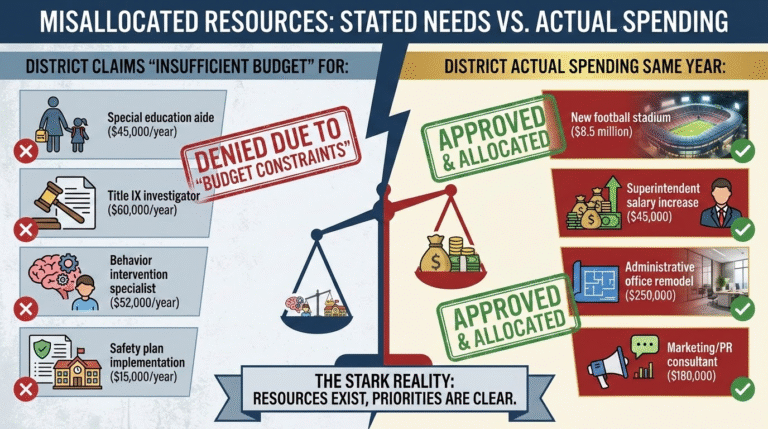
Parents in Sacramento request IDEA-required one-on-one aide for child with autism. IEP team agrees aide is necessary for FAPE (Free Appropriate Public Education). District refuses to provide, citing: “Budget constraints prevent hiring additional aides. We don’t have resources for one-on-one support.”
Parents file due process complaint. District’s defense: “We sympathize with student’s needs, but financial limitations prevent providing every requested service. District operating under severe budget constraints.”
Parents’ attorney conducts budget analysis through Public Records Act request obtaining complete district budget.
Findings:
Total district budget: $127 million annually
District’s claimed “budget constraints”:
District’s actual spending same fiscal year:
Athletics:
Administration:
Facilities:
Technology:
Total discretionary/non-mandated spending identified: $18+ million
Yet district claims inability to fund $45,000 legally-required special education aide.
Attorney’s brief:
“District’s ‘budget constraints’ defense is pretextual and legally insufficient. Supreme Court established in multiple contexts that poverty does not excuse constitutional violations. Youngberg v. Romeo held budget constraints cannot justify denying constitutionally-required services. IDEA creates enforceable right to FAPE—financial limitations do not excuse non-compliance.
Moreover, district budget analysis (Exhibit A) proves resources exist but are misallocated. District spent $8.5 million on football stadium while claiming $45,000 aide ‘unaffordable.’ This is not budget constraint—this is discriminatory resource allocation prioritizing athletics over disabled students’ civil rights.
District’s failure to budget for legally-mandated special education constitutes deliberate indifference. Cedar Rapids v. Garret F. established IDEA requires ‘necessary’ services regardless of cost. District choosing to allocate resources to discretionary athletics and administration while denying mandatory disability services violates federal law.
Budget excuse reveals discrimination: District finds millions for non-disabled students’ enrichment (stadium, technology) while claiming poverty prevents serving disabled student’s basic educational needs.”
Hearing officer decision:
“District’s budget defense fails as matter of law. Financial constraints do not excuse IDEA violations. District’s spending priorities—$8.5 million stadium while denying $45,000 required aide—demonstrate discriminatory allocation not legitimate constraint. District ordered to: provide one-on-one aide immediately, reimburse parents for private aide during denial period, compensatory education for FAPE denial, attorney fees.”
Settlement also required: Independent budget audit ensuring special education receives proportionate funding, policy prohibiting budget excuse for denying IDEA services, monitoring.
SANI developed the Budget Excuse Framework because “we can’t afford it” is districts’ most frequently-deployed defense to civil rights obligations—yet federal law categorically rejects poverty as excuse for violations.
Framework’s core principle: Budget constraints are either (1) pretextual (resources exist but misallocated), or (2) irrelevant (poverty doesn’t excuse civil rights violations).
SANI teaches families to expose budget excuse through two strategies:
Step 1: Request complete district budget via Public Records Act
Step 2: Analyze spending identifying discretionary expenditures (athletics, administration, facilities, marketing, non-mandated programs)
Step 3: Calculate total discretionary spending
Step 4: Compare to cost of denied legally-required service
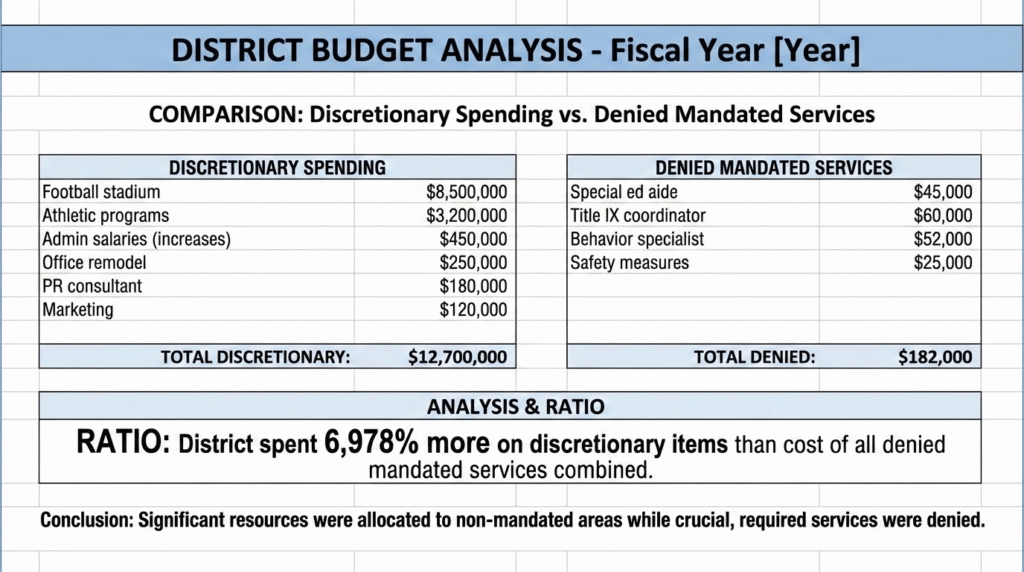
Step 5: Create visual comparison showing district spent millions on discretionary items while claiming inability to fund $50,000 required service
Example:
IDEA: Cedar Rapids Community School District v. Garret F. – Services required by IDEA must be provided regardless of cost
Title IX: Davis v. Monroe – Budget constraints do not excuse deliberate indifference to harassment
Section 504: Alexander v. Choate – Financial limitations do not justify disability discrimination
Equal Protection: Griffin v. Illinois – Poverty cannot justify denying constitutional rights
Due Process: Youngberg v. Romeo – Budget constraints cannot justify inadequate constitutionally-required services
SANI’s framework brief language:
“District’s budget defense fails legally and factually:
Legally insufficient: Supreme Court consistently holds budget constraints do not excuse civil rights violations [cite precedent]. IDEA, Title IX, Section 504, Equal Protection create enforceable rights—poverty does not eliminate obligations.
Factually pretextual: District budget analysis (attached) proves resources exist but are discriminatorily allocated. District spent $[millions] on [discretionary items] while denying $[thousands] in legally-required [service]. This is not budget constraint—this is discriminatory priority-setting violating federal law.
Deliberate indifference: District’s failure to budget for legal obligations constitutes deliberate indifference. Choosing to spend on [athletics/administration/facilities] while denying [special education/Title IX/safety measures] demonstrates deliberate decision to violate civil rights, not legitimate financial limitation.”
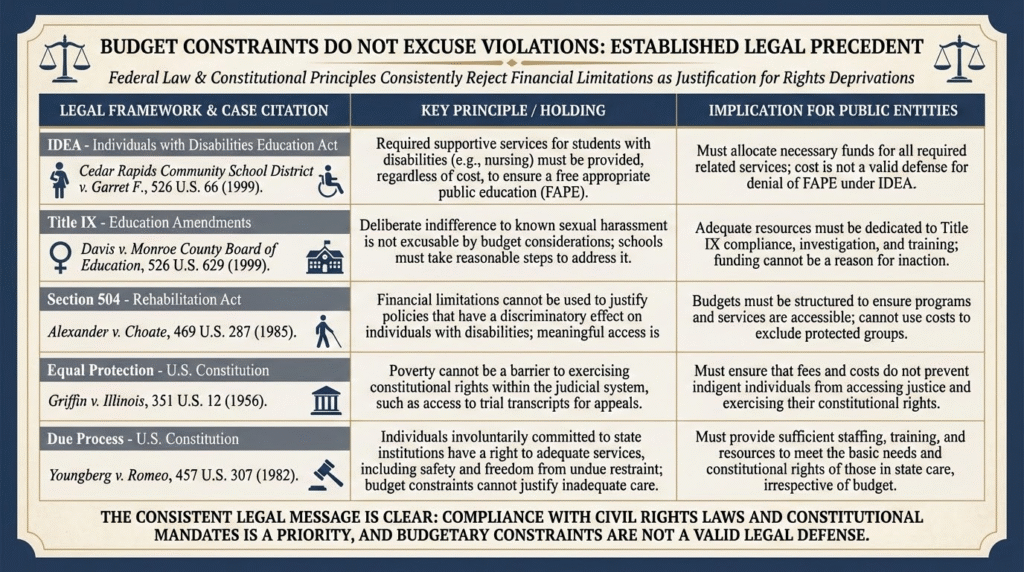
Supreme Court precedent consistently establishes: Lack of financial resources cannot justify denying constitutional rights or violating federal civil rights statutes.
Key cases:
Cedar Rapids Community School District v. Garret F., 526 U.S. 66 (1999): IDEA requires districts provide services necessary for FAPE regardless of cost. “The [IDEA’s] elaborate and costly administrative and judicial enforcement scheme would be wasted if [schools] could simply plead financial hardship to escape their obligations.”
Davis v. Monroe County Board of Education, 526 U.S. 629 (1999): Title IX deliberate indifference standard does not include budget exception—districts cannot claim insufficient resources prevent addressing harassment.
Alexander v. Choate, 469 U.S. 287 (1985): Section 504 prohibits disability discrimination—financial constraints do not justify denying disabled individuals equal access.
Griffin v. Illinois, 351 U.S. 12 (1956): Equal Protection prohibits denying constitutional rights based on poverty—”There can be no equal justice where kind of trial person gets depends on amount of money he has.”
Youngberg v. Romeo, 457 U.S. 307 (1982): Due Process requires adequate services for institutionalized individuals—budget constraints cannot justify inadequate constitutionally-required care.
Consistent legal standard: Budget limitations may affect HOW districts comply with obligations (choosing less expensive among legally-adequate options), but cannot excuse WHETHER they comply. Districts must provide legally-required services regardless of cost.
IDEA creates enforceable individual entitlement to FAPE—Free Appropriate Public Education.
Cedar Rapids principle: If service is necessary for FAPE (as determined by IEP team), district must provide regardless of cost. “Continuous one-on-one nursing care” costing tens of thousands annually required when necessary.
District cannot:
District can:
But bottom line: If service necessary for FAPE, cost irrelevant—must be provided.
Davis v. Monroe deliberate indifference standard: District liable when has actual knowledge of harassment and response is clearly unreasonable.
Budget constraints do not excuse clearly unreasonable response:
District cannot claim:
Deliberate indifference includes: Failing to allocate adequate resources to Title IX compliance when district has resources but chooses different priorities.
Example: District spends millions on athletics but claims inability to fund Title IX investigator—this IS deliberate indifference, not budget constraint.
Section 504 requires: Reasonable accommodations/modifications enabling equal access for disabled students.
Alexander v. Choate: “Section 504 does not require substantial modification of programs but does prohibit discrimination in providing benefits.”
Budget cannot excuse:
“Undue hardship” defense exists but extremely high bar—must prove accommodation fundamentally alters program or imposes significant difficulty/expense considering district’s overall resources.
Proving “undue hardship” requires showing:
Merely claiming “expensive” insufficient—must prove genuinely undue given district’s overall financial position.
Budget excuse becomes discrimination evidence when:
Pattern 1: Discretionary Spending While Denying Mandated Services
District spends millions on:
While claiming inability to fund:
This proves: Resources exist but are discriminatorily allocated away from civil rights compliance toward discretionary priorities.
Pattern 2: Selective Provision of Similar Services
District provides:
While denying identical services to others citing “budget constraints.”
This proves: Budget excuse is pretextual—if district can afford service for Student A, cannot claim poverty when denying identical service to Student B. Selective provision is discrimination not budget limitation.
Pattern 3: Finding Resources After Litigation
District claims “can’t afford” service → Parent files due process/lawsuit → District suddenly “finds” resources to provide service during litigation.
This proves: Resources existed all along—initial denial was discrimination disguised as budget constraint.
California Public Records Act request:
“Request complete adopted district budget for [fiscal year] including:
Analyze for discretionary spending:
Identify large expenditures on non-mandated items:
Calculate comparative costs:
Total discretionary spending identified: $X million
Cost of denied legally-required service: $Y thousand
Ratio showing district spent X,000% more on discretionary items than cost of mandated service proves resources exist.
Template argument:
“District’s budget defense fails legally and factually:
Supreme Court consistently rejects poverty as excuse for civil rights violations:
District’s obligation to provide [service] is not contingent on financial convenience—federal law requires compliance regardless of cost.
District budget analysis (Exhibit A) proves claimed poverty is false:
District’s claimed constraint:
District’s actual spending same fiscal year:
District spent [X]% more on discretionary non-mandated programs than entire cost of legally-required [service]. This is not budget constraint—this is discriminatory resource allocation prioritizing [athletics/administration/facilities] over disabled students’ civil rights.
III. DELIBERATE INDIFFERENCE – FAILURE TO BUDGET IS VIOLATION
District’s failure to allocate adequate budget for legal obligations constitutes deliberate indifference. Choosing to spend millions on [discretionary items] while denying [mandated services] demonstrates deliberate decision to violate federal law.
CONCLUSION
District’s budget excuse is legally invalid (poverty doesn’t excuse violations) and factually false (resources exist but are misallocated discriminatorily). District must reallocate resources to comply with federal law or face liability for discriminatory denial of services.”
When district denies service citing budget constraints: get exact cost in writing. Request: “Provide written cost estimate for [denied service—one-on-one aide, Title IX investigator, safety measures, accommodations]. Include: annual cost, implementation timeline, budget category preventing provision.” If district refuses cost estimate, note: “District claims service unaffordable but cannot/will not identify cost—suggests pretextual excuse.” This establishes baseline for comparative analysis showing whether district’s claimed poverty is legitimate constraint or discriminatory allocation.
File California Public Records Act request: “Request complete adopted district budget [fiscal year]: (1) Total revenues by source, (2) Expenditures by category (salaries, benefits, operations, facilities, athletics, special education, administration, technology, maintenance, consultants), (3) Capital projects/construction spending, (4) Reserve funds, (5) Administrator compensation including superintendent/cabinet, (6) Athletic program detailed budget, (7) Facilities/maintenance spending, (8) Consultant/contractor payments. Provide within 10 days Government Code § 6253.” This provides data proving whether resources exist but are misallocated.
From budget, identify discretionary expenditures: athletic facilities/programs (millions), administrative salaries beyond necessity (superintendent raises, cabinet positions), premium facilities (office remodels, landscaping, non-essential upgrades), marketing/PR/consultants (non-mandated spending), technology beyond instructional needs. Calculate total discretionary spending. Compare to cost of denied service. Create visual: “District spent $X million on discretionary items while claiming inability to fund $Y thousand legally-required service—ratio shows X,000% more spent on discretion than mandated compliance.” This proves resources exist, are selectively allocated.
Legal argument: “District’s budget defense fails: (I) LEGALLY INSUFFICIENT—Supreme Court establishes budget constraints don’t excuse violations: Cedar Rapids (IDEA services required regardless cost), Davis (Title IX compliance not budget-contingent), Alexander (Section 504 prohibits using finances to justify discrimination), Griffin (Equal Protection bars poverty excuse). (II) FACTUALLY PRETEXTUAL—Budget analysis (attached) proves resources exist: District spent $[millions] discretionary while denying $[thousands] mandated. This is discriminatory allocation not constraint. (III) DELIBERATE INDIFFERENCE—Choosing discretionary spending over mandated services demonstrates deliberate violation.” Establishes budget excuse fails both legally and factually.
In demand/complaint: “District must immediately: (1) Provide denied [service] within [timeframe], (2) If claiming budget prevents immediate provision, submit reallocation plan showing how discretionary spending will be reduced to fund mandated service within 30 days, (3) Provide compensatory [education/services/damages] for period service was wrongfully denied citing pretextual budget excuse, (4) Independent budget audit ensuring adequate allocation to [special education/Title IX/civil rights compliance], (5) Policy prohibiting budget excuse for denying legally-mandated services.” Forces district to either comply immediately or admit resources exist requiring reallocation, eliminating budget excuse.
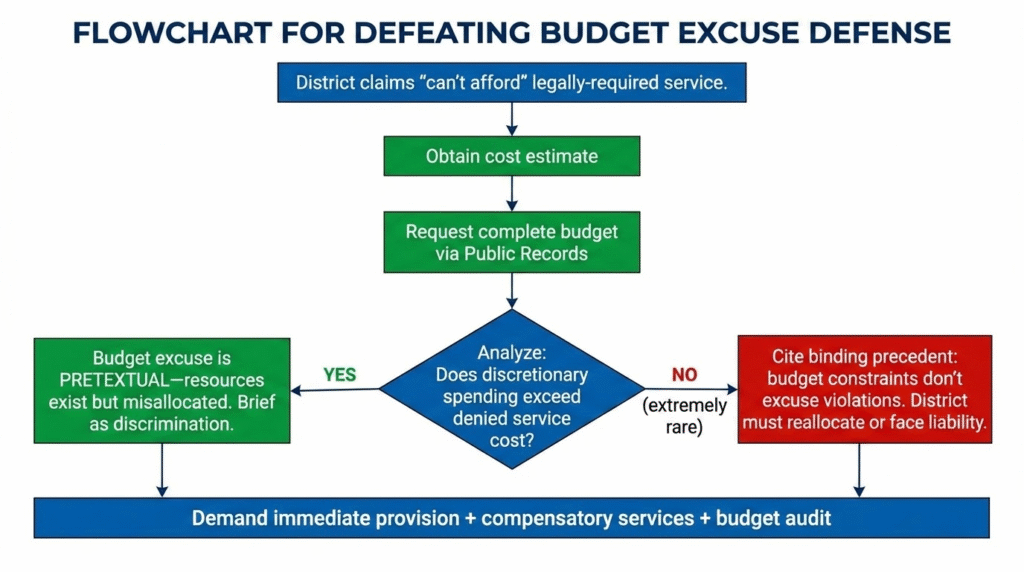
Within 48 hours of district claiming “budget constraints” prevent providing service: send written demand: “You’ve denied [service] citing budget limitations. Provide within 5 business days: (1) Exact annual cost of denied service, (2) Budget category service would come from, (3) Current spending in that category and total, (4) Explanation why reallocation from other categories impossible, (5) Written policy establishing budget caps on [special education/Title IX/civil rights] services. If cost estimate not provided, this confirms budget excuse is pretextual not legitimate constraint.” Forces district to quantify claimed limitation or admit pretext.
Within one week: “California Public Records Act Request: Complete adopted district budget [current fiscal year]: total revenues, expenditures by all categories (itemized), administrator compensation, athletic program budget, facilities/maintenance spending, capital projects, consultant payments, reserve funds. Provide within 10 days Gov Code § 6253.” When received, create spreadsheet categorizing: (1) Legally-mandated spending (special education, Title IX compliance, safety), (2) Discretionary spending (athletics, premium facilities, marketing, administrative overhead beyond necessity). Calculate totals each category proving allocation priorities.
From budget data: identify major discretionary expenditures exceeding cost of denied service (e.g., $8.5M stadium vs. $45K aide). Create comparison chart: “DISCRETIONARY SPENDING: [itemize large expenditures with amounts, total]. DENIED MANDATED SERVICE: [service] estimated cost $[amount]. ANALYSIS: District spent [X]% more on discretionary non-mandated items than entire cost of legally-required service. Resources exist—district chooses discriminatory allocation prioritizing [athletics/administration] over [disabled students’/civil rights] compliance.” Visual comparison proves pretext not constraint. Include in all complaints/litigation as exhibit.
In opposition to district’s budget defense: “District’s excuse fails legally and factually: LEGAL: Supreme Court categorically rejects poverty as civil rights excuse—Cedar Rapids (IDEA services required regardless cost), Davis (Title IX compliance not budget-contingent), Alexander (finances don’t justify discrimination), Griffin (poverty can’t deny constitutional rights). FACTUAL: Budget analysis (Exhibit) proves resources exist: District spent $[millions] on [discretionary items] while denying $[thousands] mandated [service]. This is discriminatory allocation not constraint, constituting deliberate indifference. District’s failure to budget for legal obligations demonstrates deliberate violation not financial limitation.” Establishes excuse fails under binding precedent and proves discrimination.
In settlement/resolution demands: “District must immediately: (1) Provide denied [service] within [10-30] days regardless of claimed budget constraints—federal law doesn’t include poverty exception, (2) Submit reallocation plan showing how discretionary spending (identified in budget analysis) will be reduced to fund mandated services if necessary, (3) Provide compensatory [education/services] for entire period service wrongfully denied citing pretextual budget excuse, (4) Independent budget audit ensuring adequate allocation to [special education/Title IX/civil rights compliance] preventing future budget excuses, (5) Policy prohibiting use of budget limitations as excuse for denying legally-mandated services, (6) Monitoring and quarterly budget reporting.” Forces compliance and prevents future budget excuse abuse.
Schools are generally required to comply with federal civil rights laws regardless of budget constraints. Courts have held that obligations under laws such as IDEA, Title IX, and Section 504 are not eliminated simply because resources are limited. While funding challenges may affect how services are delivered, they do not typically remove the underlying duty to provide legally required protections and access to education.
One approach is to review publicly available budget information to understand how resources are allocated. This may include examining spending on programs, facilities, administrative costs, and other discretionary areas. Comparing these allocations with the cost of the requested service can help determine whether financial limitations are being applied consistently or selectively.
Even when resources are limited, schools are expected to meet their legal obligations. In practice, this may involve prioritizing required services, identifying cost-effective alternatives that still meet legal standards, or seeking additional funding sources. The presence of budget constraints does not automatically justify the denial of services that are required under applicable laws.
Under certain laws, such as the ADA and Section 504, schools may raise an “undue hardship” defense. However, this standard is typically high and requires consideration of the institution’s overall resources, the nature of the accommodation, and whether it would fundamentally alter the program or create significant difficulty or expense. Each situation is evaluated on a case-by-case basis.
If services are denied, possible steps may include requesting a written explanation, seeking review through administrative processes, filing a complaint with appropriate oversight agencies, or consulting a qualified attorney. Keeping detailed records of requests, responses, and supporting documentation can be helpful in evaluating next steps and supporting any challenge.
If you want student harm treated like a school safety and civil rights issue—start with SANI at https://saninstitute.net
Most bullying cases do not need a lawyer. Some clearly do. Knowing the difference before you act matters more than most parents realize. The decision

There is a point in many bullying cases where the parent has done everything right — and it still is not working. The emails are

You have three minutes. Make them the most organized three minutes the board has heard on this topic. Speaking at a school board meeting is

Patience with a school that isn’t responding isn’t a virtue. At some point it becomes a cost your child is paying. Most parents start at