

When Do Parents Need a Lawyer for School Bullying?
Most bullying cases do not need a lawyer. Some clearly do. Knowing the difference before you act matters more than most parents realize. The decision

Maybe your child finally told you tonight. Maybe you saw the messages yourself. Maybe the school called, or another parent reached out, or you just put together a pattern of signs you had been trying not to name.
However you found out, you are now in that moment where the urgency is real and the path forward is not.
The worst thing you can do right now is nothing. The second worst thing is to react so fast and so hard that you make avoidable mistakes — a confrontational call to the school that goes on record wrong, a conversation with your child that shuts them down, a text to the other parent that escalates the situation before you have any leverage.
This article gives you the first steps — in order — so you can protect your child, start building the record you will need, and avoid the early mistakes that make everything harder later.
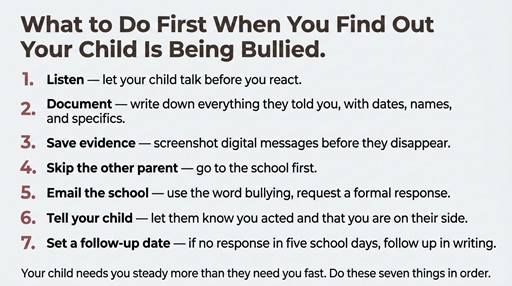
The first thing to do is not call the school. It is to listen to your child, write down what you hear, and make sure your child feels believed before you do anything else.
The second thing is to start documenting — dates, descriptions, any evidence your child can share — before memories fade and messages disappear.
The third thing is to contact the school in writing, not by phone, using the word bullying, and requesting a formal response.
Everything else — escalation, legal options, outside support — comes after those three things are in motion. Right now, your job is to slow down just enough to do the first steps correctly. Your child needs you steady more than they need you fast.
When a parent first learns their child is being bullied, the situation almost always looks different up close than it did from the outside — and understanding what is actually in front of you is the first step toward responding effectively.
The bullying has usually been going on longer than you know. Children do not typically tell parents the first time something happens. They tell parents after they have tried to manage it themselves, after it has escalated, after it has started affecting their daily life in ways they can no longer hide. The moment you find out is rarely the beginning. It is the point where the situation has grown past what your child could carry alone.
Your child is watching how you respond right now. The first conversation matters enormously. A parent who reacts with visible panic, anger at the child’s choices, or an immediate promise to ‘handle it’ can inadvertently push the child back into silence — afraid of making things worse, afraid of the parent’s reaction, or afraid of losing the small amount of control they still feel they have. Your child needs to believe you can hear this without falling apart.
The details your child shares right now are the most accurate you will get. Memory fades. Details blur. What your child tells you in the first conversation — names, dates, specific incidents, who was present, what was said — should be written down as soon as you can, as specifically as you can, while it is still fresh.
The school does not know what you know yet. Until you put it in writing, the school has nothing to respond to formally. A phone call to express concern is not a bullying complaint. The transition from informal to formal happens only when you send an email that uses the word bullying and requests a specific response under the school’s anti-bullying policy.

Most situations call for the escalation sequence described above — principal, superintendent, state — with reasonable windows between each step. But some situations call for faster movement. Do not wait for the full sequence if:
A principal who ignores a bullying report is not the end of the road — but it is the point where the path forward needs to be structured, documented, and deliberate. If you are not sure whether your documentation is strong enough to escalate effectively, or if you want help drafting the superintendent email in a way that is hard to dismiss, outside support can help you get there.
Email is generally the better option for anything related to bullying concerns. Phone calls do not automatically create a record and can later become difficult to verify or reconstruct. An email provides a timestamped written record that you control and can reference later if escalation becomes necessary. If you choose to call first, follow up the same day with an email summarizing what was discussed, any concerns raised, and any next steps that were mentioned.
This can be a very difficult situation for families. Children who are being bullied often fear retaliation, embarrassment, or escalation if adults intervene. It is important to acknowledge those fears seriously while also recognizing that safety concerns generally require adult involvement. Many parents find it helpful to explain to their child that they will approach the school carefully, calmly, and with the goal of improving safety rather than creating conflict. Keeping your child informed throughout the process can also help preserve trust.
Bullying is commonly understood to involve three factors: a power imbalance, repeated behavior over time, and conduct intended to harm, intimidate, exclude, or humiliate. A single disagreement between students with relatively equal standing may not meet that definition. Repeated targeting, exclusion, threats, humiliation, or intimidation — especially when your child feels unable to stop it — is more likely to qualify. If you are uncertain, it is still reasonable to report the behavior and ask the school to evaluate it under its bullying policy.
You should still report it to the school if the online behavior is affecting your child’s ability to feel safe, participate, or learn at school. Many districts have cyberbullying policies that apply to off-campus digital conduct when it substantially impacts the school environment. Preserve all evidence before reporting — including screenshots, usernames, dates, and timestamps. In your written report, explain how the online conduct is affecting your child at school and ask whether the district’s bullying or cyberbullying policy applies.
If you want student harm treated like a school safety and civil rights issue—start with SANI at https://saninstitute.net
Most bullying cases do not need a lawyer. Some clearly do. Knowing the difference before you act matters more than most parents realize. The decision

There is a point in many bullying cases where the parent has done everything right — and it still is not working. The emails are

You have three minutes. Make them the most organized three minutes the board has heard on this topic. Speaking at a school board meeting is

Patience with a school that isn’t responding isn’t a virtue. At some point it becomes a cost your child is paying. Most parents start at