You tried the school. You tried the district. You documented everything. And your child was still harmed.
This is the question that parents arrive at after months — sometimes years — of trying to make the system work. Not from the beginning, not in frustration, but after doing things right: filing complaints, sending emails, requesting meetings, escalating through the chain.
And still, the school failed to protect your child.
The question of whether a school can be held responsible for that failure is serious, nuanced, and highly dependent on the specific facts of your situation. This article does not give legal advice — no article can do that. What it does is give you a clear-eyed understanding of the legal frameworks that may apply, what conditions generally need to be present for institutional responsibility to exist, and what steps make sense before you decide whether to pursue outside legal guidance.
The Short Answer
Under certain circumstances, yes — a school can be held responsible for failing to protect a student from bullying. But the threshold is specific, and the standard is not simply that the bullying occurred.
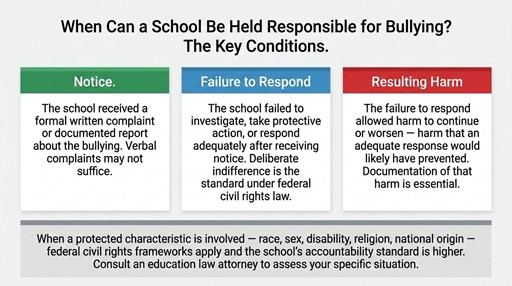
For a school to be held responsible, several conditions generally need to be present: the school must have had notice of the bullying — typically through a formal complaint or documented report; the school must have failed to respond adequately despite that notice; and the failure to respond must have caused or allowed harm that a reasonable institutional response would have prevented.
The legal framework that applies depends on the nature of the bullying. When a protected characteristic is involved — race, sex, disability, religion, national origin — federal civil rights statutes create a stronger basis for institutional accountability. In situations where no protected characteristic is directly at issue, state tort law and the school’s own policy obligations may still provide a basis for a claim, though these vary significantly by state.
This is genuinely complex legal territory. What this article can do is help you understand the conditions, the frameworks, and the documentation that would matter — so that if you decide to consult a legal professional, you arrive prepared.
What This Usually Means
Parents who reach this question are almost always at a specific point in the process — and understanding where you are helps clarify what questions to be asking.
The school had notice and did not act. The foundation of almost any accountability claim against a school in a bullying case is notice — documented, formal notice that the school received and failed to respond to adequately. A school that never knew about the bullying is in a very different legal position than one that received written complaints and took no meaningful action. Your written complaint history is not just useful — it may be essential to any accountability framework.
The harm was ongoing after the school was notified. A single incident that the school did not know about in advance is different from a pattern of harm that continued after the school was formally put on notice. Post-notification harm — harm that occurred after the school received a written complaint and failed to investigate or take protective action — is typically the most significant category for accountability purposes.
The nature of the bullying determines which legal framework applies. Peer-on-peer harassment based on sex falls under Title IX. Race-based harassment falls under Title VI. Disability-based harassment falls under Section 504 and the ADA. In each case, the standard for school liability under federal civil rights law generally requires showing that the school’s response was deliberately indifferent — not merely inadequate, but demonstrably unconcerned with the student’s welfare. That is a high standard, but it is not an unattainable one when the documented record shows repeated notice and repeated failure.
Outside civil rights frameworks, state law may provide additional options. Some states have statutes that create specific duties for schools in bullying cases. State tort law — negligence claims — may apply in cases involving physical harm. The availability and strength of these options varies significantly by state and requires legal analysis specific to your jurisdiction.
Documentation is not just helpful — it is foundational. Whatever legal framework may apply, the strength of any accountability claim depends heavily on the quality and completeness of the parent’s documentation. Every written complaint, every email, every meeting note, every date — these are not just organizational tools. They are the evidentiary foundation of a case.
What to Do Now
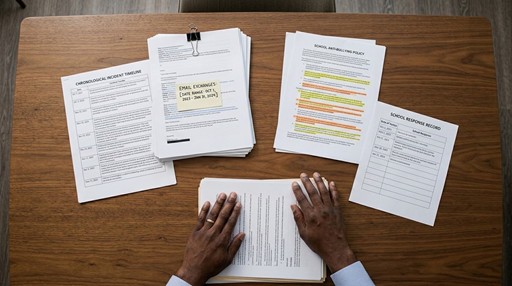
- Compile your complete documentation history before doing anything else. Create a chronological record of everything: every written complaint you filed, the dates, who received it, and what response you received. Every meeting, with notes on what was said and agreed to. Every incident of bullying after the school was notified. Every follow-up and every non-response. This is the document you would bring to any legal consultation, any advocate, or any escalation above the district level.
- Identify whether the bullying involved a protected characteristic. Race, national origin, sex, gender, disability, and religion are the categories that invoke federal civil rights frameworks. If the bullying targeted one of these characteristics, name that explicitly in your documentation summary. The federal civil rights framework is the strongest basis for institutional accountability in most bullying cases — but it requires the protected characteristic connection to apply.
- Document the specific harm your child has experienced as a result of the bullying and the school’s failure to respond. This means clinical records if your child received mental health support, medical records if there were physical injuries, records of school absences connected to the bullying, any changes in academic performance or IEP goal progress, and any documented statements from your child about the impact of the situation. The harm documentation is what connects the school’s failure to the consequence your child experienced.
- Identify the specific points at which the school received notice and failed to act. Post-notification failure is the core of most accountability frameworks. Go through your documentation and identify each date you formally notified the school, what response you received, and what happened to your child after that. If the harm continued or worsened after formal written notice, document that sequence explicitly.
- Research whether your state has specific anti-bullying liability statutes. Some states have laws that create specific legal duties for schools and specific remedies when those duties are not met. Your state attorney general’s website or a legal reference resource can help you identify whether such statutes exist in your state. This is not legal advice — it is the kind of preliminary research that helps you arrive at a legal consultation with better questions.
- Consider consulting with an educational advocate before consulting with an attorney. An educational advocate who understands school bullying cases can help you assess whether your documentation is strong enough to support a legal consultation, whether you have exhausted the institutional remedies that should precede legal action, and whether there are steps within the school system that might still produce results. Advocacy and legal action are not mutually exclusive — but the sequence matters.
- If you decide to consult with an attorney, look for one with specific experience in education law, civil rights, or school liability — not just a general practice attorney. The legal frameworks that apply to school bullying cases are specialized. An attorney who regularly handles education civil rights or school negligence cases will give you a more accurate assessment than a generalist. Many education attorneys offer initial consultations that can help you understand whether your situation has the elements that would support a claim.
What Not to Do
- Do not pursue legal action before exhausting institutional remedies. A legal claim is most credible when it comes after a documented record of institutional failure — not as a first response. Filing a complaint with the OCR, escalating to the state department of education, and working through the school and district process first both strengthens any potential legal claim and may produce results that make legal action unnecessary.
- Do not make statements to the school suggesting you are planning legal action before you have actually decided to pursue it. Statements about lawsuits made informally — in meetings, in emails, in casual conversation — can create complications without producing any benefit. If legal action is a serious possibility, discuss it with an attorney first.
- Do not assume that the bullying occurring is sufficient to establish school liability. The standard for school accountability in bullying cases is not simply that bullying happened. It generally requires notice, failure to respond, and resulting harm. A situation where the school was never formally notified, or where the school responded and the bullying continued anyway, may not meet the threshold. Know the standard before you assess your situation against it.
- Do not destroy, delete, or alter any documentation in the belief that it might hurt your position. Present everything to your advocate or attorney and let them assess what is and is not helpful. Incomplete or altered documentation creates far more problems than unfavorable documentation.
- Do not conflate moral responsibility with legal liability. A school that behaved badly — that dismissed your concerns, used the peer conflict label, moved slowly, or failed to protect your child — may have significant moral responsibility for what happened. Whether that rises to legal liability is a separate analysis that depends on specific legal standards. Both things can be true: the school behaved badly, and a legal claim may or may not be viable based on the specific facts and the applicable law.
When to Consider Legal Consultation
Not every bullying case warrants legal consultation — but some clearly do. Consider consulting with an education law attorney or civil rights attorney if:
- Your child has experienced significant documented harm — physical injury, a diagnosed psychological condition, significant academic disruption, or school withdrawal — that is directly connected to a pattern of bullying the school failed to address after formal notice.
- The bullying involved a protected characteristic, the school received formal written notice and failed to respond adequately, and your attempts to escalate through the district and state levels have not produced resolution.
- The school’s documented pattern of non-response is clear and extensive — multiple written complaints across a significant period of time, all producing inadequate or no response.
- You have filed an OCR complaint or a state-level complaint and want to understand what legal options exist in parallel with or following that process.
- Your child is no longer able to access education in the way they were before the bullying — whether through school avoidance, transfer, homeschooling, or significant academic decline — and you want to understand whether that disruption supports a legal claim.
Consulting with an attorney is not the same as filing a lawsuit. An initial consultation — which many education attorneys offer — helps you understand whether your situation has the elements that would support a claim, what the process would involve, and what the realistic range of outcomes might be. That information is valuable regardless of what you decide to do with it.
Take the Next Step
If you have exhausted the school and district process and are now seriously considering whether the school’s failure to protect your child creates broader accountability, the most important thing you can do is arrive at any next conversation — with an advocate, with an attorney, or with a state agency — with your documentation in order and your timeline clear. Outside support can help you assess where you stand before you decide how to proceed.
- Schedule a free consultation with Jerry Green: If you want help understanding whether your documentation supports escalation, what your options are at this stage, and whether your situation warrants legal consultation — a free consultation can help you get clarity before you make your next move. https://calendly.com/jerrylgreen2011
- Take the Student Protection Readiness Checklist: A practical first step to assess the completeness of your documentation, the school’s response record, and where your situation stands before any further escalation. https://sprchecklist.abacusai.app
FAQs
What does “deliberate indifference” mean in a school bullying case?
Deliberate indifference is a legal standard used in federal civil rights cases — particularly under Title IX and related statutes — to evaluate whether a school's response to harassment was so inadequate that it may constitute a violation of federal law. It means more than simple negligence or poor judgment. The standard generally asks whether the school knew about the harassment and responded in a way that was clearly unreasonable under the circumstances. Proving deliberate indifference often depends heavily on documentation showing what the school knew, when it learned of the problem, and what actions it did or did not take afterward.
Can I sue the school district directly, or only individual administrators?
In many school bullying and civil rights cases, the school district itself is the primary legal defendant rather than individual administrators. Claims under federal civil rights statutes are commonly directed at the institution responsible for policies, supervision, and responses to complaints. Depending on state law and the specific facts involved, there may also be circumstances where individual employees or administrators could face separate claims. Because these issues vary significantly by jurisdiction and legal theory, consulting an attorney familiar with education law in your state is important before pursuing litigation.
Does my child have to still be enrolled at the school for me to pursue a claim?
No. Families may still pursue claims based on past conduct even if the student has transferred, graduated, or otherwise left the school. However, legal deadlines — known as statutes of limitations — apply to many claims and differ depending on the type of claim and the state involved. Administrative complaints, federal civil rights claims, and state law claims can each have different timelines. If you believe legal action may become necessary, it is important to seek guidance promptly so that potential deadlines are not missed.
What if the school settled another family’s bullying complaint — does that affect my case?
Prior complaints or settlements involving the same school may sometimes provide relevant background information, particularly if they suggest a recurring pattern in how the district responds to bullying or harassment concerns. However, each case is still evaluated based on its own facts, including what the school knew, how it responded, and what harm occurred in your child’s situation specifically. Whether a prior settlement could be legally relevant depends on the circumstances and the law in your jurisdiction, which is something an attorney can evaluate in detail.
Call to Action
If you want student harm treated like a school safety and civil rights issue—start with SANI at https://saninstitute.net