Two words. That is all it took to make everything your child told you feel officially irrelevant.
You sat in that office. You described what has been happening — the targeting, the exclusion, the cruelty, the pattern. You watched the administrator listen and nod. And then they handed it back to you wrapped in a label that made it sound like a misunderstanding between equals.
Peer conflict.
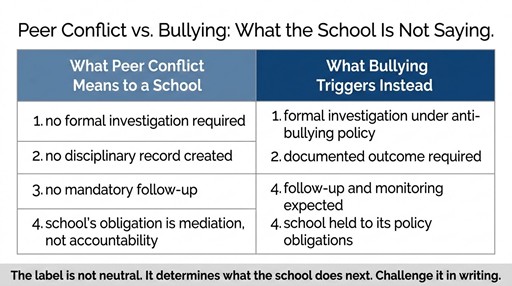
The phrase is not accidental. Schools use it deliberately — because it changes what they are required to do. Peer conflict is managed. Bullying is investigated. Peer conflict is mediated. Bullying triggers a formal response under anti-bullying policy. The label is not just a word. It is a decision about institutional responsibility.
If you are sitting with that label right now and you know it is wrong — you are probably right. And there are specific, documented steps you can take to push back on it in a way that is hard to dismiss.
The Short Answer
The school’s decision to call something peer conflict does not make it peer conflict. It makes it the school’s current characterization — and that characterization can be challenged, documented, and escalated.
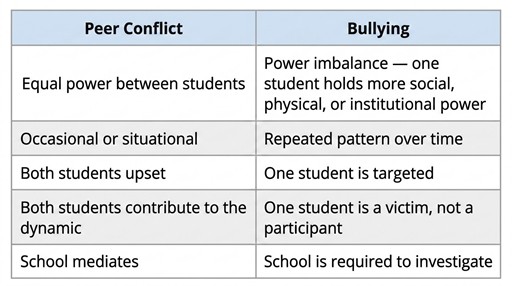
The difference between peer conflict and bullying is not a matter of opinion. It is a matter of pattern, power, and intent. Peer conflict involves two students with roughly equal standing who have a mutual disagreement. Bullying involves a power imbalance, a pattern of repeated targeting, and a child who is not an equal participant — they are a target.
If what your child is experiencing fits the second description, the school’s label does not change the reality. What it does is tell you that you need to put your disagreement in writing, keep building your documentation, and understand that the next steps are escalation rather than acceptance.
What This Usually Means
When a school uses the peer conflict label, several things are almost always true about the situation — and understanding them helps a parent respond from a position of clarity rather than just frustration.
The label protects the school, not your child. Peer conflict requires no formal investigation, no documented outcome, no disciplinary record, and no follow-up obligation. Bullying requires all of those things under most district anti-bullying policies. The label is institutional risk management. Recognizing it as such is the first step toward pushing back effectively.
The school may genuinely believe it — or may not. Some administrators use peer conflict because they genuinely see two kids with a rocky relationship and do not recognize the power imbalance. Others use it because they understand exactly what the label does and prefer the path of less administrative work. Your response strategy is the same in either case — but understanding which situation you are in helps you calibrate the tone.
Your documentation is the antidote to the label. A parent who responds to the peer conflict characterization with emotion and frustration is easy to manage. A parent who responds with a specific written account of the incidents, the dates, the power differential, the pattern, and the impact on their child is much harder to dismiss. The label cannot survive a well-documented paper trail that contradicts it.
The school has now told you something important. A school that calls your situation peer conflict has shown you its hand. It has told you that it does not intend to investigate, that it will not be creating a formal bullying record, and that it is positioning itself to avoid accountability. That information is useful. It tells you exactly what to document and what to say next.
This is the beginning of the escalation phase — not the end of the conversation. The peer conflict response is not a final determination. It is an opening position. Your job is to document your disagreement, request reconsideration in writing, and — if the school does not change its position — escalate to someone with more authority and more accountability than the building principal.
What to Do Now
- Respond to the peer conflict characterization in writing — do not let it stand unchallenged in the record. Send an email to the principal within one to two days of the meeting or communication where the peer conflict label was used. State clearly that you do not agree with that characterization. Explain why — specifically: there is a power imbalance, the incidents have been repeated over time, your child is not an equal participant, and the pattern meets the definition of bullying under the district’s own anti-bullying policy. Use the word bullying. Ask the school to reconsider its characterization and to process your report as a formal bullying complaint.
- Document the power imbalance in writing as specifically as you can. The distinction between peer conflict and bullying turns largely on power. In your written response, describe the power differential: does the other student have more social status, a larger friend group, physical size, or institutional favor? Is your child systematically excluded from groups or activities the other student controls? Is the targeting public or witnessed by peers who do not intervene? These specifics are what distinguish peer conflict from bullying in the language that matters institutionally.
- Document the pattern — not just individual incidents. Peer conflict is often described as situational. Bullying is a pattern. In your written response and in your ongoing documentation, list the incidents chronologically. Include dates, descriptions, and where each incident occurred. A list of five incidents over six weeks is not peer conflict. It is a pattern — and your documentation should make that pattern visible and hard to explain away.
- Request the school’s anti-bullying policy in writing and review the definition of bullying it contains. Most district anti-bullying policies include a specific definition of bullying — usually referencing power imbalance, repetition, and intent to harm. Compare that definition to what your child has experienced. If the situation meets the policy definition, say so explicitly in your written response. Quote the policy. Ask the school to explain in writing why the policy definition does not apply.
- Ask the school to provide their peer conflict determination in writing. If the school has concluded that this is peer conflict and not bullying, ask them to put that determination in writing — including what criteria they used, what investigation or review they conducted, and who made the determination. A school that is confident in its characterization will produce this. A school that is not may suddenly become more careful about the label.
- Keep a log of what happens after the peer conflict determination. Does the behavior continue? Does it escalate? Does your child continue to be affected? Every incident that occurs after the school has been formally notified — and after they chose not to investigate — is part of your documentation. Post-notification incidents are particularly significant if the situation escalates further.
- If the school does not reconsider, escalate to the district superintendent with your full documentation. Attach your original complaint email, your written disagreement with the peer conflict characterization, and your incident log. State that the school has declined to investigate a situation that meets the definition of bullying under the district’s own policy, and that you are requesting district-level review. This moves the situation out of the building and into a level of the system where the stakes for continued non-response are higher.
What Not to Do
- Do not accept the peer conflict label silently. A label that goes unchallenged in writing becomes the official record. If you disagree — and you do — say so in writing within days of receiving it. Your written objection becomes part of the documentation. The school’s characterization is not a final ruling. It is a position you can contest.
- Do not respond to the peer conflict characterization with only emotion. Anger is understandable and completely justified. But an angry parent is easier to manage than a documented one. Channel the anger into precision — a written account of the specific incidents, the specific power differential, and the specific ways the situation meets the policy definition of bullying. Let the facts carry the weight.
- Do not agree to mediation between your child and the child who is bullying them. Peer conflict mediation — where both students are brought together to ‘work things out’ — is inappropriate and often harmful in a genuine bullying situation. It places the targeted child in a room with their aggressor and implies equal responsibility. If the school proposes mediation, decline it in writing and explain why: your child is not an equal party to a mutual conflict.
- Do not stop documenting because the school has responded. The peer conflict response is not a resolution. It is a deflection. Keep your incident log going. Note every incident that happens after the school’s characterization. Note every communication you have with the school. The documentation you build in the weeks after the peer conflict label is often the most important.
- Do not assume escalating means a confrontation. Going above the principal — or pushing back in writing on the peer conflict label — is not a confrontation. It is a procedural step. The most effective parents in these situations are not the most aggressive ones. They are the most organized ones.
When to Escalate Past the Building Level
If the school has labeled the situation peer conflict and has not changed that position after a written challenge, escalation is the appropriate next step. Move to the district superintendent level if:
- The school received your written challenge to the peer conflict characterization and did not respond, or responded with a reaffirmation of the label without providing documented reasoning.
- The behavior has continued after the school’s peer conflict determination — meaning the school was notified, chose not to formally investigate, and the harm continued. Post-notification continuation is a significant escalation factor.
- The situation involves a pattern of incidents over weeks or months that clearly exceeds what any reasonable definition of peer conflict would cover.
- Your child is showing signs of significant distress — school refusal, anxiety, physical symptoms, emotional withdrawal — that the school is attributing to general social difficulty rather than acknowledging as connected to the targeting.
- The bullying involves a protected characteristic — race, disability, religion, sex, national origin — in which case the peer conflict label may be obscuring a civil rights issue that warrants a different escalation path entirely, including a potential OCR complaint.
Take the Next Step
Being told your child’s situation is peer conflict is demoralizing — but it is not the end. It is the point where the work becomes more specific, more documented, and more deliberate. If you want help challenging that characterization in writing, building the documentation that supports a formal bullying response, or understanding what escalation looks like from here, outside support can help you move forward with clarity.
- Schedule a free consultation with Jerry Green: If the school has dismissed your child’s situation as peer conflict and you want help understanding what to do next, how to challenge the label, and whether your documentation supports escalation — a free consultation can help you build a strategy. https://calendly.com/jerrylgreen2011
- Take the Student Protection Readiness Checklist: A practical first step to assess where your documentation stands, whether your situation meets the policy definition of bullying, and what gaps need to be addressed before your next move. https://sprchecklist.abacusai.app
FAQs
Should I call the school or email them?
Email is generally the better option for anything related to bullying concerns. Phone calls do not automatically create a record and can later become difficult to verify or reconstruct. An email provides a timestamped written record that you control and can reference later if escalation becomes necessary. If you choose to call first, follow up the same day with an email summarizing what was discussed, any concerns raised, and any next steps that were mentioned.
What if my child asks me not to tell the school?
This can be a very difficult situation for families. Children who are being bullied often fear retaliation, embarrassment, or escalation if adults intervene. It is important to acknowledge those fears seriously while also recognizing that safety concerns generally require adult involvement. Many parents find it helpful to explain to their child that they will approach the school carefully, calmly, and with the goal of improving safety rather than creating conflict. Keeping your child informed throughout the process can also help preserve trust.
How do I know if what is happening is actually bullying?
Bullying is commonly understood to involve three factors: a power imbalance, repeated behavior over time, and conduct intended to harm, intimidate, exclude, or humiliate. A single disagreement between students with relatively equal standing may not meet that definition. Repeated targeting, exclusion, threats, humiliation, or intimidation — especially when your child feels unable to stop it — is more likely to qualify. If you are uncertain, it is still reasonable to report the behavior and ask the school to evaluate it under its bullying policy.
What if the bullying is happening online and not at school?
You should still report it to the school if the online behavior is affecting your child’s ability to feel safe, participate, or learn at school. Many districts have cyberbullying policies that apply to off-campus digital conduct when it substantially impacts the school environment. Preserve all evidence before reporting — including screenshots, usernames, dates, and timestamps. In your written report, explain how the online conduct is affecting your child at school and ask whether the district’s bullying or cyberbullying policy applies.
Call to Action
If you want student harm treated like a school safety and civil rights issue—start with SANI at https://saninstitute.net