

You did everything right. You reported it. You followed up. You gave it time. And the principal is still not responding.
This is one of the most common and most demoralizing situations a parent faces in a bullying case. Not outright hostility. Not a flat refusal. Just silence. Vague responses that go nowhere. Promises of follow-up that never materialize. A principal who seems too busy, too dismissive, or too invested in keeping things quiet to actually do anything.
And while the principal stays quiet, your child keeps going to school.
The good news — if it can be called that — is that a principal who ignores a bullying report is not the last word. There is a clear path above the building level. And understanding how to use it, in the right order, with the right documentation, is what makes the difference between a complaint that keeps going nowhere and one that finally produces a response.
The Short Answer
When the principal is ignoring a bullying report, the next step is the district superintendent — contacted in writing, with your documentation attached, and a specific request for a response within a defined timeframe. That contact moves the situation from the building level to the district level, where the accountability structure is different and the stakes for continued non-response are higher.
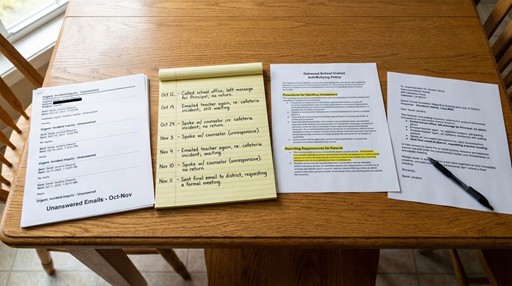
But before you make that contact, there are two things you need to confirm: that your complaint is in writing, and that the principal’s failure to respond is also in writing. A verbal complaint with no paper trail and no follow-up email documenting the principal’s silence is a much weaker foundation than a documented chain of written communication showing what you reported, when you reported it, and what you did and did not hear back.
If you do not have that written record yet — even if the situation has been going on for months — you can create it now. Start today. Send the email. Document what has already happened. Then escalate.
What This Usually Means
When a principal goes quiet on a bullying report, several things are often happening beneath the surface — and understanding them helps a parent respond more strategically.
The complaint was never formally logged. Many schools have a distinction between a parent who called or stopped by to express a concern and a parent who filed a formal written bullying complaint. If your report was made verbally, the principal may genuinely believe there is no formal complaint to respond to — or may be treating it as a casual concern rather than an institutional obligation. This is one of the most common reasons nothing moves.
The principal is hoping the situation will resolve itself. Administrators are busy. A parent who called once, got a noncommittal response, and has not followed up in writing may gradually stop being a priority. The path of least resistance for a school administrator who is managing dozens of issues is often to wait and see whether a parent escalates further.
The principal does not want to document the situation. Creating a formal bullying investigation record creates accountability. Some administrators avoid the paperwork not out of malice but out of institutional risk aversion. A formal written complaint — one that uses the word bullying and requests a specific documented response — is much harder to quietly avoid than a verbal report.
The school’s response capacity is genuinely limited. Some schools are understaffed, undertrained in bullying protocols, or administratively overwhelmed. A principal who does not respond may not be strategically avoiding accountability — they may simply be failing at basic follow-through. The right response to this is the same: escalate in writing to someone with more authority and more accountability.
The parent’s previous communications have not created enough pressure to move. A single email, a single voicemail, a single meeting — these often do not produce results on their own. A documented pattern of communication — multiple written contacts, each building on the last, each creating a clearer record of non-response — is what eventually makes a school system respond.
What to Do Now
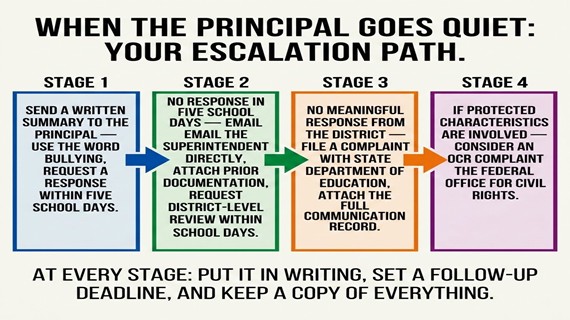
- Send a written summary of everything that has happened to the principal today — even if you have already spoken about it. Email the principal directly. In that email, summarize the bullying situation, list the dates of every contact you have had with the school about it, note what response you received or did not receive, and state that you are formally requesting a written response within five school days. Use the word bullying. This email does two things: it creates a written record of what has already occurred, and it gives the principal one final documented opportunity to respond before you escalate.
- If the principal does not respond within five school days, send a second email — this time copied to the district superintendent. Keep it brief and factual. State that you filed a bullying complaint on a specific date, that you have not received an adequate response despite multiple contacts, and that you are now bringing the situation to the superintendent’s attention and requesting district-level review. Attach your prior email as documentation.
- Address the superintendent email correctly. Do not send it to a general district inbox. Find the superintendent’s direct email address — it is usually on the district website — and address the email to them by name. If you do not know the superintendent’s name, the district website will have it. A message that lands in a general inbox may be routed back to the principal. A message addressed to the superintendent by name is harder to redirect.
- Keep your superintendent email factual and organized. Lead with your child’s name, grade, and school. State that you have been attempting to address a bullying situation at the school level since a specific date. Summarize what has happened and what the school’s response has been. State what you are asking the district to do — specifically, to review the situation and provide a written response within ten school days. Do not make it emotional. Do not make accusations about the principal as a person. Let the documented pattern of non-response speak for itself.
- Copy the right additional people on the superintendent email. Consider copying your school board representative, the district’s director of student services, and — if your child has an IEP or 504 plan — the director of special education. Each additional recipient who receives the documentation in writing is one more person who cannot later claim they were unaware of the situation.
- Continue documenting everything that happens after the superintendent contact. Note the date you sent the email. Note any response you receive and when. Note any changes — or lack of changes — in the school’s behavior toward the situation. Your documentation does not stop when you escalate. It accelerates.
- Set a calendar reminder for ten school days from your superintendent email. If you have not received a meaningful written response by that date, you have your next step ready: a formal complaint to your state’s department of education, which in most states has a process for reviewing whether school districts are following state bullying laws and policies.
What Not to Do
- Do not keep calling instead of writing. Phone calls feel more direct, but they leave no record. Every important communication about a bullying situation should go through email — so that you have a timestamped copy of what you said and a record of what the school did or did not say back. If you have been relying on calls, start converting to email now.
- Do not escalate to the superintendent in a tone that reads as a personal attack on the principal. A message that focuses on the principal as a bad person or a bad administrator is easier to dismiss than one that documents a clear pattern of institutional non-response. Stay focused on facts, dates, and the school’s failure to follow its own policy — not on your assessment of the principal’s character.
- Do not skip the superintendent and go straight to the school board or the media. Jumping levels without documentation — and without giving each level a reasonable window to respond — can make a parent appear unreasonable and may reduce the credibility of a legitimate complaint. Follow the chain. Document as you go. Escalate when each level fails to respond.
- Do not stop after one superintendent email if nothing happens. A single escalation that is not followed up on sends a signal that the parent will eventually stop pushing. Build follow-up into your plan from the beginning. If the superintendent does not respond meaningfully within ten school days, you have your next step ready.
- Do not confuse the absence of conflict with resolution. A principal who stops ignoring you but begins giving you vague, reassuring responses with no documented outcomes is still not responding adequately. Pleasantness is not accountability. Stay focused on whether you are receiving written documentation of specific actions taken — not on whether the tone of the conversation has improved.
When to Move Faster
Most situations call for the escalation sequence described above — principal, superintendent, state — with reasonable windows between each step. But some situations call for faster movement. Do not wait for the full sequence if:
- Your child is in immediate physical danger or has been physically harmed and the school has not taken protective action. Contact the superintendent the same day and, if necessary, law enforcement.
- Your child is expressing thoughts of self-harm or hopelessness connected to the bullying. Address your child’s safety first — contact your pediatrician or a crisis resource immediately. School accountability runs in parallel, not instead.
- The bullying involves a protected characteristic — race, religion, disability, sex, national origin — and the school has been explicitly dismissive. This may warrant contacting your state education agency and the federal Office for Civil Rights simultaneously with the district-level escalation rather than sequentially.
- The principal’s non-response is accompanied by pressure on you to stop escalating — suggestions that you are overreacting, that the situation is resolved when it clearly is not, or any hint that continued advocacy may not be welcome. Document those communications carefully and include them in your superintendent email.
Take the Next Step
A principal who ignores a bullying report is not the end of the road — but it is the point where the path forward needs to be structured, documented, and deliberate. If you are not sure whether your documentation is strong enough to escalate effectively, or if you want help drafting the superintendent email in a way that is hard to dismiss, outside support can help you get there.
- Schedule a free consultation with Jerry Green: If you have been ignored at the school level and are ready to escalate — or if you want help organizing what you have before you do — a free consultation can help you assess your documentation and move to the next level with a clear strategy. https://calendly.com/jerrylgreen2011
- Take the Student Protection Readiness Checklist: A practical first step to understand where your documentation stands right now — what you have, what is missing, and whether you are ready to escalate in a way that will be taken seriously. https://sprchecklist.abacusai.app
FAQs
How long should I wait before going above the principal?
The general guideline is two to three weeks after submitting a formal written complaint without any meaningful documented response. However, that timeframe should be shortened — or skipped entirely — if your child is in active distress, if the bullying is ongoing or escalating, or if the situation involves physical harm or a protected characteristic. The timeline should reflect urgency and impact on your child, not courtesy. If you have not yet submitted a formal written complaint, send one immediately and allow a short response window (often around five school days) before escalating.
What do I do if the superintendent also ignores me?
Document the superintendent’s non-response in the same way you documented the principal’s: include dates of communication, method of contact, and whether any response was received. Then escalate to your state department of education through its formal complaint process. Most states allow families to file complaints when a district fails to follow anti-bullying laws or its own policies. Include your full written record. If the situation involves a protected characteristic such as race, disability, or sex, you may also consider filing a complaint with the federal Office for Civil Rights.
Can I contact the school board directly?
Yes. In many districts, school board members are elected officials who can be contacted by constituents. After documenting a lack of response from the principal and superintendent, contacting your school board representative can be an appropriate escalation. Keep communications factual and concise, attach your written documentation, and clearly state what action you are requesting. School boards do not typically handle individual investigations, but they can direct district leadership to respond.
What if the principal responds but does nothing meaningful?
A response without action is still a failure to meaningfully address a formal complaint. If the principal responds with general statements such as “we are monitoring the situation” or “we spoke to the students” without explaining what was investigated, what findings were made, or what protective measures are being implemented, you should respond in writing. State that the response does not resolve your complaint and request specific information about the investigation process, findings, and next steps. If the response remains inadequate, proceed with escalation to the superintendent while continuing to document everything.
Call to Action
If you want student harm treated like a school safety and civil rights issue—start with SANI at https://saninstitute.net