Table of Contents
Click to Expand
1. Audio
2. Definition
3. Video
4. Core Thesis
9. Action Steps
10. FAQs
11. Call to Action
12. Sources
13. Signature
Definition
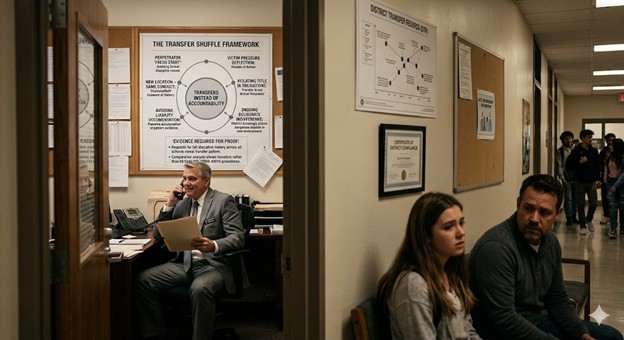
The Transfer Shuffle is SANI’s term for districts’ systematic practice of responding to serious misconduct (assault, sexual harassment, chronic bullying) by quietly transferring perpetrators to different schools/classrooms instead of implementing discipline, investigation, or accountability—creating illusion of responsive action (“we addressed it—student transferred”) while actually: enabling perpetrator to continue identical behavior at new location where students/staff unaware of history, avoiding formal discipline record that would trigger due process requirements and create liability documentation, preventing pattern evidence from accumulating in single location (multiple victims at one school become isolated incidents across schools), deflecting victim’s family’s immediate complaint pressure (perpetrator removed from victim’s environment stopping immediate harm), and systematically failing Title IX/civil rights obligations requiring actual response not geographic relocation—proven through: requests for perpetrator’s complete discipline history across all district schools revealing pattern of transfers following incidents, testimony from students/staff at new location reporting identical misconduct continuing, documentation showing no investigation or formal discipline accompanying transfer (transfer presented as “fresh start” or “better fit” not consequence), and comparative analysis showing districts transfer rather than discipline to avoid: creating written record admissible in litigation, triggering Education Code §§ 48900-48915 due process procedures, establishing pattern evidence of deliberate indifference, and providing victims with validation through formal accountability—with framework establishing transfer without discipline, investigation, or notification to new school creates ongoing deliberate indifference as district knowingly places dangerous student in new environment without protections, enabling continued harm to predictable new victims.
Core Thesis
Districts face serious misconduct requiring investigation and discipline—student commits sexual assault, engages in chronic violent bullying, demonstrates dangerous behavior threatening safety—but formal accountability creates records, triggers due process, establishes pattern evidence, and validates victims’ complaints, so districts deploy transfer as “solution” appearing responsive while avoiding all accountability mechanisms: perpetrator quietly moved to different school presented as “administrative placement” or “better educational fit,” no investigation conducted into underlying misconduct, no formal discipline imposed creating Education Code procedural obligations, no notation in records warning new school/staff of history, perpetrator arrives at new location as “clean slate” where students/staff have no knowledge of pattern—enabling identical misconduct to resume immediately against new uninformed victims while district deflects original victim’s complaint (“we addressed it—student no longer at your school”). We convert trauma into code by exposing transfer pattern through systematic documentation: request perpetrator’s complete enrollment history across all district schools via Public Records Act revealing multiple transfers, obtain incident reports from each location showing identical misconduct pattern following student, interview victims at new schools confirming continued behavior, document district’s failure to investigate or discipline before each transfer, prove through timeline that transfers occurred immediately after complaints filed (causation showing retaliation against victim while rewarding perpetrator with escape from consequences)—creating irrefutable evidence district uses transfers to avoid accountability rather than address harm. Selective enforcement IS discrimination when transfer patterns reveal: white perpetrators quickly transferred to “better” schools escaping accountability when complaints filed, while perpetrators of color face immediate suspension/expulsion for identical conduct—proving districts selectively deploy transfer privilege based on whose behavior they choose to protect versus punish.
Case Pattern Story
High school student in San Diego (Student A) reports to Title IX coordinator: male classmate (Student X) sexually harassed her repeatedly—unwanted touching, explicit comments, following her between classes. Provides detailed complaint with dates, witnesses, evidence.
Family expects: Investigation, discipline, safety measures.
District’s response: Two weeks later, “We’ve addressed the situation. Student will no longer be attending this school.”
Family’s reaction: Relief—perpetrator gone, daughter safe.
What family didn’t know: Student X transferred to different high school across district. No investigation conducted. No discipline imposed. No record created. New school not informed of history.
Six months later—Student X’s new school:
Female student (Student B) reports to counselor: male student (Student X) sexually harassed her—unwanted touching, explicit comments, following between classes. Identical pattern.
Counselor investigates Student X’s records. Finds nothing—clean record at this school.
Counselor doesn’t know: Student X has history of identical behavior at previous school.
District’s response at new school: “We’ll address this. Student may need different placement.”
Pattern continues: Student X transferred to third high school. Again, no investigation of incident at second school. No discipline. No record. New school not informed.
Year later—Student X’s third school:
Female student (Student C) reports sexual assault by Student X. Serious incident requiring police involvement.
Criminal investigation reveals: Student X has pattern across three district schools:
- School 1: Multiple harassment complaints → Transferred
- School 2: Harassment complaints → Transferred
- School 3: Sexual assault (escalation)
Pattern proving: District knew of escalating behavior, responded with transfers instead of accountability, enabled continued harm by placing student in new environments without warnings.
Attorney retained by Student C’s family investigates:
Public Records Act request: “All records related to [Student X] including enrollment history, discipline records, incident reports, transfers, across all district schools.”
Documents reveal:
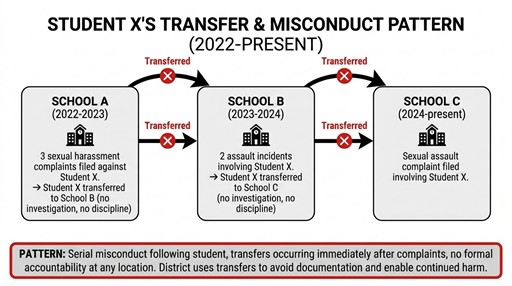
School 1 (2022-2023):
- Three harassment complaints filed against Student X (September, November, February)
- Complaints documented detailed pattern of harassment
- No formal investigation conducted
- No discipline imposed
- March 2023: Student X transferred to School 2
- Transfer documentation: “Administrative placement—better educational fit”
- No mention of harassment pattern in transfer records
- School 2 not informed of complaints
School 2 (2023-2024):
- Two assault incidents involving Student X (October, January)
- Incident reports documented physical aggression
- No formal investigation
- No discipline
- February 2024: Student X transferred to School 3
- Transfer documentation: “Student/family requested transfer”
- No mention of assault pattern
- School 3 not informed
School 3 (2024-present):
- Sexual assault complaint filed (November 2024)
- Police investigation opened
- Student C traumatized, requiring therapy
Attorney’s analysis:
“District’s transfer pattern proves deliberate indifference:
Knowledge: District had actual knowledge of Student X’s escalating dangerous behavior across two schools—multiple documented complaints.
Clearly unreasonable response: Transfers without investigation or discipline enabled continued harm. Each transfer placed Student X in new environment where students/staff unaware of history—creating predictable new victims.
Pattern evidence: District systematically uses transfers to avoid accountability:
- No investigations conducted before transfers
- No discipline creating records
- No notifications to receiving schools
- Transfer documents misrepresent reason (“better fit” not “fleeing complaints”)
Deliberate indifference: District knew Student X posed danger (documented complaints at two schools), transferred him to third school without warnings, predictably enabled sexual assault of Student C.
Claim: District’s transfer pattern constitutes deliberate indifference under Title IX, negligent supervision under California tort law, and violation of mandatory duties under Government Code § 815.6.
Damages: Student C suffered sexual assault that was directly enabled by district’s deliberate policy of transferring rather than disciplining dangerous students.
Discovery will reveal: How many other students district has transferred following misconduct, creating systematic policy of enabling harm rather than preventing it.”
Settlement: Substantial damages to Student C, policy prohibiting transfers without formal investigation and discipline when serious misconduct alleged, mandatory notification to receiving schools when transfers follow safety concerns, independent monitoring of transfer practices, training on transfer abuse.
Case establishes: Transfer without accountability as deliberate indifference enabling foreseeable harm to new victims.
SANI Connection
The Transfer Shuffle is districts’ most insidious accountability avoidance tactic—appearing responsive while enabling continued harm.
Why districts prefer transfers to discipline:
Reason 1: Avoids documentation
Formal discipline creates records admissible in litigation. Transfer creates administrative document (“student transferred for educational reasons”)—no admission of wrongdoing.
Reason 2: Avoids due process
Education Code §§ 48900-48915 mandate due process for suspensions/expulsions (notice, hearing, appeal rights). Transfers labeled “voluntary” or “administrative” avoid triggering these protections—no hearing where facts would be established.
Reason 3: Deflects immediate complaint pressure
Parent’s immediate concern: “Keep perpetrator away from my child.” Transfer accomplishes this, reducing parent’s advocacy pressure—problem “solved” from parent’s perspective.
Reason 4: Prevents pattern accumulation
Multiple complaints at one school establish pattern of deliberate indifference. Spreading complaints across schools through transfers makes each appear isolated—obscures pattern.
Reason 5: Avoids validating victim
Formal discipline finding acknowledges wrongdoing, validating victim’s complaint. Transfer avoids this validation—district never admits misconduct occurred.
SANI’s framework exposes transfer abuse:
Phase 1: Identify Transfer Pattern
When perpetrator suddenly “transfers” after complaint:
Immediate red flags:
- Transfer occurs shortly after complaint filed (temporal connection)
- No formal discipline preceded transfer
- District claims transfer is “voluntary” or “for student’s benefit”
- No investigation findings issued before transfer
- Victim’s family told “situation addressed” without specifics
Initial documentation:
Request via Public Records Act:
- Perpetrator’s complete enrollment history (all schools attended within district)
- All incident reports involving perpetrator at each school
- All complaints filed against perpetrator
- Transfer documentation explaining reason
- Communications between schools regarding transfer
Phase 2: Document Pattern Across Locations
Analysis of records:
Create chronological transfer timeline:
School A:
- Dates attended
- Incidents/complaints filed (dates, allegations)
- District’s response (or lack thereof)
- Transfer date and stated reason
- Whether investigation conducted
- Whether discipline imposed
School B:
- [Same analysis]
School C:
- [Same analysis]
Pattern indicators:
Transfer shuffle proven when records show:
- Multiple transfers following complaints/incidents
- No formal investigations before transfers
- No discipline accompanying transfers
- Transfer reasons vague/misleading (“educational fit”)
- Pattern of identical misconduct at each location
- New schools not warned of history
Phase 3: Contact Victims at Other Schools
Locate other victims:
Through records or community networks, identify other students who filed complaints against same perpetrator at different schools.
Obtain their accounts:
Interview or obtain written statements:
- What happened to them
- When they reported
- District’s response
- Whether perpetrator disciplined
- Whether perpetrator transferred shortly after
Purpose: Prove district’s pattern of transfers following complaints—not isolated decision but systematic policy.
Phase 4: Prove Foreseeable Harm
Establish causation:
District’s transfer pattern creates ongoing deliberate indifference:
Element 1: Knowledge
District knew student posed danger (documented complaints at previous school(s))
Element 2: Deliberately unreasonable response
Instead of investigating/disciplining, district transferred without warnings to new school
Element 3: Foreseeable harm
Transferring dangerous student to new environment where students/staff unaware of history makes new victimization foreseeable
Element 4: Actual harm
New victim(s) at subsequent school(s) suffered predictable harm
Causation: But for district’s transfer policy avoiding accountability, perpetrator would have been disciplined/removed or new school would have been warned—enabling new victimization.
Phase 5: Demand Policy Change and Accountability
Litigation/settlement demands:
Individual remedy: Damages for victim harmed by district’s transfer policy enabling foreseeable assault/harassment
Systemic reform:
- Policy prohibiting transfers without formal investigation when serious misconduct alleged
- Mandatory discipline findings before any transfer following safety complaints
- Notification to receiving school when transfer follows misconduct (ensuring staff awareness)
- Tracking system flagging students transferred following complaints (preventing serial transfers)
- Annual reporting on transfers following complaints (transparency preventing abuse)
- Independent monitoring of transfer practices
Accountability:
- Title IX coordinator discipline for using transfers to avoid investigations
- Administrator training on transfer abuse constituting deliberate indifference
- Board policy explicitly prohibiting transfer shuffle
Discipline Explanation
Legal Violations Created by Transfer Shuffle
Title IX Deliberate Indifference:
Davis v. Monroe application:
Actual knowledge: District has actual knowledge of harassment when victim at School A files complaint.
Clearly unreasonable response: Transferring perpetrator without investigation or discipline is clearly unreasonable because:
- Doesn’t address underlying behavior (no intervention, counseling, consequences)
- Enables continued harassment at new location (foreseeable)
- Defeats Title IX’s remedial purpose (protecting all students from sex discrimination)
Pattern of deliberate indifference: When transfer pattern shows district repeatedly transfers rather than investigates—systematic policy of deliberately inadequate response.
New victims’ claims: Students harmed at Schools B, C have independent deliberate indifference claims because district’s knowledge from School A created duty to protect students at subsequent schools—transfer without warnings to new location breaches that duty.
Negligent Supervision / Failure to Warn (California Tort Law):
Duty: District has duty to protect students from foreseeable harm, including harm from dangerous students district knows pose threats.
Breach: Transferring dangerous student to new school without warning staff/students of history breaches duty—creates foreseeable risk to uninformed community.
Causation: New victim’s harm directly caused by district’s failure to warn—had school known of history, could have implemented protections preventing harm.
Damages: New victim entitled to full damages for harm enabled by district’s transfer policy.
Government Code § 815.6 Breach of Mandatory Duty:
Mandatory duties violated:
Education Code § 48900 et seq.: Mandate discipline for specified misconduct. Transfer without discipline violates mandatory discipline framework.
Title IX regulations: Mandate adequate response to harassment. Transfer without investigation/accountability violates mandatory response requirements.
Duty to warn: When district knows student poses danger, has mandatory duty to protect other students—includes duty to warn receiving school.
Breach: Transfer shuffle violates all three mandatory duties—no discipline, no adequate response, no warning.
Exposing Transfer Abuse Through Records Analysis
Public Records Act request strategy:
Initial request (broad):
“All records related to [Student X] including:
- Enrollment history (all district schools, dates)
- Incident reports at each school
- Complaints filed against student
- Discipline records
- Transfer documentation
- Inter-school communications regarding student
- Safety plans, behavioral contracts
- Investigation records”
Analysis of received records:
Create transfer timeline spreadsheet:
|
School |
Dates |
Incidents/Complaints |
Investigation? |
Discipline? |
Transfer Date |
Transfer Reason |
New School Notified? |
|
A |
9/22-3/23 |
3 harassment complaints |
NO |
NO |
3/15/23 |
“Better fit” |
NO |
|
B |
3/23-2/24 |
2 assault incidents |
NO |
NO |
2/10/24 |
“Family request” |
NO |
|
C |
2/24-present |
Sexual assault |
Investigation opened |
Pending |
– |
– |
– |
Pattern indicators proving transfer shuffle:
Indicator 1: Temporal connection
Transfers occur shortly after complaints—proves transfer is response to complaints, not educational reasoning.
Indicator 2: No investigation
No investigation conducted before transfer—proves district avoiding fact-finding that would create accountability records.
Indicator 3: No discipline
No formal discipline imposed—proves transfer used to avoid Education Code due process requirements.
Indicator 4: Misleading transfer reasons
Transfer documents cite “educational fit” or “family request” not “fleeing accountability”—proves district concealing true reason.
Indicator 5: No notification
Receiving school not informed of history—proves district deliberately concealing information to enable “fresh start.”
Indicator 6: Repeat pattern
Multiple transfers following complaints—proves systematic policy, not isolated decision.
Comparative Analysis: Transfer vs. Discipline
Why transfer instead of discipline?
Discipline (what district avoids):
Procedural requirements:
- Written notice of charges (Education Code § 48911)
- Opportunity for hearing (§ 48918)
- Right to present evidence/witnesses
- Written findings supporting decision
- Appeal rights
Creates records:
- Discipline findings admissible in litigation
- Establishes facts (misconduct occurred)
- Validates victim’s complaint
- Creates pattern evidence across incidents
Legal consequences:
- Findings establish district’s knowledge (for deliberate indifference claims)
- Pattern of findings proves deliberate indifference
- Validates victim for damages purposes
Transfer (what district chooses):
No procedural requirements:
- Presented as “voluntary” or “administrative”
- No hearing where facts established
- No findings issued
- No appeal process
Creates no accountability records:
- Transfer document doesn’t admit misconduct
- States benign reason (“better fit”)
- Creates no pattern evidence
- Doesn’t validate victim
Legal advantages for district:
- No admission perpetrator did anything wrong
- No factual findings admissible against district
- Obscures pattern by spreading across schools
- Avoids validating victim’s complaint
This is why districts prefer transfers—avoids all accountability while appearing responsive.
Proving Transfer Was Retaliation Against Victim
Sometimes transfer also retaliates against victim:
Pattern: Victim files complaint → District transfers victim instead of (or in addition to) perpetrator.
Rationale (district’s unstated): Easier to transfer victim (who’s complaining) than discipline perpetrator (requires due process, creates records).
This is prohibited retaliation:
Title IX § 106.71: Prohibits retaliation against person making complaint.
Transferring victim because they complained = retaliation:
Proof:
- Temporal proximity (transfer shortly after complaint)
- No disciplinary basis for victim’s transfer
- District claims transfer “for victim’s safety” but victim didn’t request it
- Perpetrator not transferred or received lesser consequences
Damages: Victim entitled to damages for retaliation—forced school change, disrupted education, trauma of being punished for reporting.
Remedy: Victim returned to original school, perpetrator disciplined/removed, compensatory damages, punitive damages for retaliation.
Demanding Transparency and Policy Reform
Individual case resolution insufficient—systemic reform needed:
Demand in settlement/litigation:
Policy reforms:
- Investigation before transfer: Whenever transfer proposed following complaint, formal investigation must be completed first with findings issued. No transfers to avoid investigations.
- Discipline findings required: If investigation substantiates misconduct, formal discipline must be imposed before any transfer. Transfer cannot substitute for accountability.
- Notification to receiving school: When student with substantiated misconduct history transfers, receiving school must be notified including:
- Summary of substantiated incidents
- Safety concerns/risk factors
- Recommended monitoring/interventions
- Contact for previous school’s relevant staff
- Tracking system: District must maintain database tracking students transferred following complaints, flagging multiple transfers preventing serial offenders from exploiting system.
- Annual transparency reporting: District must publicly report:
- Number of transfers following complaints (by allegation type)
- Number of transfers with prior investigations
- Number of transfers with/without discipline
- Policy compliance metrics
- Independent monitoring: Monitor reviews all transfers following complaints ensuring policy compliance, no transfer abuse.
These reforms prevent transfer shuffle by requiring accountability before/during transfers, ensuring receiving schools have knowledge to protect students.
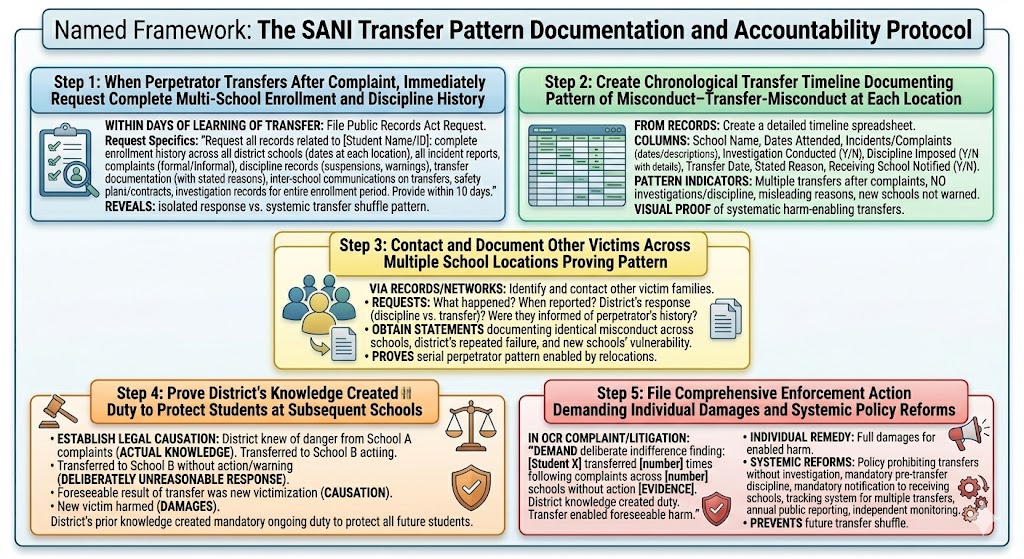
Named Framework: The SANI Transfer Pattern Documentation and Accountability Protocol
Step 1: When Perpetrator Transfers After Complaint, Immediately Request Complete Multi-School Enrollment and Discipline History
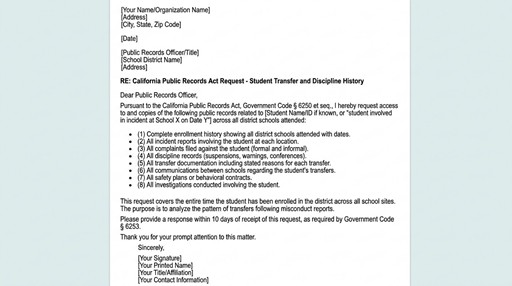
Within days of learning perpetrator transferred: file Public Records Act request: “Request all records related to [Student Name/ID]: complete enrollment history across all district schools (dates at each location), all incident reports involving student at each school, all complaints filed against student (formal/informal), all discipline records (suspensions, conferences, warnings), all transfer documentation with stated reasons, all inter-school communications regarding transfers, all safety plans/behavioral contracts, all investigation records. Request covers entire time student enrolled in district across all sites. Provide within 10 days Government Code § 6253.” This reveals whether transfer is isolated response or part of pattern—multiple transfers following complaints proves systematic transfer shuffle avoiding accountability.
Step 2: Create Chronological Transfer Timeline Documenting Pattern of Misconduct-Transfer-Misconduct at Each Location
From received records, create detailed timeline spreadsheet: columns for School Name, Dates Attended, Incidents/Complaints (with dates/descriptions), Investigation Conducted (Y/N), Discipline Imposed (Y/N with details), Transfer Date, Transfer Stated Reason, Receiving School Notified of History (Y/N). Fill in every school perpetrator attended. Pattern indicators proving transfer shuffle: multiple transfers following complaints with no investigations/discipline, misleading transfer reasons (“better fit” not “following complaints”), new schools not warned enabling “clean slate,” identical misconduct recurring at each location. Timeline provides visual proof district systematically uses transfers to avoid accountability while enabling continued harm.
Step 3: Contact and Document Other Victims Across Multiple School Locations Proving Pattern
Through records or community networks, identify other students who filed complaints against same perpetrator at different schools. Contact families requesting: what happened to their student, when reported to district, district’s response, whether perpetrator disciplined or transferred, whether they were informed of perpetrator’s history at previous schools. Obtain written statements when possible documenting: identical pattern of misconduct following student across schools, district’s repeated failure to investigate/discipline before transfers, new schools’ lack of knowledge creating vulnerability. Multiple victim accounts across locations proves district’s transfer pattern enables serial perpetrators—not protecting students but relocating problems.
Step 4: Prove District’s Knowledge Created Duty to Protect Students at Subsequent Schools
Establish legal causation: District knew from School A complaints that perpetrator posed danger (actual knowledge documented), District transferred to School B without investigation/discipline/notification (deliberately unreasonable response), New victimization at School B was foreseeable result of transfer without protections (causation), Actual harm occurred to new victim (damages). District’s knowledge from earlier complaints created mandatory duty to protect students at subsequent schools—transfer without warnings/protections breached that duty enabling foreseeable harm. Each new victim has independent deliberate indifference claim because district’s earlier knowledge created ongoing duty to all students perpetrator might encounter through transfers.
Step 5: File Comprehensive Enforcement Action Demanding Individual Damages and Systemic Policy Reforms
In OCR complaint, litigation, settlement demands: “District’s transfer pattern proves deliberate indifference. [Student X] transferred [number] times following complaints across [number] schools with no investigations/discipline [evidence attached]. District’s knowledge from School A created duty to protect students at Schools B, C—transfer without warnings enabled foreseeable harm to [Victim]. INDIVIDUAL REMEDY: Full damages for harm enabled by transfer policy. SYSTEMIC REFORMS: Policy prohibiting transfers without investigation when misconduct alleged, mandatory discipline before any transfer following complaints, notification to receiving schools when transfers follow misconduct, tracking system flagging multiple transfers, annual public reporting on transfers following complaints, independent monitoring. Reforms prevent transfer shuffle enabling serial perpetrators.”
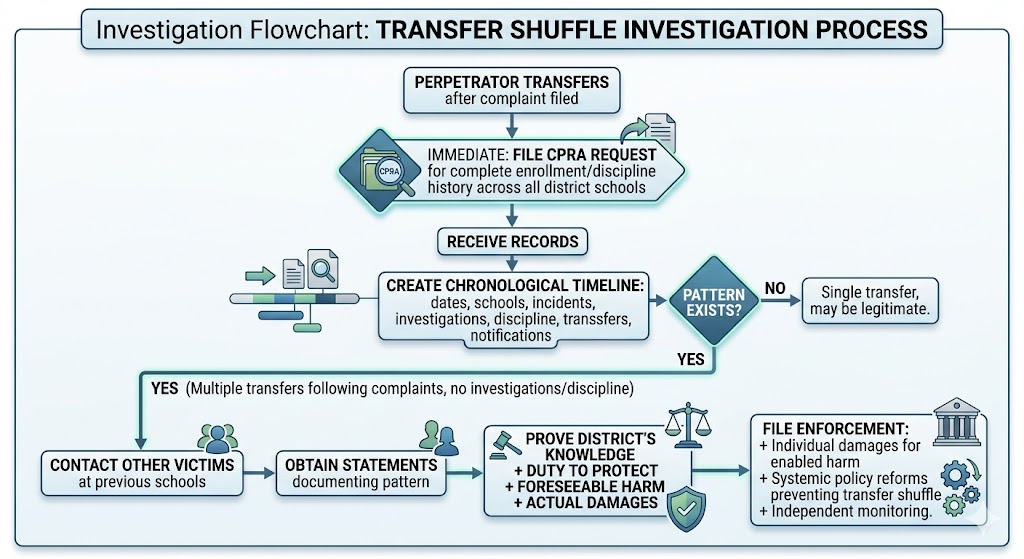
Action Steps
1. When Perpetrator Transfers Shortly After Complaint, Immediately Suspect and Document Transfer Shuffle Pattern
If district announces perpetrator “transferred” or “no longer attending” shortly after your complaint filed: red flags requiring immediate investigation. Document temporal connection: date complaint filed, date informed of transfer (proximity proves causal relationship—transfer is response to complaint not coincidence). Demand specifics from district: “What was reason for transfer? Was investigation completed before transfer? What were findings? Was discipline imposed? Is receiving school aware of complaints filed at this school?” District’s evasive responses or claims of “confidentiality” suggest transfer shuffle to avoid accountability. Immediately file Public Records request before trail goes cold.
2. File Public Records Request for Perpetrator’s Complete District-Wide Enrollment and Discipline History
Within days of learning of transfer: “California Public Records Act Request: All records related to [Student Name/ID, or if unknown: ‘student who was reported for incident at School X on Date Y and subsequently transferred’]: (1) Complete enrollment history across all district schools with dates, (2) All incident reports involving student at each location, (3) All complaints filed against student at each school, (4) All discipline records including suspensions, conferences, warnings, (5) All transfer documentation showing stated reasons, (6) All communications between schools regarding student’s transfers, (7) All investigation records. Covers entire district enrollment period. Provide within 10 days.” Records reveal pattern—multiple schools, repeated similar incidents, transfers following each complaint, lack of discipline/investigation proving transfer shuffle.
3. Create Visual Timeline Documenting Pattern of Misconduct-Transfer-Misconduct Across Multiple Schools
From received records, create spreadsheet or visual timeline: each row = one school, columns = dates attended, incidents/complaints filed (with brief descriptions), investigation completed Y/N, discipline imposed Y/N with details, transfer date, stated transfer reason, new school notified Y/N. Pattern emerges visually: School A (harassment complaints → no investigation → transfer “better fit”), School B (assault incidents → no investigation → transfer “family request”), School C (sexual assault). Timeline proves systematic transfer shuffle—district repeatedly moves perpetrator following complaints without accountability, enabling harm at each new location. Visual format powerful for complaints, litigation, media, board presentations.
4. Contact Other Victim Families Across Schools Building Multi-Victim Evidence of Pattern
Through community networks, parent groups, or identifying names in records (redacted but sometimes inferable), locate families of other students who experienced harm from same perpetrator at different schools. Reach out carefully respecting privacy: “My child was harmed by [Student X] at [School]. Records show your child also filed complaint at [Previous School]. Would you be willing to share what happened and district’s response? Building evidence of pattern.” Many families willing to help others avoid what they experienced. Obtain written statements documenting: what happened to their child, district’s response (or lack), whether perpetrator disciplined, whether they were informed of history. Multiple families with consistent accounts creates powerful pattern evidence.
5. File Enforcement Action With Individual and Systemic Demands Preventing Future Transfer Abuse
In OCR Title IX complaint, § 1983 litigation, state complaints: “District’s transfer pattern constitutes deliberate indifference. [Student X] transferred [number] times following [number] complaints across [schools] with zero investigations/discipline [timeline attached Exhibit A]. District’s knowledge from earlier schools created duty to protect students at subsequent schools—transfer without investigation/notification enabled foreseeable harm to [Victim] [medical records Exhibit B]. DEMANDS: Individual—full damages for harm enabled by transfer policy. Systemic—policy prohibiting transfers without investigation, mandatory discipline before transfers following complaints, notification to receiving schools, tracking system preventing serial transfers, annual transparency reporting, independent monitoring for [duration]. Reforms prevent transfer shuffle exploited by serial perpetrators with district complicity.”
FAQs
1. Why do districts sometimes transfer students instead of using formal discipline?
In some situations, schools may use transfers as a way to quickly separate students and address immediate concerns. However, formal discipline processes—such as suspension or expulsion—often involve specific procedural requirements, documentation, and review. A transfer may be viewed as a faster administrative option, but it does not replace the need for appropriate investigation, documentation, and accountability when misconduct is alleged.
2. How can I identify a pattern of transfers if the district cites confidentiality?
While student privacy laws limit disclosure of personally identifiable information, you may still request relevant records in redacted or anonymized form. This can include incident reports, timelines, or general data about how similar cases were handled. Keeping detailed records of your own experience and requesting available documentation can help identify whether patterns exist, even when certain details are withheld.
3. Can a school transfer my child instead of addressing the issue?
Schools may sometimes suggest or offer transfers as part of a safety or resolution plan. However, decisions should be made in the student’s best interest and not as a substitute for properly addressing underlying concerns. If a transfer is proposed, you can ask for the reasons in writing, explore alternatives, and ensure that any decision does not negatively impact your child’s access to education or support services.
4. What if a student with prior incidents is transferred into my child’s school?
Schools are generally expected to maintain safe environments and manage student conduct appropriately. While privacy rules may limit what can be shared about individual students, you can raise concerns with school administrators about safety practices, supervision, and how risks are managed. If an incident occurs, documenting what happened and requesting a review of the school’s response can help ensure appropriate action is taken.
5. What kinds of policies can help ensure accountability when transfers are used?
Effective policies may include clear procedures for investigating incidents, consistent documentation of findings, communication protocols between schools, and oversight mechanisms to ensure student safety. Transparency, regular review of practices, and adherence to established disciplinary and safety guidelines can help ensure that transfers are used appropriately and not as a substitute for accountability.
Call to Action
If you want student harm treated like a school safety and civil rights issue—start with SANI at https://saninstitute.net
Sources
-
Davis v. Monroe County Board of Education, 526 U.S. 629 (1999) – U.S. Supreme Court decision establishing that schools may be liable under Title IX when they respond to known harassment with deliberate indifference, including failing to take appropriate corrective action.
https://supreme.justia.com/cases/federal/us/526/629/ -
California Education Code §§ 48900–48915 – Defines grounds and procedures for student discipline, including suspension and expulsion, and outlines due process requirements such as notice and opportunity to respond.
https://leginfo.legislature.ca.gov/faces/codes_displayText.xhtml?lawCode=EDC&division=4.&title=2.&part=27.&chapter=6.&article=1 -
34 CFR § 106.71 – Title IX regulation prohibiting retaliation against individuals for participating in or asserting rights under Title IX protections.
https://www.ecfr.gov/current/title-34/subtitle-B/chapter-I/part-106/subpart-F/section-106.71 -
California Government Code § 815.6 – Establishes liability when a public entity fails to carry out a mandatory duty imposed by law that is designed to protect against a specific type of harm.
https://leginfo.legislature.ca.gov/faces/codes_displaySection.xhtml?lawCode=GOV§ionNum=815.6 -
California Government Code § 6253 – Part of the California Public Records Act, requiring public agencies to make records available upon request, subject to certain exemptions.
https://leginfo.legislature.ca.gov/faces/codes_displaySection.xhtml?lawCode=GOV§ionNum=6253