

When Do Parents Need a Lawyer for School Bullying?
Most bullying cases do not need a lawyer. Some clearly do. Knowing the difference before you act matters more than most parents realize. The decision
1. Audio
2. Definition
3. Video
4. Core Thesis
9. Action Steps
10. FAQs
11. Call to Action
12. Sources
13. Signature
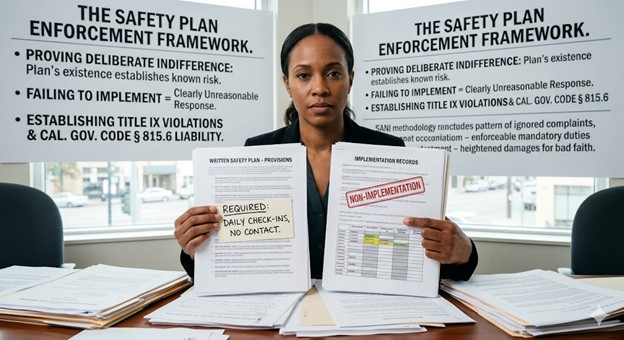
The Safety Plan Enforcement Framework is SANI’s methodology for forcing districts to implement safety plans they create but systematically ignore—addressing pattern where districts respond to bullying/harassment complaints by drafting detailed safety plans promising specific interventions (schedule changes preventing victim-perpetrator contact, assigned staff supervision, check-ins, monitoring) creating enforceable mandatory duties under California Government Code § 815.6 and Title IX adequate response requirements, then systematically failing to implement those plans while falsely claiming compliance—proven through: documentation comparing written plan provisions to actual implementation (plan promises no contact yet students share three classes, plan promises daily check-ins yet none occur for weeks, plan promises assigned supervision yet perpetrator unsupervised accessing victim), witness statements from students/staff confirming non-implementation, district’s own records disproving claimed compliance (attendance records showing no check-ins occurred, schedules showing continued shared classes, incident reports showing continued access), and contemporaneous complaints documenting ongoing violations sent to district establishing knowledge of non-implementation—with framework proving that creating safety plan then failing to implement constitutes deliberate indifference because plan’s existence proves district knew protective measures were necessary, making failure to implement those measures clearly unreasonable response establishing Title IX violations, Government Code § 815.6 breach of mandatory duty liability, and heightened damages for bad faith (promising protection then failing to provide demonstrates callous disregard for student safety).
Districts respond to bullying complaints by creating detailed safety plans promising specific protective measures—schedule changes ensuring no contact between victim and perpetrator, assigned staff supervision during transitions, daily check-ins monitoring victim’s safety, restricted perpetrator access to victim’s locations—not because they intend implementation but because creating plan creates appearance of adequate response deflecting immediate accountability pressure, with systematic pattern revealing districts never intended compliance: plan drafted quickly appearing responsive, distributed to staff without training or resources for implementation, monitoring nonexistent allowing immediate collapse, district falsely claims compliance when questioned while violations continue unchecked, plan becomes meaningless document existing only on paper providing districts legal cover (“we created safety plan”) while student remains unsafe due to non-implementation. We convert trauma into code by documenting every safety plan violation in real-time—plan promises no shared classes yet schedules show three periods together (photograph schedule with plan comparison), plan promises daily check-ins yet none occur (document dates checks missed with confirmation emails), plan promises supervision yet perpetrator regularly unsupervised accessing victim (incident log with dates/locations)—creating irrefutable evidence that plan exists on paper only, forcing districts into impossible position of either implementing plan they created or admitting they never intended compliance (proving deliberate indifference through broken promises). Selective enforcement IS discrimination when safety plan implementation reveals pattern: white students’ safety plans implemented immediately with full resources and ongoing monitoring ensuring compliance, while identical plans for students of color drafted then ignored with systematic non-implementation—proving districts selectively protect based on whose safety they value.
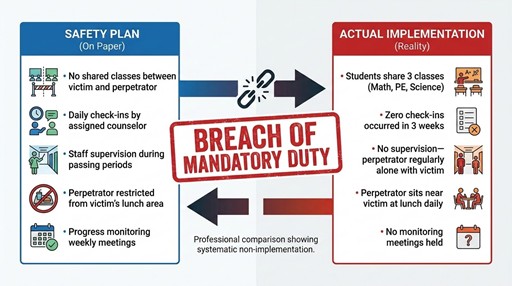
Middle school student in Oakland reports sexual harassment by classmate. District’s Title IX coordinator creates comprehensive safety plan:
Safety Plan Provisions:
Plan distributed: Victim’s family, perpetrator’s family, relevant staff (teachers, counselor, administrators).
Parent signs acknowledgment: “District will implement safety plan as written.”
Week 1 – Immediate violations:
Student reports to mother: “Nothing changed. Still in same classes. No one supervising. He sits near me at lunch.”
Mother emails Title IX coordinator: “Safety plan not implemented. Students still share Math, PE, Science. No supervision during passing periods. Same lunch area. No check-ins occurred.”
Coordinator response: “Plan being implemented. Staff has been notified.”
Week 2 – Violations continue:
Student: “Still same. No check-ins. PE class, he harasses me in locker room. No one there.”
Mother emails again with specifics: “Week 2, no check-ins occurred. Students still share three classes. Harassment continuing in PE locker room—unsupervised. Safety plan not being followed.”
Coordinator: “We are monitoring the situation.”
Week 3 – Escalation:
Perpetrator corners victim in hallway during passing period. Threatens her. No staff present despite plan promising supervision.
Mother demands meeting.
Week 3 meeting:
Coordinator: “Safety plan is in place and being implemented.”
Mother: “How? They share three classes. No check-ins have occurred. No supervision. No monitoring meetings.”
Coordinator: “Staff has been notified of the plan.”
Mother: “But it’s not happening. Here’s daughter’s schedule [shows]. Three classes together. Where are check-ins? Where’s supervision?”
Coordinator: “We’ll look into it.”
Week 4 – Family retains attorney:
Attorney’s investigation:
Schedule analysis:
Check-in documentation:
Supervision failure:
Lunch area:
Monitoring meetings:
Attorney’s demand letter:
“District created safety plan July 15 acknowledging protective measures necessary for [Student’s] safety—establishing mandatory duty to implement. District then systematically failed to implement every provision:
Schedule changes: Plan promises no shared classes. Students share three classes—documented via schedules [Exhibit A].
Check-ins: Plan promises daily counselor check-ins. Zero check-ins occurred in four weeks—documented via counselor’s own calendar [Exhibit B] and student’s log [Exhibit C].
Supervision: Plan promises staff supervision during passing periods. No supervision provided—three documented unsupervised encounters with perpetrator [Exhibit D], witness statements [Exhibits E1-E3].
Lunch separation: Plan promises separate lunch areas. Perpetrator regularly sits near victim—photographic evidence [Exhibits F1-F5].
Monitoring meetings: Plan promises weekly parent meetings. Zero meetings occurred—parent’s emails requesting meetings ignored [Exhibits G1-G4].
This constitutes:
Title IX deliberate indifference: Creating safety plan then failing to implement is clearly unreasonable response. Plan’s existence proves district knew measures necessary—failure to implement despite knowledge = deliberate indifference (Davis v. Monroe).
Government Code § 815.6 breach: Safety plan created mandatory duty to implement. Systematic non-implementation breaches mandatory duty creating liability.
Bad faith damages: Promising protection then failing to provide demonstrates callous disregard warranting punitive damages.
Parent’s repeated notifications [Exhibits H1-H6] document district’s knowledge of non-implementation—deliberate choice to ignore, not oversight.
Demand within 10 days:
Failure to comply triggers OCR Title IX complaint, § 1983 litigation, and state tort claims.”
District responds within 48 hours: Full implementation, assigned independent monitor, settlement negotiations begin.
Settlement: Substantial damages including bad faith premium, policy requiring weekly compliance verification for all safety plans, monitoring, training on plan implementation requirements.
The Safety Plan Enforcement Framework addresses districts’ most common deflection tactic: creating plans appearing responsive while never intending implementation.
Framework exposes pattern:
Step 1: Complaint received Parent reports bullying/harassment requiring intervention.
Step 2: District creates safety plan Detailed written plan promising specific protective measures—appears responsive.
Step 3: Parent mollified temporarily “District created plan—they’re addressing it”—accountability pressure reduced.
Step 4: Systematic non-implementation Plan distributed but never implemented—staff not trained, resources not allocated, monitoring nonexistent.
Step 5: Violations continue unchecked Student remains unsafe despite plan’s existence.
Step 6: District falsely claims compliance When parent complains, district: “Plan is in place and being implemented”—lie.
Step 7: Parent lacks documentation Without systematic violation tracking, parent can’t prove non-implementation—”he said/she said.”
SANI’s enforcement protocol breaks this pattern:
Demand written safety plan specifying:
No verbal plans—written only (verbal plans allow district to claim “we never promised that”).
Signed acknowledgment: “District commits to implementing plan as written.”
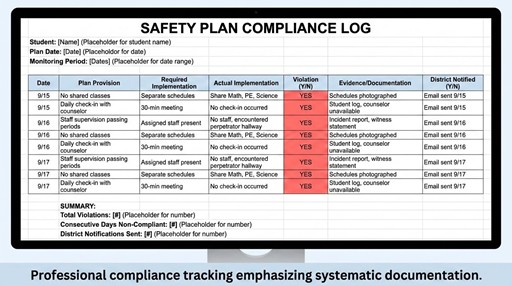
Create daily compliance log comparing plan to reality:
Template:
Date | Plan Provision | Required Action | Actual Implementation | Violation? | Evidence |
9/15 | No shared classes | Separate schedules | Share Math, PE, Science | YES | Schedules (photo) |
9/15 | Daily check-in | Counselor meeting | No check-in occurred | YES | Student log |
9/15 | Supervised passing | Staff present | No staff, encountered perpetrator | YES | Incident report |
Document every violation immediately:
Send confirmation email documenting each violation within 24 hours:
“Safety plan dated [date] requires: [specific provision]. Today [date], this was violated: [description]. [Student] [experienced X] because plan not implemented. This is [X] violation in [Y] days. When will full implementation occur?”
Purpose: Establishes district’s knowledge of non-implementation—defeats “we didn’t know” defense.
Every Friday, send comprehensive compliance report:
“Week of [dates]: Safety plan compliance review.
Schedule changes: Not implemented—students share 3 classes [evidence]
Daily check-ins: Not implemented—0 check-ins occurred [evidence]
Supervision: Not implemented—4 unsupervised encounters [evidence]
Monitoring meeting: Not held—meeting scheduled [date] cancelled by district
Plan created [date] remains unimplemented after [X] weeks. Demand immediate full compliance and verification within 48 hours.“
Organize all documentation proving systematic non-implementation:
This evidence package proves:
After 2-4 weeks of documented non-implementation:
“Safety plan created [date] remains systematically unimplemented [weeks] later. Attached documentation proves every provision violated repeatedly [evidence exhibits].
This constitutes:
Title IX deliberate indifference: Creating plan then failing to implement is clearly unreasonable response—plan proves district knew measures necessary, failure to implement despite knowledge = deliberate indifference.
Government Code § 815.6 breach: Plan created mandatory duty to implement. Non-implementation breaches duty creating liability.
Bad faith: Promising protection then failing to provide demonstrates callous disregard warranting punitive damages.
Your repeated false claims of compliance [cite emails] while violations continued prove deliberate indifference, not oversight.
Demand within 10 days:
Failure triggers OCR complaint, litigation.”
California Government Code § 815.6:
“Where a public entity is under a mandatory duty imposed by an enactment that is designed to protect against the risk of a particular kind of injury, the public entity is liable for an injury of that kind proximately caused by its failure to discharge the duty…”
Application to safety plans:
When district creates safety plan promising specific protective measures, plan creates mandatory duty to implement those measures.
Elements proving § 815.6 liability:
Element 1: Mandatory duty existed
Safety plan promises: “District will ensure no shared classes, daily check-ins, staff supervision”—these are mandatory commitments, not discretionary suggestions.
Element 2: Duty designed to protect against specific injury
Safety plan created to protect victim from continued harassment/harm—duty directly aimed at preventing that specific injury.
Element 3: Breach of duty
District failed to implement plan—breach of mandatory commitments.
Element 4: Injury proximately caused by breach
Student continued experiencing harassment because plan not implemented—causation direct.
Safety plan as binding commitment:
Unlike general policies (which may allow discretion), specific safety plan created for individual student promising concrete actions creates enforceable mandatory duty—district’s own promises bind it.
Davis v. Monroe standard: Deliberate indifference = actual knowledge + clearly unreasonable response.
Safety plan proves both elements:
Actual knowledge: Creating safety plan proves district knew:
Clearly unreasonable response: Creating plan acknowledging necessary measures then failing to implement those measures is textbook clearly unreasonable response—district identified solution but chose not to implement it.
Analogy: Doctor diagnoses condition, prescribes treatment, then deliberately doesn’t provide prescribed treatment—malpractice. District identifies needed protections, promises them in writing, then deliberately doesn’t provide them—deliberate indifference.
Non-implementation worse than no plan:
No plan: District could argue “we didn’t know what measures were needed”
Plan created but not implemented: District cannot claim ignorance—plan proves district knew exactly what was needed and chose not to do it—heightened deliberate indifference.
California tort law allows punitive/bad faith damages when defendant’s conduct shows:
Safety plan non-implementation supports bad faith damages:
Fraud: District promised protection knowing it wouldn’t implement—fraudulent inducement causing parent to trust student was safe when she wasn’t.
Malice: District created plan appearing responsive, deceived parent into false sense of security, then deliberately failed to protect—willful disregard for student’s safety.
Oppression: Student subjected to continued harassment while believing district was protecting her (per plan) constitutes cruel hardship.
Bad faith premium: Courts award enhanced damages when defendant’s conduct demonstrates callousness—promising protection then failing to provide while falsely claiming compliance is egregious bad faith warranting substantial additional damages beyond compensatory.
Documentation methods:
Schedule comparison:
Check-in documentation:
Supervision failure:
Monitoring meetings:
Contemporaneous notifications:
District’s false compliance claims:
Not every imperfect implementation = breach:
Minor deviation (not breach):
Systematic non-implementation (breach):
The test: Is plan substantially implemented with minor deviations, or systematically ignored?
Substantial implementation: Core protections provided, minor imperfections don’t undermine safety
Systematic non-implementation: Core protections not provided, plan meaningless
Document the pattern: Single violation might be oversight; repeated violations across all provisions prove systematic non-implementation.
Problem: District claims compliance while systematically violating—how to force actual implementation?
Solution: Independent monitor with verification authority.
Demand in settlement/enforcement:
“District will implement safety plan with independent monitor verifying compliance:
Monitor selection: Mutually agreed upon or court-appointed individual with no district employment/conflict
Monitor authority:
Verification requirements:
Non-compliance consequences:
Duration: 12-24 months ensuring sustained implementation, not temporary compliance”
Independent monitoring prevents:
When district proposes safety plan, demand written document (no verbal plans) specifying: (1) Exact protective measures (not vague—”no shared classes” not “minimize contact”), (2) Implementation timeline (when each measure begins), (3) Responsible staff (who implements each provision), (4) Monitoring procedures (how compliance verified), (5) Parent notification (how violations reported). Refuse vague plans (“staff will monitor situation”)—demand concrete commitments. Require district signature: “District commits to implementing safety plan as written.” Document serves as enforceable contract creating mandatory duty under Government Code § 815.6. Without written plan with specific commitments, district can claim “we never promised that”—written plan eliminates denials.
From day one of plan’s implementation, maintain daily log: spreadsheet with columns (Date, Plan Provision, Required Action, Actual Implementation, Violation Y/N, Evidence, District Notified). Each day, verify each plan provision implemented: Check student’s schedule (matches plan?), Ask about check-ins (occurred?), Review supervision (staff present?), Document monitoring meetings (held as scheduled?). When violation occurs, document immediately: date/time, which provision violated, what should have happened, what actually happened, evidence (photos, logs, witness statements), send notification email to district within 24 hours. Daily documentation creates contemporaneous record proving systematic non-implementation pattern—not isolated oversights but persistent failures.
Every Friday, compile week’s violations into comprehensive report emailed to superintendent, Title IX coordinator, principal: “Week of [dates]: Safety plan compliance review. Schedule changes: Not implemented [evidence]. Check-ins: [X] of 5 days missed [evidence]. Supervision: [X] unsupervised encounters [evidence]. Monitoring meeting: Cancelled by district [evidence]. Plan created [date] remains substantially unimplemented after [X] weeks. Demand immediate full compliance within 48 hours.” Weekly reports serve dual purpose: (1) Force district accountability through repeated documented demands, (2) Establish district’s knowledge of non-implementation for deliberate indifference claims—district cannot claim ignorance when receiving weekly detailed violation reports.
After 2-4 weeks of documented violations, organize comprehensive evidence file: (1) Written safety plan with district signature, (2) Complete daily compliance log showing pattern, (3) All contemporaneous notification emails proving real-time documentation, (4) All weekly compliance reports proving repeated demands, (5) Evidence for each violation type (schedules for class violations, logs for check-in failures, incident reports for supervision failures, emails for meeting cancellations), (6) District’s false compliance claims (emails saying “plan implemented” contradicted by evidence), (7) Harm documentation (student experiencing continued harassment due to non-implementation). Evidence package proves: plan existed creating duty, district committed to implementation, systematic violations occurred, district had knowledge via repeated notifications, false compliance claims prove bad faith not oversight.
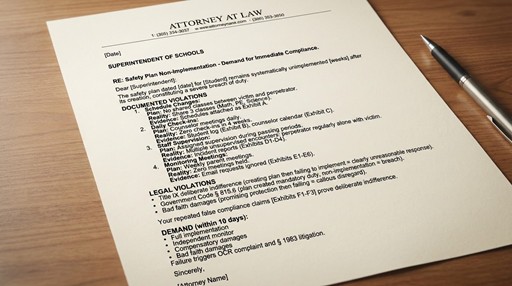
Send comprehensive demand letter (to superintendent, board, general counsel): “Safety plan dated [date] systematically unimplemented [weeks] later despite repeated notifications. Attached evidence [exhibits] proves every provision violated repeatedly. Constitutes: Title IX deliberate indifference (plan proves knowledge, non-implementation = clearly unreasonable response), Government Code § 815.6 breach (plan created mandatory duty, failure breaches duty), Bad faith damages (promising protection then failing = callous disregard). Repeated false compliance claims prove deliberate indifference not oversight. Demand within 10 days: (1) Full immediate implementation with daily verification to parent, (2) Independent monitor verifying sustained compliance, (3) Compensatory damages for unprotected period, (4) Bad faith premium for broken promises, (5) Policy requiring compliance verification for all safety plans, (6) 24-month monitoring. Failure triggers OCR Title IX complaint and § 1983 litigation with bad faith damages claims.”
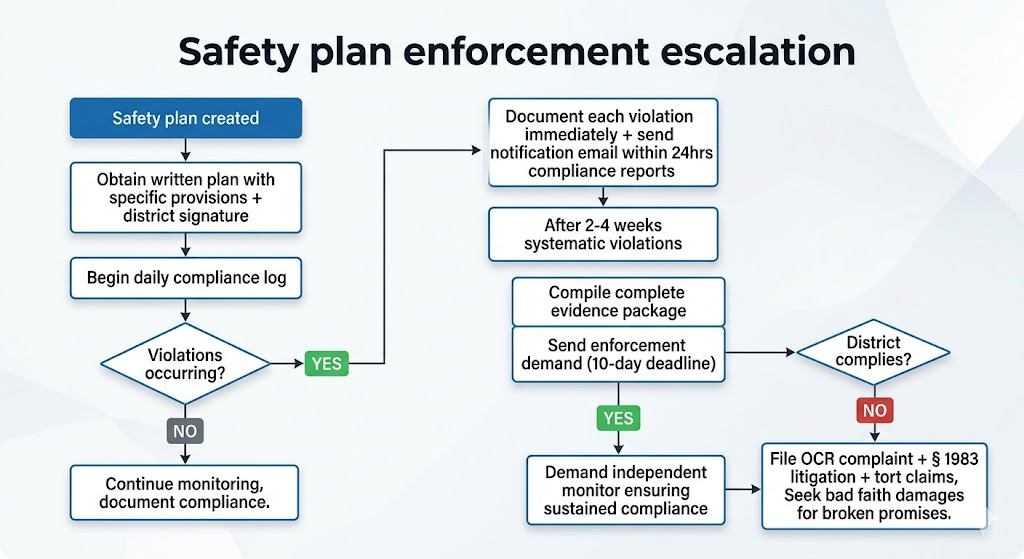
Before accepting any safety plan: require written document (refuse verbal plans—no enforceability). Demand specificity: not “minimize contact” but “no shared classes, separate lunch areas”; not “staff will monitor” but “assigned [Staff Name] supervises passing periods 8:15-8:25 AM, 12:30-12:40 PM”; not “periodic check-ins” but “daily 15-minute meeting with [Counselor Name] at 2:00 PM documenting safety status.” Include implementation timeline (when each measure begins), responsible staff (who implements each provision), monitoring procedures (how compliance verified), parent notification (violations reported within 24 hours). Require district signature: “District commits to implementing safety plan as written on [date].” Keep signed original—this is enforceable contract creating mandatory duty. Vague plan = unenforceable; specific written plan = binding.
Create spreadsheet with columns: Date, Plan Provision, Required Action, Actual Implementation, Violation (Y/N), Evidence/Documentation, District Notified (Y/N). Each day verify each plan provision: review student’s schedule against plan (shared classes?), ask student about check-ins (occurred as scheduled?), document supervision (staff present during required times?), track monitoring meetings (held as planned?). When violation occurs, document immediately: exact date/time, which provision violated, what plan required, what actually happened, evidence (photograph schedule showing shared class, student’s statement check-in didn’t occur, incident report of unsupervised encounter), send notification email to district within 24 hours: “Safety plan provision [X] violated today [date]: [description]. When will compliance occur?” Daily real-time documentation creates contemporaneous record courts find highly credible.
Compile week’s violations into detailed report emailed to superintendent, Title IX coordinator, principal, board president: “Safety Plan Compliance Review – Week of [dates]. SCHEDULE CHANGES: Not implemented—students share [X] classes [attach schedule comparison]. CHECK-INS: [X] of 5 required check-ins missed—occurred [dates], missed [dates] [attach student log]. SUPERVISION: [X] unsupervised encounters documented [attach incident reports with dates/locations]. MONITORING MEETINGS: Required weekly meeting [date] cancelled by district, rescheduled [date] cancelled again [attach email chain]. SUMMARY: Plan created [date] remains substantially unimplemented [X] weeks later. Demand immediate full compliance and verification within 48 hours.” Weekly reports establish district’s knowledge and force ongoing accountability preventing “we didn’t know” defense.
Organize all documentation proving systematic non-implementation: (1) Written safety plan with district signature acknowledging commitment, (2) Complete daily compliance log showing pattern of violations across all provisions, (3) All notification emails (organized chronologically) proving contemporaneous complaints, (4) All weekly reports proving repeated escalating demands, (5) Evidence supporting each violation type (schedules, photos, logs, incident reports, witness statements), (6) District’s responses including false compliance claims (“plan is implemented” emails contradicted by evidence), (7) Harm documentation (medical records, psychological evaluations showing continued trauma due to unsafe environment despite plan). Evidence package proves mandatory duty created, systematic breach, knowledge via notifications, bad faith via false claims. Ready for enforcement demand or litigation.
Draft comprehensive demand letter citing specific legal violations: “Safety plan dated [date] creating mandatory duty under Government Code § 815.6 remains systematically unimplemented [X] weeks later. Evidence attached [number exhibits] proves repeated violations all provisions despite weekly notifications establishing district’s knowledge. Constitutes: (1) Title IX deliberate indifference—plan proves district knew protective measures necessary, failure to implement = clearly unreasonable response (Davis), (2) § 815.6 breach—mandatory duty created by written plan, non-implementation breaches duty, (3) Bad faith—promising protection then failing while falsely claiming compliance demonstrates callous disregard warranting punitive damages. Demand within 10 days: Full implementation with daily verification, Independent monitor with unannounced verification authority, Compensatory damages for unprotected period, Bad faith premium, Policy reforms, 24-month monitoring. Failure triggers immediate OCR Title IX complaint and § 1983 litigation seeking full damages including bad faith premium.”
Yes. When a school creates a safety plan, it establishes a clear obligation to carry out the measures it identified as necessary for student protection. Failure to implement those measures can raise serious compliance concerns under applicable laws and policies. In addition, if a plan outlines specific protections and the school does not follow through, this may be viewed as an inadequate response to known risks—especially if harm continues after the plan is created.
Keep a detailed log comparing what the plan requires with what is actually happening. Document specific examples such as missed check-ins, lack of supervision, unchanged schedules, or cancelled meetings. Support your log with evidence like photos, emails, schedules, or written notes. Consistent documentation over time can demonstrate whether the plan is being followed or not.
Minor lapses are occasional or temporary issues that do not undermine the overall effectiveness of the plan, such as a single missed check-in due to staff absence. A failure to implement, however, involves ongoing or repeated issues where key parts of the plan are not carried out at all. The distinction usually comes down to consistency and impact—whether the student is still receiving the intended protections.
In some situations, it may be appropriate to request third-party or independent oversight, particularly when there are ongoing concerns about implementation. Independent monitoring can provide objective verification of whether the plan is being followed and help ensure accountability. This may be pursued through formal complaints, agreements, or legal processes depending on the situation.
If there is a discrepancy between the school’s claims and documented evidence, continue maintaining records and raise the issue in writing. Provide clear examples and request clarification or corrective action. If concerns persist, you may escalate the matter through formal complaint channels or oversight agencies. Consistent, evidence-based documentation is key to resolving disputes about implementation.
If you want student harm treated like a school safety and civil rights issue—start with SANI at https://saninstitute.net
Most bullying cases do not need a lawyer. Some clearly do. Knowing the difference before you act matters more than most parents realize. The decision

There is a point in many bullying cases where the parent has done everything right — and it still is not working. The emails are

You have three minutes. Make them the most organized three minutes the board has heard on this topic. Speaking at a school board meeting is

Patience with a school that isn’t responding isn’t a virtue. At some point it becomes a cost your child is paying. Most parents start at