

When Do Parents Need a Lawyer for School Bullying?
Most bullying cases do not need a lawyer. Some clearly do. Knowing the difference before you act matters more than most parents realize. The decision
You did what you were supposed to do. You told the school. You described what happened, when it happened, and who was involved. You may have even put it in writing.
And then — nothing. No investigation. No follow-up. Maybe a brief acknowledgment that they would “look into it,” followed by silence.
Now you are wondering: can they actually do that? Can a school just refuse to investigate bullying?
The short answer is: it depends on what you reported, how you reported it, and what your school district’s policy requires. But in many cases, the answer is no — they cannot simply ignore a formal bullying report. And if they do, there are specific steps you can take.
Most schools that receive federal funding are required by their own anti-bullying policies — and in many cases by state law — to investigate a reported bullying incident. They are not allowed to simply discard a formal complaint.
That said, there is a significant gap between what schools are required to do and what they actually do. Schools delay. They reframe bullying as peer conflict. They conduct minimal reviews and call them investigations. They respond verbally instead of in writing. All of this can make it feel like there was no investigation — even when the school believes they checked a box.
Knowing the difference between a school that genuinely failed its duty and one that conducted a inadequate process matters — because the response to each is different.
When a school appears to be refusing to investigate, one of a few things is typically happening.
They did not receive a formal report. Verbal complaints — phone calls, hallway conversations, informal chats with a counselor — are often not treated as official bullying reports. Schools may act as if no report was filed because, in their system, none was. This is one of the most common reasons nothing moves.
They relabeled the situation. If the school decided the incident was “peer conflict,” a “misunderstanding,” or a “one-time event,” they may believe their response was appropriate — even if you received nothing documented.
They conducted a review they did not tell you about. Schools sometimes conduct internal conversations or brief reviews without communicating results to the parent. This is inadequate, but it can make a parent believe nothing happened when something minimal did.
They are avoiding documentation. Some schools hesitate to create formal bullying investigation records because those records become part of the school’s accountability trail. Minimizing the paperwork is sometimes a way of managing risk.
The bullying involves a protected category — and the school does not want to acknowledge the implications. When bullying involves race, religion, disability, sex, or national origin, the school’s legal obligations may be higher than for general bullying. Some schools instinctively avoid classifying it that way.

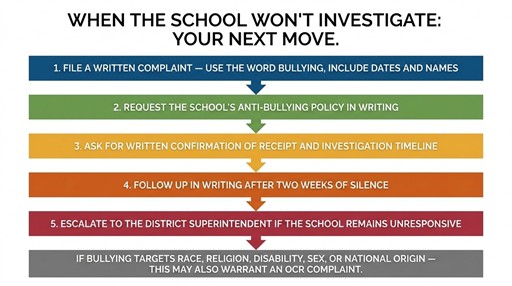
Some situations move beyond the school level faster than others. It may be time to escalate if:
In those situations, escalating to the district superintendent in writing is the appropriate next step. From there, your state education agency and the federal Office for Civil Rights are also available depending on the nature of the situation. Families in serious cases sometimes benefit from working with an educational advocate who understands the escalation process.
If the school has been unresponsive, vague, or dismissive after a bullying report — you are not out of options. You are at the point where structure, documentation, and a clear escalation path matter most. You do not have to figure that out alone.
In many districts, schools are required by policy — and sometimes by state or federal law — to respond to formal bullying complaints. The strongest way to trigger that process is through a written report that clearly identifies the conduct as bullying and requests a formal response or investigation. Informal verbal comments may not always activate the same procedures, which is why written documentation is important.
Ask for clarification in writing. Request a summary of the investigation process, including what steps were taken, what evidence was reviewed, and what standards or definitions were applied. A documented investigation with interviews and evidence review is different from a brief informal review. If the conduct continues after a finding of no bullying, continue documenting incidents and submit updated written reports establishing the ongoing pattern.
Most school policies require some form of parent notification regarding the status or outcome of a bullying investigation, even if privacy laws limit what details can be shared about another student. If you filed a formal complaint and never received follow-up communication, request written confirmation of the investigation status and outcome. Keeping that request in writing helps establish whether the school completed and communicated its process appropriately.
Potentially, yes. When conduct targets a protected characteristic such as race, national origin, sex, religion, or disability, federal civil rights laws may apply in addition to the school’s standard bullying policy. Depending on the circumstances, laws such as Title VI, Title IX, or Section 504 can create additional obligations related to investigation, response, and corrective action. Clearly identifying the protected characteristic in your written complaint may affect how the school is required to evaluate and respond to the situation.
If you want student harm treated like a school safety and civil rights issue—start with SANI at https://saninstitute.net
Most bullying cases do not need a lawyer. Some clearly do. Knowing the difference before you act matters more than most parents realize. The decision

There is a point in many bullying cases where the parent has done everything right — and it still is not working. The emails are

You have three minutes. Make them the most organized three minutes the board has heard on this topic. Speaking at a school board meeting is

Patience with a school that isn’t responding isn’t a virtue. At some point it becomes a cost your child is paying. Most parents start at