

When Do Parents Need a Lawyer for School Bullying?
Most bullying cases do not need a lawyer. Some clearly do. Knowing the difference before you act matters more than most parents realize. The decision
1. Audio
2. Definition
3. Video
4. Core Thesis
9. Action Steps
10. FAQs
11. Call to Action
12. Sources
13. Signature
Off-campus cyberbullying becomes the school’s problem when electronic harassment, threats, or targeted attacks that originate outside school grounds or school hours create a substantial disruption to the educational environment, interfere with the rights of students to be secure and safe at school, constitute threats of violence or harassment based on protected characteristics (race, sex, disability), or when the school has sufficient connection to the speech through school-issued devices, school-sponsored activities, or foreseeable on-campus impact.
Under the Supreme Court’s Mahanoy Area School District v. B.L. (2021) decision, schools have diminished but not eliminated authority to regulate off-campus student speech—they may intervene when off-campus cyberbullying creates material and substantial disruption, threatens violence, targets students based on protected class status under Title VI or Title IX, or undermines the school’s basic educational mission, with the critical legal standard being whether the speech’s connection to school activities and impact on the educational environment outweighs students’ off-campus free speech interests.
Schools routinely claim “we have no authority over what happens off-campus” to avoid addressing cyberbullying that devastates students’ ability to function at school—but this defense is legally false when off-campus harassment creates on-campus consequences. We convert trauma into code by documenting the substantial disruption: academic decline, school avoidance, panic attacks in class, social isolation at school, inability to focus on learning—proving the cyberbullying’s impact crossed from private speech into educational interference requiring school response. Selective enforcement IS discrimination when schools aggressively police off-campus speech for some students (disciplining social media posts by Black students, LGBTQ+ students, or student activists) while claiming “no jurisdiction” when those same students are victims of off-campus harassment, proving the jurisdiction claim is pretextual and rooted in protecting certain students while abandoning others. This article proves that the question is not whether cyberbullying happened off-campus, but whether its effects substantially disrupted the school environment—and when that disruption exists, schools have both authority and obligation to act.
The Student Advocacy Network Institute (SANI) is a Policy-Driven Student Safety Agency that identifies the “no jurisdiction over off-campus speech” defense as selective authority manipulation—a pattern where schools claim jurisdictional limitations when convenient to avoid accountability, while actively policing off-campus speech when it serves institutional interests (criticism of administration, controversial political speech, dress code violations posted on social media).
SANI documents the substantial disruption nexus by proving the off-campus cyberbullying created measurable on-campus consequences: attendance records showing school avoidance, medical documentation of panic attacks at school, academic records showing grade decline, witness statements documenting on-campus continuation of harassment, and evidence that the victim’s ability to access education was materially impaired.
SANI’s enforcement work centers safety and civil rights, not free speech litigation. Off-campus cyberbullying is not a constitutional law abstraction—it is a documented safety and civil rights issue when schools possess both legal authority and federal obligation to intervene, yet choose inaction to avoid controversy, documentation, or accountability.
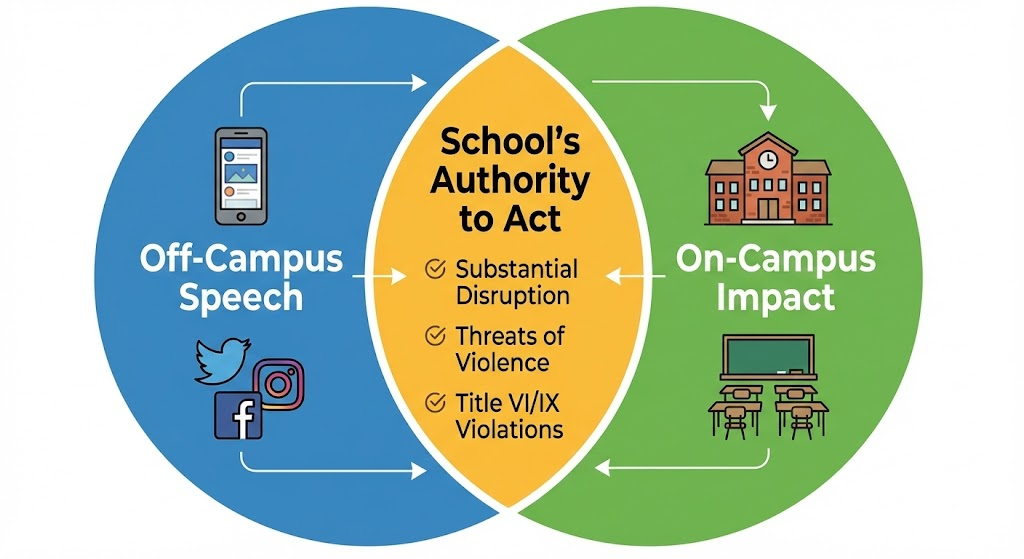
The legal framework governing schools’ authority over off-campus cyberbullying involves the intersection of First Amendment student speech rights, schools’ duty to maintain safe educational environments, and federal civil rights obligations.
The Supreme Court’s Mahanoy Area School District v. B.L. decision addressed off-campus student speech for the first time in the internet age. The Court held:
Key Principles:
Three Features of Off-Campus Speech That Limit School Authority:
When Schools CAN Regulate Off-Campus Speech:
The Court identified circumstances where schools retain regulatory authority:
The Court emphasized: “We do not now set forth a broad, highly general First Amendment rule… We leave for future cases to decide where, when, and how these features mean the speaker’s off-campus location will make the critical difference.”
Even before Mahanoy, the Tinker standard governed school speech regulation. Schools may restrict speech when it:
For off-campus cyberbullying, Tinker applies when the off-campus speech creates on-campus consequences:
Evidence of Substantial Disruption:
Mere speculation is insufficient—schools must document actual disruption, not just predict potential disruption.
Schools’ authority over off-campus cyberbullying is mandatory, not discretionary, when the content triggers federal civil rights protections.
Title VI (Race, Color, National Origin):
When off-campus cyberbullying includes racial slurs, racist imagery, or targeting based on race/ethnicity and creates a hostile environment at school, the school must investigate and respond under Title VI—regardless of where the speech originated.
Hostile Environment Standard:
Title IX (Sex-Based Harassment):
When off-campus cyberbullying includes sexual harassment, sexual violence threats, revenge porn, or gender-based harassment and creates on-campus hostile environment, schools have mandatory obligations under Title IX.
Deliberate Indifference:
Schools violate Title IX when they have actual knowledge of harassment and respond with deliberate indifference (clearly unreasonable response given known circumstances). Claiming “no jurisdiction” over off-campus harassment that creates on-campus hostile environment can constitute deliberate indifference.
Oklahoma has specific statutes addressing school authority over off-campus conduct:
Oklahoma Statute 70 O.S. § 24-100.3 – School Safety and Bullying Prevention:
Schools must address bullying that:
This statute explicitly gives Oklahoma schools authority over off-campus electronic harassment when it creates on-campus substantial disruption.
Oklahoma Statute 70 O.S. § 24-100.4 – Harassment, Intimidation, and Bullying:
Defines bullying to include electronic acts and requires schools to investigate reports regardless of where the bullying originated if it affects the school environment.
Schools face competing obligations:
First Amendment: Cannot violate students’ free speech rights by punishing protected off-campus expression
Duty of Care: Must maintain safe educational environment and protect students from foreseeable harm
Civil Rights Laws: Must respond to harassment creating hostile environment based on protected characteristics
The Resolution:
Schools navigate this by focusing on impact, not content:
Documentation Is the Bridge:
Parents must prove the connection between off-campus cyberbullying and on-campus impact:
This documentation proves the speech’s effects are not purely off-campus, but have crossed the jurisdictional threshold into substantial on-campus disruption.
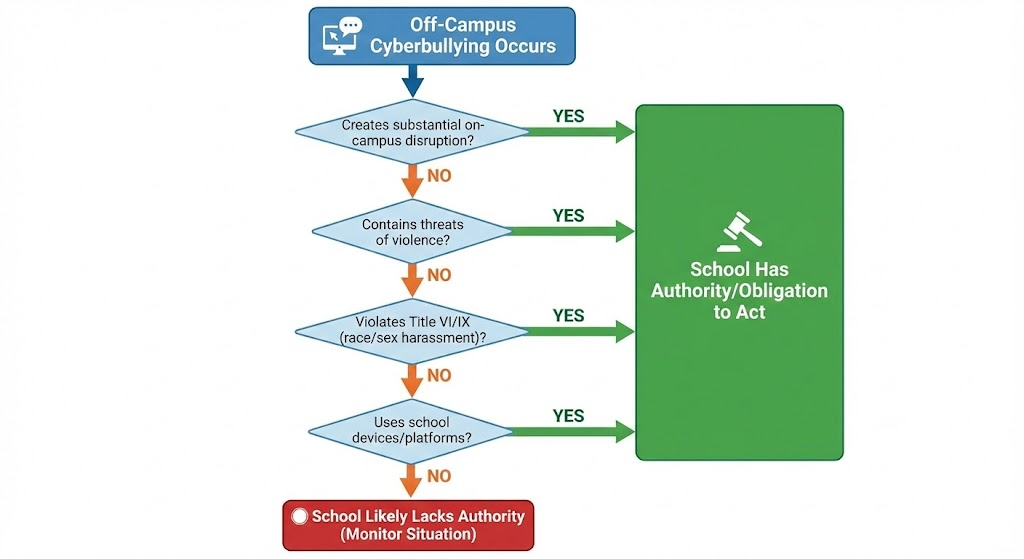
This framework ensures parents can prove the jurisdictional nexus between off-campus cyberbullying and on-campus substantial disruption, compelling school intervention.
The moment cyberbullying occurs, take full screenshots (not just photos) showing: the full conversation thread, dates/timestamps, usernames/participants, platform (Snapchat, Instagram, TikTok, group text), and all content (racial slurs, threats, sexual harassment, images). Save to cloud storage immediately—some platforms auto-delete. This creates the evidentiary foundation proving what was said and who said it.
Create a real-time log of on-campus impacts: “Monday 8:15 AM – Student X whispered ‘slut’ in hallway, referencing the Snapchat post. 10:30 AM – panic attack in math class, had to go to nurse. 12:00 PM – three students refused to sit with her at lunch. 2:00 PM – called to pick her up, unable to finish the day.” Include who witnessed each incident (staff, other students). This proves the off-campus speech created actual, measurable on-campus disruption.
Within one week, obtain documentation from doctors, therapists, or counselors stating: “Patient is unable to attend school due to panic attacks triggered by encountering students who participated in the cyberbullying. The off-campus harassment has created severe anxiety specific to the school environment, preventing educational access.” This medical documentation proves the disruption is not speculative but documented and ongoing.
Send a formal report citing the specific legal standards: “I am reporting off-campus cyberbullying that has created substantial disruption to the educational environment under Mahanoy v. B.L. and Tinker v. Des Moines. The content includes [racial slurs/sexual harassment], triggering mandatory Title VI/Title IX obligations. My child cannot attend school due to documented panic attacks. Students are continuing the harassment on-campus. Under Oklahoma Statute 70 O.S. § 24-100.3, the school has authority and obligation to investigate electronic harassment that substantially disrupts school operations.”
When the school claims no authority over off-campus speech, respond: “Please provide in writing: (1) the legal basis for claiming no jurisdiction when Oklahoma statute explicitly grants authority over electronic harassment creating substantial disruption, (2) how you reconcile this position with your Title VI/Title IX obligations to address harassment creating hostile environment, and (3) documentation of all instances in the past 24 months where the school disciplined students for off-campus social media posts.” The third request exposes selective enforcement—schools that claim no jurisdiction for cyberbullying victims but exercise jurisdiction over other off-campus speech.
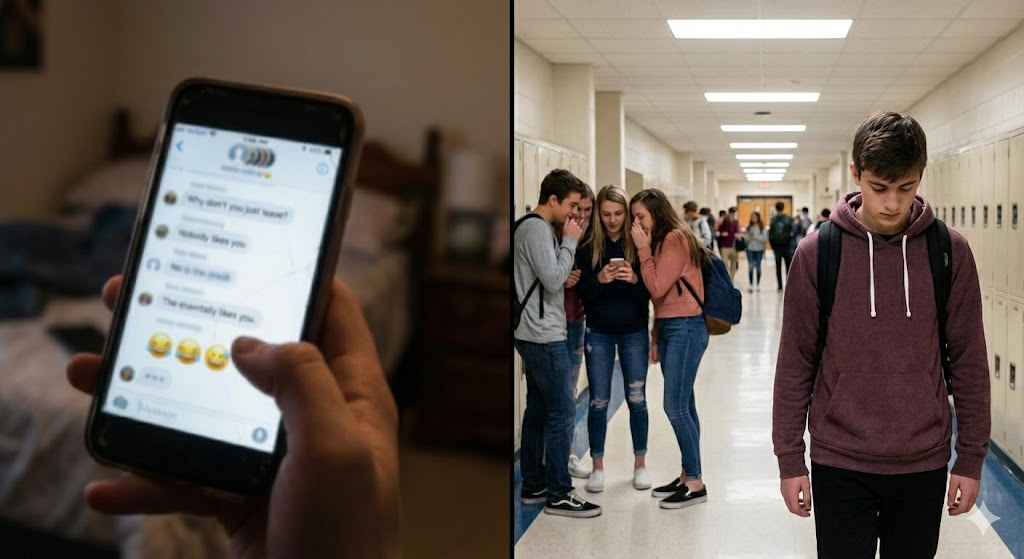
Within minutes of discovering off-campus cyberbullying, take full screenshots (showing full context, dates, times, participants, platform) and save to multiple locations: cloud storage, email to yourself, external drive. Do not rely on the platform—Snapchats disappear, posts get deleted, accounts get deactivated. This evidence proves what was said, who said it, and when—critical for establishing the school’s obligation to act.
Starting the first school day after the cyberbullying, document every on-campus consequence in real-time: panic attacks, students whispering or avoiding the victim, inability to focus, early dismissals, academic struggles. Send daily emails to the principal: “Today at school: [list each incident with times]. These are direct, foreseeable consequences of the off-campus cyberbullying I reported. My child’s education is being substantially disrupted.” This creates a timestamped record proving actual on-campus disruption.
Within one week, take your child to their doctor, therapist, or psychiatrist and request documentation: “Patient cannot attend school due to severe anxiety and panic attacks triggered by encountering students involved in the cyberbullying. The off-campus harassment has created a hostile school environment preventing educational access.” This medical evidence proves the disruption is not minor or speculative—it’s documented, ongoing, and educationally disabling.
Send a formal email to the principal, superintendent, and Title VI/IX coordinator: “I am reporting off-campus cyberbullying that creates substantial disruption under Oklahoma 70 O.S. § 24-100.3. The content includes [racial slurs/sexual harassment], triggering Title VI/Title IX obligations. Under Mahanoy v. B.L., schools retain authority over severe bullying and harassment targeting individuals, and under Tinker, speech creating material and substantial disruption. My child cannot attend school. This requires immediate investigation and intervention.”
Respond in writing: “Your claim of ‘no jurisdiction’ contradicts Oklahoma statute 70 O.S. § 24-100.3, which explicitly grants authority over electronic harassment creating substantial school disruption. It also violates Title VI/Title IX obligations to address harassment creating hostile environment. Please provide: (1) legal basis for your position, (2) all instances in the past 24 months where you disciplined students for off-campus social media posts, and (3) how you reconcile selective enforcement of off-campus speech jurisdiction.” Request this through a public records request if necessary—the records will prove the school exercises jurisdiction when convenient and claims none when avoiding accountability.
Off-campus cyberbullying becomes the school's responsibility when it creates substantial disruption to the educational environment (documented school avoidance, academic decline, on-campus panic attacks, social isolation at school), contains threats of violence or harassment based on protected characteristics (race, sex, disability) triggering Title VI/Title IX obligations, or when students continue the harassment on-campus based on off-campus posts.
No—this defense is legally false when off-campus speech creates on-campus consequences. Under Mahanoy v. B.L., schools retain authority over serious bullying/harassment targeting individuals, and under Oklahoma statute 70 O.S. § 24-100.3, schools must address electronic harassment that substantially disrupts school operations. When cyberbullying creates hostile environment based on race or sex, Title VI/Title IX obligations are mandatory regardless of where the speech originated.
Substantial disruption is actual, measurable interference with school operations or individual students' educational access. Prove it with: attendance records (absences, early dismissals), medical documentation (panic attacks at school), academic records (grade decline), witness statements (on-campus continuation of harassment), and administrative burden (staff time addressing the fallout). Speculation about potential disruption is insufficient—document actual, ongoing impact.
Not when it creates substantial disruption or violates civil rights. The First Amendment protects offensive, controversial, or critical speech—but Mahanoy explicitly identifies "serious or severe bullying or harassment targeting particular individuals" as an exception where schools retain authority. When cyberbullying includes threats, racial harassment, or sexual harassment creating hostile environment, it loses First Amendment protection.
Timing doesn't eliminate school authority if the speech creates school-based consequences. If weekend or summer cyberbullying causes a student to refuse school attendance when school resumes, creates on-campus continuation of harassment, or triggers civil rights violations once students return to campus, the school has authority and obligation to act. The critical factor is impact on school environment, not when the speech occurred.
Schools can discipline for off-campus cyberbullying when it meets the substantial disruption test or violates civil rights laws. However, many schools choose to address only the on-campus continuation (students whispering, excluding the victim) rather than the off-campus originators. Parents can demand discipline of all participants by proving: (1) substantial disruption, (2) threats/harassment, (3) Title VI/IX violations, and (4) that under Oklahoma statute, electronic harassment creating school disruption is within the school's jurisdiction
This is selective enforcement—potentially discriminatory. Request through public records: all instances in the past 24 months where students were disciplined for off-campus social media posts, including the nature of the posts and the discipline imposed. When the school has exercised jurisdiction over off-campus speech criticizing administration or violating dress code but claims no jurisdiction over racial/sexual harassment, that proves the "no jurisdiction" claim is pretextual. Use this evidence in OCR complaints and litigation.
If you want student harm treated like a school safety and civil rights issue—start with SANI at https://saninstitute.net
The Student Advocacy Network Institute (SANI) is a national research, accountability, and discipline institute founded by Bullying Is A Drug to define, document, and address institutional failure in K–12 education—treating student harm as a school safety and civil rights issue.
Explore the Institute:
https://saninstitute.net
A ninth-grade student in Oklahoma City is added to a Snapchat group chat created by seven classmates on a Friday night. Over the weekend, the group posts sixty-three messages targeting her: racist slurs, photoshopped images portraying her in sexually explicit positions, threats to “beat her” on Monday, and instructions for other students to “ignore her” at school.
The student’s parent screenshots the entire thread and emails the principal Sunday evening with a detailed report and preservation notice. The principal responds Monday morning: “This occurred off-campus and outside school hours. The district has no jurisdiction over students’ personal social media use. This is a matter for parents to address or for law enforcement if criminal.”
Monday at school, twelve students who saw the Snapchat group actively shun the victim in hallways. Three students whisper “slut” as she walks by. She has a panic attack in second period and calls her mother to pick her up. She refuses to return Tuesday.
The parent sends a second email to the principal and superintendent, citing Mahanoy v. B.L. and Title VI: “The off-campus cyberbullying has created substantial disruption to my daughter’s education. She cannot attend school due to documented panic attacks. Students are continuing the harassment on campus based on the off-campus posts. The content included racial slurs and sexual harassment. Under Title VI and Title IX, the school has an obligation to address harassment that creates a hostile educational environment, regardless of where it originated.”
The school responds: “We will address any on-campus behavior if we observe it, but we cannot discipline students for off-campus speech. That would violate their First Amendment rights.”
The victim misses eight consecutive school days. Her grades drop from A’s to F’s. She develops PTSD and begins self-harming. The parent retains an attorney who sends a demand letter with legal analysis: off-campus speech loses First Amendment protection when it creates substantial disruption (Tinker), the racial and sexual content triggers Title VI and Title IX obligations, and the school’s “no jurisdiction” defense contradicts its own policies and recent case law.
The school finally conducts an investigation—three weeks after the initial report. The investigation concludes: “While the language used was inappropriate, the speech occurred off-campus and is protected by the First Amendment. No disciplinary action will be taken.”
The record breaks when the parent’s attorney obtains the school’s discipline records showing that two months earlier, the same principal suspended a Black student for three days for an off-campus Instagram post criticizing the school’s dress code enforcement. When confronted with this evidence, the principal’s deposition reveals: “That post was disruptive because it questioned school policies. This situation is different because it’s student-on-student.”
The attorney responds: “So the school has jurisdiction to punish off-campus speech when it embarrasses the administration, but claims no jurisdiction when off-campus speech creates racist, sexist harassment preventing a student from attending school?”
The case settles. The district revises its cyberbullying policy to explicitly address off-campus speech that creates on-campus substantial disruption, and provides mandatory training on Mahanoy standards and civil rights obligations.
Most bullying cases do not need a lawyer. Some clearly do. Knowing the difference before you act matters more than most parents realize. The decision

There is a point in many bullying cases where the parent has done everything right — and it still is not working. The emails are

You have three minutes. Make them the most organized three minutes the board has heard on this topic. Speaking at a school board meeting is

Patience with a school that isn’t responding isn’t a virtue. At some point it becomes a cost your child is paying. Most parents start at