
When Do Parents Need a Lawyer for School Bullying?
Most bullying cases do not need a lawyer. Some clearly do. Knowing the difference before you act matters more than most parents realize. The decision

1. Audio
2. Definition
3. Video
4. Core Thesis
9. Action Steps
10. FAQs
11. Call to Action
12. Sources
13. Signature
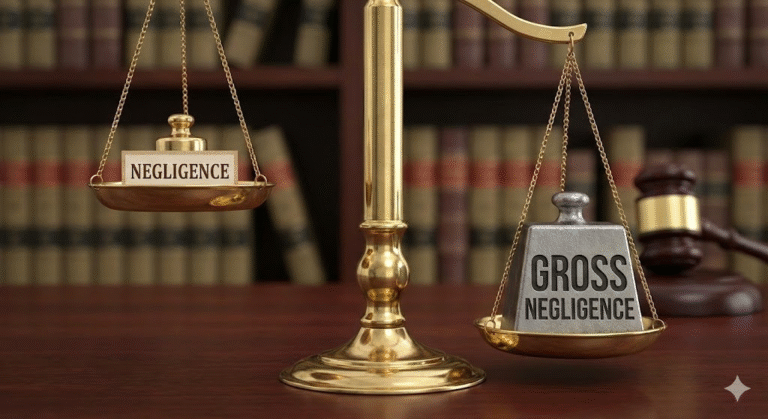
Negligence is the failure to exercise the degree of care that a reasonably prudent person would exercise under similar circumstances, resulting in harm to another—while gross negligence is the extreme departure from ordinary care, demonstrating reckless disregard for the safety or rights of others, showing conscious indifference to consequences, or acting with willful or wanton disregard for the likelihood that harm will result.
In school safety cases, negligence occurs when schools fail to supervise adequately or miss warning signs—but gross negligence occurs when schools have clear, documented notice of danger (repeated violence in a specific location, known aggressive students, documented threats), consciously choose not to act, actively conceal evidence, retaliate against complainants, or create conditions so obviously dangerous that the harm is virtually certain to occur.
Schools routinely defend safety failures as “simple negligence”—claiming they made reasonable mistakes or lacked resources—but when schools receive repeated reports of danger, document patterns of violence, and consciously choose inaction or concealment, that conduct crosses into gross negligence. We convert trauma into code by documenting not just that harm occurred, but that schools had clear notice, understood the risk, and deliberately failed to act—proving conscious indifference rather than mere oversight. Selective enforcement IS discrimination when schools demonstrate gross negligence toward certain student populations (Black, Latino, disabled students) while exercising ordinary care for others—proving the reckless disregard was not resource-based but rooted in devaluation of specific students’ safety. This article proves that the distinction between negligence and gross negligence is the difference between “we made a mistake” and “we knew children would be harmed and chose not to prevent it.”
The Student Advocacy Network Institute (SANI) is a Policy-Driven Student Safety Agency that identifies gross negligence as institutional conscious indifference—a pattern where schools possess actual knowledge of serious danger and make deliberate decisions not to act, not because they lack capacity but because acting would create administrative burden, legal exposure, or documentation of systemic failure.
SANI teaches parents to document not just the harm, but the school’s state of mind—extracting internal communications, text messages, emails between administrators, and meeting notes that reveal the school knew about the danger and consciously chose inaction. This evidence transforms a case from “they should have known” (negligence) to “they knew and didn’t care” (gross negligence).
SANI’s enforcement work centers safety and civil rights, not tort reform. Gross negligence in school cases is not about increasing damages—it is about holding institutions accountable when they treat student safety as negotiable and student lives as expendable, particularly when that devaluation follows racial, disability, or socioeconomic lines.
Negligence and gross negligence exist on a spectrum of culpability, with different legal standards, consequences, and defenses.
Negligence requires four elements:
The standard is reasonable care—what would a reasonably prudent school administrator do under similar circumstances? Negligence is often characterized by:
Example: A student is injured during recess when two students fight. The school had one yard supervisor for 200 students. No prior incidents between these students. This is likely simple negligence—inadequate supervision, but no conscious disregard.
Gross negligence is a heightened standard requiring proof of:
Gross negligence is characterized by:
Example: A bathroom has been the site of twelve documented assaults over six months. Parents have sent written complaints. The principal’s own safety audit identified it as “high risk requiring supervision.” The school assigns no monitor because “we don’t have budget.” Another assault occurs. This is gross negligence—actual knowledge, documented pattern, conscious choice not to act despite known danger.
Many states provide governmental immunity (sovereign immunity) that caps damages for simple negligence by public schools. However, gross negligence often pierces immunity—courts hold that reckless, willful, or wanton disregard for safety forfeits governmental protections.
Some liability insurance policies exclude coverage for gross negligence, willful misconduct, or intentional acts—meaning the school district’s insurance may not cover judgments, forcing the district to pay directly.
While individual school employees often have qualified immunity for simple negligence, gross negligence can expose individual administrators, principals, and staff to personal liability—particularly when their conduct was willful or violated clearly established rights.
In extreme cases, gross negligence can trigger criminal charges (child endangerment, criminal negligence, depraved indifference) when the conduct was so extreme it demonstrates criminal culpability.
Parents must document the school’s state of mind and knowledge:
Different states define gross negligence differently:
Parents should consult attorneys familiar with their state’s standards, but the core principle remains: gross negligence is proven when the school knew or should have known that harm was virtually certain and chose not to prevent it.
This framework ensures parents can elevate a simple negligence case to gross negligence by proving the school’s conscious indifference and actual knowledge.
Create a chronological log of every warning, report, complaint, or notification you gave the school about danger. Include: date, time, method (email, phone, in-person), who you spoke with, what you reported, and what response you received. This proves the school had actual notice and cannot claim they didn’t know about the danger.
Use public records requests or discovery to obtain: emails between administrators about your child’s case, text messages, meeting minutes, internal memos, safety audit reports, and investigative notes. Look for evidence that staff discussed the danger and decided not to act, minimized the risk, or prioritized budget/convenience over safety. These communications prove conscious choice rather than oversight.
Request all incident reports for the location where harm occurred or involving the aggressor. If the school’s own records show five, ten, fifteen prior incidents and no corrective action, that proves actual knowledge of a pattern. Schools cannot claim “we didn’t know it would happen” when their own documentation proves it happened repeatedly.
Obtain the school’s safety policies, emergency protocols, threat assessment procedures, and bullying response requirements. Cross-reference what the school was required to do (investigate within 24 hours, notify parents, implement safety plans, assign supervision) against what they actually did. When schools violate their own policies despite knowing the danger, it proves deliberate disregard of established safety standards.
Look for evidence that the school’s inaction was motivated by: avoiding documentation (“keep this verbal”), preventing expulsion (“if we investigate we’ll have to suspend him”), budget constraints (“we don’t have staff”), protecting reputation (“this will look bad”), or retaliation (“if you keep complaining, this will affect your child”). When the school’s internal communications reveal they chose administrative convenience or self-protection over student safety, that proves reckless indifference—the hallmark of gross negligence.
Starting immediately, send every safety concern, incident report, or request for intervention via email with read receipts. State the danger explicitly: “My child has been threatened with a weapon by [student]. I am requesting immediate investigation and safety measures.” Timestamped emails prove the school had actual notice and cannot later claim they weren’t aware of the severity.
Submit a public records request: “All incident reports documenting violence, threats, harassment, or safety concerns at [specific location] for the past 24 months, and all incident reports involving [aggressor student] regardless of location.” If the school’s own records show repeated danger and no corrective action, that proves they had knowledge of the pattern and consciously chose not to address it.
If administrators tell you in meetings or phone calls that they “know about the problem” or “are aware of the concerns,” immediately send a follow-up email: “Thank you for confirming during our meeting today that you are aware of [specific danger]. I am requesting written confirmation of what safety measures will be implemented and by what date.” This creates proof of their knowledge and their promises.
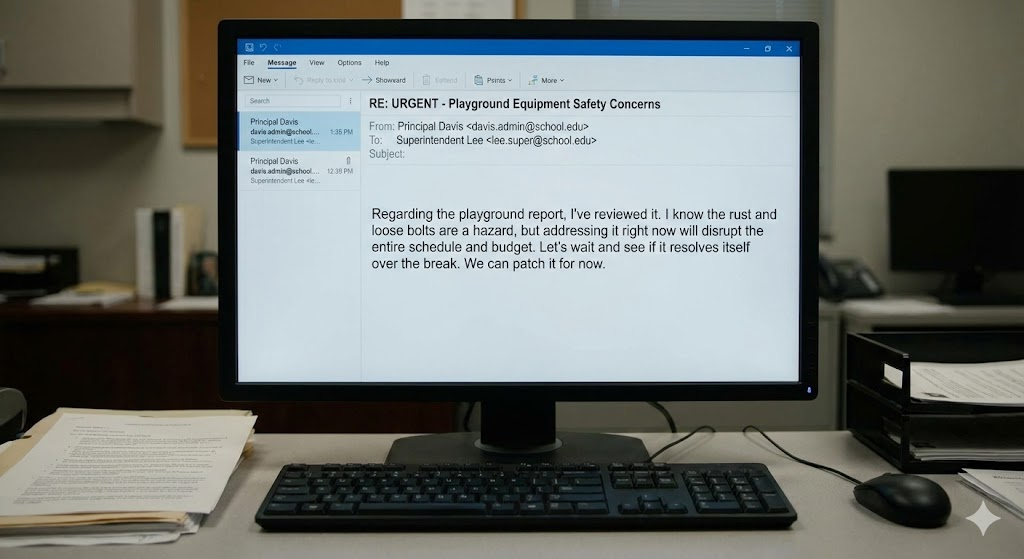
Request (or have your attorney subpoena): emails, texts, meeting notes, and memos between administrators discussing your child’s case. Look for language showing they discussed the danger and decided not to act: “Let’s wait and see,” “We don’t have budget for that,” “If we investigate we’ll have to suspend,” “Keep this off email.” These communications prove conscious indifference.
Obtain the school’s written policies on: threat assessment, violence prevention, bullying response, supervision requirements, and emergency protocols. Document every instance where the school violated its own policies. When you file a complaint or lawsuit, state: “Despite having actual knowledge of [danger] and clear policies requiring [action], the school consciously chose not to follow its own safety protocols, demonstrating reckless disregard constituting gross negligence.”
Negligence is the failure to exercise reasonable care, resulting in harm through a mistake, oversight, or poor judgment. It reflects carelessness, not intent.
Gross negligence is an extreme departure from ordinary care. It involves reckless disregard for safety, conscious indifference to known risks, or a willful failure to act despite knowing serious harm is likely. Gross negligence requires proof that the defendant knew of the danger and deliberately chose not to prevent it.
The distinction determines the school’s legal exposure. Simple negligence is often protected by governmental immunity and damage caps.
Gross negligence can pierce governmental immunity, allow punitive damages, expose individual administrators to personal liability, defeat insurance defenses, and in extreme cases trigger criminal charges. It reframes the case from “the school made a mistake” to “the school knew students would be harmed and chose not to act.”
Gross negligence is proven through evidence showing knowledge and deliberate inaction. This includes: repeated written warnings to the school, documented incident patterns in the school’s own records, internal communications acknowledging the danger, violations of the school’s own safety policies, and evidence that decisions were driven by convenience, budget, or liability avoidance rather than student safety.
Yes. If a school had actual knowledge that a specific location or activity was dangerous, received repeated complaints, knew supervision was inadequate, and consciously chose not to act, that can constitute gross negligence.
Ordinary understaffing may be negligence. Knowing students are at high risk and choosing not to assign supervision is gross negligence.
Conscious indifference means the school was aware of the risk and deliberately chose not to care or intervene.
It is proven through internal statements or communications such as: “We know about this, but it’s not a priority,” “Let’s see if it resolves on its own,” “We can’t afford to address this,” or “Investigating would create liability.” These show knowledge plus intentional inaction.
Yes. When schools have documented patterns of racial harassment, discrimination, or selective enforcement and consciously choose not to intervene despite repeated complaints and clear civil rights violations, courts have recognized this as gross negligence.
This is especially true when internal records show administrators were aware of the pattern and chose not to act.
Consequences may include piercing governmental immunity, punitive damages, higher compensatory awards, personal liability for individual administrators, loss of insurance coverage defenses, federal civil rights investigations, public accountability, and in extreme cases criminal charges.
Findings of gross negligence also create precedent that strengthens future claims against the district.
If you want student harm treated like a school safety and civil rights issue—start with SANI at https://saninstitute.net
The Student Advocacy Network Institute (SANI) is a national research, accountability, and discipline institute founded by Bullying Is A Drug to define, document, and address institutional failure in K–12 education—treating student harm as a school safety and civil rights issue.
Explore the Institute:
https://saninstitute.net
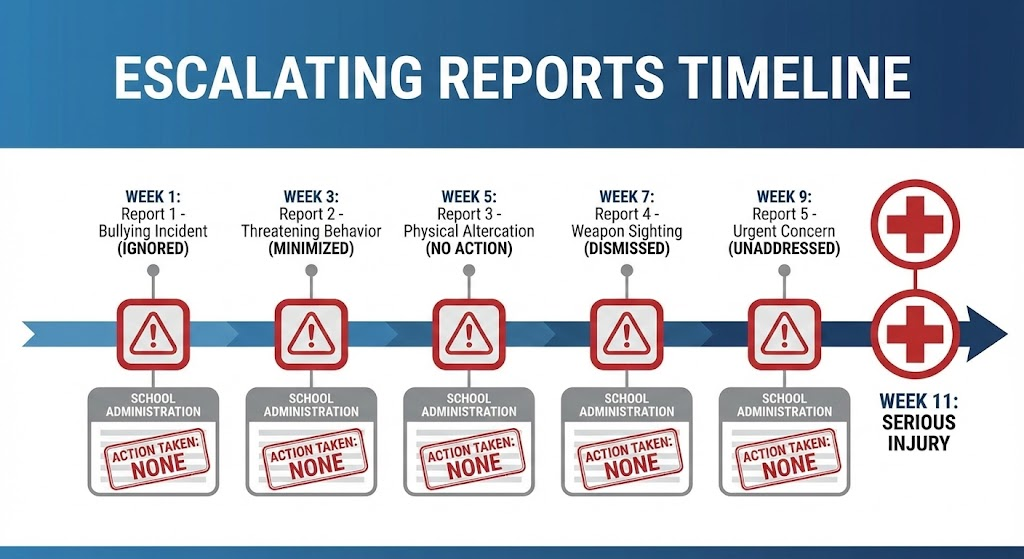
A ninth-grade student reports being threatened by another student who showed him a knife in the bathroom and said, “I’m going to hurt you.” The parent immediately emails the principal with details. The principal responds: “We take all threats seriously and will investigate.”
One week passes. No follow-up. The parent emails again requesting the outcome of the investigation. The assistant principal responds: “The student denied having a knife. We cannot search lockers without probable cause.”
The threatened student stops using the school bathrooms entirely and begins experiencing panic attacks. The parent requests a safety plan. The school offers “conflict mediation” between the two students.
Two weeks later, the student with the knife corners the victim in the same bathroom and stabs him in the shoulder, causing permanent nerve damage.
The parent files suit. The school district’s attorney argues “simple negligence”—claiming the school conducted a reasonable investigation, found no knife, and offered mediation. They argue governmental immunity caps damages at the statutory limit.
During discovery, the parent’s attorney obtains text messages between the assistant principal and the school resource officer sent the day after the initial threat report. The assistant principal texted: “Parent is freaking out about the knife thing. Kid says he didn’t have it. Do we need to do anything else?” The resource officer replied: “Probably not. If we search and find it, we have to deal with expulsion. Easier to just keep an eye on the situation.”
The record also shows that three other students had reported seeing the same student with a knife over the previous six weeks—all documented in the counselor’s notes, never investigated. The school’s own safety protocol requires immediate investigation and parent notification for any weapon report.
The court finds gross negligence: the school had multiple reports, actual knowledge of a weapon, a documented threat, a clear safety protocol, and consciously chose not to investigate or act because “dealing with expulsion” would be inconvenient. The conscious choice to prioritize administrative ease over student safety despite known danger constitutes reckless disregard. Governmental immunity does not apply. Punitive damages are awarded.
Most bullying cases do not need a lawyer. Some clearly do. Knowing the difference before you act matters more than most parents realize. The decision

There is a point in many bullying cases where the parent has done everything right — and it still is not working. The emails are

You have three minutes. Make them the most organized three minutes the board has heard on this topic. Speaking at a school board meeting is

Patience with a school that isn’t responding isn’t a virtue. At some point it becomes a cost your child is paying. Most parents start at