

When Do Parents Need a Lawyer for School Bullying?
Most bullying cases do not need a lawyer. Some clearly do. Knowing the difference before you act matters more than most parents realize. The decision

1. Audio
2. Definition
3. Video
4. Core Thesis
9. Action Steps
10. FAQs
11. Call to Action
12. Sources
13. Signature
The Paper Trail War refers to the systematic institutional strategy employed by school districts—particularly evident in Oklahoma City Public Schools—to avoid creating, preserving, or producing written documentation of safety failures, harassment reports, investigation outcomes, administrator decisions, or policy violations, accomplished through deliberate tactics including verbal-only communications, refusal to confirm promises in writing, destruction of incident reports, failure to document meetings or complaints, instructing staff to avoid “creating paper trails,” and claiming records “don’t exist” when legally requested—all designed to eliminate evidence that could prove the district’s actual knowledge, deliberate indifference, pattern negligence, or civil rights violations.
Under Oklahoma and federal law, this documentation suppression creates multiple forms of legal liability: spoliation of evidence when records are destroyed after notice of claims, deliberate indifference under Title VI/Title IX/Section 504 when lack of documentation prevents pattern recognition and appropriate response, denial of due process when families cannot access records needed to challenge district decisions, obstruction of Open Records Act obligations when districts falsely claim no records exist, and inference of consciousness of wrongdoing when systematic documentation avoidance proves districts understood their conduct was legally indefensible—making the Paper Trail War not a resource issue or administrative preference, but a calculated institutional defense strategy that courts and OCR increasingly recognize as evidence of bad faith requiring adverse inferences, sanctions, and heightened scrutiny.
Oklahoma City Public Schools—like districts nationwide—has institutionalized a “verbal-only” culture where administrators are trained to avoid creating written records that could become evidence of failures, a strategy most parents don’t recognize until they discover months or years later that incidents they reported, promises administrators made, and investigations they were told occurred have no documentation, allowing the district to claim “that never happened” or “we have no record of that” when families seek accountability. We convert trauma into code by forcing documentation at every interaction—sending follow-up emails after every verbal conversation, demanding written confirmation of every promise, creating contemporaneous external records the district cannot control, and using Oklahoma’s Open Records Act to expose when districts claim “no documentation exists” despite parents’ proof that reports were made and received. Selective enforcement IS discrimination when documentation suppression disproportionately affects families who lack sophistication to demand written confirmation—particularly Black, Latino, immigrant, and low-income families who districts bet won’t understand the legal necessity of paper trails—while wealthy, connected families receive detailed written communications, proving documentation avoidance is not administrative efficiency but targeted suppression of evidence that would prove accountability for harm against marginalized students. This article proves that the Paper Trail War is Oklahoma City’s—and the nation’s—most effective institutional defense mechanism, but it collapses when parents understand the game and systematically create external documentation that districts cannot erase, rewrite, or deny.
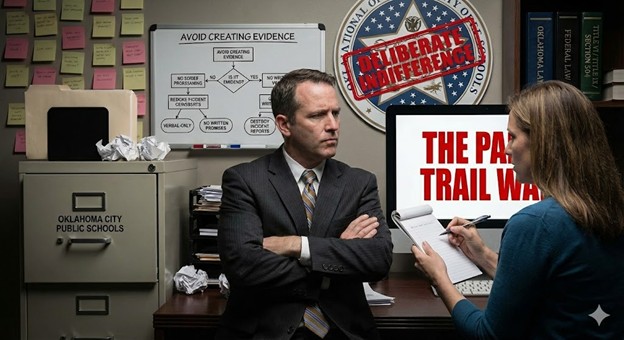
The Student Advocacy Network Institute (SANI) is a Policy-Driven Student Safety Agency that identifies the Paper Trail War as institutional evidence suppression—the most pervasive and effective defense strategy districts employ to avoid accountability for safety failures, civil rights violations, and systematic negligence.
SANI trains parents to recognize documentation avoidance tactics in real-time: when administrators say “I’ll handle it” without written confirmation, when meetings produce no written summaries, when promises are made verbally but never confirmed in email, when incident reports are never provided despite clear violations. SANI teaches the immediate counter-tactic: send follow-up emails within hours of every verbal interaction summarizing what was said, demanding written confirmation, and creating external documentation the district cannot control or deny.
SANI’s enforcement work centers safety and civil rights, not government transparency advocacy. The Paper Trail War is not about “better record-keeping”—it is a calculated institutional strategy to eliminate evidence that would prove actual knowledge, deliberate indifference, pattern negligence, and civil rights violations, making documentation suppression itself evidence of bad faith requiring adverse inferences, sanctions, and heightened liability.

The Paper Trail War operates through predictable institutional tactics designed to prevent creation, preservation, or production of evidence. Understanding these tactics allows parents to recognize and counter them systematically.
Tactic 1: Verbal-Only Communication Policy
How It Works:
Administrators are trained to handle “sensitive matters” verbally—phone calls, hallway conversations, informal meetings—rather than email or written communication.
District’s Claimed Justification:
Actual Purpose:
Eliminate evidence of what was reported, what was promised, and what was (or wasn’t) done. Verbal communication leaves no record that can be subpoenaed, requested under Open Records Act, or used to prove the district’s knowledge and inadequate response.
Parent Counter-Tactic:
Within 2 hours of every verbal conversation, send email:
“This email confirms our conversation today at [time]. You stated [summary of what they said]. You promised to [specific actions they committed to]. I requested [what you asked for]. Please confirm this summary is accurate or provide corrections by [date].”
This creates a timestamped, server-preserved record the district cannot deny. If they don’t correct it, their silence confirms your summary’s accuracy.
Tactic 2: “I Don’t Do Email” Deflection
How It Works:
When parents request written confirmation, administrators claim they “don’t use email for these matters” or “prefer phone calls for sensitive issues.”
District’s Claimed Justification:
Actual Purpose:
Avoid creating written commitments that could become evidence of broken promises or inadequate responses.
Parent Counter-Tactic:
Respond immediately: “I understand you prefer phone calls, but I need written confirmation for my records. Please send a brief email summarizing: (1) what you’re going to do, (2) when, (3) who is responsible. If you cannot provide written confirmation, I will send you a summary email and ask you to confirm or correct it.”
Then send the summary email regardless. Administrators who “don’t do email” suddenly respond to correct inaccuracies, creating written documentation.
Tactic 3: No Meeting Minutes or Written Summaries
How It Works:
Important meetings about harassment, bullying, safety concerns, or investigations occur without any written record—no minutes, no notes, no summary provided to parents.
District’s Claimed Justification:
Actual Purpose:
Prevent documentation of what the school was told, what parents requested, what school officials promised, and what evidence of failure might exist.
Parent Counter-Tactic:
At the beginning of every meeting, state: “I’m taking notes of this meeting for my records. I’ll send a written summary to everyone within 24 hours. Please review and let me know if I’ve misunderstood anything.”
Then send detailed summary email within 24 hours:
“This email summarizes today’s meeting attended by [list attendees]. Discussion included: [summary of what was discussed]. School officials stated: [quote or paraphrase their statements]. I requested: [your requests]. School committed to: [their commitments with timeline]. Please confirm or correct this summary by [date].”
Tactic 4: “We’ll Get Back to You” With No Written Timeline
How It Works:
Administrators promise to investigate, take action, or provide information, but give no written commitment or timeline.
District’s Claimed Justification:
Actual Purpose:
Create indefinite delay while avoiding written commitment that could prove they failed to act within reasonable time.
Parent Counter-Tactic:
Immediately after receiving vague promise, send email:
“Thank you for committing to [action they promised]. Please confirm in writing: (1) what specific steps you will take, (2) who is responsible, (3) when I should expect completion. Oklahoma law and Title IX/Title VI regulations require prompt response. I’m requesting written confirmation by [date 48 hours out].”
Tactic 5: Claiming “No Records Exist”
How It Works:
When parents request records via Open Records Act or attorney demand, districts claim incident reports were “never created,” meetings “weren’t documented,” or investigations “have no file.”
District’s Claimed Justification:
Actual Purpose:
Avoid producing evidence of safety failures, patterns, or inadequate responses. If no records exist, districts can claim they had no notice, conducted no investigation, or made no specific promises.
Parent Counter-Tactic:
Maintain parallel external documentation from day one:
When district claims “no records,” you produce your records proving:
Tactic 6: Document Destruction or “Routine Purging”
How It Works:
Districts destroy incident reports, emails, or video footage, then claim it was “routine retention policy” or “automatic deletion.”
District’s Claimed Justification:
Actual Purpose:
Eliminate evidence of patterns, prior incidents, or documented failures after receiving notice of potential claims—which is spoliation of evidence.
Parent Counter-Tactic:
In your first communication after serious incident, include explicit preservation notice:
“This email creates a legal duty to preserve all responsive documents including: video footage, incident reports, emails, witness statements, investigative files, and communications between staff. Destruction, alteration, or routine deletion of any records after receipt of this notice constitutes spoliation of evidence and will result in legal sanctions.”
This puts district on notice that destruction = liability.
Tactic 7: Instructing Staff to “Avoid Paper Trails”
How It Works:
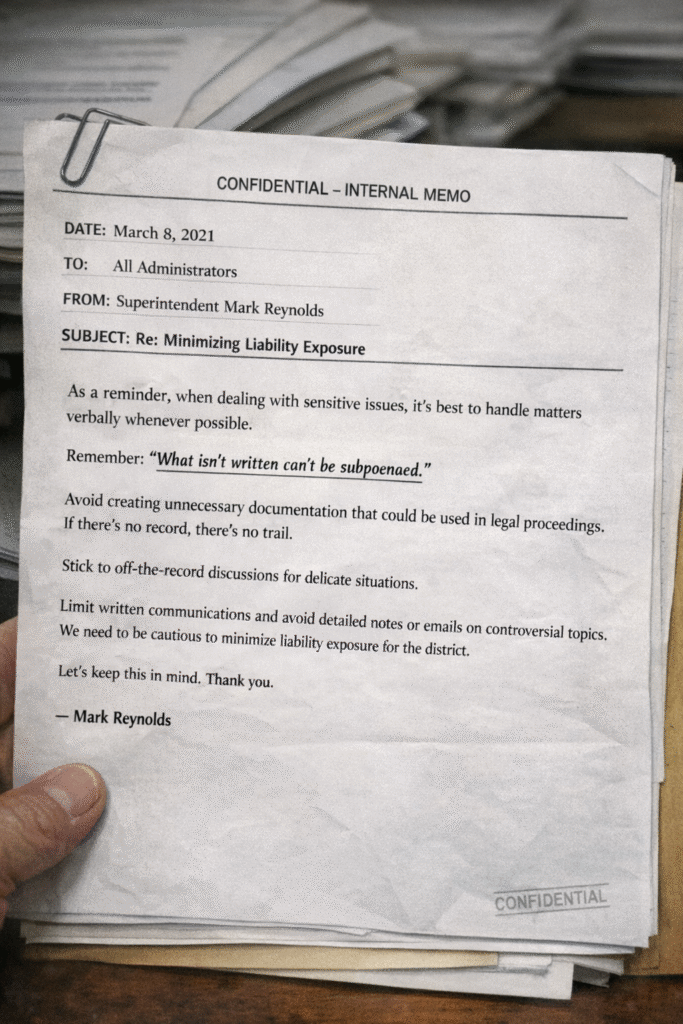
District administrators explicitly train staff to minimize written documentation, handle matters “verbally when possible,” and avoid creating records that could be used against the district.
District’s Claimed Justification:
Actual Purpose:
Systematic evidence suppression to prevent proof of institutional knowledge, patterns, inadequate responses, and policy violations.
Parent Counter-Tactic:
Obtain training materials, internal memos, or staff emails through Open Records Act requests or discovery that reveal the systematic documentation suppression policy. These materials prove:
Courts and OCR treat such evidence as proving bad faith, warranting adverse inferences and sanctions.
When districts destroy or fail to create records after notice of potential claims, they face:
Oklahoma Authority: Oklahoma common law recognizes spoliation tort; federal courts apply spoliation sanctions under Federal Rules of Civil Procedure Rule 37(e).
Lack of documentation prevents schools from:
Courts have found that systematic failure to document complaints and incidents can itself constitute deliberate indifference, as it prevents the school from fulfilling its duty to respond to known harassment.
When districts instruct staff to avoid creating records, then claim “no records exist” in response to Open Records Act requests, they violate Oklahoma’s transparency laws.
Oklahoma Authority: 51 O.S. § 24A.19 makes willful violation of Open Records Act a misdemeanor; systematic documentation suppression can constitute willful violation.
When districts refuse to document meetings, investigations, or decisions, families cannot:
This violates procedural due process under the Fourteenth Amendment.
Courts increasingly recognize that systematic documentation avoidance itself proves districts knew their conduct was legally indefensible.
Legal Principle: “Consciousness of guilt” or “consciousness of wrongdoing” allows fact-finders to infer that parties who destroy or avoid creating evidence do so because the evidence would prove their liability.
Based on SANI’s work with Oklahoma City families, several district-specific documentation suppression patterns emerge:
Pattern 1: “Informal Resolution” Language
Oklahoma City administrators frequently frame serious incidents as “informal matters” not requiring “formal documentation,” then refuse to investigate or create records.
Pattern 2: “Privacy” Justification for Non-Documentation
District claims it cannot document incidents involving multiple students due to “student privacy,” misapplying FERPA to justify evidence suppression.
Pattern 3: Differential Documentation by Demographics
Wealthy, white families in affluent Oklahoma City schools receive detailed written communications, incident reports, and meeting summaries. Black, Latino, and low-income families receive verbal-only responses with no paper trail—proving documentation suppression targets marginalized families.
Pattern 4: Title IX Coordinator Inaccessibility
Oklahoma City’s Title IX coordinator is often unknown to families, not listed on school websites, and does not receive formal complaints—preventing creation of Title IX investigative files required by federal law.
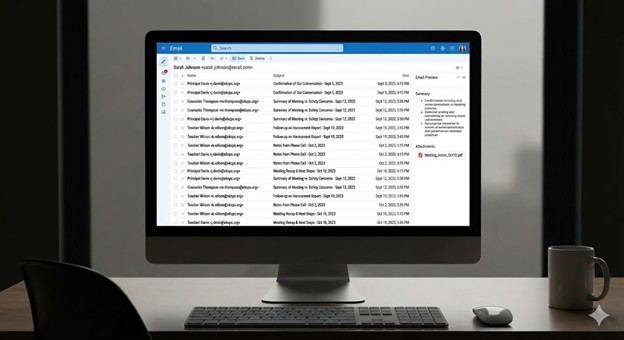
This framework ensures parents create external, timestamped documentation that districts cannot erase, deny, or rewrite—defeating the Paper Trail War systematically.
After every phone call, hallway conversation, or informal meeting with any school employee, immediately send email to that person (and CC principal, counselor, or other relevant staff): “This email confirms our conversation today at [time]. You stated: [summary]. You committed to: [specific actions with timeline]. I requested: [your requests]. Please confirm this summary is accurate or provide corrections by [date 48 hours out].” This creates timestamped, server-preserved documentation the district cannot deny.
When administrators make verbal promises (“I’ll talk to them,” “We’ll investigate,” “We’ll create a safety plan”), immediately respond: “Please send me written confirmation of: (1) what specific actions you will take, (2) who is responsible, (3) what the timeline is. I need this in writing for my records and to ensure we have shared understanding. If you cannot provide written confirmation, I will send you a summary email and ask you to confirm or correct.” Then send the summary regardless of their response.
Maintain a running timeline in Google Doc, Evernote, or email drafts to yourself documenting: Date/Time of every incident, what happened, who you reported to, what they said, what they promised, what actually happened. Email yourself a copy after each entry to create server timestamp. This parallel documentation proves the district had notice and made commitments even when they later claim “no records exist.”
When reporting assault, serious harassment, threats, or discrimination, include this paragraph: “This communication creates a legal duty under Oklahoma law to preserve all responsive documents including: video footage, incident reports, emails between staff, witness statements, investigative files, and communications about this matter. Destruction, alteration, or routine deletion of records after receipt of this notice constitutes spoliation of evidence.” This prevents districts from claiming “automatic deletion” or “routine purging.”
When district claims “no records exist,” immediately file Open Records Act request for: “All training materials, memos, emails, or policies instructing staff on when to create or avoid creating documentation of student safety incidents, harassment reports, or parent complaints.” Also request: “All emails between administrators discussing documentation practices, record retention, or avoiding paper trails.” These requests often reveal systematic suppression policies proving bad faith.
Do not wait. Do not assume they’ll document it. Immediately after hanging up or leaving the meeting, draft email to the school official: “This confirms our [phone call/meeting] today at [time]. You stated: [their statements]. You committed to: [their promises with specific timeline]. I requested: [your requests]. Please confirm or correct this summary by [date].” Send to them and CC superintendent, Title IX coordinator, or principal. This forces them to confirm in writing or create written record by correcting you.
Never accept verbal promises without written follow-up. Immediately respond: “I appreciate your commitment. Please send brief email confirming: (1) what you will do, (2) when, (3) who is responsible. I need this for my records.” If they refuse or deflect, send your own confirmation email within 2 hours. Their failure to correct your summary becomes their implicit confirmation.
Open a Google Doc titled “[Student Name] School Safety Timeline.” After every incident, report, or school interaction, create entry with: Date/Time, What Happened, Who You Told, Their Response, Their Promises, Evidence (attach photos/screenshots). After each entry, email the entire timeline to yourself with subject line “[Date] Timeline Update.” Email timestamps prove contemporaneous creation the district cannot claim you fabricated later.
When reporting assault, threats, harassment, or discrimination, include this exact paragraph in your email: “This email creates a legal duty to preserve all relevant evidence including video footage, incident reports, emails, witness statements, and investigative files. Destruction or deletion of any records after receipt of this notice—including ‘automatic’ or ‘routine’ deletion—constitutes spoliation of evidence and will result in legal sanctions and adverse inferences.” This prevents “we routinely delete” excuses.
Within 30 days of discovering the district claims “no records,” file Oklahoma Open Records Act request: “All training materials, memos, policies, or emails instructing staff regarding: when to document parent complaints, how to handle harassment reports, when to create incident reports, documentation best practices for sensitive matters, and any communications regarding avoiding paper trails or limiting written records.” These materials often reveal systematic suppression proving bad faith.
Districts systematically avoid documentation to eliminate evidence that could prove actual knowledge of safety issues, inadequate responses, broken promises, patterns of harassment, civil rights violations, and deliberate indifference. Written records can be subpoenaed, requested under Open Records Act, and used to establish district liability. By keeping communications verbal and avoiding incident reports, districts later claim “we weren’t aware,” “we never promised that,” or “no pattern exists.”
No law requires schools to provide written confirmation of every statement, but refusal becomes evidence of bad faith when combined with later denials. Parents can create written records unilaterally by sending confirmation emails. When schools fail to correct a parent’s written summary, their silence confirms accuracy. Additionally, Title IX, IDEA, and Section 504 require written notice for specific actions, making refusal to document potential violations of federal law.
Within two hours, send a confirmation email: “This confirms our conversation today at [time]. You stated you would [specific action]. You committed to [timeline]. I requested [your request]. Please confirm this summary or provide corrections by [date].” If they do not respond or correct it, their silence confirms your summary’s accuracy. Save the email as proof of notice.
Schools may claim this, but it creates serious legal problems. It prevents recognition of patterns required under Title VI, Title IX, and Section 504, potentially establishing deliberate indifference. It may violate their own policies if documentation of safety concerns is required. Strategic non-documentation shows consciousness of wrongdoing, and courts increasingly treat systematic non-documentation as bad faith warranting adverse inferences.
Spoliation is the destruction or failure to preserve evidence when litigation is reasonably foreseeable. Once parents report serious incidents, districts must preserve relevant evidence such as video footage, incident reports, and emails. Deleting video after a request or claiming reports “were never created” when policy requires them constitutes spoliation. Sanctions can include adverse inference and monetary penalties.
If you want student harm treated like a school safety and civil rights issue—start with SANI at https://saninstitute.net
An Oklahoma City mother reports that her daughter is being sexually harassed by three male students in her eighth-grade class. She calls the assistant principal, who listens sympathetically and says: “I’ll talk to the boys today. We’ll handle this. Don’t worry.”
The mother asks: “Can you send me an email confirming what you’re going to do?”
The assistant principal responds: “I don’t really do email for these things. Too formal. But trust me, I’ll take care of it.”
The mother, trusting the school, doesn’t push further.
One week later, the harassment continues. The mother calls again. The assistant principal says: “I talked to them. Sometimes boys don’t listen the first time. I’ll talk to them again.”
Again, the mother asks for written confirmation. Again, the assistant principal deflects: “I’m handling it. You’ll see improvement soon.”
Two weeks later, the harassment escalates to physical touching. The mother demands a meeting. At the meeting, the assistant principal and counselor both promise: “We’ll open a Title IX investigation. We’ll separate the students. We’ll create a safety plan.”
The mother asks: “Can I get that in writing?”
The counselor responds: “We’ll send you a letter when the investigation is complete.”
Nothing arrives. The mother emails requesting an update. The assistant principal responds: “We’re still looking into it.”
Three weeks pass. The mother retains an attorney who sends a demand letter requesting: all incident reports, all investigation files, all communications between staff about the case, and the Title IX investigation outcome.
The district’s response: “We have no incident reports on file. No formal Title IX investigation was opened because the complaint did not meet the threshold for investigation. We have no documentation of the meetings you reference.”
The mother is stunned. She called twice, met in person once, and was promised action repeatedly. Now the district claims none of it happened—or at least, none of it was documented.
The attorney immediately sends follow-up demands: “My client has detailed contemporaneous notes of three contacts with school officials. She was promised investigation and safety measures. Your claim that ‘no investigation was opened’ contradicts your assistant principal’s explicit promises. Please provide: (1) the assistant principal’s notes from phone calls, (2) meeting minutes from the in-person meeting, (3) all emails or written communications about this case.”
The district’s attorney responds: “Phone calls are not documented unless formal complaints are filed in writing. The meeting had no formal minutes. There are no emails because discussions were handled verbally to protect student privacy.”
The mother’s attorney recognizes the pattern: systematic documentation avoidance.
During discovery, the attorney obtains internal training materials used by Oklahoma City Public Schools administrators. One slide reads:
**”Best Practices for Sensitive Student Matters:
Another internal memo from the superintendent to principals states: “We’ve had several recent litigation matters where internal emails and incident reports were used against the district. Please be mindful of what you commit to writing. When in doubt, handle matters verbally and document only final outcomes, not processes.”
The record breaks. The district’s systematic policy of avoiding documentation—taught to administrators as “best practice”—is exposed as an institutional strategy to eliminate evidence of failures.
The mother’s attorney files an amended complaint adding: (1) spoliation of evidence (failure to create and preserve records despite notice of potential claims), (2) deliberate indifference (lack of documentation prevented pattern recognition required under Title IX), (3) violation of Oklahoma Open Records Act (claiming no records exist while instructing staff not to create them), and (4) bad faith (systematic documentation suppression proving consciousness of wrongdoing).
The court grants adverse inference instruction, allowing the jury to presume that had the school documented its actions, the documentation would have shown inadequate response and deliberate indifference. The district settles before trial.
Most bullying cases do not need a lawyer. Some clearly do. Knowing the difference before you act matters more than most parents realize. The decision

There is a point in many bullying cases where the parent has done everything right — and it still is not working. The emails are

You have three minutes. Make them the most organized three minutes the board has heard on this topic. Speaking at a school board meeting is

Patience with a school that isn’t responding isn’t a virtue. At some point it becomes a cost your child is paying. Most parents start at