

When Do Parents Need a Lawyer for School Bullying?
Most bullying cases do not need a lawyer. Some clearly do. Knowing the difference before you act matters more than most parents realize. The decision
1. Audio
2. Definition
3. Video
4. Core Thesis
9. Action Steps
10. FAQs
11. Call to Action
12. Sources
13. Signature
Safety accommodations in IEPs and 504 plans are legally enforceable modifications to a student’s educational environment, services, and supervision designed to ensure equal access to education by mitigating the impact of disability-related vulnerabilities to bullying, harassment, or peer aggression—and these accommodations must be individualized, specific, measurable, and directly tied to how the student’s disability creates increased risk or reduced capacity to self-protect in the school environment.
Under the Individuals with Disabilities Education Act (IDEA) and Section 504 of the Rehabilitation Act, schools have an affirmative obligation to provide a Free Appropriate Public Education (FAPE) in the Least Restrictive Environment (LRE), which requires addressing safety barriers that prevent disabled students from accessing education—making safety accommodations not optional support but mandatory civil rights protections when bullying interferes with FAPE.
Schools routinely tell parents that IEPs and 504 plans “cannot address bullying” because bullying is a “behavior issue, not a disability issue”—but this is legally false and strategically designed to avoid accountability. We convert trauma into code by documenting how the student’s disability creates vulnerability to bullying (social skill deficits, communication impairments, executive function challenges, trauma responses) and demanding accommodations that remove barriers to FAPE caused by peer aggression. Selective enforcement IS discrimination when schools provide robust safety accommodations for some disabled students while refusing protections for others—particularly Black, Latino, or multiply-disabled students who face intersectional harassment. This article proves that safety accommodations are not optional add-ons to IEPs and 504 plans—they are mandatory civil rights protections when disability-related vulnerabilities intersect with foreseeable peer harm.
The Student Advocacy Network Institute (SANI) is a Policy-Driven Student Safety Agency that identifies the “bullying is not an IEP issue” defense as disability rights denial—a systemic pattern where schools weaponize procedural boundaries to avoid their legal obligation to address how disability creates vulnerability to peer harm.
SANI trains parents to document the nexus: the connection between the student’s specific disability and their inability to self-protect, recognize danger, report harm, or function in environments where peer aggression occurs. When this nexus is documented, safety accommodations become mandatory FAPE components, not discretionary behavior supports.
SANI’s enforcement work centers safety and civil rights, not special education advocacy. IEP and 504 safety accommodations are not about “being nice to bullied kids”—they are enforceable civil rights protections under federal law that schools violate when they refuse to address disability-based vulnerability to peer violence.

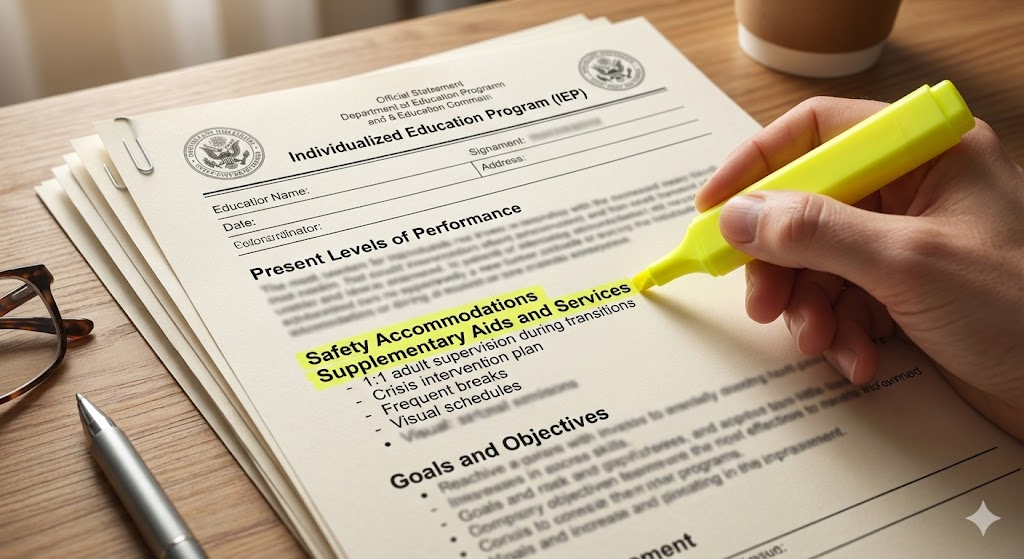
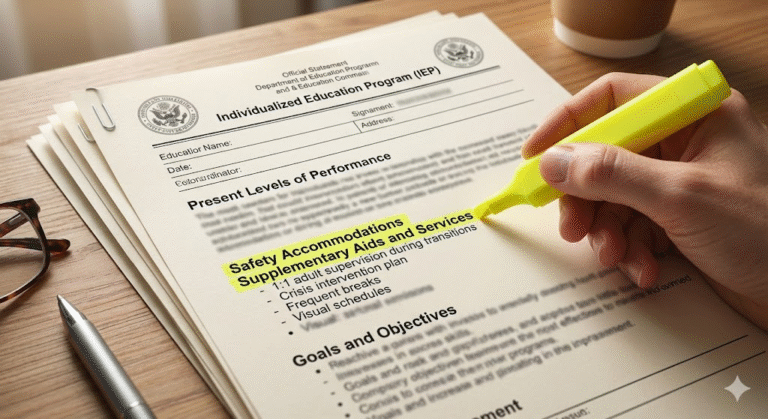
IEPs (Individualized Education Programs) are legally binding documents under IDEA that govern special education services for students with disabilities who require specially designed instruction. 504 Plans are legal accommodations under Section 504 of the Rehabilitation Act for students with disabilities who need modifications to access the general education curriculum but do not require special education.
Both documents must provide Free Appropriate Public Education (FAPE), which means education reasonably calculated to enable the student to make progress appropriate in light of their circumstances. When bullying or peer aggression prevents a disabled student from accessing FAPE, the IEP or 504 team must address it.
The Nexus Requirement
Safety accommodations are legally required when there is a documented connection (nexus) between:
Examples of nexus documentation:
Once the nexus is documented, the school cannot refuse accommodations by claiming “we can’t control other students’ behavior.” The accommodations address the student’s disability-based inability to function safely in the environment—not the other students’ conduct.
Categories of Safety Accommodations
Enforcement Through Prior Written Notice
When schools refuse proposed safety accommodations, parents must demand Prior Written Notice (PWN) stating:
PWN creates a paper trail proving the school denied FAPE. If the justification is “we can’t control other students” or “bullying isn’t an IEP issue,” that PWN becomes evidence of civil rights violation.
Documentation is the enforcement mechanism. Parents must bring to IEP/504 meetings:
This documentation proves the nexus and makes refusal of accommodations a denial of FAPE.
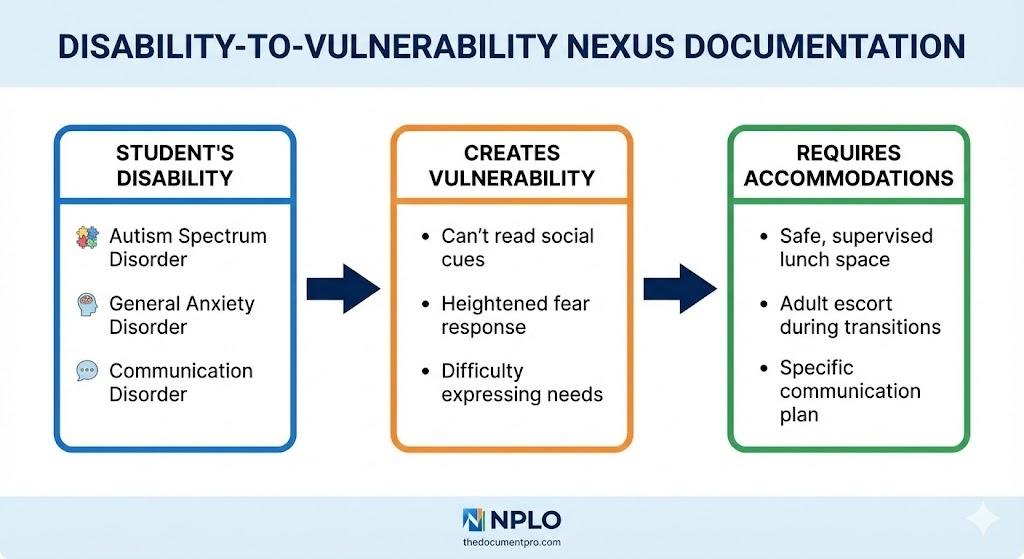
This framework ensures parents can document the disability-to-vulnerability connection and secure legally enforceable IEP/504 protections.
Pull language directly from the student’s evaluations, medical records, and diagnostic reports that explain why the disability creates vulnerability. Write it explicitly: “Student’s autism diagnosis includes ‘significant deficits in social communication and interpreting peer intent,’ making him unable to recognize when peers are escalating from teasing to aggression.” This language establishes the nexus.
Create a two-column chart. Column 1: Date/location/description of bullying incident. Column 2: How the student’s disability prevented them from self-protecting or accessing help. Example: “10/15 – cafeteria – peers surrounded student and made loud noises. Student’s sensory processing disorder caused shutdown; unable to verbally request help or exit the situation.” This proves the disability-harm nexus.
Avoid vague language like “school will keep student safe” or “increase supervision.” Instead, write: “Student will eat lunch in Room 204 with no more than 3 pre-selected peers and 1 adult supervisor, daily, for the remainder of the school year.” Specific accommodations are enforceable; vague promises are not.
For every proposed accommodation, state how it removes a barrier to FAPE. Example: “Alternative lunch location is required because the student’s sensory processing disorder and anxiety create inability to regulate in the chaotic cafeteria environment, resulting in refusal to eat (12 lb weight loss), panic attacks, and inability to focus academically in afternoon classes. This accommodation removes the environmental barrier and restores access to nutrition and learning.”
If the school refuses any accommodation, immediately state: “I am requesting Prior Written Notice explaining why the school is refusing this accommodation, what data supports the refusal, and what alternatives were considered.” When the school puts their refusal in writing, it becomes evidence of FAPE denial. If they claim “bullying isn’t an IEP issue,” that PWN proves they violated Section 504 and IDEA.
Before the IEP or 504 meeting, review every evaluation, diagnosis, medical report, and psychological assessment. Highlight any language about: social deficits, communication impairments, executive function challenges, sensory issues, trauma responses, anxiety, or any deficit that affects the student’s ability to self-protect, recognize danger, or access help. Write these exact phrases into your accommodation proposals.
Document every bullying incident with four pieces of information: (1) what happened, (2) where/when it happened, (3) how the student’s disability prevented them from self-protecting, and (4) what impact it had on their ability to access education (refused to attend, panic attack, academic regression, physical illness). Bring this log to the meeting as evidence of the nexus.
Do not wait for the school to propose accommodations—they often won’t. Write your own proposed accommodations using specific, measurable language: “Student will be escorted by [specific staff person or role] during all hallway transitions between classes, daily.” Include location-specific, time-specific, and person-specific details. Bring copies to distribute at the meeting.
When proposing each accommodation, say: “This accommodation is necessary to ensure FAPE because [student’s disability] creates [specific vulnerability], and the current environment results in [documented harm that prevents educational access].” Use the phrase “denial of FAPE” if the school resists. Schools are legally required to provide FAPE and cannot refuse accommodations that are necessary to meet that obligation.
If the school says no to any accommodation, immediately say: “I am requesting Prior Written Notice under IDEA/Section 504 explaining why this accommodation is being refused, what data supports that decision, and what alternatives were considered. I need that in writing within 10 days.” Do not leave the meeting without making this demand. The PWN creates a paper trail for complaints and due process.
Safety accommodations can include alternative locations for lunch, PE, or recess; adult escorts during transitions; a designated safe person or safe space; modified seating away from aggressors; structured communication supports for reporting harm; social skills instruction focused on safety; trauma-informed crisis protocols; excused absences for safety-related medical or mental health care; and modified schedules to avoid contact with specific students.
All accommodations must be tied to how the student’s disability creates vulnerability to harm or interferes with safe access to education.
No. That refusal violates FAPE. When a student’s disability creates vulnerability to peer harm—such as through social communication deficits, sensory sensitivities, executive functioning impairments, anxiety, or trauma responses—and that harm interferes with educational access, the IEP or 504 team must address it.
The accommodation addresses the student’s disability-based inability to function safely, not the behavior of other students.
Establish the nexus by using language directly from evaluations, eligibility reports, and progress notes that identify specific deficits—such as social communication, sensory processing, executive functioning, or anxiety.
Pair this with an incident log showing how those deficits prevented self-protection. For example: “Student’s autism includes difficulty interpreting peer intent. On 10/12, the student did not recognize mocking behavior and continued engaging, which escalated the harassment.”
FAPE does not mean the least noticeable or least conspicuous support—it means an appropriate education. If a student cannot access lunch safely due to sensory overload and peer aggression, an alternative lunch location is necessary, not excessive.
Schools may not refuse accommodations to avoid making a disability visible. That rationale is inconsistent with federal disability law.
Yes. IEPs and 504 plans can specify staff roles such as a special education aide, designated counselor, or trained support staff to supervise or escort a student.
While naming a specific individual is sometimes appropriate, it is often more durable to specify the role, qualifications, and need for consistency, since staff turnover may require plan revisions.
Document every failure: the date, time, required accommodation, what actually occurred, and who was responsible. After each incident, send a written notice to the case manager and principal.
For example: “Per the IEP, the student is entitled to [accommodation]. Today it was not provided. Please confirm how the district will ensure compliance.” Repeated failures constitute a denial of FAPE and support a state complaint.
Both. Section 504 plans are legally binding and must provide FAPE. Safety accommodations are often appropriate in 504 plans when a student does not need specially designed instruction but does need environmental modifications or supervision due to disability-related vulnerability.
While enforcement mechanisms differ slightly, the obligation to provide a safe and accessible education is the same.
If you want student harm treated like a school safety and civil rights issue—start with SANI at https://saninstitute.net
The Student Advocacy Network Institute (SANI) is a national research, accountability, and discipline institute founded by Bullying Is A Drug to define, document, and address institutional failure in K–12 education—treating student harm as a school safety and civil rights issue.
Explore the Institute:
https://saninstitute.net
A seventh-grade student with autism and anxiety disorder is repeatedly targeted in the cafeteria—students mock his stimming behaviors, steal his food, and surround him while making loud noises that trigger sensory overload. The student begins refusing to eat lunch, loses twelve pounds in six weeks, and experiences panic attacks before school.
The parent requests an IEP meeting to address the bullying. The school psychologist states: “Bullying is not part of the IEP process. That’s a separate discipline issue.” The special education director adds: “We can’t write accommodations to control other students’ behavior.”
The parent, with advocacy support, comes to the next meeting prepared with documentation: the student’s autism diagnosis specifically notes “social communication deficits and difficulty interpreting peer intent,” making him unable to recognize escalating aggression or advocate for himself. The anxiety disorder diagnosis notes “heightened startle response and difficulty self-regulating in chaotic environments,” directly implicating the cafeteria as a FAPE barrier.
The parent proposes specific accommodations tied to the disability:
The school initially refuses, claiming these accommodations are “too restrictive” and would “single the student out.” The parent responds with a prior written notice demand: “Refusing safety accommodations when bullying prevents FAPE is a Section 504 violation. The student’s disability makes him unable to self-protect. Peer aggression is a documented FAPE barrier. Failure to accommodate creates denial of FAPE.”
The school relents after the parent files a state complaint. The IEP is amended to include all six accommodations. Within three weeks, the student’s panic attacks cease, he regains eight pounds, and his academic performance stabilizes.
The record breaks when the parent later obtains the school psychologist’s internal notes from before the IEP meeting, which state: “We need to avoid setting a precedent where we’re responsible for managing peer behavior through IEPs. Legal says to push back unless the parent escalates.” This proves the refusal was not based on educational judgment but on institutional liability avoidance.
Most bullying cases do not need a lawyer. Some clearly do. Knowing the difference before you act matters more than most parents realize. The decision

There is a point in many bullying cases where the parent has done everything right — and it still is not working. The emails are

You have three minutes. Make them the most organized three minutes the board has heard on this topic. Speaking at a school board meeting is

Patience with a school that isn’t responding isn’t a virtue. At some point it becomes a cost your child is paying. Most parents start at