

When Do Parents Need a Lawyer for School Bullying?
Most bullying cases do not need a lawyer. Some clearly do. Knowing the difference before you act matters more than most parents realize. The decision
1. Audio
2. Definition
3. Video
4. Core Thesis
9. Action Steps
10. FAQs
11. Call to Action
12. Sources
13. Signature
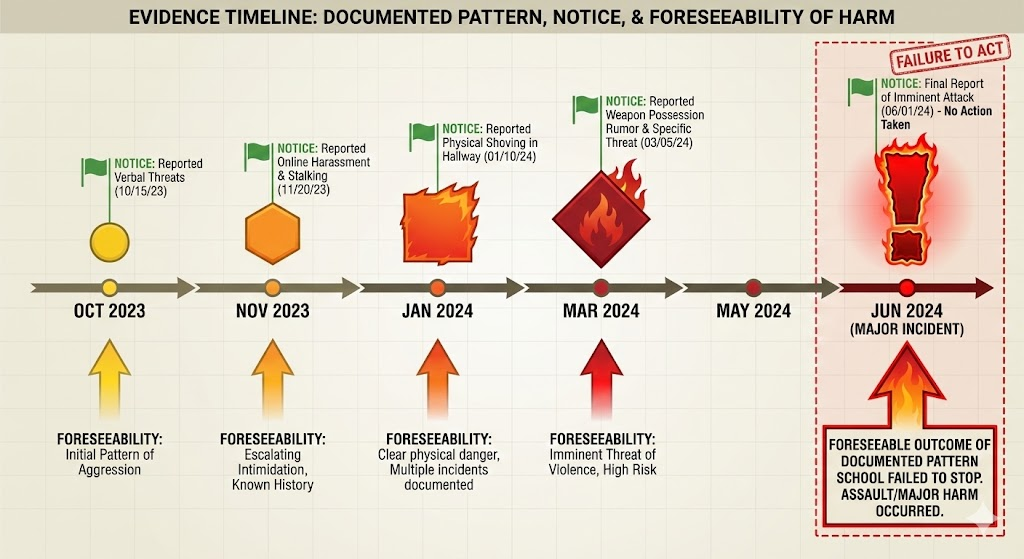
Notice is proof that the school had actual knowledge (you told them directly) or constructive knowledge (circumstances made the danger obvious to any reasonable observer) of a specific threat or pattern of harmful conduct. Foreseeability is proof that a reasonable school, given the notice and circumstances, could have predicted that harm was likely to occur without intervention. Together, notice + foreseeability create the foundation for negligence and deliberate indifference claims by establishing: the school knew about the danger, the danger was predictable, and the school’s failure to act was unreasonable. Both are proven through systematic documentation: dated communications showing what you reported and when, pattern evidence showing escalation, witness statements corroborating the school’s awareness, and comparative evidence showing the school recognized similar dangers in other contexts.
Schools escape accountability by claiming “we had no idea this would happen”—but notice and foreseeability destroy that defense. The Student Advocacy Network Institute, a Policy-Driven Student Safety Agency, operates on this principle: if you cannot prove the school had notice and the harm was foreseeable, you cannot prove negligence or deliberate indifference—no matter how egregious the harm. We convert trauma into code by teaching parents that notice and foreseeability are not abstract concepts—they are documentary evidence chains built through dated emails, pattern timelines, witness statements, and expert analysis. Every report you make creates notice. Every incident that goes unaddressed increases foreseeability. Every escalation in severity proves predictability. When you document systematically, “we didn’t know” becomes “here are 14 dated emails proving you knew.” Selective enforcement IS discrimination, and notice-foreseeability analysis often reveals it—when schools claim they “didn’t know” about your child’s danger while simultaneously responding to less severe threats against other students, the disparity proves both notice (they knew how to recognize danger) and foreseeability (they knew harm was predictable). This article provides the complete evidentiary framework for proving what schools knew and when they knew it.
The Student Advocacy Network Institute exists because most parents cannot articulate the difference between “I knew harm was coming” and “I can prove the school knew harm was coming and was foreseeable.” As the nation’s first Policy-Driven Student Safety Agency, SANI operates at the intersection of evidentiary standards, documentation methodology, and legal proof construction.
When a parent contacts SANI and says, “The school should have known this would happen,” we ask two questions:
Question 1: Can you prove the school had NOTICE?
Actual notice (you told them directly):
Constructive notice (circumstances made it obvious):
Question 2: Can you prove the harm was FORESEEABLE?
Pattern evidence:
Expert validation:
Comparative evidence:
We convert trauma into code by teaching parents that notice and foreseeability are not feelings—they are evidence chains. Every email you send creates a link in the notice chain. Every incident you document creates a link in the foreseeability chain. When you build both chains systematically, the school cannot claim ignorance or unpredictability.
SANI treats student harm as both a school safety issue and a civil rights issue because notice-foreseeability analysis reveals discrimination. When schools claim they “couldn’t have known” about danger to your child while simultaneously recognizing and responding to less severe dangers affecting other students, the disparity proves:
Notice: The school knew how to recognize danger (they did it for others)
Foreseeability: The school knew harm was predictable (they prevented it for others)
Discrimination: The school applied different standards based on protected class
Selective enforcement IS discrimination—and notice-foreseeability documentation exposes it.
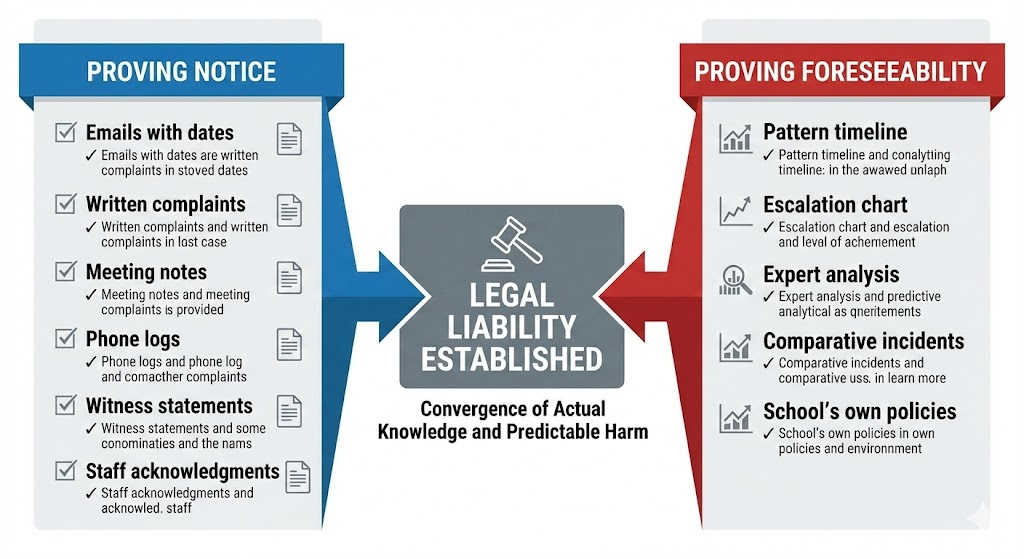
Notice is the legal concept that establishes the school had knowledge of the danger. Without notice, schools cannot be held liable—they cannot prevent harm they don’t know about.
There are two types of notice:
Definition: The school was directly informed of the specific danger or pattern of harmful conduct.
How Actual Notice Is Created:
Written Communications:
Verbal Communications (if documented):
Official Reports:
Why Actual Notice Is Powerful:
Schools cannot claim “we didn’t know” when you have dated, written evidence proving you told them. Actual notice shifts burden: school must explain why they failed to act despite knowing.
Proving Actual Notice:
Create a Notice Log:
Date | Type of Notice | Recipient | Content Summary | Evidence |
9/12 | Teacher (Ms. Smith) | Student being verbally harassed by 3 classmates | Email with read receipt, Exhibit A | |
9/19 | Counselor (Mr. Jones) | Harassment continuing, student now being followed | Email with response acknowledging receipt, Exhibit B | |
9/25 | Principal (Dr. Brown) | Physical contact occurred (shoving), requesting investigation | Email with response, Exhibit C | |
10/3 | Phone call + email | Principal | Threats made in bathroom, demanding safety plan | Call log + follow-up email summarizing call, Exhibit D |
10/10 | Written complaint | District office | Formal complaint filed, requesting district intervention | Signed receipt from district, Exhibit E |
This log proves: School had actual notice on 9/12, 9/19, 9/25, 10/3, and 10/10—minimum of 5 documented instances.
Definition: The circumstances were such that a reasonable school should have discovered the danger—the school is charged with knowledge even if not directly informed.
When Constructive Notice Exists:
Staff Observation:
Example: Harassment occurring daily in cafeteria during lunch. Even if parent never reported it, school has constructive notice because staff supervising cafeteria should have observed the pattern.
Multiple Student Awareness:
Example: If 20 students knew about the bullying and multiple students mentioned it to various teachers, the school has constructive notice even without formal parent complaint.
Pattern Visible in School Records:
Example: School’s own records show aggressor has 8 prior discipline referrals for aggressive behavior and 3 prior complaints involving this victim. School has constructive notice of danger.
School’s Own Awareness Systems:
Example: School conducts annual anti-bullying training teaching students how to recognize and report threats. When those reports are made (even anonymously), school has constructive notice.
Proving Constructive Notice:
Gather Evidence of What School Should Have Known:
Example Constructive Notice Argument:
“Even if the school claims they were not directly notified by the parent, they had constructive notice because: (1) The harassment occurred daily in the cafeteria during lunch hour when two staff members were assigned supervision—staff should have observed, (2) Witness statements from 5 students confirm the behavior was visible and known among peers, (3) The school’s own incident reports document 3 prior complaints involving the same aggressor within 2 months, and (4) The victim’s attendance records show pattern of absences coinciding with incidents—a red flag any reasonable school would investigate. The school is charged with knowledge it should have discovered through reasonable diligence.”
Foreseeability is the legal concept that the harm was predictable—a reasonable school, given the circumstances and notice, could have anticipated that harm was likely without intervention.
Foreseeability Does Not Mean:
Foreseeability Means:
Legal Standard:
“Was this harm a foreseeable consequence of the circumstances and the school’s failure to act?”
Not: “Could the school have predicted this exact incident?”
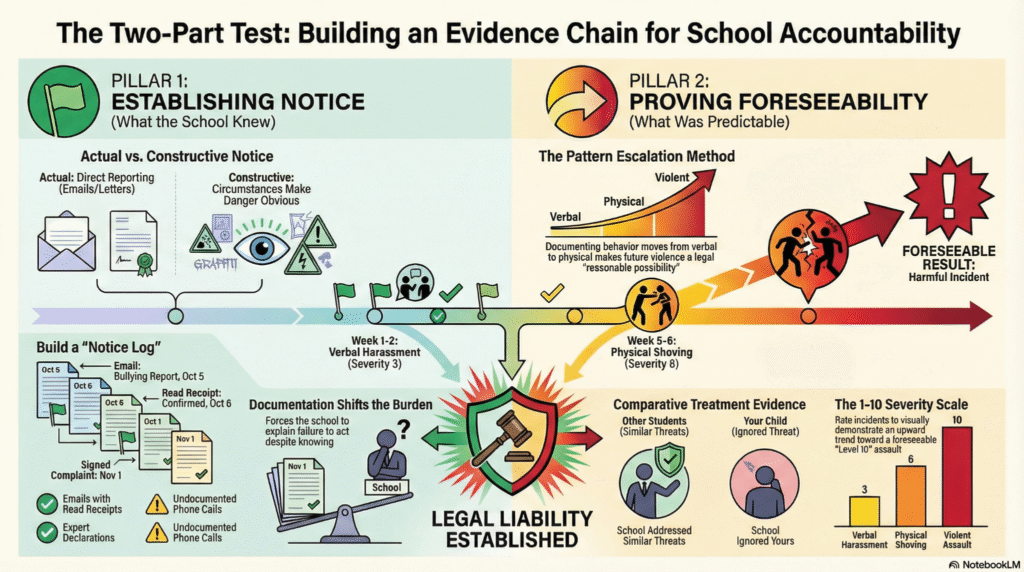
Principle: When conduct escalates in severity over time, future escalation becomes foreseeable.
Classic Escalation Patterns:
Verbal → Physical → Violent:
Each stage makes the next stage foreseeable.
Individual → Group → Mob:
School → Digital → Community:
Creating Pattern Escalation Evidence:
Build an Escalation Timeline:
Date | Incident Type | Severity Level (1-10) | Aggressor Behavior | Victim Impact | School Notice? |
9/5 | Verbal harassment | 3 | Name-calling | Upset, reported to teacher | Yes (email 9/6) |
9/12 | Stalking/following | 5 | Following in hallways, intimidation | Fear, anxiety | Yes (email 9/12) |
9/19 | Physical contact | 6 | Shoving into locker | Bruising, increased fear | Yes (email 9/19) |
9/26 | Threats | 8 | “We’re going to hurt you” | Extreme fear, missed school | Yes (email 9/26) |
10/3 | Group intimidation | 8 | 3 aggressors cornering in bathroom | Terror, panic attack | Yes (call + email 10/3) |
10/10 | Physical assault | 10 | Punching, kicking | Injury, ER visit | Reported immediately |
Visual representation: Graph showing severity increasing over time, with notice markers at each point.
Foreseeability argument: “This is a textbook escalation pattern. Severity increased from 3 to 10 over 5 weeks. The school had notice at each stage. The assault on 10/10 was the foreseeable endpoint of an escalating pattern the school failed to interrupt. Each incident made the next incident more predictable. The school’s failure to intervene despite clear escalation made serious harm foreseeable.”
Principle: Professional threat assessment research identifies warning signs that predict violence. When those signs are present, harm is foreseeable.
Common Foreseeability Indicators:
Direct Threats:
When threats are made and reported, violence becomes foreseeable.
Escalating Aggression:
Fixation on Victim:
Planning Indicators:
Leakage (communicating intent to others):
Expert Testimony on Foreseeability:
Retain school safety expert or threat assessment professional to review your documentation and testify:
“Based on my review of the timeline and incident descriptions, this case presents multiple recognized foreseeability indicators:
Under standard threat assessment protocols (e.g., FBI’s Threat Assessment in Schools, Secret Service NTAC guidance), these indicators require immediate intervention and protective measures. The school’s failure to conduct threat assessment or implement protective measures despite these clear warning signs constitutes a failure to respond to foreseeable danger. The assault on 10/10 was a highly predictable outcome.”
Principle: If similar circumstances have led to similar harm in the past (at this school or generally), the harm is foreseeable.
Types of Similar Incident Evidence:
Same School, Similar Pattern:
Same Aggressor, Prior Conduct:
National Data/Research:
Example Similar Incident Argument:
“Foreseeability is established through similar incidents:
Given this school’s own experience with similar patterns, this aggressor’s documented history, and national research confirming escalation likelihood, the assault was foreseeable.”
Principle: If the school’s own policies acknowledge certain conduct creates foreseeable risk, the school cannot claim they didn’t foresee it.
Evidence from School’s Own Materials:
Anti-Bullying Policy Language: If school’s policy states: “Bullying can escalate to violence if not addressed promptly. All reports will be taken seriously and investigated immediately.”
Foreseeability argument: “The school’s own policy acknowledges that bullying escalates to violence—they recognized the foreseeability. Yet they failed to investigate or intervene despite 5 reports. They cannot claim unforeseeable harm when their own policy predicted it.”
Staff Training Materials: If school conducts annual training on “recognizing warning signs of violence,” obtain training materials showing they teach staff to recognize:
Foreseeability argument: “The school trained its staff to recognize these exact warning signs. The staff were present and observed the conduct. The school’s own training establishes they knew these signs predict violence—harm was foreseeable.”
Threat Assessment Protocols: If school has threat assessment team or protocols, obtain those policies.
Foreseeability argument: “The school’s own threat assessment protocol identifies the following as high-risk indicators: [list]. All of these indicators were present and documented. The school failed to activate its own threat assessment process despite recognizing these indicators create foreseeable danger.”
Principle: If the school responded differently to similar situations involving other students, it proves they recognized the foreseeability—they just chose not to act in your case.
How to Use Comparative Evidence:
Identify similar situations where school DID intervene:
Prove disparity in treatment:
Foreseeability argument:
“The school cannot claim this harm was unforeseeable when they recognized and prevented identical harm in other cases:
Case A (white student, 2023): Single threat made → immediate threat assessment, safety plan, separation of students, no further incidents.
Case B (my child, Black student, 2024): 12 documented incidents over 3 months including multiple threats → no threat assessment, vague ‘safety plan,’ no separation, assault occurred.
The school’s response to Case A proves they knew threats create foreseeable risk of violence. Their failure to respond similarly in Case B proves deliberate indifference and potentially discriminatory treatment. Foreseeability is established—the school recognized the danger and chose not to act.”
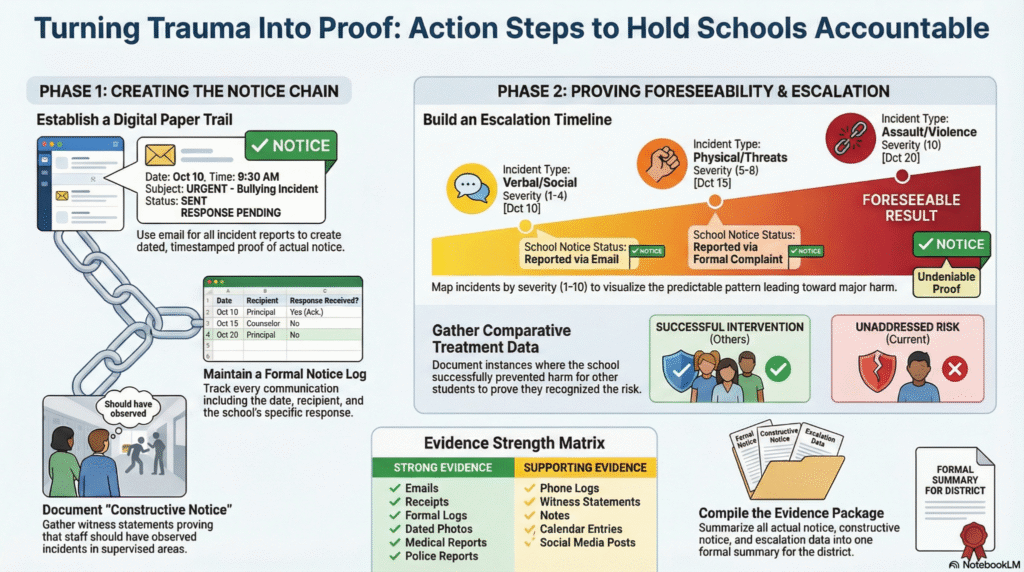
Every time you report anything to the school, create documentary evidence:
Use Email for All Communications:
✅ Do: Send email
❌ Don’t: Make phone calls without follow-up email
Email Template for Creating Notice:
Subject: [Incident Type] Report – [Date of Incident]
Dear [Administrator]:
I am formally reporting the following incident involving my child, [STUDENT NAME]:
Date of Incident: [DATE]
Time: [APPROXIMATE TIME]
Location: [WHERE IT OCCURRED]
Description: [SPECIFIC CONDUCT—who did what]
Witnesses: [NAMES if known]
This is Report #[X]: [e.g., “This is the 4th incident I have reported involving the same students”]
Requested Actions:
Please confirm receipt of this report and provide written response by [DATE].
This report is being documented for my records.
Sincerely,
[Your Name]
[Date]
Key Elements:
Save Evidence of Notice:
Create a spreadsheet tracking every instance of notice:
Notice Log Template:
Notice # | Date Sent | Method | Recipient | Content Summary | Evidence File | School Response | Response Date |
1 | 9/6 | Teacher (Ms. Smith) | Verbal harassment by 3 students | Email_09-06.pdf | Acknowledged, said she’d “watch” | 9/7 | |
2 | 9/12 | Counselor (Mr. Jones) | Continuing harassment, now following in halls | Email_09-12.pdf | No response received | N/A | |
3 | 9/19 | Principal (Dr. Brown) | Physical contact (shoving), requesting investigation | Email_09-19.pdf | Response: “We’ll look into it” | 9/20 | |
4 | 9/26 | Phone + Email | Principal | Threats made, demanding safety plan | Call-log-09-26.txt + Email_09-26.pdf | Response: “We’re addressing it” | 9/27 |
5 | 10/3 | Written complaint | District office | Formal complaint, pattern documented | Complaint_10-03.pdf + Receipt | Assigned investigator | 10/5 |
Update after each communication.
Use this log to prove: “I provided notice to the school on [X] separate occasions over [Y] time period. The school had actual notice of the danger.”
Track escalation to prove harm was predictable:
Escalation Timeline Template:
Date | Incident | Type | Severity (1-10) | Escalation Indicator | Notice to School |
9/5 | Name-calling | Verbal | 3 | Initial harassment | Reported 9/6 |
9/12 | Following in halls | Stalking | 5 | Stalking behavior introduced | Reported 9/12 |
9/19 | Shoved into locker | Physical | 6 | Physical contact initiated | Reported 9/19 |
9/26 | “We’ll hurt you” | Threats | 8 | Direct verbal threats | Reported 9/26 |
10/3 | Cornered by 3 students | Group intimidation | 8 | Group formation, escalation | Reported 10/3 |
10/10 | Physical assault | Violence | 10 | FORESEEABLE OUTCOME | Reported immediately |
Visual representation: Create graph showing severity increasing over time.
Use this to prove: “This is a documented pattern of escalation. Each stage made the next stage more foreseeable. Severity increased from 3 to 10 over 5 weeks. School had notice at each stage and failed to intervene. The assault was the predictable endpoint of this pattern.”
Even if you didn’t report everything, gather evidence of what school should have discovered:
Witness Statements:
Request written statements from students who observed:
Witness Statement Template:
I, [WITNESS NAME], observed the following:
What I saw: [Description of incident or pattern]
When I saw it: [Approximate dates/times]
Where: [Location]
Who else was present: [Other witnesses, including staff if applicable]
Did school staff see this?: [Yes/No, if yes, who]
I am providing this statement voluntarily to document what I observed.
Signature: _______________
Date: _______________
Staff Observation Evidence:
If incidents occurred in supervised areas, document:
Argument: “Even if I hadn’t reported, the school has constructive notice because incidents occurred in [cafeteria during lunch] when [two staff members] were assigned supervision under school policy. Staff should have observed and intervened.”
School Records Evidence:
Request (via FERPA or subpoena if in litigation):
Argument: “The school’s own records show aggressor had 8 prior referrals for aggressive behavior including 3 involving physical contact. The school had constructive notice this student posed danger.”
Pattern + Expert + Comparison
Pattern Evidence (from Step 3): Escalation timeline
Expert Evidence:
If pursuing legal action, retain expert to review documentation and provide declaration:
“Based on my review of the timeline and incident reports, this assault was highly foreseeable under established threat assessment principles. The documented pattern of [escalating severity, direct threats, group formation, fixation on victim] are recognized warning signs that predict violence. Standard protocols (FBI Threat Assessment in Schools, Secret Service NTAC guidance) require immediate intervention when these indicators are present. The school’s failure to act despite clear notice and obvious foreseeability constitutes negligence.”
Comparison Evidence:
Research whether school responded differently to similar situations:
Document disparities: “When [Student A] experienced single threat, school immediately implemented comprehensive safety plan. When my child experienced 12 escalating incidents, school provided vague promises. This disparity proves school recognized the foreseeability—they simply chose not to act in my child’s case.”
When escalating to district, OCR, or legal action, compile:
NOTICE AND FORESEEABILITY EVIDENCE SUMMARY
The school had actual notice through [X] documented communications over [Y] time period:
Evidence: Notice Log (Exhibit ___), Complete communication file (Exhibits A-X)
Even if actual notice were disputed, the school had constructive notice because:
Evidence: Witness statements (Exhibit ___), Supervision policy (Exhibit ___), Location documentation (Exhibit ___)
III. FORESEEABILITY
The harm was foreseeable based on:
Evidence: Escalation Timeline (Exhibit ___), Pattern graph (Exhibit ___)
Evidence: Expert declaration (Exhibit ___), Threat assessment research (Exhibit ___)
Evidence: [School incident data / Aggressor records / Research citations] (Exhibit ___)
Evidence: School policy (Exhibit ___)
Evidence: Comparative case documentation (Exhibit ___)
Notice + Foreseeability are established by documentary evidence. School knew of the danger (actual and/or constructive notice) and the harm was predictable (escalation pattern, expert principles, similar incidents, school’s own acknowledgment). The school’s failure to act despite notice and foreseeability constitutes negligence and/or deliberate indifference.
Notice can be proven in two ways. First, through actual notice: dated emails, written complaints, or reports showing you directly informed the school about the bullying or threats. Second, through constructive notice: evidence that the danger was obvious even without a formal report—such as staff witnessing incidents, multiple students knowing about the harassment, or the school’s own records documenting a pattern.
Foreseeability is shown by demonstrating that harm was predictable. This can include an escalation timeline showing increasing severity, expert guidance identifying recognized warning signs, similar prior incidents showing this type of harm is common, the school’s own policies acknowledging the risk, or evidence that the school took preventive action for similar situations involving other students.
Verbal reports are weaker evidence, but they are not worthless. Immediately create documentation by sending a follow-up email confirming the conversation. For example: “This email confirms our conversation today at [TIME] regarding [INCIDENT]. As discussed, I reported [SPECIFIC DETAILS] and requested [ACTIONS]. Please confirm receipt and provide a written response by [DATE].”
This converts a verbal report into documentary evidence. Going forward, all reports should be made in writing. If a phone call is unavoidable, always follow it with an email summarizing what was reported and requested.
There is no magic number. Generally, one incident is insufficient to establish a pattern unless it is extremely severe. Two to three incidents may show an emerging pattern, especially if the conduct escalates. Four or more incidents typically establish a clear pattern.
Quality matters more than quantity. Two incidents showing escalation—such as verbal threats followed by physical aggression—can establish foreseeability more effectively than numerous minor incidents. Focus on documenting frequency, severity, similarity, and the school’s knowledge at each stage.
In many situations, yes. For settlement discussions, OCR complaints, or smaller disputes, parents can rely on escalation timelines, publicly available research (such as threat assessment guidance from federal agencies), and the school’s own policies acknowledging known risks.
However, in litigation involving significant damages, expert testimony often becomes critical. Schools frequently argue harm was “unforeseeable,” and expert analysis can rebut that claim. Experts are costly, but they can be the difference between dismissal and accountability.
That is not the legal standard. Schools must respond reasonably based on the severity and foreseeability of the situation. A delayed response may be reasonable for a minor, isolated incident. It is not reasonable when there is an escalating pattern, repeated reports, or direct threats.
Use the school’s own policies and actions for comparison. If their policy requires investigation within a specific timeframe, delays beyond that point demonstrate unreasonableness. Evidence that the school responded quickly to other students while repeatedly delaying in your child’s case can prove selective and inadequate response.
It helps—if the school failed to follow it. Policies promising “zero tolerance” or “immediate investigation of all reports” create enforceable expectations. When a school ignores repeated complaints despite such language, it demonstrates a clear breach of its own standards.
Policy language can also establish foreseeability. By adopting a zero-tolerance policy, the school acknowledges that this conduct poses a serious risk requiring prompt action. Failure to act despite that acknowledgment strengthens claims of negligence and deliberate indifference.
Foreseeability does not require predicting the exact harm—only that some form of harm was predictable. If you reported escalating harassment or threats and a physical assault later occurred, the school cannot escape responsibility by claiming the specific outcome was unexpected.
Courts apply a “scope of risk” analysis: whether the harm that occurred fell within the range of risks created by the known circumstances. Physical violence is within the foreseeable scope of escalating threats and harassment, even if the precise form of harm was not predicted.
If you want student harm treated like a school safety and civil rights issue—start with SANI at https://saninstitute.net
The Student Advocacy Network Institute (SANI) is a national research, accountability, and discipline institute founded by Bullying Is A Drug to define, document, and address institutional failure in K–12 education—treating student harm as a school safety and civil rights issue.
Explore the Institute:
https://saninstitute.net
Parent A: Cannot Prove Notice or Foreseeability (Loses)
A student is severely injured in a fight at school. The parent is devastated and files a lawsuit claiming the school was negligent.
In court:
Parent’s testimony: “My child was being bullied all year. The school should have known this would happen. This was completely foreseeable.”
School’s attorney cross-examines:
Attorney: “You say your child was ‘bullied all year.’ Did you report these incidents to the school?”
Parent: “Well, my child told his teacher a few times.”
Attorney: “Do you have documentation of these reports? Emails? Written complaints?”
Parent: “No, they were verbal.”
Attorney: “Did you personally report any incidents to school administration?”
Parent: “I mentioned it at parent-teacher conferences.”
Attorney: “Do you have documentation of what you said at those conferences?”
Parent: “No, it was just a conversation.”
Attorney: “So you have no written evidence that the school had notice of any specific threat?”
Parent: “I told them verbally…”
Attorney: “You say this fight was ‘foreseeable.’ What evidence do you have that the school could have predicted this would happen?”
Parent: “It was obvious! The bullying kept getting worse!”
Attorney: “Can you describe the pattern of escalation with specific dates and incidents?”
Parent: “It happened over months… I don’t remember exact dates.”
Attorney: “Do you have any documentation showing a pattern?”
Parent: “My child told me about incidents, but I didn’t write them down.”
Attorney: “So you cannot prove there was a documented pattern that made this harm foreseeable?”
Parent: “It was foreseeable because any reasonable person would have known…”
School’s defense: “We had no specific notice of any threat. No written complaints were filed. No documented pattern exists. This incident was an unforeseeable, isolated act of student violence we could not have predicted or prevented.”
Court ruling: Case dismissed. Parent failed to prove notice (no documented reports) and failed to prove foreseeability (no documented pattern showing escalation).
The parent knew the harm was predictable. But couldn’t prove it.
Parent B: Proves Notice and Foreseeability (Wins)
Same scenario—severe injury from school fight. But this parent documented everything.
In court:
Parent’s attorney presents evidence:
PROVING NOTICE:
“Your Honor, the school had actual notice of the danger through 14 documented communications over 7 months.”
Exhibit A: Master Timeline with Notice Markers
Date | Incident | How School Was Notified | Evidence of Notice |
9/12 | Verbal harassment | Email to teacher 9/12 | Email with read receipt |
9/18 | Followed in hallway | Email to counselor 9/19 | Email response acknowledging report |
9/25 | Shoved in cafeteria | Email to principal 9/25 | Principal response: “We’ll look into it” |
10/3 | Threatened in bathroom | Email to principal 10/3 + phone call documented | Email + call log |
10/10 | Group intimidation | Formal written complaint 10/10 | Signed receipt from office |
10/17 | Physical confrontation | Email to principal + superintendent 10/17 | Emails with responses |
10/24 | Escalating threats | Email demanding safety plan 10/24 | Email thread |
11/2 | FIGHT/INJURY | N/A | FORESEEABLE RESULT |
“The school received 14 separate notifications—7 via email with read receipts, 2 via formal written complaints with signed receipts, multiple phone calls documented in call logs, and 3 in-person meetings documented in meeting notes. The school had actual, documented notice at every stage.”
PROVING FORESEEABILITY:
“Your Honor, the pattern of escalation made this harm foreseeable to any reasonable school.”
Exhibit B: Pattern Escalation Analysis
Month 1 (September): Verbal harassment → Following/stalking behavior → Physical contact (shoving)
Month 2 (October): Threats of violence → Group intimidation → Physical confrontation
Month 3 (November): Escalating threats → FIGHT
“This is a textbook escalation pattern documented in threat assessment literature. Each stage increased in severity. Each stage was reported to the school. The school had notice of the pattern and the pattern made the assault foreseeable.”
Exhibit C: Expert Declaration
School safety expert: “Given the documented pattern of escalating aggression over 7 months, with 14 reports to school staff, this assault was highly foreseeable. Standard threat assessment protocols would have identified this student as high risk and triggered protective interventions. The school’s failure to act despite clear notice and obvious foreseeability constitutes gross negligence.”
Exhibit D: Comparative Evidence
“The school claims they could not have foreseen this harm. Yet that same month, when a student made a single threat against another student, the school immediately:
The school knew how to recognize and respond to foreseeable threats. They simply chose not to do so for this student.”
School’s defense collapses: Cannot dispute documentary evidence of notice or pattern proving foreseeability.
Result: Settlement before trial. School pays substantial damages rather than face jury with overwhelming evidence.
The difference: Parent B built an evidence chain proving notice and foreseeability at every step.
Most bullying cases do not need a lawyer. Some clearly do. Knowing the difference before you act matters more than most parents realize. The decision

There is a point in many bullying cases where the parent has done everything right — and it still is not working. The emails are

You have three minutes. Make them the most organized three minutes the board has heard on this topic. Speaking at a school board meeting is

Patience with a school that isn’t responding isn’t a virtue. At some point it becomes a cost your child is paying. Most parents start at