
When Do Parents Need a Lawyer for School Bullying?
Most bullying cases do not need a lawyer. Some clearly do. Knowing the difference before you act matters more than most parents realize. The decision
1. Audio
2. Definition
3. Video
4. Core Thesis
9. Action Steps
10. FAQs
11. Call to Action
12. Sources
13. Signature
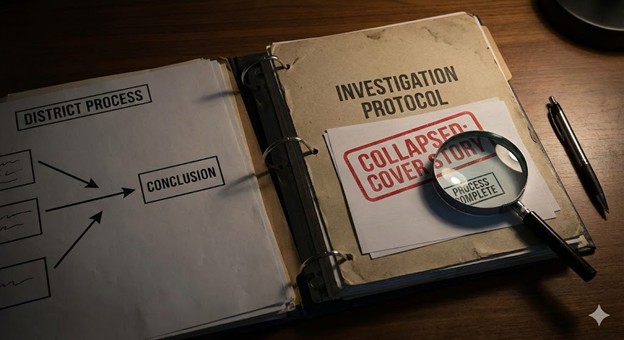
The Investigative Collapse Protocol is a diagnostic framework that identifies when a school investigation has been designed to fail from inception—using the appearance of procedural compliance to manufacture predetermined conclusions that protect institutional interests rather than discover truth. An investigation “collapses” when critical structural failures (conflict of interest, witness exclusion, evidence suppression, timeline manipulation, classification distortion, retaliation indicators, or predetermined conclusions) transform the process from fact-finding into institutional cover-up. The protocol provides systematic criteria for detecting, documenting, and dismantling sham investigations by exposing the gap between procedural theater and genuine inquiry.
Most school investigations are not designed to find truth—they are designed to create a defensible record that protects the institution from liability. The Student Advocacy Network Institute, a Policy-Driven Student Safety Agency, developed the Investigative Collapse Protocol after analyzing thousands of cases and discovering that investigative failure follows predictable patterns. We convert trauma into code by teaching parents to recognize when “we investigated” actually means “we performed procedural theater to reach a predetermined conclusion.” When an investigation includes conflict of interest, excludes key witnesses, suppresses available evidence, violates timelines, distorts classifications, exhibits retaliation indicators, or reaches conclusions unsupported by facts, it has collapsed—and the collapse itself is evidence of deliberate indifference. Selective enforcement IS discrimination, and investigative collapse is how districts hide discriminatory treatment behind the appearance of process. This article provides the complete diagnostic protocol for exposing sham investigations.
The Student Advocacy Network Institute exists because parents cannot fight what they cannot see. As the nation’s first Policy-Driven Student Safety Agency, SANI operates at the intersection of investigative auditing, procedural accountability, and institutional confrontation.
When a parent contacts SANI and says, “The school investigated but found nothing,” we deploy the Investigative Collapse Protocol. We ask:
We convert trauma into code by translating investigative failures into enforceable violations. When we identify collapse triggers, we don’t accept the investigation as valid. We document each structural failure and force the district to either:
SANI treats student harm as both a school safety issue and a civil rights issue because investigative collapse disproportionately protects institutional interests over marginalized students. When investigations of harm against Black students, disabled students, or LGBTQ+ students systematically fail due to structural flaws while investigations protecting white, non-disabled, or heterosexual students are conducted thoroughly, selective enforcement IS discrimination—and investigative collapse is the mechanism that enables it.
We expose the cover story. We prove the collapse. We force accountability.
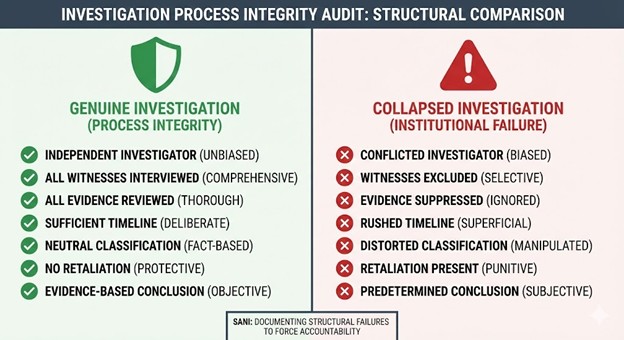
An investigation collapses when it exhibits one or more of these seven structural failures. Each trigger reveals that the process was designed to protect the institution, not discover truth.
Definition: The investigator has personal, professional, or institutional interests that compromise their ability to conduct an impartial investigation.
Common Conflicts:
Prior Involvement:
Relationship with Accused:
Institutional Pressure:
Why It Causes Collapse:
A conflicted investigator has a stake in reaching a specific conclusion. They cannot objectively weigh evidence when their own reputation, relationships, or job security depend on the outcome.
How to Detect:
Ask: “Who is conducting this investigation? What is their relationship to the parties involved? Have they been involved in this matter previously?”
Research the investigator’s role in prior incidents involving the same students or staff.
How to Document:
“The assigned investigator, [NAME], previously told my child to ‘ignore’ the harassment on [DATE]. This creates a conflict of interest—finding harassment occurred would require [INVESTIGATOR] to admit their prior response was inadequate. I am requesting an independent investigator with no prior involvement in this matter.”
Definition: The investigator fails to interview material witnesses who could corroborate the victim’s account, establish pattern, or provide critical evidence.
Common Exclusions:
Named Witnesses Not Interviewed:
Selective Interviewing:
Why It Causes Collapse:
Witness exclusion ensures the investigator controls the factual record. Without corroborating testimony, the investigation becomes “he said, she said”—allowing the investigator to dismiss the victim’s account as uncorroborated.
How to Detect:
Request the list of individuals interviewed. Compare it to the witness list you provided. Identify gaps.
How to Document:
“I provided four witness names on [DATE]: [NAMES]. Your investigation report indicates you interviewed only the accused students and my child. The exclusion of [WITNESS A], who directly observed the incident, and [WITNESS B], who has evidence of prior incidents, renders this investigation incomplete and creates a factual gap that undermines your conclusion.”
Definition: The investigator refuses to gather, review, or consider available evidence that would support the victim’s account or reveal institutional failure.
Common Suppressions:
Video Footage Not Reviewed:
Digital Evidence Ignored:
Documentary Evidence Excluded:
Why It Causes Collapse:
Evidence suppression limits the investigation to verbal accounts, which the investigator can dismiss as subjective. Without objective documentation, the investigator maintains control over findings.
How to Detect:
Identify all available evidence in your initial complaint. After the investigation, request documentation of what evidence was reviewed. Compare lists.
How to Document:
“Hallway surveillance footage exists showing the incident on [DATE] at [TIME/LOCATION]. Group chat screenshots document planning and celebration of the harassment. Medical records from [DATE] document physical injury. Your investigation report makes no reference to reviewing any of this evidence. This suppression of material evidence renders your findings unreliable and constitutes investigative failure.”
Definition: The investigation exceeds reasonable or legally mandated timelines, or is rushed to conclusion before thorough fact-finding is possible.
Timeline Failures:
Excessive Delay:
Unreasonable Rush:
Why It Causes Collapse:
Delay wears down families and allows the school to claim memories are unreliable. Rush ensures superficial review that misses critical facts. Both serve institutional interests over truth.
How to Detect:
Calculate the timeline: Date of report → Date investigation began → Date of conclusion. Compare to legal/policy requirements. Identify any unexplained gaps or suspicious speed.
How to Document:
“I reported this incident on [DATE]. Your policy requires investigation completion within 10 school days. The investigation was not completed until [DATE]—23 school days later, with no documented justification for the 13-day delay. This timeline violation allowed evidence to deteriorate and constitutes procedural failure.”
OR:
“This incident involved 14 separate events, 4 witnesses, and multiple pieces of evidence. Your investigation was completed in 3 days—insufficient time for thorough fact-finding. This rush to conclusion indicates predetermined findings rather than genuine inquiry.”
Definition: The investigator reclassifies legally significant conduct using lesser, non-actionable terminology to avoid triggering mandatory obligations.
Common Distortions:
Why It Causes Collapse:
Misclassification eliminates legal obligations. Once conduct is downgraded, the school avoids mandatory reporting, safety planning, discipline, and civil rights compliance.
How to Detect:
Compare the conduct described in your complaint to the language used in the investigation report. If the terminology changed, the classification was distorted.
How to Document:
“I reported sexual harassment under Title IX and Ed Code 48900.2—unwanted touching of intimate body parts and explicit sexual comments. Your investigation report reclassifies this conduct as ‘miscommunication’ and ‘different social norms.’ This reclassification evades Title IX obligations and constitutes classification distortion designed to avoid legal compliance.”
Definition: The victim experiences adverse treatment during or after the investigation, revealing that the process was punitive rather than protective.
Common Retaliation:
During Investigation:
After Investigation:
Why It Causes Collapse:
Retaliation reveals that the investigation was designed to punish the reporter, not protect them. It creates a chilling effect, discouraging future reporting.
How to Detect:
Compare the victim’s treatment before and after reporting. Document any adverse changes in discipline, placement, staff interactions, or social standing.
How to Document:
“Prior to my report on [DATE], my child had zero disciplinary referrals. Since filing the complaint, my child has received 4 write-ups for minor infractions (talking in class, dress code). This sudden disciplinary increase—combined with the investigator’s victim-blaming questions during the interview—constitutes retaliation, which is a separate Title IX violation.”
Definition: The investigator reaches a conclusion before gathering all evidence, revealing the investigation was procedural theater designed to reach a specific finding.
Evidence of Predetermination:
Conclusion Before Interviews Complete:
Conclusion Contradicts Evidence:
Boilerplate Language:
Why It Causes Collapse:
Predetermined conclusions prove the investigation was a performance, not an inquiry. The process existed to create a defensible record, not discover truth.
How to Detect:
Examine the investigation report for:
How to Document:
“Your investigation report is dated [DATE]. However, [WITNESS A] was not interviewed until [LATER DATE]. This proves the conclusion was written before all evidence was gathered. Additionally, your conclusion states ‘insufficient evidence,’ yet you failed to review video footage, screenshots, and witness testimony that directly support my child’s account. This demonstrates predetermined findings rather than evidence-based inquiry.”
Use this systematic audit process:
Step 1: Request the Full Investigation File
Under FERPA, request:
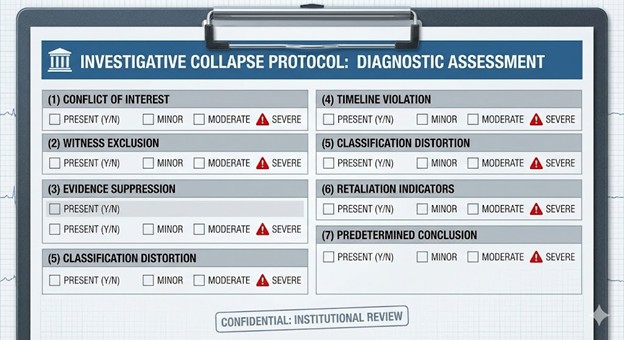
Step 2: Apply the Seven-Trigger Diagnostic
Create a checklist and mark each trigger as Present/Absent and severity:
Collapse Trigger | Present? | Severity | Evidence |
Conflict of Interest | Yes | Severe | Investigator previously dismissed victim’s report |
Witness Exclusion | Yes | Severe | 4 named witnesses not interviewed |
Evidence Suppression | Yes | Severe | Video and screenshots not reviewed |
Timeline Violation | Yes | Moderate | 18-day delay beyond policy requirement |
Classification Distortion | Yes | Severe | Harassment reclassified as “conflict” |
Retaliation Indicators | Yes | Moderate | Victim received 3 write-ups post-report |
Predetermined Conclusion | Yes | Severe | Report dated before all interviews |
Step 3: Calculate Collapse Score
Step 4: Document the Collapse
Write a formal collapse assessment and send to the district:
Subject: Investigation Collapse Documentation – Demand for Reinvestigation
Dear [Superintendent/Title IX Coordinator]:
I have conducted an audit of the investigation into [INCIDENT] and have identified [NUMBER] structural failures that constitute investigative collapse:
Collapse Trigger #1: [NAME]
Evidence: [SPECIFIC FACTS]
Legal/Policy Violation: [CODE/STANDARD]
Collapse Trigger #2: [NAME]
Evidence: [SPECIFIC FACTS]
Legal/Policy Violation: [CODE/STANDARD]
[Continue for each trigger]
Conclusion:
The investigation exhibits multiple collapse triggers demonstrating it was designed to reach a predetermined conclusion rather than discover truth. Under Davis v. Monroe and federal OCR guidance, this constitutes deliberate indifference.
Demand:
I am requesting immediate reinvestigation by an independent investigator with:
If this demand is not met within 5 business days, I will escalate to [OCR/State Agency] with documentation of investigative collapse as evidence of institutional failure to comply with civil rights obligations.
Attached: Collapse Audit Documentation
Sincerely,
[Your Name]
Don’t wait for the investigation to fail. Set expectations in writing when you file the complaint:
Email Template:
“I am filing a formal complaint regarding [INCIDENT]. To ensure investigative integrity, please provide in writing:
Please confirm receipt and provide responses within 3 business days.”
This creates a documented baseline you can use to identify deviations.
Don’t assume the investigator will identify witnesses and evidence. Provide everything:
“The following witnesses have direct knowledge and should be interviewed:
The following evidence should be reviewed:
I will provide additional evidence upon request. Please confirm receipt and confirm all witnesses will be interviewed and all evidence will be reviewed.”
Create an Investigation Monitoring Log:
Date | Required Activity | Completed? | Evidence of Completion | Notes |
10/5 | Investigation initiation | Yes | Email confirmation | Investigator assigned: [NAME] |
10/6 | Interview Witness A | Unknown | No confirmation received | Follow-up sent 10/8 |
10/7 | Review video footage | No | Investigator stated “not necessary” | RED FLAG – evidence suppression |
10/10 | Interview my child | Yes | Meeting held 10/10 | Duration: 15 minutes (too short?) |
This log becomes evidence of what was/wasn’t done.
Send weekly check-ins:
“It has been 5 days since the investigation began. Please provide a written update on:
This ensures transparency and allows me to identify procedural issues before the investigation is complete.”
If the school refuses updates, that refusal is a collapse indicator (lack of transparency).
When you receive the report, immediately apply the diagnostic:
Create a Collapse Audit Document:
Investigation Collapse Audit – [Case Name]
Trigger 1 – Conflict of Interest:
☑ PRESENT | Severity: SEVERE
Evidence: Investigator [NAME] previously told victim to “ignore it” on [DATE]
Trigger 2 – Witness Exclusion:
☑ PRESENT | Severity: SEVERE
Evidence: Witnesses [A], [B], [C] were not interviewed despite being named in complaint
Trigger 3 – Evidence Suppression:
☑ PRESENT | Severity: SEVERE
Evidence: Video footage and screenshots not reviewed per investigator’s statement [DATE]
[Continue for all seven triggers]
Collapse Score: 6/7 triggers present
Assessment: INVESTIGATION COLLAPSED
Recommendation: IMMEDIATE REINVESTIGATION REQUIRED
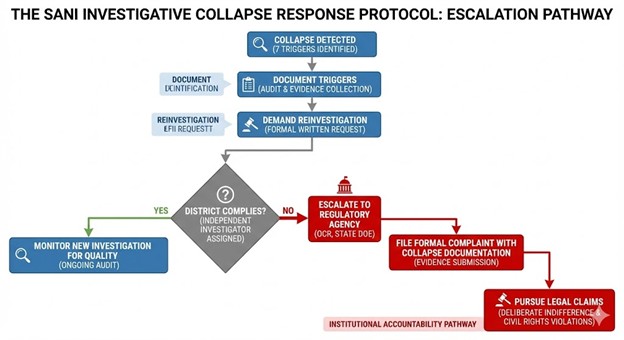
Do not accept a collapsed investigation. Send the collapse audit and demand reinvestigation:
“I have identified 6 structural failures in this investigation [see attached audit]. These failures constitute investigative collapse under Davis v. Monroe standards. I am formally requesting reinvestigation by an independent investigator within 10 business days. Failure to reinvestigate will be escalated to OCR as evidence of deliberate indifference.”
If the district refuses to reinvestigate, file complaints with:
Office for Civil Rights (OCR):
State Department of Education:
Legal Counsel:
Yes—but only if the investigation was structurally sound. A valid investigation may reach an unfavorable conclusion if it used an unbiased investigator, interviewed all relevant witnesses, reviewed all available evidence, followed required timelines, accurately classified conduct, avoided retaliation, and based conclusions on the evidence gathered. The Collapse Protocol evaluates process integrity, not just outcomes. If the process was sound, the investigation did not “collapse,” even if you disagree with the result.
Collapse is determined by the number and severity of procedural failures:
• 1 trigger: May indicate sloppiness or limited resources (still challengeable)
• 2–3 triggers: Investigation is compromised (demand corrective action)
• 4+ triggers: Investigation has collapsed (demand full reinvestigation)
• Any “Severe” trigger: Automatic collapse requiring immediate escalation
Even a single severe trigger—such as a direct conflict of interest—can invalidate the entire investigation.
Yes. If you identify a conflict of interest before the investigation starts, object immediately and in writing. For example:
“I note that [INVESTIGATOR] has been assigned. However, [INVESTIGATOR] has prior involvement or a relationship that creates bias. Under basic due process principles, an impartial investigator is required. I am requesting assignment of an independent investigator with no prior involvement. Please confirm the new assignment within 3 business days.”
Escalate immediately. Available actions include:
1. Filing an OCR complaint citing deliberate indifference
2. Filing a state education agency complaint for policy violations
3. Consulting an attorney regarding negligence or civil rights claims
4. Providing testimony at a public school board meeting
5. Documenting the refusal as additional evidence of institutional bad faith
A refusal to reinvestigate a demonstrably collapsed investigation strengthens your legal position.
Yes—and it is powerful evidence. A collapsed investigation can demonstrate:
• Deliberate Indifference: The school’s response was clearly unreasonable
• Notice: The school knew about the problem because it investigated
• Institutional Bad Faith: The process protected the institution, not the student
• Pattern of Evasion: Especially when combined with other avoidance behavior
Your Collapse Audit becomes a documented exhibit in litigation.
Partial witness interviews can still constitute exclusion if key witnesses were omitted. Document the omission clearly. For example:
“You interviewed 3 of 7 named witnesses. The 4 excluded witnesses include [NAMES], who possess the most direct evidence. This selective interviewing creates a factual gap and suggests the investigation was structured to avoid corroborating evidence.”
Predetermination is proven through circumstantial evidence—not intent. Indicators include:
• The report is dated before all witnesses were interviewed (chronological impossibility)
• Conclusions contradict the evidence gathered (logical impossibility)
• Boilerplate or template language appears instead of individualized analysis
• Early communications telegraph the outcome before the investigation concluded
You do not need to prove motive. You prove the conclusion could not have been based on evidence that was never fully gathered or analyzed.
If you want student harm treated like a school safety and civil rights issue—start with SANI at https://saninstitute.net
The Student Advocacy Network Institute (SANI) is a national research, accountability, and discipline institute founded by Bullying Is A Drug to define, document, and address institutional failure in K–12 education—treating student harm as a school safety and civil rights issue.
Explore the Institute:
https://saninstitute.net
A high school student reports being sexually harassed by three male classmates over six weeks—unwanted touching, explicit comments, following her in hallways, and group intimidation. The parent files a formal Title IX complaint with detailed documentation: timeline of 14 incidents, four witness names, screenshots of group chat messages, and photos showing the aggressors following the victim.
The Title IX Coordinator assigns the investigation to the assistant principal—the same administrator who, three weeks earlier, told the victim to “ignore the boys” when she first reported the harassment verbally.
Day 1 of Investigation: The assistant principal interviews the three accused students together, in the same room, allowing them to coordinate their stories. They claim the victim “misinterpreted friendly behavior” and that she “likes the attention.”
Day 2: The assistant principal interviews the victim. No witness present. No recording. The meeting lasts 12 minutes. The assistant principal asks: “Are you sure they meant it that way? Could you have been overreacting? Do you dress in ways that might send mixed signals?”
Day 3: The assistant principal does not interview any of the four named witnesses.
Day 4: The assistant principal does not review the group chat screenshots provided by the parent.
Day 5: The assistant principal does not review hallway surveillance footage showing the group following the victim.
Day 8: The assistant principal issues a two-page “investigation report”:
Conclusion: “Based on interviews with the involved parties, I find insufficient evidence to substantiate the allegations. The students have different interpretations of social interactions. Both parties have been reminded about respectful communication. This matter is considered resolved.”
The parent is devastated: “You didn’t interview the witnesses. You didn’t look at the evidence. How can you say there’s insufficient evidence when you ignored all the evidence?”
The district responds: “We conducted a thorough investigation in accordance with our procedures. Our findings are final.”
This investigation didn’t fail—it was designed to fail. Every structural element was engineered to produce the predetermined conclusion: “No harassment occurred.”
The Collapse Triggers:
This is not incompetence. This is investigative collapse by design—process as cover story.
Most bullying cases do not need a lawyer. Some clearly do. Knowing the difference before you act matters more than most parents realize. The decision

There is a point in many bullying cases where the parent has done everything right — and it still is not working. The emails are

You have three minutes. Make them the most organized three minutes the board has heard on this topic. Speaking at a school board meeting is

Patience with a school that isn’t responding isn’t a virtue. At some point it becomes a cost your child is paying. Most parents start at