

When Do Parents Need a Lawyer for School Bullying?
Most bullying cases do not need a lawyer. Some clearly do. Knowing the difference before you act matters more than most parents realize. The decision
1. Audio
2. Definition
3. Video
4. Core Thesis
9. Action Steps
10. FAQs
11. Call to Action
12. Sources
13. Signature
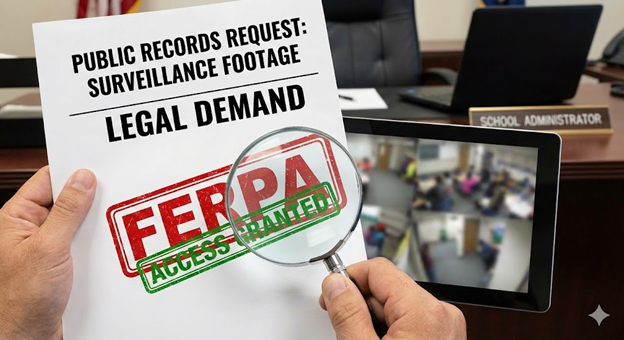
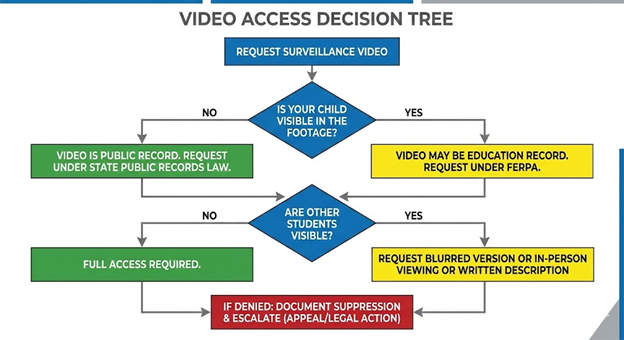
FERPA (Family Educational Rights and Privacy Act) is a federal law protecting student education records—but surveillance footage is generally not an educational record under FERPA and is instead governed by state public records laws with different privacy limitations. When schools claim they “cannot show video because of FERPA,” they are typically either: (1) misrepresenting FERPA’s scope to suppress evidence, (2) conflating FERPA with legitimate privacy concerns about other students visible in footage, or (3) using privacy as cover for the fact that video evidence contradicts their narrative. The correct response requires understanding what FERPA actually covers, what alternatives exist (blurred footage, in-person viewing, written description), and how to expose evidence suppression disguised as legal compliance.
Schools claim “FERPA prevents us from showing you the video” because parents don’t know FERPA law well enough to challenge the lie. The Student Advocacy Network Institute, a Policy-Driven Student Safety Agency, operates on this principle: surveillance footage is almost never protected by FERPA, and even when legitimate privacy concerns exist, schools have multiple options to provide access without violating privacy. We convert trauma into code by teaching parents that when schools refuse to show video evidence, they are deploying Pattern #2 (Evidence Suppression) disguised as Pattern #12 (Liability Deflection using false legal claims). The real reason schools refuse to show footage is usually: (1) the video contradicts their narrative, (2) the video reveals staff failure to supervise, or (3) the video proves pattern/escalation they previously denied. Selective enforcement IS discrimination, and video evidence often proves disparate treatment—which is why schools desperately want to suppress it. This article dismantles the FERPA excuse and provides the exact demands that force video access or expose suppression.
The Student Advocacy Network Institute exists because schools weaponize legal-sounding language to suppress evidence that exposes their failures. As the nation’s first Policy-Driven Student Safety Agency, SANI operates at the intersection of education law, public records law, privacy law, and strategic evidence preservation.
When a parent contacts SANI and says, “The school won’t show me the video because of FERPA,” we ask three questions:
Question 1: “Did they cite a specific FERPA provision, or just say ‘FERPA’?”
If they just said “FERPA” without citing specific legal language, they’re likely bluffing. Real legal restrictions come with specific citations.
Question 2: “Did you request alternatives like blurred footage, in-person viewing, or written description?”
If you didn’t request alternatives, the school can claim you wanted something unreasonable. If you did request alternatives and they refused all of them, that’s evidence suppression.
Question 3: “Did you document the refusal in writing and ask for the legal basis?”
Oral refusals are deniable. Written refusals create evidence of suppression.
We convert trauma into code by teaching parents that “FERPA” is Pattern #12 (Liability Deflection)—invoking legal-sounding excuses to avoid transparency. When combined with refusal to show video, it becomes Pattern #2 (Evidence Suppression)—the deliberate avoidance of evidence that would support the victim’s account or reveal institutional failure.
SANI treats student harm as both a school safety issue and a civil rights issue because video evidence often proves both. Video footage frequently shows:
When schools suppress video, they suppress the objective record that proves institutional failure. Selective enforcement IS discrimination—and video evidence makes it visible and undeniable.
Our job is to teach parents how to force access to the evidence schools desperately want to hide.
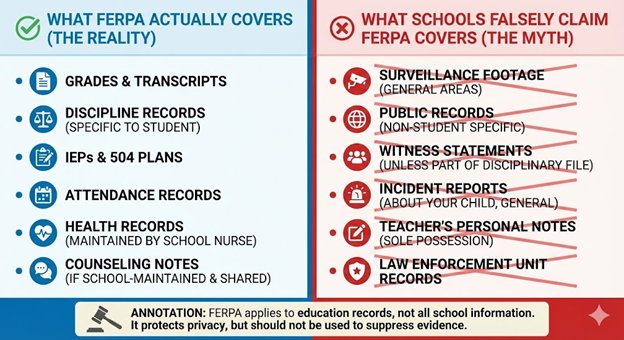
FERPA Definition of “Education Records” (20 U.S.C. § 1232g; 34 CFR § 99.3):
Education records are records that are:
Key Phrase: “Directly related to a student”
This means records that are about a specific, identifiable student—maintained for the purpose of tracking that student’s educational progress, behavior, or participation.
Examples of Education Records Protected by FERPA:
What FERPA Does NOT Cover (Not Education Records):
Law Enforcement Records (34 CFR § 99.8):
Sole Possession Records (34 CFR § 99.3):
Employment Records (34 CFR § 99.3):
Surveillance Footage (Generally NOT an Education Record):
Key Legal Guidance: U.S. Department of Education’s Family Policy Compliance Office has consistently held that surveillance footage is not an education record under FERPA because it is not maintained about a specific student.
Even though FERPA doesn’t apply to surveillance footage, other students’ privacy rights under state law and general privacy principles create legitimate concerns.
The Real Issue:
Legitimate Privacy Protection: Schools have a responsibility to protect the privacy of students who are not the subject of the request.
BUT—This Does NOT Justify Complete Refusal
There are multiple ways to provide access while protecting privacy:
Option 1: Blur Other Students’ Faces
Technology exists to blur or pixelate faces of individuals who are not the subject of the request. This is routinely done in:
Schools can and should offer this option.
Option 2: In-Person Viewing Without Copy
Allowing a parent to view footage in the school office without providing a digital copy:
This is the most common solution when privacy concerns exist.
Option 3: Detailed Written Description
If video cannot be shown, school should provide written description:
Option 4: Still Images
Provide still images from footage showing key moments, with other students’ faces blurred.
Option 5: Redacted Footage
Show only the portion of the frame where the incident occurred, blocking out other areas where uninvolved students appear.
Critical Point: If schools refuse ALL alternatives, they are suppressing evidence, not protecting privacy.
Since surveillance footage is generally NOT a FERPA-protected education record, it is typically subject to state public records laws (also called Freedom of Information Acts, Open Records Acts, Sunshine Laws, etc.).
How Public Records Laws Work:
General Rule: Records created or maintained by public entities (including public schools) are presumed to be public and accessible unless a specific exemption applies.
Common Exemptions:
Privacy Exemption Application to School Video:
Most states allow public entities to withhold records when disclosure would constitute an “unwarranted invasion of privacy.”
Courts have held:
Examples of State Standards:
California (Public Records Act, Gov. Code § 6250):
New York (Freedom of Information Law):
Florida (Sunshine Law):
Schools claim “FERPA” or “privacy,” but the actual reasons are usually:
Reason 1: Video Contradicts School’s Narrative
Most common scenario:
Showing video forces school to admit they misclassified the incident.
Reason 2: Video Shows Staff Failure
Video frequently shows:
This creates liability for failure to supervise.
Reason 3: Video Proves Pattern School Denied
Parent: “This has been happening for weeks.”
School: “We have no record of prior incidents.”
Video: Shows prior interactions, confrontations, or targeting behavior visible in earlier footage.
Showing video proves the school knew or should have known about the pattern.
Evidence of Bad Faith Refusal:
Schools acting in good faith offer alternatives (blurred video, in-person viewing).
Schools acting in bad faith:
Step 1: Confirm Existence
In your request: “Please confirm in writing whether surveillance footage exists for [LOCATION] on [DATE] during [TIME PERIOD]. If footage exists, please confirm the retention period under district policy.”
Step 2: Request Preservation
“I am formally requesting preservation of all footage from [DATE/TIME/LOCATION] as potential evidence in [investigation / complaint / legal action]. Under litigation hold and evidence preservation principles, you are now on notice that this footage must not be deleted.”
This creates a legal duty to preserve.
Step 3: Request Metadata
“Please provide: (1) Camera locations that would have captured the incident, (2) Retention period for footage, (3) Date footage will be deleted if not preserved, (4) Confirmation that footage has been preserved per my request.”
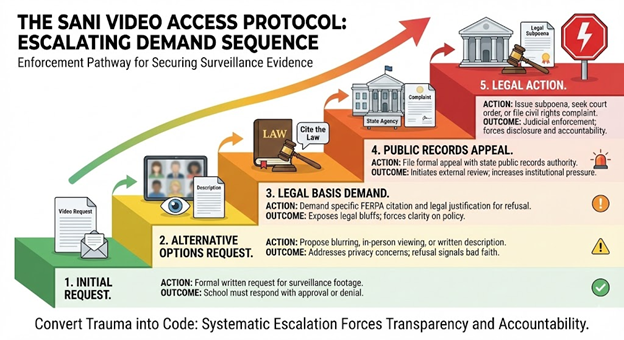
Send this within 24 hours of the incident if possible, definitely within 72 hours:
Subject: Public Records Request – Surveillance Footage [DATE/LOCATION]
Dear [Principal / Records Custodian]:
I am requesting access to surveillance footage as follows:
Incident Information:
Legal Framework:
Public Records Request:
Under [STATE PUBLIC RECORDS LAW, e.g., California Public Records Act, Gov. Code § 6250 et seq.], I am requesting access to all surveillance footage from cameras that would have captured the incident described above.
FERPA Analysis:
I understand you may claim FERPA prevents disclosure. However, surveillance footage is generally not an “education record” under FERPA (20 U.S.C. § 1232g; 34 CFR § 99.3) because it is not maintained “about” a specific student. The U.S. Department of Education has consistently held that general surveillance footage is not protected by FERPA.
Privacy Concerns Addressed:
I understand other students may be visible in the footage. To address legitimate privacy concerns, I am requesting one or more of the following alternatives:
Preservation Demand:
I am formally requesting preservation of all footage from [DATE/TIME/LOCATION] as potential evidence. You are on notice that this footage must not be deleted, overwritten, or destroyed. This is a litigation hold.
Timeline:
Under [STATE LAW], you have [X] days to respond to this request.
If You Refuse:
If you refuse all access alternatives listed above, please provide in writing:
Escalation Notice:
Refusal to provide any form of access will be documented as Pattern #2 (Evidence Suppression) and Pattern #12 (Liability Deflection using false legal claims). I will:
I expect response within [STATE TIMELINE, typically 10-14 days].
Sincerely,
[Your Name]
[Date]
Send this follow-up:
Subject: Response to FERPA Claim – Request for Legal Basis
Dear [Administrator]:
You stated that FERPA prevents disclosure of surveillance footage. Please provide the following:
If FERPA genuinely prevents disclosure in this case, these questions should have straightforward answers. If you cannot provide specific legal citations, I will conclude that your FERPA claim is false and that you are suppressing evidence.
Please respond within 5 business days.
Sincerely,
[Your Name]
Escalate immediately:
Level 1: District Compliance Office
Forward entire chain to district general counsel and compliance office:
“Building administration has refused all access to surveillance footage and cannot cite specific legal authority. I am requesting district-level review and access authorization.”
Level 2: State Public Records Appeal
Most states have appeal processes for public records denials. File formal appeal with state agency (Attorney General, Information Commissioner, etc.).
Level 3: Administrative Complaint
Include video suppression in complaints to:
Frame as: “School refused to provide evidence that would corroborate victim’s account and reveal staff failures—this is evidence suppression designed to protect the institution.”
Level 4: Legal Action
Attorney can:
Create Video Evidence Tracker:
Date | Action | School Response | Evidence of Suppression |
10/5 | Requested footage | Claimed “FERPA prevents it” | No specific citation provided |
10/7 | Requested alternatives (blur/view/describe) | Refused all | No legal basis for refusing in-person viewing |
10/10 | Requested legal citation | No response | Refusal to provide legal basis |
10/15 | Escalated to district | Under review | 10 days of delay |
10/20 | Threatened subpoena | Suddenly offered in-person viewing | Proves footage existed all along, suppression was strategic |
This tracker proves suppression pattern.
Generally, no. Surveillance footage is typically not considered an “education record” under FERPA because it is not maintained about a specific student—it captures common areas for security purposes. Even when other students appear in the footage, schools can address privacy concerns through reasonable alternatives such as blurring faces, allowing in-person viewing, or providing a written summary. A complete refusal to provide access to any form of the footage is often evidence suppression, not legitimate privacy protection.
If your child is not visible, the footage is even less likely to be protected under FERPA and may be subject to your state’s public records law. However, schools may question relevance. If the footage provides context—such as prior interactions, patterns of behavior, or movements of aggressors—clearly explain that justification in your request. Contextual evidence is still evidence.
Retention periods vary by district policy, but typically fall into these ranges:
• 30–90 days for general footage before it is overwritten
• One year or longer if an incident is reported and footage is preserved
• Indefinitely if the footage becomes part of an investigation or litigation
Critical: Request preservation immediately. Once footage is overwritten, it is permanently lost.
Request written confirmation. Ask the school to confirm in writing that no footage exists for the specified date, time, and location. If the footage was deleted, request the deletion date, the reason for deletion, and whether the deletion occurred before or after your preservation request. If footage was deleted after notice, this may constitute spoliation—destruction of evidence—which can create separate legal liability and result in sanctions.
Unless explicitly permitted, assume no. Most schools prohibit recording during in-person viewing. However, you may take detailed notes, sketch what you observe, record timestamps, and request specific screenshots or still images. These notes become your documented record of what the footage showed and should be preserved in your Case File.
Request written confirmation that no surveillance cameras cover the specified location and ask for a list of camera locations for your records. The absence of cameras in known problem areas can support a negligence claim, particularly if the school was aware of prior incidents and failed to provide adequate supervision or monitoring.
Request the full, unedited footage with visible timestamps, along with metadata showing the original file creation date and time and any available chain-of-custody documentation. If you observe timestamp gaps, abrupt cuts, or missing context, document those discrepancies immediately. Suspected editing or alteration should be preserved and reported as potential evidence tampering.
If you want student harm treated like a school safety and civil rights issue—start with SANI at https://saninstitute.net
The Student Advocacy Network Institute (SANI) is a national research, accountability, and discipline institute founded by Bullying Is A Drug to define, document, and address institutional failure in K–12 education—treating student harm as a school safety and civil rights issue.
Explore the Institute:
https://saninstitute.net
Parent A: Accepts the FERPA Excuse (Fails)
A student is assaulted in the cafeteria. Multiple students record it on phones. The parent reports to the principal: “I want to see the surveillance footage.”
Principal: “I’m sorry, we can’t share that due to FERPA. Other students are visible in the video, and we’re not allowed to show you records that contain information about other students.”
Parent, not knowing FERPA law: “Oh, I understand. Can you at least tell me what it shows?”
Principal: “I can confirm there was an incident. We’ve addressed it appropriately. The matter is closed.”
The parent never sees the footage. Months later, through a lawsuit, they discover the video shows:
The school’s entire narrative collapses—but only after expensive litigation. The parent trusted the FERPA excuse and lost critical evidence for months.
Parent B: Challenges the FERPA Excuse (Succeeds)
Same scenario. Parent requests video.
Principal: “We can’t share that due to FERPA.”
Parent’s response:
“I need to clarify what FERPA actually covers. Under FERPA case law and Department of Education guidance, surveillance footage is generally not an ‘education record’ because it’s not maintained about a specific student—it’s a general security recording. Therefore, FERPA doesn’t apply.
However, I understand there may be legitimate privacy concerns about other students visible in the footage. I’m requesting one of the following alternatives:
If you refuse all four alternatives, please provide in writing:
This is a formal public records request under [STATE PUBLIC RECORDS LAW]. You have [X] days to respond. Refusal to provide any form of access will be documented as Pattern #2: Evidence Suppression and escalated to [DISTRICT COMPLIANCE / STATE AGENCY / OCR] as evidence of deliberate indifference.”
Principal’s response (2 days later):
“We can arrange for you to view the footage in my office on [DATE]. You may not record it, but you may take notes.”
Parent views the footage. It proves:
Parent uses this information to:
The difference: Parent B knew FERPA law and called the bluff.
Most bullying cases do not need a lawyer. Some clearly do. Knowing the difference before you act matters more than most parents realize. The decision

There is a point in many bullying cases where the parent has done everything right — and it still is not working. The emails are

You have three minutes. Make them the most organized three minutes the board has heard on this topic. Speaking at a school board meeting is

Patience with a school that isn’t responding isn’t a virtue. At some point it becomes a cost your child is paying. Most parents start at