

When Do Parents Need a Lawyer for School Bullying?
Most bullying cases do not need a lawyer. Some clearly do. Knowing the difference before you act matters more than most parents realize. The decision

1. Audio
2. Definition
3. Video
4. Core Thesis
9. Action Steps
10. FAQs
11. Call to Action
12. Sources
13. Signature
The Case File System is a structured documentation methodology that converts parental trauma, student harm, and institutional failure into organized, timestamped, categorized evidence that proves notice, foreseeability, breach, causation, and damages in school safety and civil rights cases. The system includes five core components: the Master Timeline, the Communication Log, the Evidence Repository, the Pattern Tracker, and the Impact Documentation. When properly maintained, a Case File transforms emotional distress into procedural power, making it impossible for schools to claim ignorance, deny patterns, or escape accountability.
Schools win when families operate emotionally. Families win when they operate procedurally. The Student Advocacy Network Institute, a Policy-Driven Student Safety Agency, developed the Case File System because documentation is the only language districts respect and courts recognize. We convert trauma into code by teaching parents to build evidence in real time—before memories fade, before emails are deleted, before the district rewrites the narrative. When parents maintain a Case File, they shift from defenseless to dangerous. They can prove notice, prove pattern, prove harm, and prove the school’s failure to act. Selective enforcement IS discrimination, and the Case File is how you prove it. This article provides the complete framework families need to document institutional failure from day one.
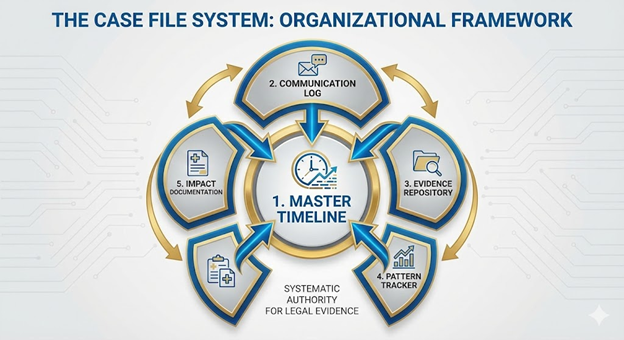
The Student Advocacy Network Institute exists because most families lose cases they should win—not because they lack truth, but because they lack documentation. As the nation’s first Policy-Driven Student Safety Agency, SANI operates at the intersection of evidence methodology, legal strategy, and procedural enforcement.
When a parent contacts SANI, the first question we ask is: “Do you have a Case File?”
If the answer is no, we build one immediately. If the answer is yes, we audit it for gaps, organize it for legal use, and weaponize it for district confrontation.
We convert trauma into code by teaching parents that documentation is not optional—it is the foundation of accountability. Without a Case File:
With a Case File:
SANI treats student harm as both a school safety issue and a civil rights issue because the Case File is the tool that proves both. Selective enforcement IS discrimination—and the Case File is how you prove the school gave your child one chance while giving another student seven chances. The Pattern Tracker shows it. The Communication Log proves when you reported it. The Master Timeline locks in the sequence.
This is why districts fear organized parents. Documentation removes their ability to lie.
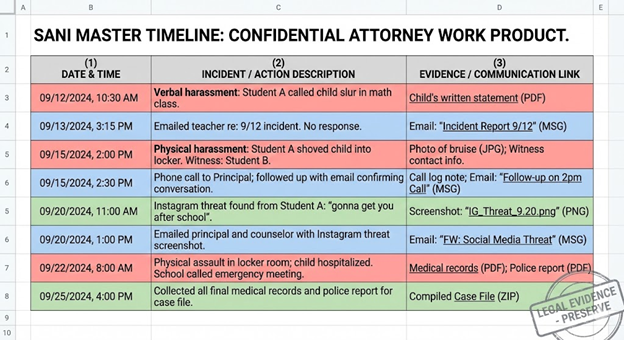
The Master Timeline is the spine of the Case File. It is a chronological record of every incident, every communication, every school action (or inaction), and every piece of evidence.
Format: Use a spreadsheet (Excel, Google Sheets) or a dated document (Word, Google Docs). Each entry must include:
Example Entries:
Date | Time | Incident/Action | Evidence | School Response |
9/12/24 | 10:30am | Student A called my child [slur] in math class | Child’s written account | None – reported to teacher verbally |
9/13/24 | 3:15pm | Sent email to counselor reporting 9/12 incident | Email saved in Comm Log | No response |
9/15/24 | 2:00pm | Student A shoved my child into locker, hallway camera present | Witness: Student B; bruise photo | Reported to principal by phone |
9/15/24 | 2:30pm | Follow-up email to principal documenting 2pm phone call | Email saved in Comm Log | Principal responded: “We’ll look into it” |
9/20/24 | 11:00am | Instagram post from Student A: “gonna get you after school” | Screenshot saved | Reported via email to principal + counselor |
9/22/24 | 8:00am | Physical assault in locker room, child hospitalized | Police report, medical records, photos | School calls emergency meeting |
The Master Timeline creates an irrefutable sequence. It shows:
This is the document that proves foreseeability, notice, breach, and causation.
The Communication Log is a folder (digital or physical) containing every communication between you and the school.
What to Include:
Best Practices:
Critical Rule: Never communicate only verbally. Always follow up in writing. If the school says “just call me,” respond: “I prefer to document our conversations in writing to ensure clarity. I will send a summary email after our call.”
The Evidence Repository is a folder containing all physical and digital evidence of harm, pattern, and school failure.
What to Include:
Photos:
Screenshots:
Videos:
Documents:
Audio:
File Naming Convention: Use clear, searchable filenames:
This ensures evidence is retrievable, shareable, and usable in legal proceedings.
The Pattern Tracker is a document that categorizes and quantifies the type, frequency, and severity of harm over time.
Purpose: To prove this is not an “isolated incident” but a pattern the school failed to address.
Format: Create a chart with these columns:
Date | Type of Harm | Severity (1-10) | Reported to School? | School Action | Escalation? |
9/12 | Verbal harassment | 4 | Yes (verbal to teacher) | None | N/A |
9/15 | Physical (shove) | 6 | Yes (email + call) | “Looking into it” | Yes |
9/20 | Threat (online) | 7 | Yes (email) | No response | Yes |
9/22 | Physical assault | 10 | Yes (immediate report) | Emergency meeting | Yes |
Categories of Harm:
The Pattern Tracker shows:
This is devastating evidence in legal claims and OCR complaints.
The Impact Documentation folder contains evidence of how the harm affected your child’s education, health, and well-being.
What to Include:
Academic Impact:
Medical/Psychological Impact:
Social/Emotional Impact:
Financial Impact:
This documentation proves damages—the harm caused by the school’s failure. It is required for legal claims and strengthens OCR complaints.
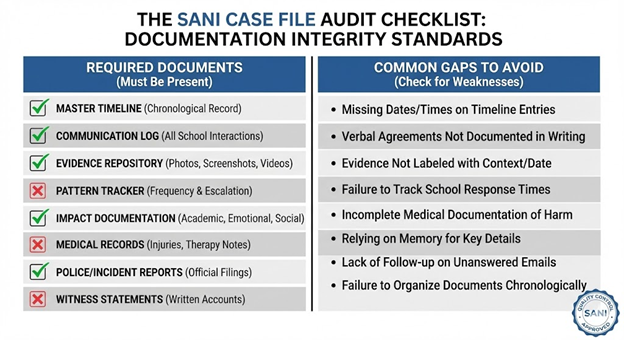
Do not wait until you “have time.” Create the structure immediately:
Digital Option:
Physical Option:
The structure matters more than perfection. You can refine as you go.
Open a spreadsheet or document and create your first entry today. Go back as far as you can remember and document:
Even if your memory is incomplete, start the timeline. It will jog more memories as you build it.
Gather everything you already have:
Move everything into the appropriate folder/section.
From now on:
Consistency is more important than volume. A well-maintained Case File with 10 entries is stronger than a chaotic pile of 100 documents.
Stop making phone calls without written follow-up. Instead:
Before a call: Send an email requesting the call and stating the purpose.
After a call: Send an email summarizing what was discussed:
Subject: Summary of Phone Call – [Date]
Dear [Administrator]:
Per our phone conversation today at [TIME], we discussed the following:
You stated that [SCHOOL ACTION]. I am requesting written confirmation of this plan and the expected timeline.
If I have misunderstood or misrepresented anything, please clarify in writing within 48 hours.
Thank you,
[Your Name]
This forces the school to either confirm your account or correct it—both create evidence.
Submit a FERPA request (see prior article on records requests) and add everything the school provides to your Evidence Repository. Compare the school’s records to your Master Timeline. Document any discrepancies:
“The school’s incident report states the assault occurred on 9/22 at 10:00am. My timeline and my child’s account indicate it occurred at 8:15am. The school’s timeline is inconsistent with witness statements.”
Discrepancies are evidence of investigative failure or manipulation.
Do not overwhelm the school with your entire Case File at once. Use it strategically:
In meetings: Bring the Master Timeline. Reference specific dates and communications. This signals you are organized and cannot be gaslit.
In demand letters: Attach the Pattern Tracker to show this is not isolated.
In OCR complaints: Submit the full Case File as supporting documentation.
In legal proceedings: Your attorney will use the Case File to prove notice, breach, causation, and damages.
The Case File is your power. Use it when it will create maximum accountability.
Immediately—the moment you have a concern. Do not wait for the problem to escalate or for the school to fail. Start documenting on Day 1. If the issue resolves, you can stop maintaining the Case File. If it escalates, you will already have the evidence you need. It is always better to have documentation you don’t need than to need evidence you don’t have.
Start now. Go back as far as you reasonably can and reconstruct the timeline using available sources, including sent emails, calendar entries, medical or therapy appointments, your child’s recollection, and dated records such as report cards or attendance logs. Even an incomplete timeline is valuable and can be strengthened as additional details come back to you.
Yes. The Case File is designed to be admissible evidence. The Master Timeline can be introduced as a summary of events. The Communication Log establishes notice and the school’s response. The Evidence Repository contains supporting exhibits such as photos, screenshots, and medical records. The Pattern Tracker demonstrates that the issue was ongoing, not isolated, and the Impact Documentation supports damages.
Use discretion. Sharing portions of your Case File—such as a Master Timeline—during meetings can demonstrate that you are organized, credible, and serious, which often changes how the school responds. However, you should not provide the full Case File unless legally required. Maintain control over your evidence at all times.
This is precisely why you save everything. If you sent an email, your saved copy proves it was sent—especially if you have delivery or read confirmation. A claim that the school “never received it” becomes evidence of either technical failure or dishonesty. Follow-up emails summarizing phone calls are critical because they force the school to respond in writing or silently confirm your account.
Detailed enough to be clear, but not so detailed that maintaining the timeline becomes unmanageable. Strong entries include the date and time, a brief description of what happened, who was involved, what evidence exists, and how the school responded (or failed to respond). Consistency and clarity matter more than length.
Yes. Educational advocates, parent advocates, and some attorneys assist families with organizing Case Files. SANI specializes in building and auditing Case Files for families, but many parents successfully build strong files themselves using this framework. The key is consistent documentation—not perfection.
If you want student harm treated like a school safety and civil rights issue—start with SANI at https://saninstitute.net
The Student Advocacy Network Institute (SANI) is a national research, accountability, and discipline institute founded by Bullying Is A Drug to define, document, and address institutional failure in K–12 education—treating student harm as a school safety and civil rights issue.
Explore the Institute:
https://saninstitute.net
A seventh-grader is harassed daily for three weeks. Classmates call him slurs, shove him in hallways, and post threats on social media. The parent reports it verbally to a teacher, then emails the counselor, then calls the principal.
The school says: “We’re looking into it.”
Three weeks later, the harassment escalates to a physical assault in the locker room. The student is hospitalized.
The parent meets with the district. The assistant superintendent says: “We had no indication this was an ongoing problem. If you had reported it, we would have acted.”
The parent is devastated. “I reported it multiple times!”
The district responds: “We have no record of that.”
The parent has:
The district’s attorney produces a two-page incident report from the assault and says: “This appears to be an isolated incident. We responded appropriately.”
Without documentation, the parent cannot prove:
The case collapses—not because the parent was lying, but because trauma doesn’t create evidence. Systems create evidence.
Now compare this to a parent who used the Case File System:
Day 1: Child reports harassment. Parent creates a Master Timeline entry: “9/12 – Child reports Student A called him [slur] in math class, 3rd period.”
Day 2: Parent emails teacher with subject line: “Incident Report – Harassment 9/12.” Email saved in Communication Log folder.
Day 5: Child shows parent Instagram post with threat. Parent screenshots it, saves it in Evidence Repository with filename: “2024-09-17_Instagram_Threat_StudentA.jpg”
Day 8: Parent calls principal. Immediately after, parent sends email: “Per our phone conversation today at 2:15pm, I reported ongoing harassment. You stated you would investigate. I am requesting written confirmation of the investigation plan and timeline.”
Day 15: Harassment continues. Parent updates Master Timeline with five new entries. Sends follow-up email: “15 days since initial report. No response. Harassment ongoing. Requesting immediate action.”
Day 22: Assault occurs. Parent has:
When the district claims “we had no indication,” the parent produces a 15-page Case File with:
The district cannot claim ignorance. The Case File destroys their defense.
Most bullying cases do not need a lawyer. Some clearly do. Knowing the difference before you act matters more than most parents realize. The decision

There is a point in many bullying cases where the parent has done everything right — and it still is not working. The emails are

You have three minutes. Make them the most organized three minutes the board has heard on this topic. Speaking at a school board meeting is

Patience with a school that isn’t responding isn’t a virtue. At some point it becomes a cost your child is paying. Most parents start at