

When Do Parents Need a Lawyer for School Bullying?
Most bullying cases do not need a lawyer. Some clearly do. Knowing the difference before you act matters more than most parents realize. The decision

The emails are sent. The meetings are scheduled. The documentation exists. And the school is still not responding the way it should.
At that point, many parents start wondering whether they are missing something — whether there is someone who understands this system better than they do, who knows what to say and what to push for, and who can stand beside them so they are not navigating it alone.
An educational advocate may be exactly that person. Or it may not be — depending on where you are in the process, what kind of support you actually need, and what the situation calls for.
This article helps you make that assessment honestly — without overselling what advocacy is or dismissing the value it provides when the situation genuinely calls for it.
You may benefit from an educational advocate if the school has been unresponsive despite documented complaints, if the situation involves your child’s IEP or 504 plan and you are navigating both the bullying and special education systems simultaneously, if you are preparing for a high-stakes school or district meeting and want someone in the room who understands the process, or if you feel that the system is outpacing your ability to manage it alone.
You may not need an advocate yet if the situation is early, you have not yet filed a formal written complaint, or the school is still in the process of responding to a complaint you filed recently. Advocacy is most valuable when the informal process has failed — not as a first step before it has been tried.
An advocate is not a lawyer. They do not provide legal representation, cannot appear on your behalf in court, and do not guarantee specific outcomes. What they provide is expertise, structure, and a second set of experienced eyes on a process that is often designed to be confusing to anyone who has not navigated it before.
Parents who reach the question of whether they need an educational advocate are almost always at a specific inflection point — and recognizing where you are helps clarify what kind of support would actually help.
The process has become too complex to manage alone. A bullying case that involves an IEP, a civil rights component, multiple levels of escalation, and a school that has responded with a series of contradictory or inadequate responses is not a simple situation. Managing documentation, meeting preparation, escalation strategy, and communication with the school simultaneously — while also supporting a child in distress — is genuinely difficult. An advocate who has done this dozens of times can reduce that burden significantly.
You are walking into meetings where the school has institutional knowledge you do not. School administrators know the policy, the procedure, the language, and the leverage points. Most parents do not — at least not the first time through. An advocate levels that information gap. They know what the school is required to say, what it is trying to avoid, and what the next move should be based on how the meeting goes.
You have tried the process and it has not worked. The most valuable moment for advocacy is after documented attempts at resolution have failed. An advocate who reviews your case history can often identify the gaps — the steps you took that were not framed quite right, the documentation that is strong, the documentation that is missing, and the next move that gives your situation the best chance of producing a real response.
You need someone to help you stay organized and strategic under emotional pressure. A parent whose child is being harmed is operating under significant stress. The school is not. That asymmetry affects how meetings go, how documents are reviewed, and how decisions are made. An advocate provides a steadier perspective — not because they do not care, but because they are not carrying the same emotional weight and can think more clearly about strategy.

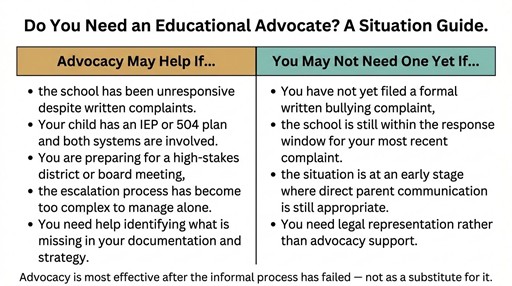
The decision to bring in outside support — whether an advocate, a consultant, or an attorney — is a personal one. But certain patterns in a bullying case make that decision relatively clear:
If you have reached the point where outside support feels like the right move — or if you simply want an honest assessment of where your situation stands and what it would take to move it forward — a consultation is the right starting point. Not a commitment. Not an engagement. Just a conversation with someone who has seen situations like yours before and can tell you clearly what they see and what they would do next.
An educational advocate works within the school system to help families navigate processes like IEPs, 504 plans, school complaints, and administrative escalation. They understand policies, timelines, documentation strategies, and how schools typically respond to parent concerns. Advocates can attend meetings, help prepare written communications, review records, and support strategy — but they cannot provide legal representation or act as attorneys in court or formal legal proceedings.
A lawyer with education law experience, by contrast, provides legal advice, represents families in due process hearings or court, and handles formal legal claims. In many situations, advocates and attorneys are used together: the advocate manages day-to-day navigation of the school system, while the attorney handles legal enforcement when necessary.
Costs vary significantly depending on experience, location, and the level of involvement needed. Some advocates charge hourly rates, others offer flat fees for specific services such as meeting preparation or attendance, and some provide ongoing support packages.
Many families begin with a consultation, which is usually a lower-cost way to assess the situation and determine whether ongoing support is necessary. Before committing, it is reasonable to ask exactly what the consultation includes, what follow-up support would cost, and whether the advocate offers limited-scope services rather than full representation.
Yes. Parents generally have the right to bring a support person to school meetings, including IEP meetings, and IDEA specifically protects the right to bring individuals of your choosing to special education meetings. In most general education contexts, schools also allow parents to bring an advocate or support person, though procedures may vary by district.
An advocate’s presence can help keep the meeting focused, ensure key points are addressed, assist with note-taking, and provide guidance on follow-up questions. If a school attempts to restrict who you can bring, it is appropriate to ask for that restriction in writing and clarify the basis for it before proceeding.
A concise timeline of events is the most helpful starting point — when the issue began, what was reported, when it was reported, and how the school responded. Bring copies of key emails, complaint submissions, and any written responses from the school.
If your child has an IEP or 504 plan, include the most recent version. If you have maintained a log of incidents or communications, bring that as well. The goal is not perfection or completeness — it is enough structure for the advocate to quickly understand the pattern and assess what options are realistically available.
If you want student harm treated like a school safety and civil rights issue—start with SANI at https://saninstitute.net
Most bullying cases do not need a lawyer. Some clearly do. Knowing the difference before you act matters more than most parents realize. The decision

You have three minutes. Make them the most organized three minutes the board has heard on this topic. Speaking at a school board meeting is

Patience with a school that isn’t responding isn’t a virtue. At some point it becomes a cost your child is paying. Most parents start at
You tried the school. You tried the district. You documented everything. And your child was still harmed. This is the question that parents arrive at