
A notice of harassment is one of the most underused tools a parent has — and most parents have never heard of it.
You’ve reported the bullying. You’ve followed up. You’ve sent emails, attended meetings, and waited for a response that either never came or amounted to nothing.
At some point, informal complaints stop being enough. Not because you haven’t tried hard enough — but because the situation has crossed into territory where a more formal, documented communication is the appropriate next step.
A notice of harassment is that tool. It changes the dynamic not by threatening the school — but by creating a formal, legally grounded record that the school received specific notice of a harassment situation and had an obligation to act.
That distinction matters more than most parents realize.
The Short Answer
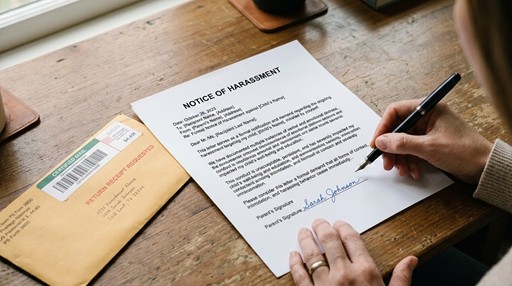
A notice of harassment is a formal written document — sent by a parent to a school — that puts the school on official notice that a student is being subjected to harassment, bullying, or discriminatory conduct. It is more structured than a complaint email and more specific than a general report.
Its purpose is to create an unambiguous record that the school received formal notice of a serious situation — and that a response was required. In situations involving protected characteristics like race, sex, religion, or disability, this kind of formal notice may carry particular legal significance because it connects the school’s awareness to its obligations under federal civil rights law.
You do not need a lawyer to send one. But you do need to understand when it is appropriate and how to use it correctly.
What This Usually Means
Most parents go through several rounds of informal reporting before they discover that a notice of harassment exists as a distinct tool. By that point, a few things are typically true.
The school has been notified informally but hasn’t acted. Emails have been sent, meetings have happened, and the situation has continued. The school is aware — but there is no formal record creating accountability for what happens next.
The bullying may involve a protected characteristic. When harassment targets a child’s race, sex, religion, national origin, or disability, it may fall under federal civil rights protections — including Title VI, Title IX, and Section 504. A formal notice of harassment in these situations connects the school’s knowledge to its legal obligations in a way that a general bullying complaint does not.
The parent needs to establish a clear escalation timeline. A notice of harassment creates a documented moment: the school received formal written notice on this date, about this situation, and was put on notice that a response was required. Everything that happens — or doesn’t happen — after that date becomes part of the record.
Informal complaints have produced no paper trail. If prior communications were largely verbal or produced only vague responses, a notice of harassment resets the record with something harder to minimize or misplace.
What to Do Now
- Determine whether your situation warrants a notice of harassment. A notice of harassment is most appropriate when the bullying has been reported informally and not resolved, when the conduct targets a protected characteristic, or when you are preparing to escalate and need a formal record of notice. It is not typically the first step — it is the step you take when earlier steps have not produced results.
- Gather your documentation before drafting. Before writing the notice, compile your incident log, prior complaint emails, any school responses, and any evidence of the bullying itself. The notice should reference this documentation — not replace it.
- Address it to the right people. A notice of harassment should be addressed to the school principal and copied to the district superintendent and student services coordinator at minimum. In situations involving potential civil rights violations, some parents also send a copy to the district’s legal counsel — though this is a judgment call based on the severity of the situation.
- Use clear, specific language. The notice should identify your child by name and grade, describe the conduct in specific terms — including dates and incidents — name the protected characteristic if applicable, state that the conduct constitutes harassment under the school’s policy and applicable law, and formally request a written response describing the steps the school will take.
- Reference applicable policy and law carefully. If the harassment involves a protected characteristic, reference the relevant federal framework — Title VI for race, Title IX for sex, Section 504 for disability — without making legal conclusions. A phrase like “this conduct may implicate the school’s obligations under Title IX” is appropriate. Claiming the school has violated the law is not — that is a conclusion for a court or agency, not a parent letter.
- Send it in a way that creates a delivery record. Email is acceptable — but for a notice of harassment, certified mail with return receipt requested adds an additional layer of documentation. Send both if the situation is serious.
- Keep a copy of everything. The notice, the delivery confirmation, and every response — or non-response — that follows. This is now a formal part of your record.
What Not to Do
Don’t use a notice of harassment as your first step. It is a formal escalation tool, not an opening move. Using it before you have exhausted informal complaint channels — and documented those attempts — weakens its impact and may make you appear to be skipping the process rather than working through it.
Don’t make legal conclusions in the notice. Saying the school “has violated Title IX” or “is liable for harassment” goes beyond what a parent letter should claim. Use careful language: “this conduct may implicate,” “we are requesting a response consistent with the school’s obligations under.” Leave legal conclusions to agencies and courts.
Don’t send it without documentation to back it up. A notice of harassment is most powerful when it references a documented pattern — dates, incidents, prior complaints, school responses. Without that foundation, it is easier to dismiss.
Don’t expect an immediate resolution. A notice of harassment creates a formal record and a stronger obligation to respond — but it does not guarantee a specific outcome. Its primary value is in what it establishes: that the school had notice, what that notice said, and when it was received.
Don’t confuse a notice of harassment with a legal filing. It is a parent-generated document, not a court filing or agency complaint. It can support a later OCR complaint or legal action, but it is not itself a legal proceeding.
When to Escalate
A notice of harassment is itself an escalation — but it is not the last step available.
It may be time to move further if:
The school receives the notice and takes no documented action within a reasonable timeframe
The response to the notice is dismissive, vague, or reframes the situation without addressing the substance
The conduct continues or worsens after the notice is delivered
The harassment involves a protected characteristic and the school’s response does not reflect its civil rights obligations
You are preparing to file an OCR complaint or seek outside legal or advocacy support
In those situations, filing a formal complaint with the U.S. Department of Education’s Office for Civil Rights, escalating to the district superintendent, or consulting an educational advocate may be the appropriate next steps. A well-documented notice of harassment strengthens all of those paths.
Take the Next Step
A notice of harassment is a powerful tool — but only when it is drafted carefully, sent to the right people, and supported by solid documentation. If you are considering sending one and want help getting it right, or if you’ve already sent one and are deciding what comes next, support is available.
If you need help drafting a notice of harassment, reviewing your documentation, or deciding whether this step is right for your situation, click here to book a parent strategy call.
Before you send anything formal, it helps to know exactly where your documentation stands. Click here to complete the Student Protection Readiness Checklist — a practical tool that helps you assess what you have and what you still need.
FAQs
1. Does a bullying complaint have to be in a specific format to be official?
In most cases, no. A clear written report—such as an email—can serve as an official complaint as long as it includes relevant details (who, what, when, where, and impact). Some districts also provide formal complaint forms. If available, you can submit the form and follow up with an email so you have a documented record of your report.
2. What if I’ve already spoken to the school verbally and nothing changed?
It’s helpful to follow up with a written report that references those earlier conversations. For example: “I previously raised this concern verbally on [approximate date]. I am now submitting a formal written report.” This creates a clear timeline and ensures there is a documented record moving forward.
3. Should I include that my child is afraid to go to school?
Yes, if it accurately reflects your child’s experience. Information about school avoidance, stress, or physical symptoms helps show the impact of the situation on your child’s well-being and ability to participate in school. Keep the description factual and specific, including dates and observable effects when possible.
4. What if the school says they investigated but found no evidence of bullying?
You can request a written summary of the investigation process, including what steps were taken and how the conclusion was reached. If concerning behavior continues, document each new incident and submit additional reports. A consistent record of reports and outcomes can be important if you need to escalate the issue later.
Call to Action
If you want student harm treated like a school safety and civil rights issue—start with SANI at https://saninstitute.net