
Table of Contents
Click to Expand
1. Audio
2. Definition
3. Video
4. Core Thesis
9. Action Steps
10. FAQs
11. Call to Action
12. Sources
13. Signature
Definition
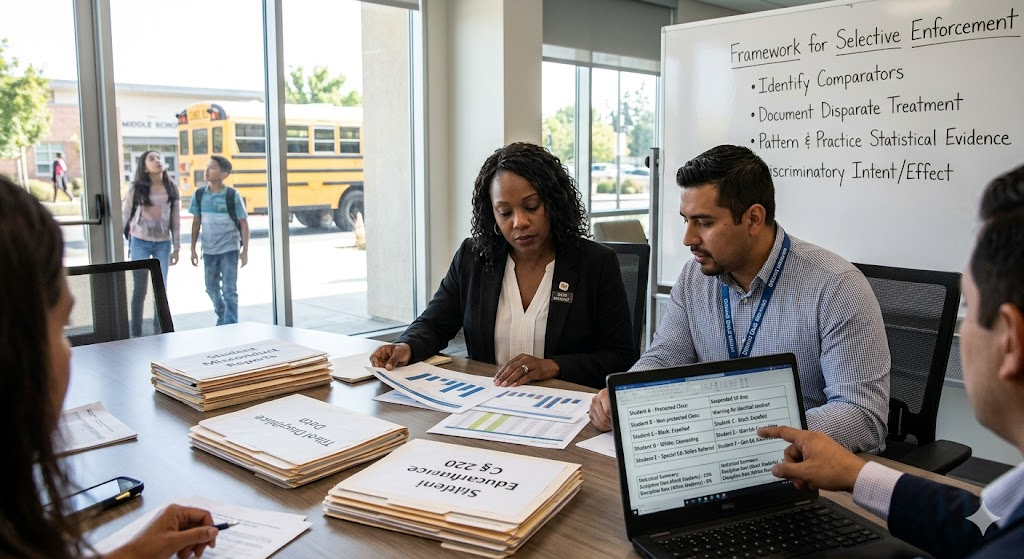
The Comparative Treatment Analysis Framework is SANI’s systematic methodology for proving selective enforcement and discrimination by documenting how districts treat similarly-situated students differently based on protected characteristics (race, disability, sex)—requiring collection of comparative data showing: student A (protected class) suspended 10 days for disruption while student B (non-protected class) received warning for identical conduct, student C (Black) expelled for altercation while student D (white) received counseling for same behavior, student E (special education) referred to police for outburst while student F (general education) received behavioral support—establishing Equal Protection Fourteenth Amendment violations, Title VI racial discrimination (42 USC § 2000d), Section 504/ADA disability discrimination, and California Education Code § 220 prohibition on discrimination, with framework proven through: (1) identification of similarly-situated comparators (students who engaged in identical or substantially similar conduct), (2) documentation of disparate treatment (harsher discipline for protected class student), (3) statistical evidence showing pattern across incidents (not isolated occurrence), (4) elimination of legitimate non-discriminatory explanations (district cannot articulate valid reason for disparity), and (5) demonstration of discriminatory intent or effect under disparate impact theory.
Core Thesis
Districts systematically apply discipline more harshly to students of color and students with disabilities for identical conduct that receives minimal consequences when committed by white or non-disabled students—but proving discrimination requires more than alleging bias, it demands rigorous comparative data showing pattern of disparate treatment across multiple incidents, with SANI’s Comparative Treatment Analysis Framework providing systematic methodology for: identifying similarly-situated students who engaged in substantially similar conduct, documenting exact disciplinary responses each received, gathering statistical evidence proving pattern not isolated incident, eliminating district’s claimed legitimate reasons for disparity (showing reasons are pretextual), and establishing discriminatory intent or disparate impact violating Equal Protection, Title VI, Section 504, and California anti-discrimination laws. We convert trauma into code by transforming anecdotal experiences of unfair treatment into legally-actionable comparative data sets documenting that Black student suspended 10 days for “disruption” while white student received verbal warning for identical behavior, special education student expelled for “defiance” while general education student received behavior plan for same conduct, creating irrefutable statistical evidence selective enforcement IS discrimination proven through systematic comparison not subjective perception. Selective enforcement IS discrimination—this framework provides the evidentiary structure proving it in court, before OCR, and in public accountability forums by showing districts cannot articulate legitimate non-discriminatory reasons for systematically harsher treatment of protected class students.
Case Pattern Story
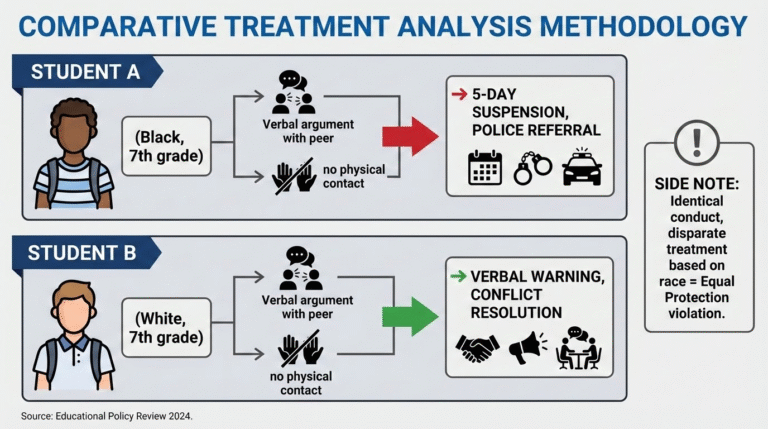
Middle school in Oakland. Two eighth-grade students—one Black, one white—engage in verbal arguments with peers during same week. Neither argument involved physical contact, weapons, or threats. Both incidents reported as “disruption” and “defiance.”
Black student (Student A):
- Suspended 5 days
- Police called to campus during incident
- Referred to district discipline review
- Incident documented as “aggressive confrontation”
- Parents told “zero tolerance for threatening behavior”
White student (Student B, same week):
- Verbal warning from teacher
- Counseling session with school counselor
- No suspension
- Incident documented as “peer conflict requiring mediation”
- Parents notified of “minor incident resolved”
Identical conduct. Drastically different responses.
Student A’s parents file complaint alleging racial discrimination. District responds: “Each incident assessed individually based on specific circumstances. Student A’s behavior more severe requiring stricter response.”
Parents retain attorney who demands: “Provide documentation showing how Student A’s verbal argument differed from Student B’s verbal argument justifying 5-day suspension versus warning. Both incidents involved verbal disagreement with peer, no physical contact, no weapons, no threats. Explain disparate treatment.”
District cannot articulate legitimate difference—both incidents virtually identical except students’ races.
Attorney conducts Comparative Treatment Analysis across full school year:
Requests discipline records (anonymized for privacy) for all eighth-grade students for academic year showing: student demographic data (race, disability status), incident description, disciplinary consequence.
Analyzes data:
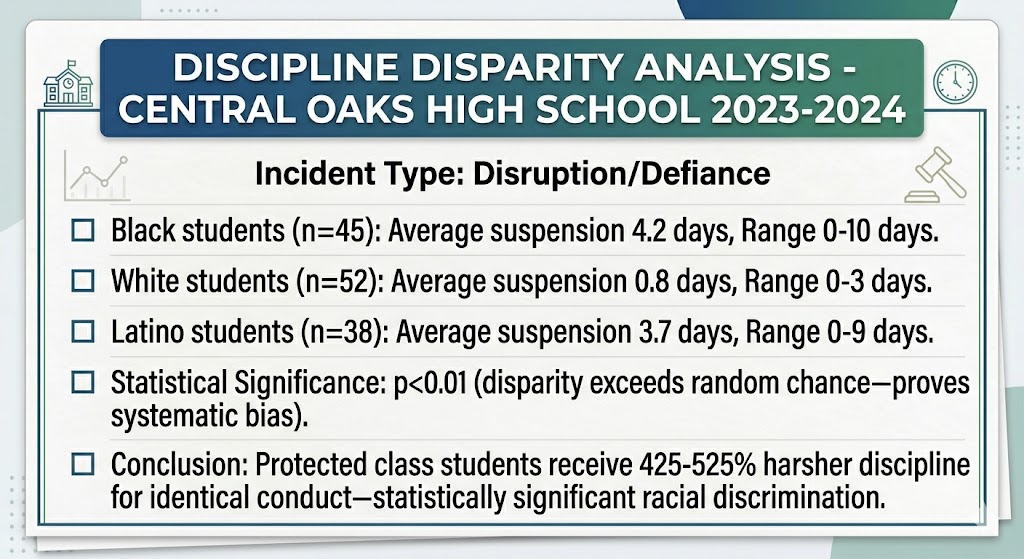
“Disruption/defiance” incidents:
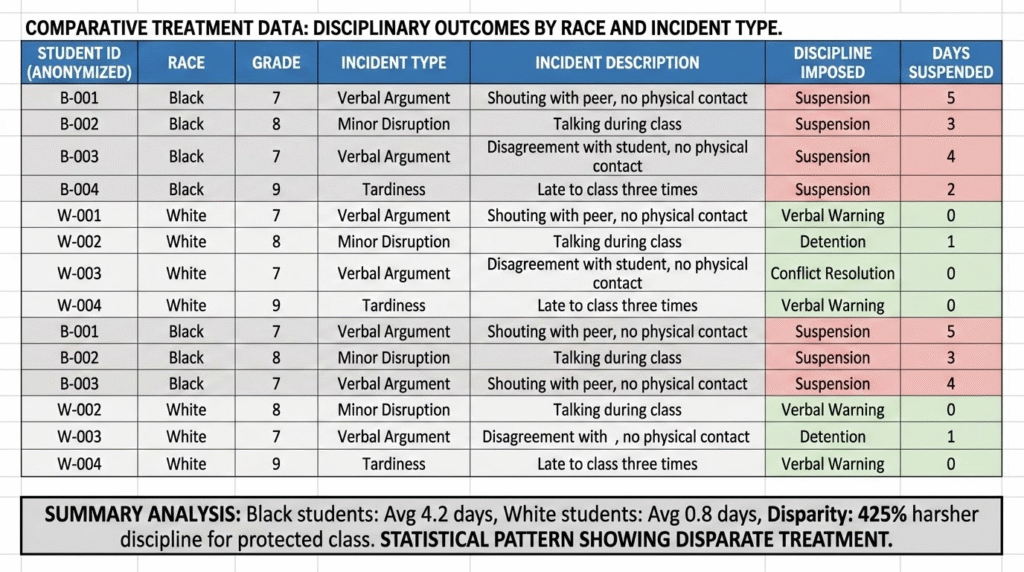
- Black students: Average 4.2 days suspension per incident
- White students: Average 0.8 days suspension per incident
- Latino students: Average 3.7 days suspension per incident
“Physical altercation” incidents:
- Black students: 78% resulted in expulsion recommendation
- White students: 23% resulted in expulsion recommendation
- Same conduct, wildly disparate outcomes
Comparative pairs identified (similarly-situated students, identical conduct):
Pair 1: Black student vs. white student—both skipped class
- Black student: 3-day suspension
- White student: Lunch detention
Pair 2: Latino student vs. white student—both used profanity toward teacher
- Latino student: 5-day suspension, recommendation for expulsion
- White student: 2-day suspension, anger management counseling
Pair 3: Special ed student vs. general ed student—both threw objects in classroom
- Special ed student: Police referral, emergency expulsion
- General ed student: Parent conference, behavior plan
Pattern irrefutable: Protected class students receive substantially harsher discipline for identical conduct.
Attorney’s expert conducts statistical analysis: Racial disparity statistically significant—cannot be explained by chance, proves systematic discrimination.
Settlement: Significant damages, comprehensive discipline policy reform requiring comparative analysis before suspensions exceeding 3 days (administrators must document how proposed discipline compares to discipline given to similarly-situated students for similar conduct), independent equity audit of discipline data, OCR monitoring, anti-bias training for all staff.
Case establishes: Comparative Treatment Analysis Framework as evidence standard for proving selective enforcement and discrimination.
SANI Connection
SANI developed the Comparative Treatment Analysis Framework because proving discrimination requires more than alleging bias—it demands systematic documentation showing pattern of disparate treatment.
The framework is SANI’s signature methodology converting individual experiences into statistically-significant evidence:
Phase 1: Identify Your Child’s Incident
Document exactly what happened: date, conduct, circumstances, who was involved, what discipline imposed.
Phase 2: Identify Similarly-Situated Comparators
Request discipline records identifying students who engaged in substantially similar conduct: same grade level (or close), same type of violation (disruption, altercation, defiance, etc.), same severity (verbal vs. physical, with/without weapon), within same time period (same year, ideally same semester).
Phase 3: Document Disparate Treatment
Create comparison chart showing: Your child (protected class): [conduct] → [harsh discipline], Comparator (non-protected class): [identical conduct] → [minimal discipline], Disparity: [quantify difference—5-day suspension vs. warning]
Phase 4: Gather Statistical Evidence Showing Pattern
Don’t rely on single comparison. Analyze broader data: All “disruption” incidents by race, All “defiance” incidents by disability status, All “altercations” incidents by race, Calculate average discipline by demographic group, Prove pattern across multiple incidents.
Phase 5: Eliminate Legitimate Explanations
Anticipate district’s defenses: “Student A’s conduct more severe” (demand documentation showing difference), “Student A had prior disciplinary history” (show comparator had similar or worse history), “Different administrators handled incidents” (prove policy requires consistency), Force district to articulate specific legitimate non-discriminatory reason—then prove reason is pretextual.
Phase 6: File Discrimination Complaint With Data
Submit to OCR/state complaint: “Comparative Treatment Analysis (attached) proves selective enforcement. Student [name] (Black) suspended 5 days for [conduct]. Student [comparator] (white) received warning for identical conduct same week. Pattern analysis shows Black students receive average 4.2 days suspension for ‘disruption’ while white students average 0.8 days for same violation—statistically significant disparity proving discrimination violating Title VI, Equal Protection, California Ed Code § 220.”
SANI provides template data request, comparison chart templates, statistical analysis guidance.
Discipline Explanation
Legal Standards for Proving Discrimination Through Comparative Evidence
Equal Protection (Fourteenth Amendment):
Requires proving: (1) similarly-situated individuals treated differently, (2) based on race or protected class, (3) with discriminatory intent or effect.
Comparative evidence essential: Showing protected class student received harsher discipline than non-protected student for identical conduct strongly suggests discriminatory motive.
Title VI (42 USC § 2000d) – Racial Discrimination:
Two theories:
Disparate treatment: Intentional discrimination—proving protected class student disciplined more harshly based on race
Disparate impact: Policy/practice with disproportionate racial effect—discipline policies producing statistically significant racial disparities regardless of intent
Comparative Treatment Analysis supports both theories: Shows individual disparate treatment AND pattern proving systemic disparate impact.
Section 504/ADA – Disability Discrimination:
Prohibits discrimination based on disability. Comparative evidence: Special education student disciplined more harshly than general education student for identical conduct proves disability discrimination.
California Education Code § 220:
Prohibits discrimination based on race, disability, sex, and other protected characteristics. Comparative treatment proving disparate discipline violates state anti-discrimination law.
Elements of Comparative Treatment Analysis
Element 1: Similarly-Situated Comparators
Requirements:
Students engaged in substantially similar conduct (not identical—substantially similar sufficient)
Conduct occurred in similar context (on campus, same type of violation)
Students similar in relevant respects: grade level (age), school, time period
Example valid comparators:
Your 7th grade Black child suspended 5 days for verbal argument with peer → Valid comparator: 7th grade white student who had verbal argument with peer same month
Invalid comparators:
Your 7th grade child suspended for verbal argument → Invalid comparator: 11th grade student suspended for physical assault (conduct not similar)
Element 2: Disparate Treatment Documentation
Quantify disparity:
Protected class student: 5-day suspension
Comparator: Verbal warning
Disparity: 500% harsher discipline (5 days vs. 0 days)
Or:
Protected class student: Expelled
Comparator: Suspended 3 days
Disparity: Expulsion vs. suspension for identical conduct
Element 3: Pattern Evidence (Not Isolated Incident)
Single comparison may not suffice—districts argue “isolated incident, individual circumstances.”
Strengthen case with pattern:
Identify 5-10 comparative pairs showing consistent disparity
Analyze discipline data across grade/school showing protected class students consistently receive harsher discipline
Statistical analysis proving disparity statistically significant (not random chance)
Element 4: Eliminating Legitimate Non-Discriminatory Explanations
District will claim disparity due to legitimate factors:
“Student A’s conduct more severe than Student B’s”
“Student A had prior discipline history”
“Different administrators exercise different judgment”
Rebut these:
Demand documentation showing conduct severity difference—if none exists, explanation pretextual
Show comparator had similar or worse prior history—eliminates history explanation
Prove policy requires consistency regardless of administrator—eliminates judgment explanation
If district cannot articulate specific legitimate reason OR reason is pretextual—discrimination proven.
Element 5: Discriminatory Intent or Disparate Impact
Two paths to proving discrimination:
Intent: Comparative evidence + pretextual explanations + pattern = inference of discriminatory intent
Impact: Statistical evidence showing policy produces racially disproportionate outcomes—even without proving intent, disparate impact violates Title VI
Data Collection for Comparative Treatment Analysis
Step 1: Document Your Child’s Incident Thoroughly
Date, exact conduct, who witnessed, what was said/done, circumstances, discipline imposed with dates, who made decision.
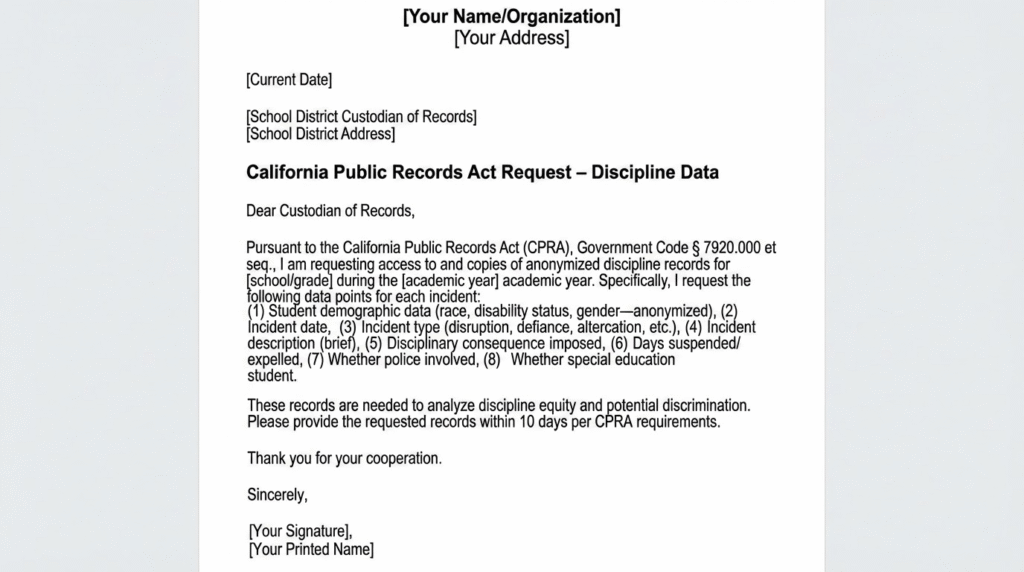
Step 2: Request Discipline Records Under California Public Records Act
“Request anonymized discipline records for [grade level / school] for [academic year] including: student demographic data (race, disability status—anonymized), incident date, incident type/description, disciplinary consequence, days suspended/expelled, whether police involved.”
Step 3: Identify Similarly-Situated Comparators
Review records for students with substantially similar conduct: Same violation type (disruption, defiance, altercation), Similar severity (verbal vs. physical, weapon/no weapon), Same grade level or age range, Same time period
Step 4: Create Comparative Chart
Template:
Student | Race | Disability | Incident | Discipline | Days |
A (Your child) | Black | No | Verbal argument | 5-day suspension | 5 |
B (Comparator) | White | No | Verbal argument | Warning | 0 |
Disparity |
|
| Identical | 500% harsher |
|
Step 5: Statistical Analysis
Calculate averages by demographic group:
Average suspension days for disruption:
- Black students: 4.2 days
- White students: 0.8 days
- Disparity: 425%
Step 6: Expert Analysis (If Resources Allow)
Statistician can prove disparity statistically significant—exceeds what random chance would produce, proving systematic discrimination.
Using Comparative Treatment Analysis in Complaints
OCR Title VI Complaint:
“Student [name] (Black, 7th grade) suspended 5 days for verbal disagreement with peer. Student [comparator] (white, 7th grade) received warning for substantially similar verbal disagreement same week. Attached Comparative Treatment Analysis documents pattern: Black students at [school] receive average 4.2 days suspension for ‘disruption’ violations while white students receive average 0.8 days for identical violations—425% disparity statistically significant. District cannot articulate legitimate non-discriminatory reason for disparity. Violates Title VI prohibiting racial discrimination. Request investigation, corrective action, compensatory education.”
Equal Protection § 1983 Lawsuit:
“Comparative Treatment Analysis (Exhibit A) proves selective enforcement violating Fourteenth Amendment Equal Protection. Plaintiff (Black) and identified comparators (white) engaged in substantially similar conduct. Plaintiff received significantly harsher discipline solely based on race. Pattern analysis across [number] incidents proves systematic discrimination. District’s claimed reasons pretextual. Seek damages, injunctive relief requiring equity review of discipline decisions.”
State Discrimination Complaint:
“California Education Code § 220 prohibits discrimination based on race and disability. Attached Comparative Treatment Analysis demonstrates special education student [name] disciplined more harshly than general education students for identical conduct. Pattern proves disability discrimination. Request investigation and corrective action.”
Named Framework: The SANI Comparative Treatment Analysis Framework (Five-Step Methodology)
Step 1: Document Your Child’s Incident With Comprehensive Detail (Baseline Establishment)
Create detailed incident record: exact date and time, precise conduct (what child did—be specific, objective), context and circumstances (what led to incident, who was involved), witnesses present, statements made by child/staff, discipline imposed (suspension days, expulsion recommendation, police involvement), who made disciplinary decision and when, any explanations given for discipline severity. This baseline documentation enables comparison to similarly-situated students showing whether your child’s discipline was proportionate or excessive compared to peers.
Step 2: Request Anonymized Comparative Discipline Data Through Public Records (Comparator Identification)
File California Public Records Act request: “Request anonymized discipline records for [specific school/grade level] for [academic year] including: student demographic characteristics (race, disability status, gender—anonymized with coded identifiers not names), incident date, incident classification (disruption, defiance, altercation, insubordination, etc.), brief incident description, disciplinary consequence (warning, detention, suspension, expulsion recommendation), days of suspension/expulsion, whether police involved, whether student has IEP/504 plan. Need records to analyze equity in discipline practices. Provide within 10 days per Government Code § 6253.” This provides pool of potential comparators.
Step 3: Identify Similarly-Situated Comparators and Document Disparate Treatment (Pattern Analysis)
From received records, identify students who: engaged in substantially similar conduct (same violation type, comparable severity), similar age/grade level, same time period (ideally same semester or year), received markedly different discipline. Create comparative chart showing: your child (protected class) + conduct + discipline received, comparator student (non-protected class) + identical/similar conduct + discipline received, quantified disparity (e.g., 5 days suspension vs. warning = 500% harsher). Identify 3-5+ comparative pairs strengthening pattern evidence. Calculate statistical averages by demographic group proving systematic disparity beyond individual comparisons.
Step 4: Eliminate District’s Claimed Legitimate Explanations as Pretextual (Rebuttal Preparation)
Anticipate district defenses and prepare rebuttals: If district claims “Student A’s conduct more severe”—demand documentation showing severity difference; if none exists or difference minimal, explanation is pretextual. If “Student A had prior discipline history”—research comparator’s history; if comparator has similar/worse history but received lesser discipline, explanation pretextual. If “Different administrators have discretion”—cite district policy requiring consistency; prove pattern shows discrimination not individual judgment. If “Student A posed greater safety risk”—demand objective evidence; if speculative or based on stereotypes, pretextual. Force district to articulate specific non-discriminatory reason then prove reason cannot withstand scrutiny.
Step 5: File Discrimination Complaint With Comprehensive Comparative Evidence (Legal Action)
Submit to OCR (Title VI/Section 504) and/or file lawsuit (§ 1983 Equal Protection): “Comparative Treatment Analysis (attached exhibits) proves selective enforcement and discrimination. [Your child] ([race/disability status]) received [harsh discipline] for [conduct]. Identified comparators ([non-protected status]) received [minimal discipline] for substantially similar conduct. Statistical analysis shows [protected class] students receive average [X] days suspension while [non-protected class] receive average [Y] days for identical violations—[Z]% disparity statistically significant proving systematic discrimination. District cannot articulate legitimate non-discriminatory explanation for disparity. Violates [Title VI / Equal Protection / Section 504 / California Ed Code § 220]. Request: investigation, corrective action, compensatory education, damages, injunctive relief requiring equity review of discipline.”
Action Steps
1. Immediately After Your Child Disciplined, Document Incident Details Comprehensively
Create detailed record before memories fade: exact date/time, precise conduct description (objective facts not characterizations), context leading to incident, witnesses present, statements by child/staff during incident, discipline imposed (days suspended, expulsion recommendation, police involvement), who made decision and when, explanations given for discipline severity, your child’s prior discipline history for comparison. Save all school communications (emails, letters, texts). This baseline enables comparing your child’s treatment to similarly-situated students proving whether discipline proportionate or excessive based on protected class.
2. File Public Records Request for Anonymized Comparative Discipline Data
Within 30 days of incident, file California Public Records Act request: “Request anonymized discipline records [specific school/grade] [academic year]: student demographics (race, disability, gender—anonymized), incident date, incident type, brief description, consequence imposed, days suspended, police involvement, special education status. Need to analyze discipline equity. Provide within 10 days Government Code § 6253.” This provides comparative data pool. If denied, appeal: “Anonymized discipline data is public record. Provide with personal identifiers removed complying with privacy laws.”
3. Analyze Data Identifying Similarly-Situated Comparators With Disparate Treatment
From received records: identify students with substantially similar conduct (same violation type, comparable severity), similar grade/age, same timeframe, who received markedly different discipline. Create comparison chart: your child (race/disability) + conduct + discipline, comparator (different race/non-disabled) + similar conduct + lesser discipline, disparity quantified. Identify 3-5+ pairs showing pattern. Calculate averages by demographic: “Disruption incidents: Black students avg 4.2 days, white students avg 0.8 days = 425% disparity.” Pattern evidence stronger than single comparison.
4. Prepare Rebuttals to District’s Anticipated Defenses Before Filing
Before submitting complaint, anticipate defenses and prepare responses: District claims “conduct more severe”—demand documentation showing difference; if minimal/none, note pretextual. Claims “prior history”—research comparator’s history; if similar/worse with lesser discipline, note selective application. Claims “administrator discretion”—cite policy requiring consistency, prove pattern shows discrimination not discretion. Claims “safety risk”—demand objective evidence; if speculative/stereotypical, note bias. Having rebuttals ready prevents district derailing complaint with unsubstantiated explanations. Include in initial filing: “Anticipated defenses and rebuttals attached—district cannot articulate legitimate non-discriminatory explanation for documented disparity.”
5. File Comprehensive Discrimination Complaint With Full Comparative Analysis
Submit to OCR (Title VI/Section 504) with complete evidence package: cover letter summarizing discrimination, detailed Comparative Treatment Analysis with charts/data, statistical analysis showing pattern, rebuttals to anticipated defenses, supporting documentation (discipline notices, emails, records). “Attached Comparative Treatment Analysis proves selective enforcement. [Child] ([protected class]) received [harsh discipline] for [conduct]. Comparators ([non-protected]) received [minimal discipline] for identical conduct. Statistical analysis shows [X]% disparity—systematic discrimination violating [Title VI/Section 504/Ed Code 220]. Request investigation, corrective action, compensatory education.” Complete evidence package increases investigation likelihood and settlement leverage.
FAQs
1. What is the Comparative Treatment Analysis Framework and why is it important?
The Comparative Treatment Analysis Framework is a structured approach used to evaluate whether similarly situated students are treated differently in disciplinary decisions. Rather than relying on general claims of unfairness, this method focuses on comparing outcomes across students to identify patterns that may indicate unequal treatment. This type of analysis can be important in assessing whether school practices align with obligations under civil rights laws such as Title VI, Section 504, and state nondiscrimination statutes.
2. How do I identify "similarly situated" students for comparison?
Students are typically considered similarly situated when key factors are comparable, such as the type of conduct involved, the general level of severity, age or grade level, and the timeframe of the incident. The goal is not to find identical situations, but to identify comparable circumstances that allow for meaningful evaluation of how discipline was applied across different students.
3. What data do I need to request to conduct a comparative analysis?
Useful data may include anonymized discipline records showing incident type, dates, outcomes (e.g., warning, suspension), and general student characteristics such as grade level or program participation. Public records laws may allow access to aggregated or anonymized information. This type of data can help identify trends and support a more objective review of disciplinary practices.
4. How do I determine whether differences in discipline are justified?
Differences in outcomes may be evaluated by considering whether there are clear, documented reasons for the variation, such as differences in conduct severity, prior history, or other relevant factors. A consistent pattern of differing outcomes without clear justification may raise concerns and warrant further review.
5. Can this framework be used for different types of discrimination?
Yes. Comparative analysis can be applied across various protected categories, including race, disability, and other characteristics covered by applicable laws. The same general approach—comparing how similar situations are handled—can help assess whether policies and practices are being applied consistently and fairly.
Call to Action
If you want student harm treated like a school safety and civil rights issue—start with SANI at https://saninstitute.net
Sources
-
42 U.S.C. § 2000d (Title VI) – Prohibits discrimination on the basis of race, color,
or national origin in programs receiving federal funding. Comparative evidence may be used to evaluate
whether similarly situated individuals are treated differently.
https://www.law.cornell.edu/uscode/text/42/2000d -
U.S. Constitution, Amendment XIV (Equal Protection Clause) – Provides that no state
shall deny any person equal protection of the laws, forming the constitutional basis for evaluating
unequal or selective treatment.
https://constitution.congress.gov/constitution/amendment-14/ -
29 U.S.C. § 794 (Section 504) – Prohibits discrimination on the basis of disability in
programs receiving federal financial assistance, including educational settings.
https://www.law.cornell.edu/uscode/text/29/794 -
California Education Code § 220 – Prohibits discrimination on the basis of protected
characteristics, including race, disability, and sex, in California educational programs and activities.
https://leginfo.legislature.ca.gov/faces/codes_displaySection.xhtml?lawCode=EDC§ionNum=220 -
California Government Code § 6253 – Part of the California Public Records Act, requiring
disclosure of public records upon request, which may include anonymized data relevant to evaluating
government practices.
https://leginfo.legislature.ca.gov/faces/codes_displaySection.xhtml?lawCode=GOV§ionNum=6253