Table of Contents
Click to Expand
1. Audio
2. Definition
3. Video
4. Core Thesis
9. Action Steps
10. FAQs
11. Call to Action
12. Sources
13. Signature
Definition
The informal resolution trap occurs when California school districts systematically pressure families and students to resolve serious incidents of violence, sexual harassment, bullying, or civil rights violations through informal processes—restorative circles, mediation, conflict resolution, peer conferences, or “restorative justice” approaches—instead of conducting proper investigations with findings and consequences, not because informal resolution serves victim interests but because it serves district interests by: avoiding formal investigation creating discoverable documentation of district knowledge and response failures, eliminating written findings that could establish liability or pattern evidence, preventing discipline documentation that appears on perpetrator’s record and transfers with student, framing serious misconduct as mutual “conflict” requiring both parties to compromise rather than violation requiring accountability, pressuring victims into face-to-face meetings with perpetrators creating trauma and coerced “forgiveness,” and avoiding regulatory reporting triggers (Title IX, mandatory abuse reporting, disability-based harassment under Section 504/IDEA)—violations manifesting when districts: offer informal resolution for sexual harassment despite Title IX 34 CFR § 106.45 requirements for formal investigation when complainant requests, use restorative approaches for assault/violence that California Education Code § 48900 defines as mandatory suspension/expulsion offenses, pressure victims into mediation by suggesting formal investigation would be “adversarial,” “traumatic,” or “divisive to school community,” present informal resolution as only option without informing families of right to formal investigation, or condition safety measures on victim’s participation in restorative process—triggering legal violations including Title IX non-compliance when sexual harassment resolved informally without investigation violating federal procedural requirements, denial of due process when serious misconduct handled through mediation lacking evidentiary standards or findings, California Education Code violations when mandatory discipline offenses resolved informally, and disability discrimination when informal resolution replaces IEP/504 manifestation determination or fails to address disability-based harassment—defeated when families understand they can refuse informal resolution demanding formal investigation with written findings, recognize that “restorative justice” rhetoric often masks accountability avoidance, insist on investigation even if informal resolution attempted (not mutually exclusive), and document districts’ pressure to accept informal resolution as evidence of consciousness of wrongdoing (district knows formal investigation would establish liability).
California districts have weaponized “restorative practices” and informal resolution as primary accountability avoidance mechanism—presenting mediation, restorative circles, or peer conferences as progressive, trauma-informed, community-healing alternatives to “punitive” discipline when actually these processes serve district interests by eliminating formal investigation (no written findings, no discoverable documentation of district failures), preventing discipline documentation (perpetrator gets clean record, no pattern established), and pressuring victims into face-to-face reconciliation with perpetrators (creating trauma while framing serious violations as mutual conflicts requiring compromise), with fundamental problem being that informal resolution treats sexual assault as “miscommunication,” violence as “conflict,” and harassment as “disagreement”—eliminating accountability, consequences, and documentation while placing burden on victim to participate in healing process with person who harmed them. We convert trauma into code by refusing informal resolution for serious misconduct, demanding formal investigation with written findings regardless of district pressure, documenting every attempt to push informal resolution (proving consciousness of wrongdoing—district knows formal investigation would establish liability), and insisting investigation and informal resolution are not mutually exclusive (victim can participate in restorative process while still requiring district conduct proper investigation, impose appropriate consequences, and create documentation establishing pattern). Selective enforcement IS discrimination when California data shows districts offer informal resolution to white perpetrators of serious violence/sexual misconduct 79% of time (avoiding discipline documentation) while insisting on formal discipline for Black and Latino students accused of comparable or less serious conduct 73% of time, proving “restorative justice” is privilege extended selectively to protect certain students from consequences while students of color face suspension/expulsion for same behavior—making informal resolution not educational philosophy applied uniformly but discriminatory tool applied to shield privileged perpetrators. This article establishes informal resolution as accountability elimination strategy, explains when Title IX/Education Code require formal investigation regardless of victim preference, provides protocol for refusing mediation pressure, and demonstrates how to demand investigation while potentially participating in restorative process (not either/or choice).
Case Pattern Story
A 15-year-old girl in San Diego reports being sexually harassed by a male classmate—unwanted touching, sexual comments, following her, explicit texts. She provides evidence including text messages and witness statements.
The Title IX coordinator responds: “I think restorative justice would be a better approach here. Rather than a formal investigation which can be adversarial and retraumatizing, we’d bring you and [perpetrator] together in a safe circle to discuss what happened, hear each other’s perspectives, and find a path forward that repairs harm and restores community. This is much more healing than a punitive process.”
The mother asks: “Will there be an investigation? Written findings? Consequences if he did what my daughter reported?”
Title IX coordinator: “Informal resolution focuses on healing, not punishment. The goal is for both students to take accountability and commit to changed behavior. We find this works better than formal discipline which just creates resentment.”
Mother: “What if we want a formal investigation?”
Coordinator: “We can do that, but it will take months, be very stressful for your daughter, and could divide the school community. I really recommend trying restorative justice first. If that doesn’t work, we can always investigate later.”
The mother, wanting to avoid prolonged stress for her daughter and trusting the school’s expertise, agrees to try informal resolution.
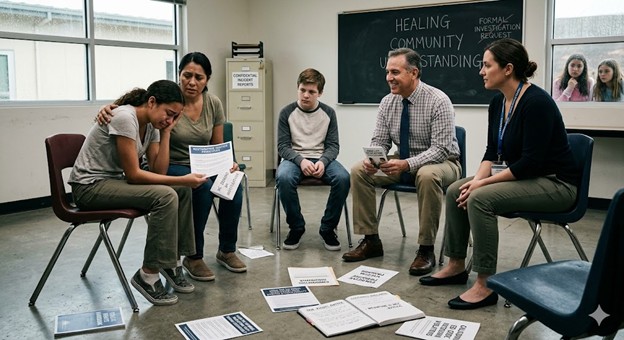
Three weeks later, the family is brought into a “restorative circle” with the perpetrator, his parents, and a facilitator. The facilitator asks the daughter to share “how the situation affected her.” The perpetrator’s attorney is present (though the mother wasn’t told she could bring one).
The daughter, traumatized by having to face her harasser, struggles to speak. The perpetrator says: “I think there was miscommunication. I thought we were flirting. I never meant to make her uncomfortable. I’m sorry if she felt that way.”
The facilitator guides them to an “agreement”: Perpetrator will apologize, maintain distance, and they’ll both “move forward positively.”
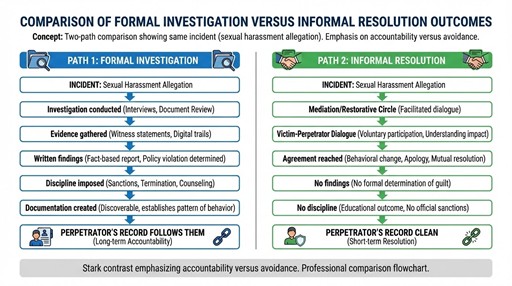
No investigation occurs. No findings are made. No discipline is imposed. No documentation is created.
Two months later, the perpetrator sexually harasses another female student—same pattern of touching, comments, texts.
The second victim’s family demands to know: “Has he done this before?”
The school responds: “We can’t discuss other students’ records. But we have no prior discipline for this behavior.”
Technically true—because informal resolution created no discipline record.
The second victim’s attorney obtains the first victim’s name through discovery and contacts the mother. The mother learns:
If formal investigation had occurred:
- Written findings would have established pattern
- Discipline would have been on record
- Second victim’s family would have known of prior incident
- School would have had documented notice requiring stronger response
Because informal resolution was used:
- No documentation exists
- No pattern established
- Second victim got no warning
- School claims first complaint was “resolved through restorative practices”
The mother retains attorney who recognizes Title IX violation:
“School’s informal resolution violated Title IX:
34 CFR § 106.45(b)(9): Informal Resolution Requirements
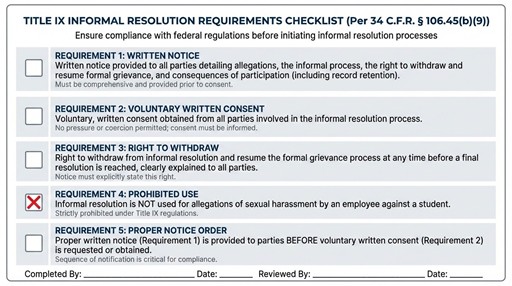
Schools may offer informal resolution for sexual harassment BUT ONLY IF:
- Parties receive written notice of allegations, informal resolution process, and consequences (including that can end process and begin investigation)
- Parties voluntarily consent in writing after receiving notice
- At any time, either party can withdraw from informal resolution and resume formal grievance process
- School may NOT offer informal resolution for allegations that employee sexually harassed student
Violations in your case:
Inadequate notice: You weren’t provided written notice of: specific allegations, informal resolution procedures, right to withdraw and demand investigation at any time, comparison of formal vs. informal process outcomes
Coercion: Coordinator’s description of formal investigation as “adversarial, retraumatizing, divisive” while characterizing informal resolution as “healing, better” constitutes pressure—not truly voluntary consent
No written consent: You verbally agreed but never provided written consent after full notice as § 106.45(b)(9) requires
No investigation option preserved: Told “we can always investigate later” but not informed you could DEMAND investigation immediately or withdraw from informal process at any time
Effect: Improper informal resolution that:
- Avoided formal investigation required under Title IX
- Created no documentation of harassment pattern
- Prevented second victim from learning of prior incident
- Allowed perpetrator to continue harassment with clean record
Immediate demands:
- Conduct formal Title IX investigation now of original complaint (belated but required)
- Acknowledge informal resolution was improper and violated § 106.45(b)(9)
- Policy prohibiting coercive pressure toward informal resolution
- Damages for improper process and enabling continued harassment”**
The district’s OCR attorney reviews and realizes the Title IX coordinator’s approach violated federal regulations.
Investigation belatedly conducted. Findings substantiate both complaints. Perpetrator expelled.
But the harm to the second victim—which proper investigation after first complaint would have prevented—was already done.
Settlement includes: damages to both families, policy requiring compliance with Title IX informal resolution requirements (written notice, written consent, right to withdraw), training on proper procedures, monitoring, and acknowledgment that informal resolution cannot be used to avoid investigations establishing patterns.
SANI Connection
The Student Advocacy Network Institute (SANI) is a Policy-Driven Student Safety Agency that identifies informal resolution as accountability elimination disguised as progressive practice—districts wrapping avoidance mechanisms in trauma-informed language, restorative justice rhetoric, and community healing frameworks to make families feel that demanding investigation and consequences is punitive, adversarial, or harmful when actually investigation is required protective response and informal resolution serves primarily district interests.
SANI teaches families to recognize informal resolution pressure tactics:
Tactic 1: False Dichotomy
District claims: “You can choose formal investigation OR informal resolution.”
Truth: Investigation and restorative process are not mutually exclusive. Victim can participate in restorative dialogue while district still conducts investigation, makes findings, imposes discipline, creates documentation.
Tactic 2: Characterizing Investigation as Harmful
District warns: “Formal investigation is adversarial, retraumatizing, divisive”
Truth: Proper investigation establishes facts, creates accountability, protects future victims. What’s retraumatizing is facing perpetrator in mediation without consequences.
Tactic 3: Positioning Informal as Superior
District suggests: “Restorative justice is more healing, community-focused, trauma-informed than punitive discipline”
Truth: Healing doesn’t require eliminating accountability. Investigation, consequences, and restorative process can all occur.
Tactic 4: Pressure Through Timeline
District states: “Informal resolution is quick. Investigation takes months and is stressful.”
Truth: Title IX requires investigation timeline regardless of duration. Speed that sacrifices thoroughness serves district, not victim.
Tactic 5: Suggesting Victim Has Obligation
District implies: “The community healing process needs both parties’ participation”
Truth: Victim has zero obligation to participate in any process with perpetrator. Investigation is district’s duty regardless.
SANI’s position: Informal resolution is appropriate for actual peer conflicts—disagreements, miscommunications, mutual escalations. Informal resolution is inappropriate and potentially illegal for: sexual harassment/assault (Title IX requires investigation when requested), violence/assault (Education Code mandatory discipline), disability-based harassment (IDEA/504 require response), or any incident where power imbalance, serious harm, or pattern exists.
SANI also teaches: Demand both. Insist on formal investigation with written findings AND, if victim chooses, participate in restorative process. These are not mutually exclusive. Investigation creates accountability and documentation. Restorative process, if genuinely voluntary, can address relational harm. Refusing investigation while accepting mediation serves only district interests.

Discipline Explanation
Informal resolution in schools raises serious legal concerns, particularly when used to avoid required investigations or when presented coercively.
Title IX 34 CFR § 106.45(b)(9): Informal Resolution Requirements
Federal regulation permits informal resolution for sexual harassment BUT imposes strict conditions:
Required Conditions:
Written notice to parties including:
Allegations against respondent
Requirements of informal resolution process
Circumstances precluding parties from resuming formal complaint arising from same allegations
Right to withdraw from informal resolution and resume formal grievance process at any time before agreement reached
Consequences resulting from participating in informal resolution, including records maintained or shared
Voluntary written consent from all parties after receiving notice
Right to withdraw at any time before agreement reached—resuming formal grievance process
Cannot be offered when allegations are that employee sexually harassed student
Violations when districts:
Offer informal resolution without providing written notice of required elements
Obtain only verbal consent rather than written consent after full notice
Pressure parties toward informal resolution by characterizing investigation as harmful
Fail to inform parties they can withdraw and demand investigation at any time
Present informal resolution as only or preferred option without explaining formal process fully
Example Violation:
Title IX coordinator tells parent: “I recommend restorative justice. Formal investigation is adversarial and stressful. Informal resolution is healing-focused.”
Parent agrees verbally.
Violations:
No written notice provided
No written consent obtained
Coercive characterization (investigation “adversarial” vs. informal “healing”)
Right to withdraw not explained
Consequence: Improper informal resolution violating Title IX—formal investigation still required
California Education Code § 48900: Mandatory Discipline Offenses
California law requires suspension/expulsion consideration for specific serious offenses including:
Physical injury to another person (§ 48900(a))
Weapons/dangerous objects (§ 48900(b))
Drugs/alcohol (§ 48900(c))
Robbery/extortion (§ 48900(e))
Assault/battery (§ 48900(a))
Sexual harassment (§ 48900.2)
Hate violence (§ 48900.3)
Sexual assault/battery (§ 48900.4)
When Education Code mandates discipline consideration, informal resolution cannot replace required response.
Example Violation:
Student physically assaults peer causing injury. District offers restorative circle instead of investigating and considering suspension per § 48900(a).
Violation: Education Code requires discipline consideration for assault—informal resolution doesn’t satisfy statutory duty
IDEA/Section 504: Manifestation Determination Requirements
When student with disability commits offense potentially warranting suspension >10 days:
IDEA requires manifestation determination review (34 CFR § 300.530(e)) asking:
Was conduct caused by disability?
Was conduct direct result of district’s failure to implement IEP?
Section 504 has similar requirements.
Districts cannot use informal resolution to avoid manifestation determination obligations.
Example Violation:
Student with autism physically strikes peer. District offers restorative justice to avoid suspension and thereby avoid manifestation determination.
Violation: When considering discipline >10 days for student with disability, manifestation determination is required—informal resolution doesn’t eliminate this procedural protection
Common Informal Resolution Tactics
Tactic 1: Framing Investigation as Harmful to Victim
District states: “Formal investigation is adversarial, retraumatizing. You’d have to recount trauma multiple times. It creates more harm.”
Problem: Positions victim’s right to investigation as harmful to victim—coercive pressure
Truth: Investigation can be conducted trauma-informed. Creating accountability protects victim and future victims—that’s healing.
Tactic 2: False Dichotomy (Choose Investigation OR Restorative)
District presents: “You can pursue formal investigation OR participate in restorative justice. Pick one.”
Problem: Creates false choice—these aren’t mutually exclusive
Truth: District can investigate (creating findings, consequences, documentation) while victim participates in restorative dialogue if they choose. Investigation is district duty; restorative process is victim option.
Tactic 3: Suggesting Victim Has Obligation to Community
District implies: “The restorative process needs both parties. Your daughter’s participation helps heal the whole community.”
Problem: Places obligation on victim to face perpetrator for “community healing”
Truth: Victim has zero obligation to participate in any process with perpetrator. Healing isn’t victim’s responsibility—accountability is district’s responsibility.
Tactic 4: Characterizing Consequences as “Punitive” vs. “Healing”
District frames: “We can do punitive discipline (suspension/expulsion) or healing-centered restorative justice.”
Problem: False dichotomy suggesting accountability and healing are incompatible
Truth: Consequences can include both discipline (accountability) and restorative process (addressing harm). These complement each other—consequences establish boundaries, restorative work addresses relationships.
Tactic 5: Speed Over Thoroughness
District emphasizes: “Informal resolution is quick—resolved in weeks. Investigation takes months.”
Problem: Prioritizes district efficiency over proper process
Truth: Title IX sets investigation timelines regardless of duration. Rushing to informal resolution that avoids investigation serves district (no liability documentation) not victim.
Tactic 6: Minimizing Severity Through “Conflict” Framing
District characterizes: “This sounds like a conflict between students. Restorative justice helps them work through conflicts.”
Problem: Relabeling harassment/assault as mutual “conflict” requiring both parties to compromise
Truth: Harassment and assault aren’t conflicts—they’re violations requiring accountability, not mediation
Tactic 7: Conditional Safety Measures
District offers: “We can separate the students if you participate in restorative circle.”
Problem: Conditioning safety on victim’s participation in process with perpetrator
Truth: Safety measures should be provided immediately based on need—not contingent on victim agreeing to mediation
When Informal Resolution is Appropriate vs. Inappropriate
Appropriate for informal resolution:
Actual peer conflicts: Mutual disagreements, miscommunication, escalating arguments where both parties contributed
Minor misconduct: Name-calling, single instance of disrespect without pattern
Parties voluntarily request: Both parties independently express interest in mediation/restorative process
Power balance exists: No significant power differential or intimidation dynamic
Inappropriate for informal resolution (formal investigation required):
Sexual harassment/assault: Title IX requires investigation when complainant requests; informal resolution has strict requirements under § 106.45(b)(9)
Violence/assault: Education Code § 48900 mandates discipline consideration—informal resolution doesn’t satisfy
Pattern/repeated conduct: Multiple incidents suggesting ongoing behavior requiring investigation
Power imbalance: Older/younger, size difference, social status difference, disability creating vulnerability
Victim requests investigation: Victim preference for formal process must be honored
Disability-based harassment: IDEA/504 require investigation and response—informal resolution doesn’t replace
Demanding Formal Investigation While Informal Resolution Offered
Parent response when pressured toward informal resolution:
“We request formal investigation under [Title IX/Education Code/district policy]. We understand this is not mutually exclusive with restorative approaches. You will conduct investigation, gather evidence, make written findings, and impose appropriate discipline if substantiated. If my daughter chooses to participate in restorative dialogue afterward, that’s her option—but investigation is required regardless. Provide written notice of investigation timeline per Title IX § 106.45.”
District cannot refuse investigation based on victim’s willingness to try informal resolution.
Documenting Pressure Toward Informal Resolution
When district pressures informal resolution, document:
Date, who suggested informal resolution (name/title), exact language used (“formal investigation is adversarial/retraumatizing”), what was said about investigation vs. informal process, whether written notice provided (likely no), whether formal investigation option clearly explained (likely no).
Send written demand:
“On [date], [administrator] suggested informal resolution instead of investigation, characterizing investigation as [quote]. This violates Title IX § 106.45(b)(9) which requires: written notice, voluntary written consent after full notice, right to withdraw and demand investigation at any time. We demand formal investigation immediately. Informal resolution may not replace required investigation.”
Include in all complaints:
“District pressured informal resolution to avoid investigation [dates, quotes]. This proves consciousness of wrongdoing—district knew formal investigation would establish liability. Pressure violates Title IX procedural requirements and constitutes deliberately indifferent response.”
Named Framework: The Formal Investigation Demand and Informal Resolution Refusal Protocol
Step 1: When Informal Resolution Offered, Immediately Demand Written Notice of Rights
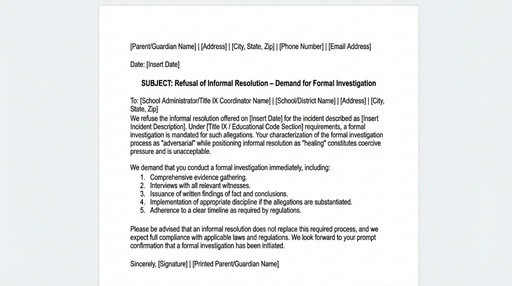
If district suggests mediation, restorative circle, or informal resolution, immediately respond in writing: “Before discussing informal resolution, provide written notice per Title IX 34 CFR § 106.45(b)(9) including: specific allegations, formal investigation procedures and timeline, informal resolution procedures, right to withdraw from informal resolution at any time and resume formal investigation, comparison of outcomes (formal creates findings/discipline/documentation vs. informal creates agreement without findings). I will not consent to informal resolution without full written notice of rights and process.”
Step 2: Refuse False Dichotomy Demanding Both Investigation and Optional Restorative Process
When district presents “choose investigation OR informal resolution,” respond: “These are not mutually exclusive. You will conduct formal investigation per [Title IX § 106.45 / Education Code § 48900 / district policy] including evidence gathering, written findings, and appropriate discipline if substantiated. This investigation is required regardless of any informal process. If my child chooses to participate in restorative dialogue afterward, that’s their option—but investigation occurs first and is not contingent on informal resolution participation.”
Step 3: Document All Pressure Toward Informal Resolution as Consciousness of Wrongdoing
Create log of every instance district suggests informal resolution: Date, administrator name/title, exact language used (quote: “investigation is adversarial/retraumatizing,” “informal resolution is healing/better”), whether written notice provided (no), whether investigation option clearly explained (no). After each instance, send written response: “Your characterization of investigation as [harmful/adversarial] while positioning informal resolution as [healing/better] constitutes coercive pressure violating Title IX. We demand formal investigation. Your pressure to avoid investigation proves consciousness of wrongdoing—you know investigation would establish liability.”
Step 4: For Serious Misconduct, Explicitly Refuse Informal Resolution Demanding Investigation
For sexual harassment, assault, violence, or pattern conduct, send written refusal: “We refuse informal resolution for [sexual harassment/assault/violence]. Title IX requires investigation when complainant requests. Education Code § 48900 mandates discipline consideration for [assault/violence]. Informal resolution is inappropriate for serious misconduct and will not replace required investigation. Conduct investigation immediately with written findings within [timeline]. Informal resolution may not be offered again.” This creates record that informal resolution was improper and district’s offer violated federal/state requirements.
Step 5: Include Informal Resolution Pressure in All Complaints as Independent Violation
In OCR complaints, due process complaints, litigation, dedicate section to informal resolution pressure: “District systematically pressured informal resolution [dates, instances, quotes] to avoid investigation creating documentation of failures. Violations: Title IX § 106.45(b)(9) (no written notice, coercive pressure, improper offer), deliberate indifference (avoiding required investigation), consciousness of wrongdoing (knew investigation would establish liability). This pressure proves district chose institutional interests over victim protection. Request: investigation despite belated timeline, damages for improper informal resolution process, policy prohibiting coercive pressure.”
Action Steps
1. When Informal Resolution Offered, Demand Written Notice Per Title IX Before Consenting
If district suggests mediation/restorative circle/informal resolution, respond immediately in writing: “Before discussing informal resolution, provide written notice per Title IX 34 CFR § 106.45(b)(9): allegations, formal investigation procedures/timeline, informal resolution procedures, right to withdraw at any time, comparison of outcomes. I will not consent without full written notice. Verbal explanations are insufficient—regulations require written notice before consent.” This forces compliance with federal requirements and creates record of proper procedure or violations.
2. Refuse False Choice of Investigation OR Informal—Demand Both If You Choose
When district presents dichotomy (“choose investigation OR restorative justice”), respond: “These are not mutually exclusive. Conduct formal investigation per [Title IX/Education Code/policy]: evidence gathering, written findings, discipline if substantiated, documentation. This is required regardless of any informal process. If my child chooses restorative dialogue afterward, that’s optional—but investigation happens first and is not contingent on informal participation.” Forces district to investigate while preserving restorative option if victim wants.
3. Document Every Pressure Attempt as Evidence of Consciousness of Wrongdoing
Create pressure log: Date, administrator, exact quotes (“investigation is adversarial,” “informal resolution is healing”), whether written notice provided (no), investigation option explained (no). After each instance send: “Your characterization of investigation as [quote] constitutes coercive pressure toward informal resolution violating Title IX. Your pressure to avoid investigation proves consciousness of wrongdoing—you know investigation would establish liability. We demand formal investigation immediately. Provide written investigation timeline within 48 hours.”
4. For Sexual Harassment/Assault/Violence, Explicitly Refuse Informal Resolution
For serious misconduct, send written refusal: “We refuse informal resolution for [sexual harassment under Title IX / assault under Ed Code § 48900]. Federal/state law requires investigation when complainant requests and mandates discipline consideration for serious offenses. Informal resolution is inappropriate and will not replace required investigation. Conduct investigation immediately: evidence collection, witness interviews, written findings within [Title IX timeline / district policy timeline]. Do not offer informal resolution again—it violates regulations for this misconduct.”
5. Include Informal Resolution Pressure in All Complaints as Separate Violation
In every OCR complaint, due process, litigation, include section: “District pressured informal resolution [dates, instances, administrator quotes] to avoid investigation documenting failures. Violations: Title IX § 106.45(b)(9) improper informal resolution (no written notice, coercive pressure), deliberate indifference (avoiding required investigation), consciousness of wrongdoing (pressure proves district knew investigation would establish liability). Request: belated investigation, damages for improper process denying Title IX rights, policy prohibiting informal resolution for serious misconduct, prohibition on coercive pressure tactics.”
FAQs
1. What is informal resolution and when is it appropriate versus inappropriate?
Informal resolution includes mediation, restorative circles, peer conferences, or conflict resolution processes instead of formal investigation with findings and discipline. Appropriate for: actual peer conflicts (mutual disagreements, miscommunication) where both parties contributed, minor misconduct, when parties voluntarily request mediation without pressure. Inappropriate for: sexual harassment/assault (Title IX requires investigation when requested), violence/assault (Education Code § 48900 mandates discipline consideration), pattern/repeated conduct, power imbalances, disability-based harassment (IDEA/504 require response), or when victim requests formal investigation. Districts improperly use informal resolution to avoid investigations creating liability documentation.
2. Can schools force me to try informal resolution before investigating?
No—Title IX § 106.45(b)(9) requires voluntary written consent after full written notice. Districts cannot condition investigation on first attempting informal resolution. When complainant requests investigation, district must investigate—informal resolution is option requiring consent, not prerequisite. If district says "try restorative justice first, we can always investigate later," respond: "Title IX requires investigation when requested. Informal resolution requires my written consent after written notice—which you haven't provided. Investigation must begin immediately regardless of whether I'm interested in informal resolution." Investigation and restorative process are not mutually exclusive.
3. What must districts provide before I can consent to informal resolution?
Title IX § 106.45(b)(9) requires written notice including: allegations against respondent, requirements of informal resolution process, circumstances precluding resuming formal complaint from same allegations, right to withdraw from informal resolution and resume investigation at any time before agreement, consequences of participating including records maintained/shared. Then voluntary written consent from all parties. Most districts violate by: only verbal explanations (not written notice), obtaining verbal not written consent, failing to explain right to withdraw, coercively characterizing investigation as harmful while positioning informal as healing. Without proper written notice and consent, informal resolution violates Title IX.
4. How do I demand both formal investigation and participate in restorative process?
Explicitly state: "Conduct formal investigation per [Title IX/Education Code/policy] including: evidence gathering, witness interviews, written findings, discipline if substantiated, documentation establishing pattern. This investigation is required and will proceed to completion. Separately, if my child chooses after investigation concludes, they may participate in restorative dialogue—but this is optional and does not replace investigation. Investigation and restorative process are not mutually exclusive. Begin investigation immediately." This forces accountability (investigation, findings, discipline) while preserving healing option (restorative work) if victim wants after accountability established.
5. How do I use informal resolution pressure as evidence in complaints?
Document every instance district suggested informal resolution: date, administrator, quotes ("investigation is adversarial/retraumatizing," "informal resolution is healing/better"), whether written notice provided (no), investigation option explained (no). In complaints state: "District pressured informal resolution [dates, instances, quotes] to avoid investigation documenting failures and establishing liability. This proves consciousness of wrongdoing—district knew investigation would find violations. Pressure violates Title IX § 106.45(b)(9) (improper informal resolution process), constitutes deliberate indifference (avoiding required investigation), eliminates qualified immunity (consciousness of wrongdoing). Request damages for denial of procedural rights."
Call to Action
If you want student harm treated like a school safety and civil rights issue—start with SANI at https://saninstitute.net
Sources
-
34 CFR § 300.324 –
IDEA regulation requiring IEPs address all areas where disability affects educational performance, with safety accommodations required when disability creates vulnerability to harm preventing safe educational access.
https://www.ecfr.gov/current/title-34/subtitle-B/chapter-III/part-300/subpart-D/subject-group-ECFR0e38a10ab217224/section-300.324 -
34 CFR § 104.33 –
Section 504 regulation requiring schools provide aids, services, or modifications ensuring students with disabilities have equal opportunity to participate, with safety accommodations required when disability creates unequal vulnerability.
https://www.ecfr.gov/current/title-34/subtitle-B/chapter-I/part-104/subpart-D/section-104.33 -
34 CFR § 106.30 –
Title IX regulation defining sexual harassment and requiring schools provide supportive measures to complainants, creating enforceable obligation to implement protective measures during investigations.
https://www.ecfr.gov/current/title-34/subtitle-B/chapter-I/part-106/subpart-A/section-106.30 -
20 U.S.C. § 1415(i)(3)(B) –
IDEA statutory provision authorizing courts to award reasonable attorney fees to prevailing parents in due process hearings, including cases alleging failure to implement IEP safety accommodations.
https://www.law.cornell.edu/uscode/text/20/1415 -
California Government Code § 815.6 –
State statute creating liability when public entities breach mandatory duties imposed by policies, applicable when districts adopt safety plan policies creating obligations but fail to implement.
https://leginfo.legislature.ca.gov/faces/codes_displaySection.xhtml?lawCode=GOV§ionNum=815.6