
When Do Parents Need a Lawyer for School Bullying?
Most bullying cases do not need a lawyer. Some clearly do. Knowing the difference before you act matters more than most parents realize. The decision
1. Audio
2. Definition
3. Video
4. Core Thesis
9. Action Steps
10. FAQs
11. Call to Action
12. Sources
13. Signature
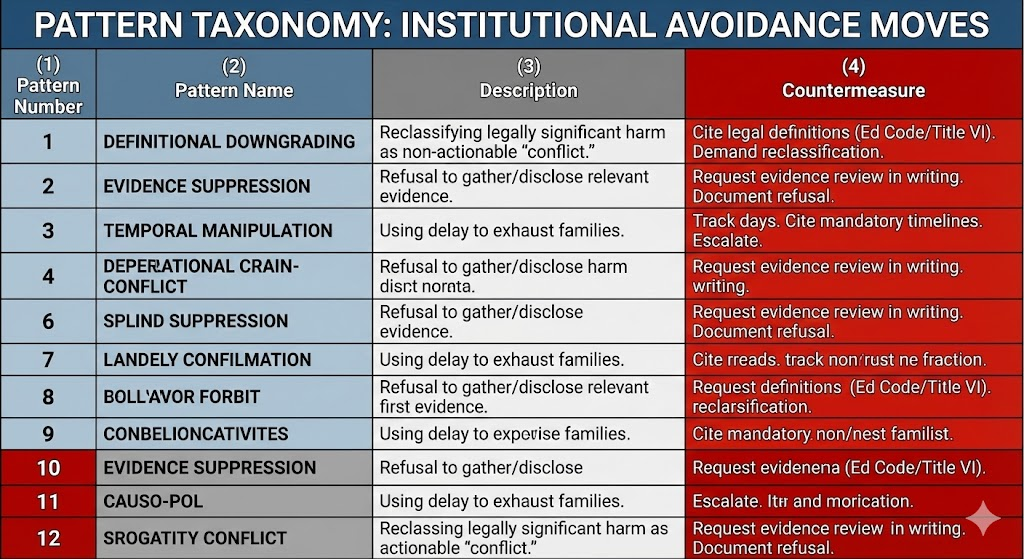
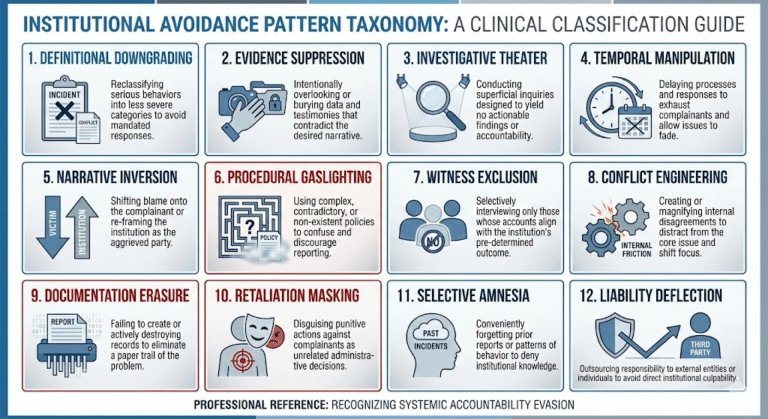
Pattern Taxonomy is a classification system that identifies, names, and categorizes the predictable institutional behaviors schools use to avoid accountability for student safety failures. These patterns include Definitional Downgrading, Temporal Manipulation, Evidence Suppression, Investigative Theater, Narrative Inversion, Procedural Gaslighting, Witness Exclusion, Conflict Engineering, Documentation Erasure, Retaliation Masking, Selective Amnesia, and Liability Deflection. By naming these patterns, families and advocates can recognize avoidance tactics in real time, document them systematically, and expose institutional manipulation that would otherwise remain invisible.
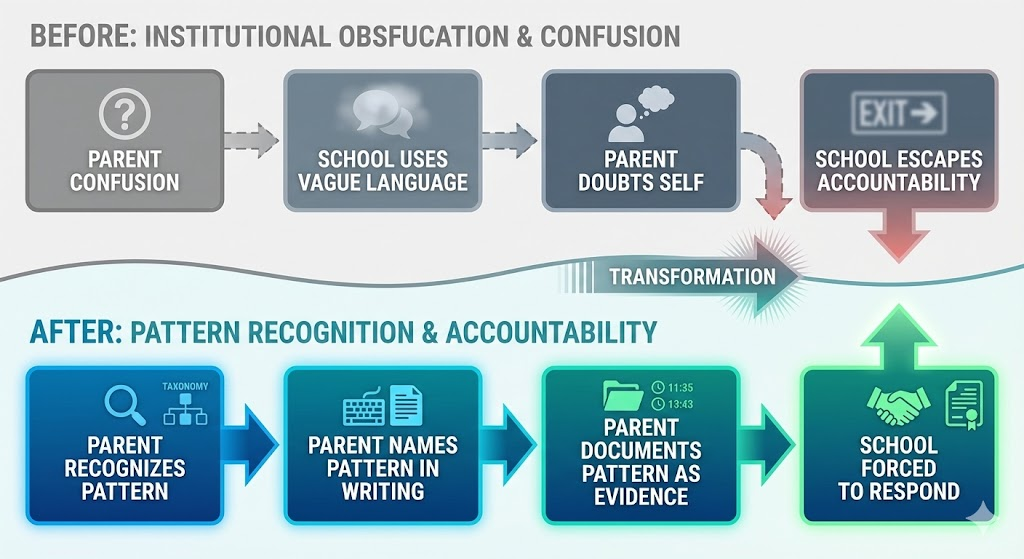
Districts do not improvise their defenses—they follow a playbook. The Student Advocacy Network Institute, a Policy-Driven Student Safety Agency, developed the Pattern Taxonomy after analyzing thousands of cases and discovering that institutional avoidance is systematic, not random. We convert trauma into code by teaching parents to recognize these patterns, name them explicitly, and document them as evidence of deliberate indifference. When a parent can say, “The district is using Pattern #4: Investigative Theater,” they shift from confusion to clarity. They can prove the school’s response was strategic evasion, not good-faith engagement. Selective enforcement IS discrimination, and the Pattern Taxonomy reveals how districts hide discrimination behind procedural language. This article provides the complete classification system that exposes institutional manipulation.
The Student Advocacy Network Institute exists because most families cannot see the institutional manipulation happening to them in real time. As the nation’s first Policy-Driven Student Safety Agency, SANI operates at the intersection of pattern recognition, procedural enforcement, and strategic documentation.
When a parent contacts SANI and describes what the school is doing, we translate their confusion into pattern language:
We convert trauma into code by teaching parents to name what the district is doing. Once named, the pattern can be documented, countered, and used as evidence of deliberate indifference.
SANI treats student harm as both a school safety issue and a civil rights issue because the Pattern Taxonomy reveals how districts systematically evade both safety obligations and civil rights compliance. Selective enforcement IS discrimination—and these avoidance patterns are how districts hide discriminatory practices behind procedural language.
When parents can name the patterns, districts lose their primary weapon: confusion.
Definition: The reclassification of legally significant conduct (bullying, harassment, assault, threats) into lesser, non-actionable categories (peer conflict, misunderstanding, horseplay, mutual combat) to avoid triggering mandatory timelines, investigations, documentation, and civil rights obligations.
Examples:
Purpose: Eliminates legal obligations. Once conduct is downgraded, no investigation timeline, no safety plan, no mandatory reporting, no civil rights compliance.
How to Counter:
Language to Use: “You have classified this as [school’s term]. Under [legal standard], this conduct meets the definition of [legal term]. I am requesting reclassification and compliance with mandatory investigation requirements.”
Definition: The refusal to gather, review, or disclose available evidence (video footage, witness statements, prior incident reports, text messages, social media posts) that would support the victim’s account or reveal institutional failure.
Examples:
Purpose: Limits the factual record to only what supports the school’s preferred conclusion. Prevents pattern recognition. Avoids documentation of school failure.
How to Counter:
Language to Use: “Surveillance footage exists showing the incident. Text messages document the harassment. Three witnesses are willing to provide statements. Your refusal to review this evidence renders the investigation incomplete and creates deliberate indifference under [Title VI/IX/504].”
Definition: The use of time as a weapon—indefinite delays, missed deadlines, “ongoing investigations,” slow responses—designed to exhaust families, allow evidence to deteriorate, and avoid accountability through attrition.
Examples:
Purpose: Families give up. Evidence disappears. Witnesses forget. Retaliation occurs unchecked. Violations of mandatory timelines are buried under procedural language.
How to Counter:
Language to Use: “It has been 18 days since I reported this incident. Under [state law/district policy], investigations must be completed within [X] days. This delay violates mandatory timelines and constitutes deliberate indifference.”
Definition: The performance of an investigation designed not to find truth but to produce a predetermined conclusion that protects the institution. Includes going through motions (interviewing select people, writing a report) while ensuring the outcome exonerates the school.
Examples:
Purpose: Creates the appearance of compliance while avoiding real accountability. District can claim “we investigated” without producing real findings or consequences.
How to Counter:
Language to Use: “This investigation exhibits multiple collapse triggers: missing witnesses, conflict of interest, evidence suppression, predetermined conclusion. Under [civil rights law], this constitutes deliberate indifference.”
Definition: The strategic reversal of victim and aggressor roles, where the student who was harmed is reframed as the problem—blamed for provoking the harm, accused of overreacting, or subjected to discipline for defending themselves.
Examples:
Purpose: Shifts responsibility from the school and the aggressor to the victim. Justifies inaction. Creates chilling effect (other victims won’t report).
How to Counter:
Language to Use: “You are inverting the narrative. My child was targeted repeatedly for [weeks/months]. Self-defense is not mutual combat. Blaming the victim for harm they did not initiate violates both safety obligations and civil rights standards.”
Definition: The use of complex, contradictory, or false procedural language to confuse families, make them doubt their own understanding, or convince them they have no rights or recourse.
Examples:
Purpose: Undermines parental confidence. Makes families believe the school’s version of reality. Prevents escalation by convincing families they are powerless.
How to Counter:
Language to Use: “You stated [X], but [policy/law] requires [Y]. Please provide the specific policy provision that supports your claim. If no such provision exists, I expect compliance with [actual requirement].”
Definition: The intentional or negligent failure to interview material witnesses who would corroborate the victim’s account, reveal patterns, or expose school failure.
Examples:
Purpose: Limits factual record. Prevents corroboration. Ensures investigation remains incomplete and favorable to the school’s conclusion.
How to Counter:
Language to Use: “I named three witnesses who observed the incident. You did not interview them. This exclusion renders the investigation incomplete and creates a factual gap that undermines your conclusion.”
Definition: The manipulation of dispute resolution processes to create the appearance of “mutual conflict” between students of equal power, when in reality there is a clear aggressor-victim dynamic.
Examples:
Purpose: Eliminates the school’s obligation to protect. If it’s “mutual,” the school doesn’t need to investigate, discipline the aggressor, or create safety plans.
How to Counter:
Language to Use: “This is not mutual conflict. My child was repeatedly targeted by [aggressor/group] over [time period]. There is a clear power imbalance. Mediation is inappropriate for bullying and violates [policy/best practice].”
Definition: The failure to create, maintain, or preserve records of incidents, reports, investigations, or disciplinary actions—ensuring that patterns cannot be proven and the school’s failures remain invisible.
Examples:
Purpose: Without documentation, there is no pattern. Without a pattern, there is no foreseeability. Without foreseeability, there is no liability. Erasure protects the institution.
How to Counter:
Language to Use: “You claim to have investigated, but no incident report exists. No investigation file was created. No documentation was preserved. This failure to document violates [policy/law] and creates deliberate indifference.”
Definition: The concealment of retaliatory conduct (increased discipline, social isolation, staff hostility, academic punishment) behind facially neutral justifications, making retaliation appear legitimate.
Examples:
Purpose: Punishes families for reporting. Creates chilling effect. Hides civil rights violations behind procedural language.
How to Counter:
Language to Use: “My child had no disciplinary issues prior to my report on [date]. Since that report, they have received [list adverse actions]. This pattern suggests retaliation, which is a separate civil rights violation under [Title VI/IX/504].”
Definition: The strategic claim by school staff that they have no memory of prior reports, conversations, or incidents—allowing the school to deny notice and avoid accountability for failure to act.
Examples:
Purpose: Destroys the notice element of liability. If the school “didn’t know,” they can’t be held responsible for failing to act.
How to Counter:
Language to Use: “You claim you don’t recall our conversation on [date]. I sent a follow-up email that same day summarizing our discussion (attached). You did not dispute my summary. This establishes notice.”
Definition: The invocation of legal-sounding excuses (student privacy, confidentiality, ongoing investigation, attorney advice) to avoid transparency, accountability, or compliance with parent requests.
Examples:
Purpose: Creates the illusion that the school is legally prohibited from acting, when in reality they are choosing not to act. Shields the school from scrutiny.
How to Counter:
Language to Use: “You claim you cannot provide records due to ‘student privacy.’ Under FERPA, I have the right to access all educational records concerning my own child. Please cite the specific legal provision that prohibits disclosure, or comply with my request within [X] days.”
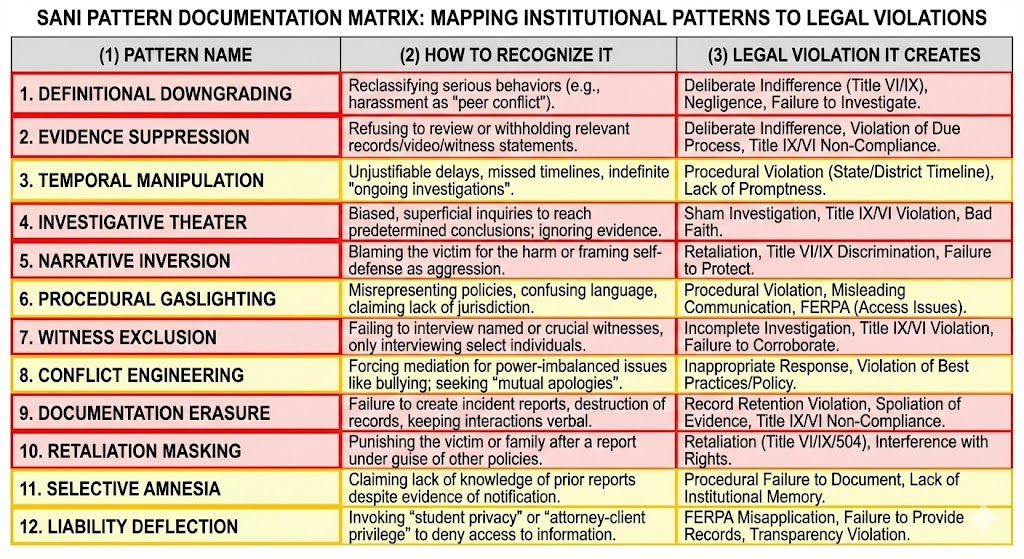
Study the twelve patterns until you can identify them as they happen. When the school says something that feels wrong, ask yourself: “Which pattern is this?”
Recognition is the first step to countering.
When you respond to the school, explicitly name the pattern:
“Your email exhibits Pattern #3: Temporal Manipulation. It has been 14 days since my report, and you continue to delay without providing a timeline or update.”
This signals to the district that you are educated, organized, and documenting their tactics.
Add a section to your Case File called “Pattern Documentation.” Each time you identify a pattern, log it:
|
Date |
Pattern Name |
Evidence |
Legal Violation |
|
10/5 |
Definitional Downgrading |
Email calling assault “mutual combat” |
Ed Code 48900, Title VI |
|
10/12 |
Temporal Manipulation |
18 days, no investigation update |
State timeline violation |
|
10/15 |
Witness Exclusion |
Three named witnesses not interviewed |
Investigative collapse |
This tracker becomes powerful evidence in OCR complaints and legal claims.
When a school deploys multiple patterns, it reveals that their response was not good-faith error—it was strategic evasion. Courts and OCR recognize this.
In your complaint or demand letter:
“The district deployed six distinct avoidance patterns: Definitional Downgrading, Evidence Suppression, Witness Exclusion, Investigative Theater, Liability Deflection, and Temporal Manipulation. This systematic evasion demonstrates that the district’s response was clearly unreasonable and constitutes deliberate indifference under [Title VI/IX/504].”
Institutional avoidance thrives on isolation. When parents don’t know the patterns, each family thinks their experience is unique. When parents share the taxonomy, they recognize the playbook.
Create a parent network. Share this article. Compare notes: “They did Pattern #5 to me too.”
Collective pattern recognition creates collective power.
Once you know the taxonomy, you can predict what the school will do next:
Prediction allows you to preempt. You can address the expected pattern in your initial communication:
“I am requesting witness interviews. I anticipate you may claim they are unnecessary (Pattern #7: Witness Exclusion). To be clear: all named witnesses must be interviewed for the investigation to meet legal standards.”
Age-appropriately, teach your child what the school might do:
When your child can name what’s happening, they feel less gaslit and more empowered.
Naming creates clarity and power. When schools rely on vague language, shifting explanations, or procedural confusion, parents are left disoriented. Naming a pattern—such as “Pattern #6: Procedural Gaslighting”—moves the parent from confusion to control. It also creates documentation. Once patterns are named in writing, they can be tracked over time and shown to be systematic evasion rather than good-faith effort.
Yes. Pattern documentation is evidence of deliberate indifference and institutional bad faith. When parents can demonstrate that a school repeatedly deployed multiple avoidance patterns, it supports the legal standard of a response that was “clearly unreasonable.” Pattern evidence strengthens civil-rights claims, OCR complaints, negligence cases, and due-process challenges.
Denial is expected. Documentation is what matters. When a pattern is named in writing and supported by concrete evidence—emails, timelines, missing reports, or excluded witnesses—the school is forced into one of two outcomes: either they defend their conduct (implicitly admitting the pattern), or they correct their behavior. Both outcomes benefit the family.
Not all schools use all patterns, but these twelve patterns appear consistently across thousands of cases nationwide. Some schools deploy only a few; others rely on many. The patterns are predictable because they have historically worked—until parents learn to recognize, document, and counter them.
Start by documenting the behavior itself. For example: “The school is delaying the investigation without explanation.” You can later match the behavior to the closest pattern, such as “Pattern #3: Temporal Manipulation.” Even imperfect labeling is valuable. Precision improves with practice, but documentation always strengthens your position.
You can, but discretion is important. Sharing the framework in meetings may educate staff and prompt corrective behavior, but it may also make the school more careful about leaving evidence. A strategic approach is to use the taxonomy internally to guide documentation and to name patterns in written communications once supporting evidence already exists.
Pattern #9: Documentation Erasure. Without records, all other patterns become harder to prove. Missing notes, altered timelines, and undocumented meetings erase accountability. This is why maintaining an independent Case File is critical—when schools fail to document or erase evidence, the parent’s records become the authoritative record.
If you want student harm treated like a school safety and civil rights issue—start with SANI at https://saninstitute.net
The Student Advocacy Network Institute (SANI) is a national research, accountability, and discipline institute founded by Bullying Is A Drug to define, document, and address institutional failure in K–12 education—treating student harm as a school safety and civil rights issue.
Explore the Institute:
https://saninstitute.net
A parent reports that their daughter has been sexually harassed by a classmate for six weeks—unwanted touching, explicit comments, and following her between classes. The parent emails the principal with detailed accounts, witness names, and dates.
The principal responds: “We take all reports seriously. We are investigating.”
Week 1: The parent receives no updates. They follow up. The school says, “The investigation is ongoing.”
Week 2: The parent asks to meet. The assistant principal says, “We interviewed the students. It appears to be a misunderstanding. Both students interpreted the interactions differently.”
The parent is confused: “My daughter said he grabbed her. How is that a misunderstanding?”
“Well, he said he was just trying to get her attention. We’ve talked to both students about personal space and respectful communication. We consider the matter resolved.”
“What about the witnesses I named?”
“We didn’t feel it was necessary to interview them. We had sufficient information.”
“Can I see the investigation report?”
“That’s an internal document. We can’t share it due to student privacy.”
“What consequence did he receive?”
“We can’t discuss another student’s discipline with you.”
The harassment continues. The parent reports it again. The school says, “We already investigated this. We can’t keep reopening closed cases.”
The parent is trapped. They don’t know it yet, but the district deployed six distinct avoidance patterns:
If the parent had recognized these patterns, they could have documented each one and escalated immediately. Instead, they spent weeks confused, doubting themselves, and allowing the school to control the narrative.
Now imagine the parent knew the Pattern Taxonomy. After the first response, they would have written:
Subject: Pattern Documentation – Avoidance Tactics
Dear Principal,
Your response exhibits multiple institutional avoidance patterns that I am documenting for the record:
Pattern #1 – Definitional Downgrading: You reclassified sexual harassment (Ed Code 48900.2) as “misunderstanding” to avoid mandatory reporting and investigation requirements.
Pattern #7 – Witness Exclusion: You refused to interview the three witnesses I named, ensuring the investigation would lack corroborating evidence.
Pattern #2 – Evidence Suppression: You refused to provide the investigation report, preventing me from evaluating the thoroughness or validity of your findings.
Pattern #12 – Liability Deflection: You invoked “student privacy” to avoid accountability, despite FERPA allowing disclosure of records concerning my own child.
I am requesting:
Most bullying cases do not need a lawyer. Some clearly do. Knowing the difference before you act matters more than most parents realize. The decision

There is a point in many bullying cases where the parent has done everything right — and it still is not working. The emails are

You have three minutes. Make them the most organized three minutes the board has heard on this topic. Speaking at a school board meeting is

Patience with a school that isn’t responding isn’t a virtue. At some point it becomes a cost your child is paying. Most parents start at