

When Do Parents Need a Lawyer for School Bullying?
Most bullying cases do not need a lawyer. Some clearly do. Knowing the difference before you act matters more than most parents realize. The decision
1. Audio
2. Definition
3. Video
4. Core Thesis
9. Action Steps
10. FAQs
11. Call to Action
12. Sources
13. Signature
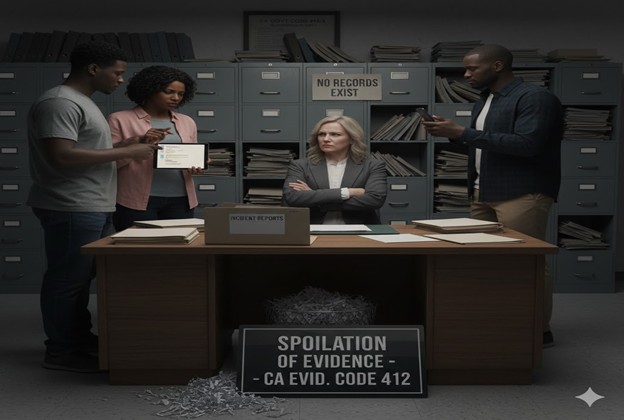
The documentation gap occurs when California school districts systematically fail to create, maintain, or produce written records of harassment incidents, safety complaints, parent reports, or disciplinary responses—not through oversight but as deliberate institutional strategy—allowing schools to later claim “no records exist” or “we have no documentation of that” when parents demand accountability, with the gap manifesting through: refusing to write incident reports despite policy requirements, conducting meetings without minutes or written summaries, providing only verbal responses to complaints (no email confirmation), destroying records after parents request them (spoliation), and maintaining parallel “unofficial” documentation systems that avoid creating discoverable evidence, creating what courts recognize as consciousness of wrongdoing when systematic absence of records proves district understood proper documentation would create liability, violating California Government Code Section 815.6 when policy-mandated documentation duties are breached, triggering adverse inference under California Evidence Code Section 412 (allowing fact-finders to presume missing evidence would have been unfavorable to district), and establishing spoliation of evidence under California common law when records are destroyed or never created after notice of potential claims, making the documentation gap not administrative failure but strategic evidence suppression that parents can defeat by creating parallel external documentation systems districts cannot control or deny.
California districts have learned that “no documentation” is their strongest defense against accountability—if no incident reports exist, they can claim incidents never happened; if no meeting minutes exist, they can deny promises made; if no investigation files exist, they can claim they investigated but found nothing—making documentation suppression more effective than falsifying records because absence of evidence is harder to disprove than false evidence. We convert trauma into code by creating external parallel documentation systems: emailing yourself after every report (timestamped proof), sending follow-up confirmation emails after every conversation (“This confirms you stated…”), maintaining contemporaneous incident logs with dates/times/witnesses, and using California Public Records Act to expose when districts claim “no records” exist despite policies requiring documentation, then proving through policy violations under California Government Code § 815.6 that failure to document was breach of mandatory duty. Selective enforcement IS discrimination when documentation gaps disproportionately affect families of color—wealthy white families receive detailed incident reports, meeting summaries, and email confirmations while Black and Latino families receive verbal-only responses with no paper trail, proving documentation suppression targets marginalized families whose lack of documentation literacy makes them less likely to create external records. This article establishes that documentation gaps are not accidents but evidence suppression, creating multiple legal violations including spoliation, mandatory duty breach, and consciousness of wrongdoing—all defeated when parents understand they must become the documentarians.
The Student Advocacy Network Institute (SANI) is a Policy-Driven Student Safety Agency that identifies the documentation gap as evidence elimination through non-creation—the most effective institutional defense strategy because absence of records is harder to challenge than false records, making documentation suppression more valuable to districts than documentation manipulation.
SANI teaches parents that districts create documentation gaps deliberately, not accidentally, because administrators are trained (explicitly or implicitly) that “what isn’t written can’t be subpoenaed.” The strategy depends on parents not understanding they must create external documentation—parents who rely on district documentation find themselves with “no evidence” when seeking accountability.
SANI’s counter-strategy is simple: Parents must become the documentarians. Email yourself immediately after every report (creates timestamp), send confirmation emails after every conversation (creates external record district must correct or implicitly confirm), maintain incident logs with dates/times/witnesses, save all texts/voicemails, and photograph injuries or evidence. When district later claims “no records,” parents produce their contemporaneous documentation proving reports were made, promises were broken, and the district’s documentation gap was strategic.
SANI’s enforcement work centers safety and civil rights, not record-keeping. Documentation gaps matter because they eliminate evidence needed to prove patterns (Title VI/IX “persistent” harassment), actual notice (defeating “we didn’t know” defenses), and causation (linking district failures to harm). When parents create external documentation systems, they defeat the district’s primary defense and transform documentation suppression from successful strategy into evidence of bad faith.
A mother in Sacramento reports her daughter’s harassment to the vice principal weekly for three months—17 separate reports. Each time: “I’ll look into it. I’ll talk to the students involved.”
After the 17th report, the mother demands: “I need copies of all incident reports.”
Vice principal responds: “We don’t create formal incident reports for every complaint. We handle these informally.”
Mother: “So there’s no documentation of anything I’ve reported?”
Vice principal: “We document serious incidents. These were peer conflicts.”
The mother retains an attorney who requests through California Public Records Act: “All incident reports, investigation files, communications between staff regarding [daughter’s] harassment complaints, and meeting notes from parent meetings.”
District response: “No responsive records exist.”
The attorney files complaint alleging district policy violations. The district’s student handbook states: “All harassment complaints will be documented in writing. Parents will receive written confirmation of reports and investigation outcomes.”
The attorney proves documentation gap violations:
Policy Requirement vs. Reality:
The attorney demands: “Provide all training materials instructing staff when to document incidents, all emails discussing documentation practices, and all policies governing incident reporting.”
Discovery reveals smoking gun email from principal to staff: “Reminder: be mindful of what we put in writing. Incident reports create liability. Handle matters verbally when possible. Document only what we’re legally required to document—and even then, keep it minimal.”
This proves documentation gap was intentional strategy, not oversight.
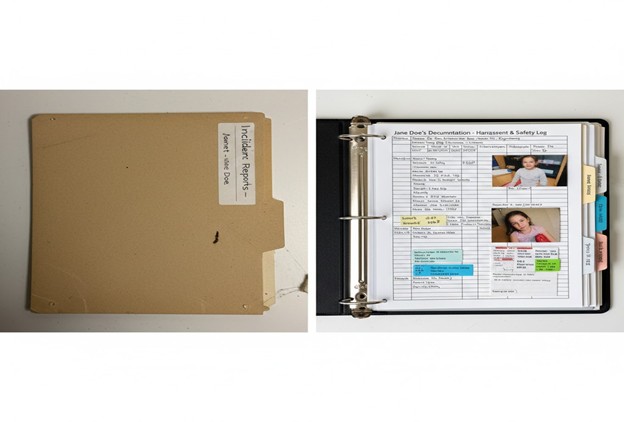
The mother had, however, created her own documentation:
The attorney presents this external documentation to prove: “District claims ‘no records’ but parent’s contemporaneous documentation proves 17 reports were made. District’s failure to document violated policy, created liability, and proves consciousness of wrongdoing. Under California Evidence Code § 412, jury may presume missing incident reports would have been unfavorable to district.”
The district cannot dispute timestamped emails proving reports were made. The documentation gap becomes evidence of institutional bad faith rather than successful defense.
Settlement includes: damages for denial of safe environment, policy requiring all complaints documented with tracking numbers, quarterly auditing of documentation compliance, and three years monitoring.
Internal audit after settlement reveals documentation gap was systematic: 847 harassment complaints over two years, only 93 incident reports created (11% documentation rate), with documentation rates varying by demographics—white students’ complaints documented 42% of time, Black students’ complaints documented 6% of time.

The documentation gap creates legal liability through multiple frameworks, each providing independent grounds for challenging districts’ “no records” defense.
When districts adopt policies requiring documentation (“all harassment complaints will be documented”), those policies create mandatory duties. Failure to document breaches mandatory duty.
Elements: (1) Enactment imposing mandatory duty (board policy, administrative regulation), (2) Duty designed to protect against specific harm (harassment, safety failures), (3) Breach of duty (no documentation created), (4) Causation (lack of documentation prevented appropriate response or created inability to prove notice).
Application: If board policy requires incident reports for harassment complaints, and district creates no reports for 17 complaints, this violates mandatory duty regardless of whether harm occurred—the breach itself is actionable.
When party fails to produce evidence within their control, fact-finder may presume the evidence would have been unfavorable.
Standard: Evidence Code § 412 states: “If weaker and less satisfactory evidence is offered when it was within the power of the party to produce stronger and more satisfactory evidence, the evidence offered should be viewed with distrust.”
Application: When district claims “no incident reports” exist despite policy requiring them, jury may presume the missing reports would have shown district had notice of pattern, failed to respond, or documented evidence supporting parent’s claims.
California common law recognizes spoliation—destruction or failure to preserve evidence when litigation is reasonably anticipated—as independent tort and as basis for sanctions.
Elements: (1) Pending or reasonably foreseeable litigation, (2) Duty to preserve evidence, (3) Destruction or failure to preserve, (4) Resulting prejudice.
Application: When parent files complaint (putting district on notice of potential litigation), district must preserve all relevant evidence. If district then destroys records or claims records “were never created,” this constitutes spoliation. Sanctions include adverse inference, monetary penalties, or default judgment.
Systematic documentation suppression proves district understood proper documentation would create liability—demonstrating consciousness of wrongdoing.
Legal Principle: When parties destroy or avoid creating evidence, fact-finders may infer they did so because evidence would prove liability.
Application: Internal emails instructing staff to “avoid paper trails” or “document minimally” prove documentation gap was strategic, not accidental, supporting punitive damages and proving bad faith.
Under Davis v. Monroe, schools violate Title IX when they respond to known harassment with deliberate indifference. Systematic failure to document complaints prevents schools from recognizing patterns required under Title IX.
Application: School cannot claim it didn’t recognize “persistent or pervasive” pattern when it intentionally avoided creating documentation that would reveal pattern. Documentation suppression itself constitutes deliberate indifference.
When districts claim “no records exist” in response to Public Records Act requests, but evidence proves records should exist per policy, this violates California transparency laws.
California Government Code § 7921.505: Public entities must maintain records required by policy. Failure to create mandated records violates CPRA and creates enforcement through Attorney General or mandamus actions.
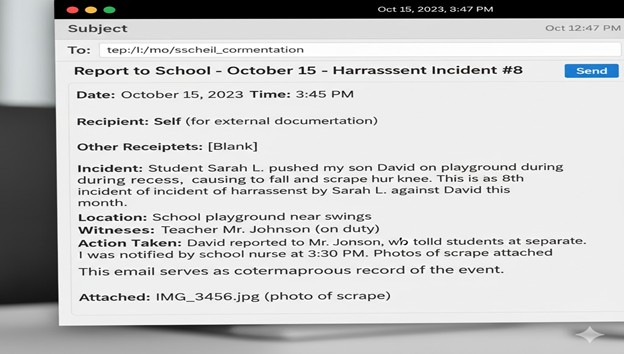
Immediately after incident occurs or after reporting to school, email yourself detailed summary: “Date: [date], Time: [time], What happened: [description], Witnesses: [names], Injuries/evidence: [describe], Who I reported to: [name/title], Their response: [exact words if possible].” Email timestamp creates undeniable contemporaneous record. Save these emails in dedicated folder—this becomes your external incident log district cannot control.
Within 2 hours of any phone call or in-person meeting with school staff, send email: “This email confirms our conversation today at [time]. You stated: [summary]. You committed to: [actions/timeline]. I requested: [your requests]. Please confirm this summary is accurate or provide corrections by [date 48 hours out].” If they don’t correct, their silence confirms your summary. This forces written record of verbal communications.
When school provides only verbal response, immediately send email: “Per your Board Policy [cite specific policy], all harassment complaints must be documented in writing. Please provide: (1) incident report number, (2) written confirmation of investigation timeline, (3) written summary of actions taken. Your policy creates mandatory duty to document under California Government Code § 815.6. Failure to provide documentation within 5 business days will be documented as policy violation.”
After 3-4 incidents with no documentation provided, file California Public Records Act request: “All incident reports involving [student] from [date] to present, all meeting notes/minutes regarding [student’s] complaints, all communications between staff about [student’s] reports, all policies requiring staff to document harassment complaints.” When district responds “no records exist,” this proves documentation gap you can use as evidence of mandatory duty violation and consciousness of wrongdoing.
When district claims “we have no records” or “you never reported that,” produce your external documentation: timestamped emails to yourself (proving when reports made), confirmation emails to staff (proving what was reported and promised), incident logs with dates/witnesses (proving pattern). Include in all complaints/litigation with statement: “District claims ‘no records’ but attached external documentation proves: 17 reports made [dates listed], district had actual notice, documentation gap violates mandatory duty per California Government Code § 815.6.”

Within 2 hours of incident or report to school, send email to yourself: Subject line: “School Report – [Date] – [Brief Description].” Body: Date, time, location, what happened, witnesses, injuries/evidence, who you reported to (name/title), their response (exact words), what they promised. Save in dedicated email folder. Email timestamp proves contemporaneous creation—district cannot claim you fabricated records later. Do this EVERY time, even “minor” incidents.
After every phone call or in-person meeting with school staff, send email within 2 hours: “This confirms our [phone call/meeting] today at [time]. You stated: [summary]. You committed to: [actions with timeline]. I requested: [specific requests]. Please confirm this summary or provide corrections by [date 48 hours out].” If no response, their silence confirms your account. This creates written record of verbal communications district cannot later deny.
When school responds verbally (“I’ll handle it”), immediately send email: “Thank you. Per Board Policy [cite specific number if known, or describe: ‘requiring documentation of harassment complaints’], please provide within 5 business days: (1) incident report number, (2) written investigation timeline, (3) written confirmation of actions taken. Your policy creates mandatory documentation duty under California Government Code § 815.6.”
Create spreadsheet or physical log with columns: Date, Time, What Happened, Location, Witnesses, Evidence (photos/medical), Who Notified at School, Their Response, Actions Taken (or Not). Update immediately after each incident. This aggregates what district fragments, proving pattern when they claim “isolated incidents.” Print or screenshot regularly to preserve in multiple locations.
After 3-4 incidents with no district documentation provided, file California Public Records Act request: “All incident reports involving [student] from [start date] to present, all investigation files, all meeting notes regarding [student’s] complaints, all communications between staff about [student], all policies requiring harassment documentation.” When district says “no records exist,” you’ve documented the documentation gap proving policy violations and consciousness of wrongdoing.
Districts avoid documentation because they understand "what isn't written can't be subpoenaed"—absent records eliminate evidence of actual notice (defeating "we didn't know" defenses), patterns (preventing Title IX "persistent" harassment findings), inadequate responses (can't prove promises were broken), and causation (can't link district failures to harm). Internal training or implicit culture teaches administrators to "handle verbally," "avoid paper trails," and "document minimally." This is strategic evidence suppression, not oversight.
Challenge this immediately in writing: "Your Board Policy [or Student Handbook] states 'all harassment complaints will be documented.' Your refusal to document violates your own policy, creating mandatory duty breach under California Government Code § 815.6. Additionally, failure to document prevents you from recognizing patterns required under Title IX. Provide incident report number and written confirmation within 48 hours or I will document this policy violation in my complaint." Then create your own documentation through external records.
Create contemporaneous records: email yourself immediately after incidents/reports (timestamps prove when created), send confirmation emails to school after conversations (creates external record), maintain incident log with dates/times/witnesses updated same-day, save all texts/voicemails from school, photograph injuries or evidence immediately, request medical documentation after each incident requiring treatment. Contemporaneous creation (documented at or near time of event) has high evidentiary value because created before outcome known—courts trust real-time documentation more than reconstructed accounts.
Adverse inference (California Evidence Code § 412) allows fact-finders to presume missing evidence would have been unfavorable to the party who failed to produce it. When district's policy requires incident reports but district produces "no records," jury may presume the missing reports would have shown: district had notice of pattern, failed to investigate properly, or documented facts supporting parent's claims. Documentation gap becomes evidence against district rather than successful defense.
Only if destruction occurred BEFORE litigation was reasonably foreseeable. Once parent files formal complaint, retains attorney, or threatens legal action, district has duty to preserve all relevant evidence. Destruction after notice—even "routine" destruction—constitutes spoliation. Include preservation notice in early communications: "This creates legal duty to preserve all evidence. Routine destruction after receipt of this notice is spoliation." If district then destroys or claims "routine purging," this becomes actionable.
If you want student harm treated like a school safety and civil rights issue—start with SANI at https://saninstitute.net
Most bullying cases do not need a lawyer. Some clearly do. Knowing the difference before you act matters more than most parents realize. The decision

There is a point in many bullying cases where the parent has done everything right — and it still is not working. The emails are

You have three minutes. Make them the most organized three minutes the board has heard on this topic. Speaking at a school board meeting is

Patience with a school that isn’t responding isn’t a virtue. At some point it becomes a cost your child is paying. Most parents start at