

When Do Parents Need a Lawyer for School Bullying?
Most bullying cases do not need a lawyer. Some clearly do. Knowing the difference before you act matters more than most parents realize. The decision
1. Audio
2. Definition
3. Video
4. Core Thesis
9. Action Steps
10. FAQs
11. Call to Action
12. Sources
13. Signature
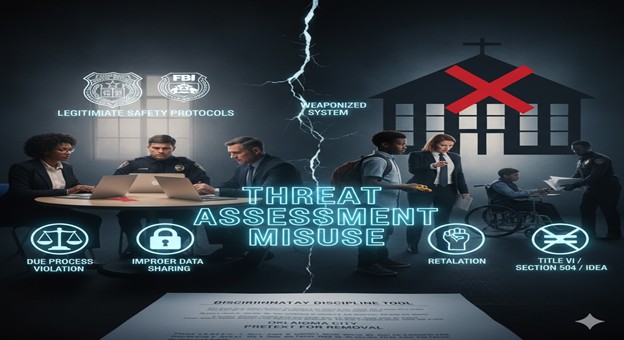
Threat assessment misuse as push-out tool occurs when Oklahoma City and other school districts weaponize legitimate safety protocols—originally designed under Secret Service and FBI guidance to identify students who pose genuine threats of violence—by misapplying threat assessment procedures to students who are not dangerous but whom the district wants to remove, including: students with disabilities whose behaviors stem from their conditions rather than violent intent, students of color subjected to threat assessments for conduct white students engage in without consequence, students who report being bullied then face threat assessments based on their “angry” reactions to ongoing harassment, and students whose families advocate aggressively or retain attorneys, with districts using threat assessments to create paper trails justifying exclusion, expulsion, or involuntary transfers while claiming “safety concerns” that school psychologists, outside evaluators, or proper threat assessment protocols would not support.
Under federal law and Oklahoma policy, this misuse violates IDEA and Section 504 when districts assess students with disabilities as threats without considering how disability symptoms (ADHD impulsivity, autism spectrum social difficulties, emotional disturbance manifestations) create behaviors that are not dangerous but are mischaracterized as threatening, Title VI when Black and Native American students in Oklahoma City face threat assessments at rates 4-6 times higher than white students for comparable conduct, due process when districts conduct sham threat assessments with predetermined conclusions rather than following evidence-based protocols requiring multidisciplinary teams and external consultation, retaliation when threat assessments are triggered by parents filing complaints or students reporting harassment, and FERPA when districts improperly share threat assessment information with law enforcement, community members, or other families to justify exclusion—making threat assessment misuse not a legitimate safety measure but a discriminatory discipline tool that courts, OCR, and state education agencies increasingly recognize requires strict procedural compliance, independent review, and prohibition on using assessments as pretexts for removing students districts find inconvenient, costly, or difficult.
Oklahoma City Public Schools and districts nationwide have transformed evidence-based threat assessment—a process designed to identify the rare student who genuinely poses risk of targeted violence—into a bureaucratic weapon for removing students the district finds problematic, creating “safety” justifications for expulsions, transfers, and exclusions that have nothing to do with actual danger and everything to do with institutional convenience, with the misuse most frequently targeting students with disabilities (whose IEP/504-protected behaviors are recharacterized as “threats”), students of color (whose ordinary adolescent conduct triggers threat assessments that white students never face), and students who have reported being bullied or whose parents have filed complaints (whose justifiable anger at institutional failures becomes “evidence” of dangerous ideation). We convert trauma into code by obtaining the actual threat assessment protocols districts claim to follow (usually based on Secret Service/FBI models requiring evidence of planning, pathway toward violence, and inability to access intervention), comparing those protocols to what the district actually did (single administrator’s subjective fear, no multidisciplinary team, no consideration of disability, no evidence of actual planning), and proving the assessment was pretextual—a predetermined conclusion designed to justify removal rather than an objective safety evaluation. Selective enforcement IS discrimination when Oklahoma City data shows Black students receive threat assessments for “making threats” (vague statements, rap lyrics, frustrated outbursts) at rates 6 times higher than white students who make identical or more explicit statements but are characterized as “venting” or “going through a tough time,” proving threat assessment application is not based on objective danger but on whose behavior the district pathologizes and criminalizes. This article proves that threat assessment misuse is one of the most effective push-out tools because it wraps discrimination in “safety” language that intimidates parents, silences advocates, and convinces administrators they’re justified in removing students—but when proper protocols are demanded, outside evaluators are obtained, and disparate application is exposed, these weaponized assessments collapse under scrutiny, revealing them as pretextual justifications for excluding students districts don’t want to serve.

The Student Advocacy Network Institute (SANI) is a Policy-Driven Student Safety Agency that identifies threat assessment misuse as safety theater masking discrimination—a practice where districts invoke “threat assessment” language to create appearance of following legitimate protocols while actually conducting predetermined, pretextual evaluations designed to justify removing students they find inconvenient, expensive, or difficult.
SANI teaches parents to recognize threat assessment misuse by demanding actual protocol documentation, comparing district’s process to evidence-based standards (Secret Service/FBI models requiring multidisciplinary teams, consideration of context/disability, evidence of planning), and exposing when assessments are triggered by parent advocacy, disability manifestations, or reactions to being victimized rather than genuine dangerous behavior.
SANI’s enforcement work centers safety and civil rights, not opposing legitimate threat assessment. Real threat assessment—conducted properly with trained professionals, evidence-based protocols, and consideration of disability and context—is essential for preventing school violence. But when districts weaponize threat assessment to remove students with disabilities, students of color, or students who report being harmed, they undermine both safety (ignoring actual threats while chasing false ones) and civil rights (using “safety” as pretext for discrimination).
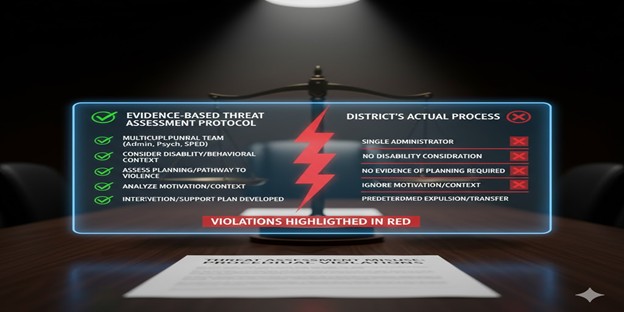
Threat assessment misuse operates at the intersection of legitimate safety protocols and discriminatory discipline practices. Understanding both the proper standards and common violations helps parents challenge weaponized assessments.
Legitimate threat assessment emerged from research by the U.S. Secret Service and FBI following school shootings in the 1990s-2000s. The research found that targeted school violence is preventable when schools identify students on pathway toward violence and intervene.
Key Research Findings:
Evidence-Based Threat Assessment Focuses On:
National Threat Assessment Center (Secret Service) Model:
Step 1: Identify Concerning Behavior
Not all concerning statements/behaviors warrant formal assessment. Screeners determine if behavior suggests:
Step 2: Multidisciplinary Team Assessment
Required team members:
Step 3: Gather Information
Step 4: Assess Threat Level
Transient (Low Risk):
Substantive (Elevated Risk):
Step 5: Intervention Planning
Even “substantive” threats rarely warrant expulsion. Interventions include:
Expulsion is last resort when interventions cannot mitigate risk.
Oklahoma School Security Institute (OSSI) Guidelines:
Oklahoma statute (70 O.S. § 24-100.4) requires schools to have threat assessment protocols. OSSI provides model procedures including:
Required Elements:
Oklahoma Special Education Requirements:
For students with IEPs/504 plans:
Misuse Pattern 1: Using “Threat Assessment” for Non-Threatening Behavior
Proper Use: Student researches guns, makes detailed plan, identifies targets
Misuse: Student says “I hate this school” or “I can’t take it anymore”
Why It’s Misuse: Vague expressions of frustration are not threats requiring formal assessment. Secret Service research shows attackers make specific, detailed communications—not general complaints.
Misuse Pattern 2: Single Administrator “Assessment”
Proper Use: Multidisciplinary team (administrator, psychologist, specialist, law enforcement if needed)
Misuse: Assistant principal alone decides student is threat
Why It’s Misuse: Proper threat assessment requires diverse expertise—mental health, law enforcement, education. Single administrator lacks training/objectivity.
Misuse Pattern 3: Ignoring Disability
Proper Use: Team includes special education staff, reviews IEP/504, considers how disability manifests, conducts FBA and manifestation determination
Misuse: District treats disability-related behavior (impulsivity, emotional dysregulation, communication difficulties) as evidence of dangerous intent
Why It’s Misuse: IDEA requires consideration of disability before imposing discipline. Many behaviors triggering threat assessments are disability manifestations requiring intervention, not punishment.
Misuse Pattern 4: Ignoring Context
Proper Use: Team investigates what triggered behavior—was student being bullied, experiencing trauma, responding to provocation?
Misuse: District treats reactive statement (“If they hit me again, I’ll defend myself”) as unprovoked threat
Why It’s Misuse: Secret Service model explicitly requires context analysis. Statements made during conflict are typically not genuine threats.
Misuse Pattern 5: No Evidence of Planning/Pathway
Proper Use: Team looks for planning indicators—researching weapons, acquiring means, scoping locations, writing detailed plans
Misuse: District labels student as threat based solely on angry statement with no evidence of planning
Why It’s Misuse: Research shows attackers don’t just talk—they plan, prepare, and move down pathway. Vague statements without planning are not credible threats.
Misuse Pattern 6: Predetermined Outcome
Proper Use: Team objectively gathers evidence, considers all factors, determines whether intervention or exclusion is necessary
Misuse: Administrator decides to expel student before assessment, uses “threat assessment” to create paper trail justifying predetermined conclusion
Why It’s Misuse: This isn’t assessment—it’s pretext. Evidence includes initiating assessment after parent advocacy, emails showing intent to “get rid of” student, or failure to follow any actual protocol.
Misuse Pattern 7: Retaliation Through Threat Assessment
Proper Use: Threat assessment triggered by objective concerning behavior
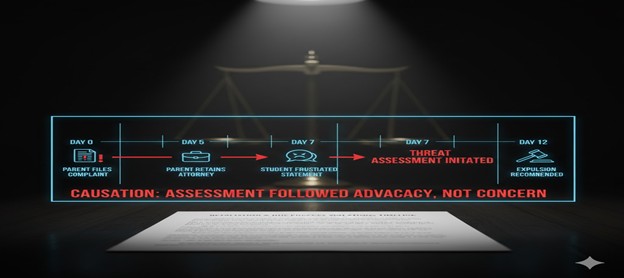
Misuse: Threat assessment initiated immediately after parent files complaint, retains attorney, demands IEP changes, or reports bullying
Why It’s Misuse: Timing proves assessment is retaliatory—designed to punish family for advocacy, not address genuine safety concern.
IDEA Violations (Students with Disabilities):
Section 504 Violations:
Title VI Violations:
Due Process Violations (Fourteenth Amendment):
Retaliation (Title VI, Title IX, Section 504, IDEA):
Based on SANI’s Oklahoma City casework:
Pattern 1: Disability-to-Threat Pipeline
Students with emotional disturbance, ADHD, autism spectrum disorders disproportionately subjected to threat assessments for disability-related behaviors:
Pattern 2: Bullying Victim Recharacterization
Students who report being bullied, then express frustration or self-defense statements, face threat assessments while bullies face no consequences:
Pattern 3: Racial Disparities in Statement Interpretation
Identical statements treated differently based on student race:
Pattern 4: Advocacy Retaliation
Threat assessments initiated within days of parent:
This framework ensures parents can identify threat assessment misuse, demand proper protocols, obtain independent evaluations, and challenge weaponized assessments through administrative and legal remedies.
Within 24 hours of learning of threat assessment, send written demand: “I am requesting under Oklahoma Open Records Act: (1) the written threat assessment protocol your district follows, (2) names and qualifications of all threat assessment team members, (3) training records showing team members completed evidence-based threat assessment training, (4) the specific statement or behavior triggering this assessment with exact words, date, time, context. Provide within 48 hours.” This forces district to show they’re following actual protocol.
Simultaneously with district’s assessment, retain independent evaluator (psychologist, threat assessment specialist, behavioral consultant) to conduct proper evidence-based assessment. Provide evaluator: student’s full history, context of statement/behavior, disability documentation, evidence of stressors (bullying, trauma). Independent evaluation creates competing expert opinion that often contradicts district’s predetermined conclusion and proves district’s assessment was not objective.
If student has IEP/504, immediately send written demand: “Under IDEA 34 CFR § 300.530, you must conduct Functional Behavioral Assessment and manifestation determination before any disciplinary removal exceeding 10 days. [Student’s] behavior [describe behavior] is manifestation of their documented disability [ADHD/emotional disturbance/autism]. Failure to conduct manifestation determination violates IDEA. Provide written findings within 10 school days.” This triggers mandatory procedural protections.
Within one week, file Open Records Act request: “All threat assessments conducted in past 24 months showing: student race, disability status, exact statement/behavior triggering assessment, threat assessment team members, outcome (returned to school/suspended/expelled/transferred). This data will be analyzed for disparate impact.” When data shows Black/disabled students assessed at disproportionate rates for less serious conduct than white students, it proves discriminatory application.
Within 30 days, file: (1) OCR complaint alleging disability discrimination and/or racial discrimination in threat assessment application, (2) State Department of Education complaint alleging IDEA violations (failure to conduct manifestation determination), (3) Due process hearing requesting stay-put (student remains in current placement pending resolution), (4) If applicable: retaliation complaint documenting temporal proximity between parent advocacy and threat assessment initiation. Multiple simultaneous proceedings create maximum pressure.
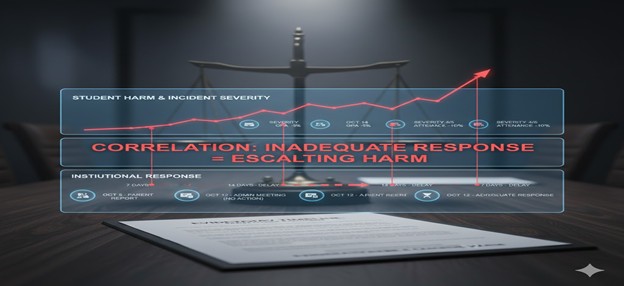
Immediately create spreadsheet with five tabs: Incident Frequency, Severity, Educational Impact, Response Times, Comparative Treatment. Log first incident with date/time/description/severity rating (1-5). Do this same day, every incident. Create baseline: request student’s GPA, attendance, participation grades from prior semester as comparison. This contemporaneous tracking defeats later district claims of exaggeration.
Each week: calculate total incidents, average severity score, compare current GPA/attendance to baseline, calculate days elapsed since each report without resolution. Create simple line graphs showing trends. Even 4-6 weeks of data showing escalation proves pattern. Update after each new incident or district response (or non-response).
File California Public Records Act request: “All harassment complaints past 24 months showing: student demographics (race, disability status), date reported, date investigation started, date completed, outcome. Requesting to analyze institutional response patterns.” When data shows your child’s demographic group faces longer response times, that’s objective discrimination proof.
Once you have 4+ weeks of data, include summary in all correspondence: “Safety Index data shows 3.8 incidents/week (up from 2.0), average severity 3.2 (up from 2.0), GPA declined 28%, attendance declined 15%, your average response time 21 days versus 5-day policy requirement. This quantifies deliberate indifference under Davis v. Monroe and mandatory duty violation under California Government Code § 815.6.”
When filing OCR complaints, state complaints, or litigation, attach: frequency line graph, severity trend chart, educational impact comparison (before/after), response time analysis, comparative treatment data if available. Courts and investigators respond to visual data. Include statement: “Safety Index methodology attached as Exhibit A demonstrates persistent harassment (frequency), severe impact (severity + educational decline), and deliberate indifference (response failures) satisfying all legal standards.”
A 14-year-old Black student with ADHD and emotional disturbance (covered by IEP) in Oklahoma City has been bullied for six months. He reports repeatedly to staff. Nothing changes. The bullying escalates to physical assaults.
After one assault, the student tells a friend in the hallway: “I’m so tired of this. If they don’t stop, I’m going to fight back. I can’t take it anymore.”
A teacher overhears, reports it to the assistant principal. The assistant principal calls the student’s mother: “We need to conduct a threat assessment. Your son made threatening statements. He cannot return to school pending the assessment.”
The mother, terrified by the word “threat,” asks: “What did he say?”
The assistant principal responds: “He threatened violence. That’s all I can share. A team will assess whether he can safely return.”
The student is excluded for five school days while the “threat assessment” occurs. The mother receives no written documentation of the process, who is on the team, what protocol is being followed, or how disability is being considered.
On day six, the assistant principal calls: “The threat assessment team has determined your son poses a risk to school safety. We’re recommending expulsion with placement at the alternative school.”
The mother is devastated. She retains an attorney who immediately demands:
“Please provide within 48 hours:
The district responds with a two-page “Threat Assessment Summary” that states:
The attorney immediately identifies multiple fatal flaws:
Flaw 1: No Actual Protocol Followed
The district claims to follow the “Oklahoma School Security Institute Threat Assessment Protocol,” which requires:
The district’s “assessment” had:
Flaw 2: The Statement Wasn’t Actually a Threat
Under threat assessment best practices, statements must be evaluated for:
The student’s statement:
The attorney obtains guidance from the National Threat Assessment Center (Secret Service) which explicitly states: “Statements made in anger, frustration, or during conflict are typically not indicators of genuine threat and should not trigger formal threat assessment.”
Flaw 3: No Disability Consideration
The student’s IEP documents:
His statement was made immediately after assault—at peak emotional dysregulation—and reflects disability manifestation, not dangerous intent.
Under IDEA, districts must conduct Functional Behavioral Assessment (FBA) and determine if behavior is disability manifestation before imposing discipline. The district did neither.
Flaw 4: Retaliation Pattern
Timeline reveals:
The threat assessment occurred immediately after parent advocacy escalated, suggesting retaliation.
Flaw 5: Racial Disparate Impact
The attorney files Oklahoma Open Records Act request for: “All threat assessments conducted in past 24 months, including student race, disability status, statement/behavior triggering assessment, and outcome.”
Data reveals:
Black students (15% of enrollment):
White students (55% of enrollment):
Example disparities:
This data proves threat assessment is applied discriminatorily based on race.
The record breaks when the attorney obtains internal emails showing:
Email from Assistant Principal to Principal:
“[Student’s] mom is becoming a problem—filed complaint, threatened OCR, now wants IEP changes. If we can document he’s a threat, we can move him to alternative school and get the family off our backs.”
Email from Principal to Assistant Principal:
“Good thinking. Do threat assessment. Make it clear he can’t return here.”
The threat assessment was not about safety—it was retaliation and push-out disguised as safety protocol.
The attorney demands immediate reinstatement and files:
Within two weeks, the district:
Settles for compensatory services and monitoring

Within 24 hours of learning a threat assessment is occurring or has occurred, send email: “Under Oklahoma Open Records Act, provide within 48 hours: (1) your written threat assessment protocol, (2) names and credentials of all team members who conducted this assessment, (3) documentation showing they completed evidence-based threat assessment training, (4) the exact statement or behavior triggering assessment with date/time/context/witnesses, (5) all written findings and recommendations. Oklahoma law requires written protocol—I am entitled to see what you followed.”
Contact licensed psychologist, threat assessment specialist, or behavioral consultant with evidence-based threat assessment training. Provide them: full context of incident, student’s disability documentation if applicable, evidence of stressors (bullying reports, trauma history), statement in context. Request written evaluation addressing: whether behavior indicates genuine threat, whether proper protocol was followed, whether disability was considered, comparison to evidence-based standards. Independent evaluation often contradicts district’s rushed, predetermined conclusion.
Send written demand immediately: “My child has IEP/504 plan documenting [disability]. Under IDEA 34 CFR § 300.530, you cannot remove them for more than 10 school days without: (1) Functional Behavioral Assessment, (2) manifestation determination by IEP team determining whether behavior was caused by or had direct relationship to disability. [Describe behavior] is manifestation of [disability symptoms documented in IEP]. Conduct manifestation determination within 10 school days or face due process complaint.”
File Oklahoma Open Records Act request: “All threat assessments conducted in past 24 months including: student’s race, disability status (IEP/504/none), specific statement or behavior triggering assessment, assessment team members, outcome. This data will be analyzed for disparate impact under Title VI and IDEA.” When data shows your child’s demographic group faces assessments at 4-6 times rate of other students for less serious conduct, it proves discriminatory application requiring policy change.
Within 30 days, file: (1) OCR complaint at https://ocrcas.ed.gov/ alleging: disability discrimination (IDEA/504 violations—no manifestation determination, assessment triggered by disability manifestation) and/or racial discrimination (disparate impact in threat assessment application), and retaliation if assessment followed parent advocacy. (2) Oklahoma State Department of Education complaint alleging IDEA procedural violations. (3) Due process hearing if student has IEP, requesting stay-put and compensatory services. Multiple proceedings create pressure for settlement.
Legitimate threat assessment follows evidence-based protocols requiring multidisciplinary teams, consideration of disability and context, evidence of planning toward violence, and intervention-focused outcomes. Misuse occurs when districts rely on a single administrator, assess non-threatening behavior, ignore disability manifestations or context, predetermine expulsion outcomes, or initiate assessments as retaliation after parent advocacy—weaponizing “safety” language to remove inconvenient students.
Yes, but critical protections apply: a Functional Behavioral Assessment (FBA) must examine disability contributions, manifestation determination must occur before discipline, special education staff must be included on the team, and disability-related accommodations must be considered as interventions. IDEA Take care prohibits punishing students for disability-related behaviors.
Within 24 hours: request all threat assessment documentation in writing, hire an independent evaluator, demand manifestation determination if the student has an IEP/504, document the behavioral context, and avoid agreeing to voluntary transfers or placements that waive appeal rights.
Create a timeline showing when advocacy actions occurred and when the threat assessment was initiated. Request internal communications, initiation records, and comparative treatment data through Open Records requests. Close timing combined with disparate treatment strongly supports retaliation claims.
Transient threats involve reactive, vague statements without planning or preparation and are typically context-driven. Substantive threats involve detailed intent, planning indicators, target identification, or acquisition of means. Misuse occurs when districts classify transient statements as substantive threats.
Yes. Retain a licensed psychologist or threat assessment specialist trained in evidence-based models. Independent evaluations review context, disability factors, and research-based criteria and are often used in hearings, complaints, and negotiations.
File records requests for threat assessment data including race, disability status, triggering behaviors, team composition, and outcomes. Analyze for disparate impact and compare discipline outcomes for similar conduct. Training records and internal communications may further reveal bias or predetermined outcomes.
If you want student harm treated like a school safety and civil rights issue—start with SANI at https://saninstitute.net
Most bullying cases do not need a lawyer. Some clearly do. Knowing the difference before you act matters more than most parents realize. The decision

There is a point in many bullying cases where the parent has done everything right — and it still is not working. The emails are

You have three minutes. Make them the most organized three minutes the board has heard on this topic. Speaking at a school board meeting is

Patience with a school that isn’t responding isn’t a virtue. At some point it becomes a cost your child is paying. Most parents start at