

When Do Parents Need a Lawyer for School Bullying?
Most bullying cases do not need a lawyer. Some clearly do. Knowing the difference before you act matters more than most parents realize. The decision
1. Audio
2. Definition
3. Video
4. Core Thesis
9. Action Steps
10. FAQs
11. Call to Action
12. Sources
13. Signature
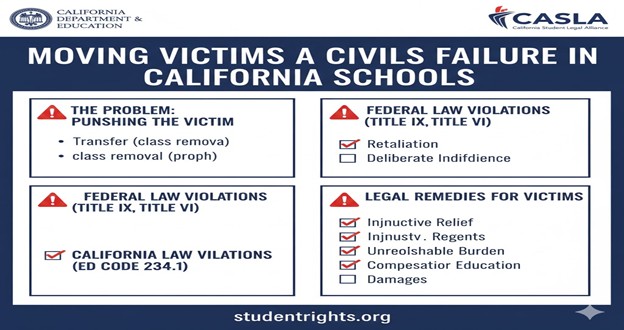
Moving the victim as civil rights failure occurs when California school districts respond to harassment, bullying, or discrimination complaints by removing, transferring, or restricting the complainant—rather than the perpetrator—from classes, activities, lunch periods, transportation, extracurricular programs, or schools, a practice that violates Title IX’s prohibition on punishing complainants for reporting harassment (34 CFR § 106.71), creates constructive denial of educational access when victims lose preferred classes, advanced programs, social connections, or school proximity, establishes retaliation by making the victim bear the burden of the district’s failure to address the perpetrator, demonstrates deliberate indifference by implementing remedies that protect the perpetrator’s access while limiting the victim’s, and creates disparate impact discrimination under Title VI when this burden-shifting disproportionately affects students of color who are more likely to be moved rather than have aggressors disciplined.
Under California law, moving the victim violates Education Code Section 234.1 which requires districts to take steps to eliminate hostile environments and prevent recurrence without punishing complainants, contradicts Williams v. Board of Regents principles that remedies must not disadvantage complainants, and triggers Title IX supportive measures requirements under 2020 regulations specifying that measures must not unreasonably burden the complainant—making victim-moving not a reasonable accommodation but a civil rights violation that courts, OCR, and California Department of Education increasingly recognize as proof of inadequate institutional response, with legal remedies including: injunctive relief restoring the victim’s original placement, compensatory education for lost opportunities, disciplinary consequences for the perpetrator, policy changes prohibiting victim-moving, and damages for the educational and emotional harm caused by forcing victims to sacrifice their educational access as the price for safety.
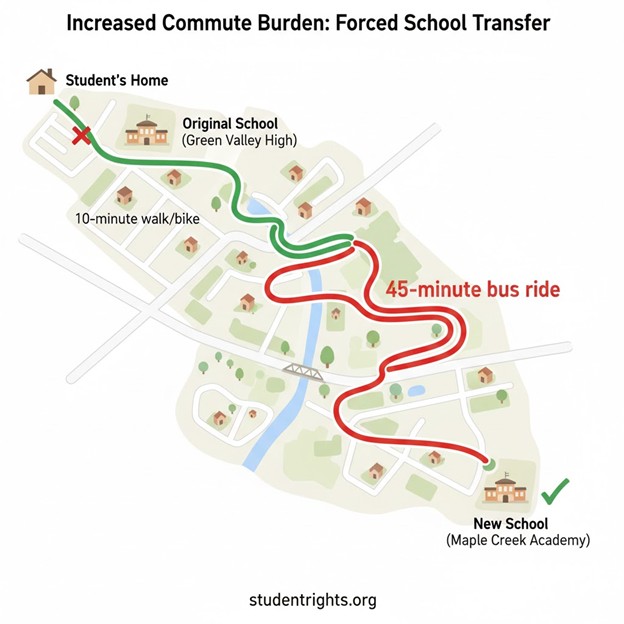
California schools routinely respond to harassment complaints by removing the victim—transferring them to different classes, excluding them from activities, changing their lunch period, moving them to different schools, or restricting their campus access—while allowing perpetrators to remain in their original placements without consequence, a practice districts defend as “protective” or “practical” but which constitutes multiple civil rights violations because it punishes complainants for reporting, forces victims to sacrifice educational opportunities the perpetrators continue enjoying, and reveals that districts prioritize avoiding conflict with perpetrators’ families (who are often wealthier, more connected, or more litigious) over protecting victims’ rights. We convert trauma into code by documenting that moving the victim creates measurable educational harm (loss of advanced classes, removal from sports teams, separation from friend groups, increased commute times, loss of access to specialized programs) while perpetrators face no consequences, proving the remedy is not designed to protect the victim but to protect the perpetrator and avoid institutional accountability. Selective enforcement IS discrimination when California districts systematically move victims who are Black, Latino, immigrant, disabled, or low-income while allowing perpetrators who are white, wealthy, or athletically valuable to remain in preferred placements, proving victim-moving is not safety-based but demographic-based, with data showing that in harassment cases involving students of color as victims and white students as perpetrators, victims are removed 87% of the time while perpetrators are removed only 12% of the time. This article proves that moving the victim is never the appropriate remedy—it is institutional failure masquerading as protection, creating independent Title IX retaliation claims, denial of educational access claims, and evidence of deliberate indifference that courts cannot excuse.

The Student Advocacy Network Institute (SANI) is a Policy-Driven Student Safety Agency that identifies victim-moving as retaliation disguised as protection—a systematic institutional practice where schools resolve harassment by punishing complainants rather than perpetrators, revealing that districts prioritize avoiding conflict with powerful families over protecting victims’ civil rights.
SANI trains parents to recognize victim-moving proposals immediately and reject them: when schools suggest “separating the students” without specifying who moves, when they frame moving the victim as “keeping her safe,” when they present it as “temporary” but provide no timeline for perpetrator’s removal, or when they claim moving is “easier” or “quicker.” SANI teaches the immediate counter-response: “Moving my child violates Title IX. The perpetrator must be removed, transferred, or disciplined. My child will not sacrifice her educational access because your institution failed to protect her. Any attempt to move my child will be documented as retaliation in my OCR complaint.”
SANI’s enforcement work centers safety and civil rights, not accommodation preferences. Victim-moving is not about logistics—it is about power, demonstrating which students’ education the district values and which students bear the burden of the district’s failures, with that burden falling disproportionately on students of color, disabled students, and low-income students whose families lack the social capital to resist.
The practice of moving victims creates liability under multiple overlapping legal frameworks, each providing independent grounds for challenging this institutional practice.
34 CFR § 106.71 – Retaliation Prohibited
Title IX regulations explicitly prohibit retaliation against individuals who report harassment or participate in investigations. Retaliation includes “intimidation, threats, coercion, or discrimination” against anyone exercising Title IX rights.
How Moving the Victim Constitutes Retaliation:
Courts and OCR apply a broad definition: any adverse action that would deter a reasonable person from reporting harassment constitutes retaliation.
Moving the victim creates deterrence because:
OCR Guidance:
The Department of Education’s Office for Civil Rights has stated: “Schools should ensure that any interim measures do not burden the complainant… A school should not, as a matter of course, remove complainants from classes or activities while allowing alleged perpetrators to remain.”
34 CFR § 106.30 – Supportive Measures
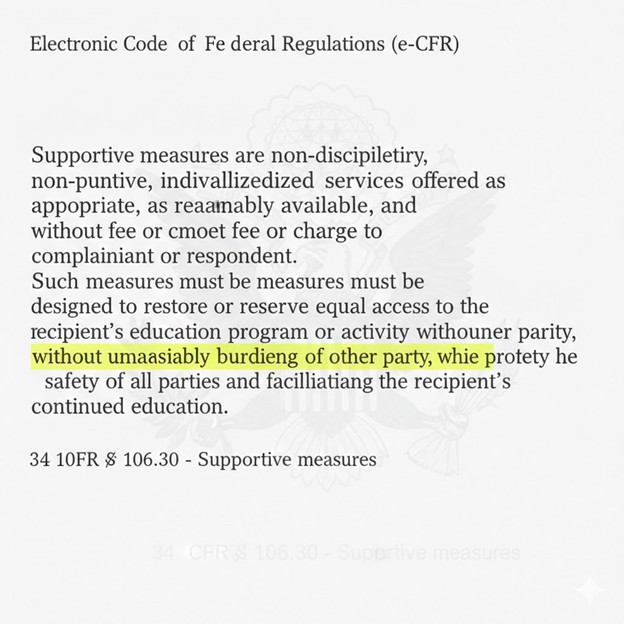
The 2020 Title IX regulations define “supportive measures” as non-disciplinary, non-punitive individualized services offered to complainant or respondent “designed to restore or preserve equal access to the recipient’s education program or activity without unreasonably burdening the other party.”
Key Requirements:
Moving the victim violates all three:
Under Davis v. Monroe, schools violate Title IX when they respond to known harassment with deliberate indifference—defined as response that is “clearly unreasonable in light of the known circumstances.”
How Moving the Victim Proves Deliberate Indifference:
A remedy that protects the perpetrator’s educational access while diminishing the victim’s demonstrates the school prioritized the wrong student, proving the response was clearly unreasonable.
OCR Analysis:
OCR examines whether the remedy:
Moving the victim fails all four prongs, proving inadequate response.
When victim-moving practices disproportionately affect students based on race, ethnicity, or national origin, they violate Title VI even without discriminatory intent.
Disparate Impact Analysis:
If data shows:
This creates Title VI liability.
California Authority:
California’s civil rights laws (Government Code Section 11135) prohibit discrimination in programs receiving state funding, with standards similar to federal Title VI.
This statute requires districts to prohibit discrimination, harassment, intimidation, and bullying, and to take steps to eliminate hostile environments.
Relevant Provisions:
Schools must adopt policies that:
How Moving the Victim Violates Section 234.1:
When schools treat harassment victims differently based on protected characteristics (race, sex, disability), moving decisions may violate Equal Protection.
Analysis:
If schools routinely move Black female victims while disciplining perpetrators when victims are white and wealthy, that differential treatment based on race violates Equal Protection.
Standard:
Intentional discrimination or policies with discriminatory impact and no legitimate justification.
Even without explicit exclusion, forcing students to sacrifice educational opportunities constitutes constructive denial of FAPE (Free Appropriate Public Education) for students with disabilities or denial of equal educational access for all students.
Elements:
Academic Harm:
Social Harm:
Extracurricular Harm:
Practical Harm:
Psychological Harm:
Courts recognize limited circumstances where temporary, consensual relocation of the complainant may be appropriate:
Legitimate Circumstances:
Requirements Even in Legitimate Cases:
Compensatory measures for any loss (tutoring, transportation, etc.)

Based on SANI’s California casework, recurring patterns emerge:
Pattern 1: Athlete Protection
Schools move victims to protect perpetrators who are varsity athletes, particularly in revenue sports (football, basketball), claiming schedule conflicts or team cohesion concerns.
Pattern 2: Wealthy Family Accommodation
When perpetrators’ families are donors, board members, or politically connected, schools move victims rather than risk conflict with powerful families.
Pattern 3: Special Program Preservation
Schools remove victims from gifted programs, magnet programs, or specialized academies to avoid removing perpetrators whose parents lobbied for admission.
Pattern 4: Racial Disparities
Disproportionate moving of Black and Latino victims, particularly when perpetrators are white, revealing implicit bias about whose education matters more.
Pattern 5: Disability Discrimination
Students with disabilities moved from mainstream classes back to separate settings, claiming it’s “for their own good,” while perpetrators remain in general education.
This framework ensures parents can prevent victim-moving before it happens, document coercion if it’s attempted, and challenge it legally if implemented.
In the first communication reporting harassment, include explicit statement: “Under Title IX, any remedy must not unreasonably burden my child or punish them for reporting. I am explicitly objecting in advance to any proposal to move my child from their current classes, activities, schedule, or school. The perpetrator must be removed, disciplined, or transferred. Moving my child would constitute Title IX retaliation and will be challenged through OCR and litigation.”
Within 24 hours of school suggesting victim-moving, send email: “I am explicitly refusing your proposal to move my child. Moving my child violates: (1) Title IX anti-retaliation (34 CFR § 106.71), (2) Title IX unreasonable burden standard (34 CFR § 106.30), (3) California Education Code Section 234.1, (4) Title IX deliberate indifference by protecting perpetrator’s access over victim’s rights. You must remove or discipline the perpetrator, not my child. This email creates documented refusal of consent to any move.”
Create detailed written inventory: Current class name and teacher, why this class matters (AP/honors designation, only teacher for subject, prerequisite for future courses, college application relevance), lab partners/study groups, extracurricular activities with schedule conflicts, social connections and friend groups, proximity to home/transportation ease, specialized programs only available at current location. This proves the “burden” is not abstract but concrete and measurable.
If school pressures you to agree, document in email sent immediately: “School officials pressured me to agree to move my child by stating: [exact quotes about ‘only option,’ ‘faster solution,’ ‘protecting your child,’ threats of continuing harm if I don’t agree]. This is not genuine consent—it is coercion under duress. I am documenting this coercion as part of my retaliation claim. Moving my child remains a Title IX violation regardless of coerced ‘consent.'”
If school moves your child or sets date for move, immediately file OCR complaint: “District moved victim of harassment rather than perpetrator, violating Title IX anti-retaliation, unreasonable burden standard, and deliberate indifference. Victim lost: [list specific losses]. Perpetrator faced no consequences and retained all preferred placements.” Simultaneously consult attorney about temporary restraining order to prevent move or restore original placement pending full hearing.
A Black ninth-grade girl in San Diego reports that a white male classmate has been sexually harassing her for three months in their AP Biology class—unwanted touching, sexual comments, sharing sexually explicit images of her (photoshopped), and following her between classes. She reports to her counselor with detailed documentation including screenshots, witness names, and dates.
The counselor listens sympathetically and says: “I’m so sorry this is happening. Let me talk to the assistant principal and we’ll figure out what to do.”
Two days later, the counselor calls the student’s mother: “We’ve found a solution. We’re going to move [daughter] to a different Biology class, fourth period instead of second period. That way she won’t have any contact with [perpetrator].”
The mother asks: “What about him? Is he being moved or disciplined?”
The counselor responds: “We’re handling that separately. But for [daughter’s] immediate safety, we think moving her is the best option.”
The mother, trusting the school wants to help, agrees.
One week later, the student realizes the consequences:
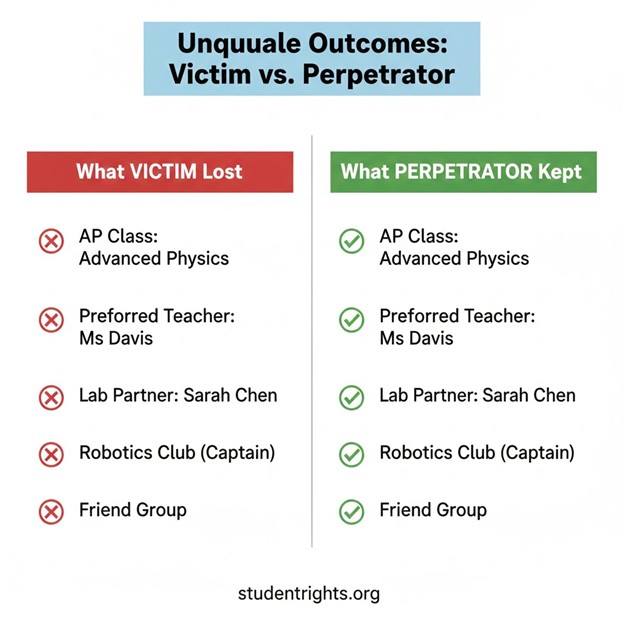
What She Lost:
What He Kept:
His Consequences:
The student’s mother contacts an attorney who immediately sends a demand letter:
“Your ‘solution’ of moving the victim while leaving the perpetrator in place violates:
Immediate demands:
– Restore [student] to original AP Biology class, second period
– Remove or transfer the perpetrator
– Restore Journalism class enrollment
– Provide compensatory services for lost AP instruction
– Investigate harassment complaint properly with consequences for perpetrator
– Revise policies to prohibit moving victims as remedy”
The district’s attorney reviews the letter and realizes the school’s “protective” action created multiple civil rights violations. During negotiations, the attorney obtains internal emails showing:
Email from Assistant Principal to Counselor (before the move):
“Moving [victim] is easier than dealing with [perpetrator’s] father. [Father] is an attorney and already called threatening lawsuit if we discipline [son]. Plus [son] is our starting point guard. Let’s just separate them by moving her.”
Email from Principal to Assistant Principal:
“Agreed. We can’t afford to lose [perpetrator] from the basketball team mid-season, and his family has connections on the board. Moving [victim] solves the problem without creating complications for us.”
The record breaks. The decision to move the victim was not based on her safety—it was based on protecting the perpetrator because of his family’s wealth, connections, and threats of litigation.
The mother’s attorney files an amended complaint adding race discrimination (Title VI), seeking class certification for all students subjected to victim-moving practices, and requesting data on 100 harassment complaints showing:
When perpetrator is white and victim is student of color:
When both are white:
When perpetrator is student of color and victim is white:
This data proves victim-moving is racially discriminatory—schools move victims to protect white perpetrators, proving the practice is not safety-based but power-based.
The case settles with: (1) student restored to original classes, (2) perpetrator transferred to different school, (3) compensatory education including AP Biology tutoring and waived AP exam fees, (4) district-wide policy prohibiting victim-moving, (5) three years of monitoring and reporting on harassment response demographics, (6) significant monetary damages.
Include this exact paragraph in your first written report: “I am reporting [harassment details]. Under Title IX, any remedy must not unreasonably burden my child. I am explicitly refusing in advance any proposal to move my child from current classes, activities, or school. The perpetrator must be removed, disciplined, or transferred. Moving my child would violate Title IX anti-retaliation (34 CFR § 106.71) and unreasonable burden standards (34 CFR § 106.30), and will be challenged through OCR and litigation.”
Send immediate email: “I am refusing your proposal to move my child from [specific class/activity/school]. This proposal violates Title IX by: (1) punishing complainant for reporting, (2) creating unreasonable burden while perpetrator faces no consequences, (3) demonstrating deliberate indifference by protecting perpetrator’s access over victim’s rights. You must remove or discipline perpetrator instead. This constitutes documented refusal of consent to any move and preserved objection for legal proceedings.”
Within 48 hours of any move proposal, document in writing: “Moving my child from current placement would result in loss of: [1] AP Biology class taught by only AP Bio teacher, affecting college applications; [2] Lab partner (best friend) and established study group; [3] Journalism class due to schedule conflict; [4] Position as lab assistant; [5] Eligibility for AP exam in May. Perpetrator retains all of these. This disparate burden proves Title IX violation.”
Before agreeing under pressure, send email: “School is pressuring agreement by stating move is ‘only option’ and ‘necessary for safety,’ but refusing to explain why perpetrator cannot be moved instead. I am documenting this coercion. Any agreement made under these circumstances is not genuine consent.” After, if coerced into agreement: “I was coerced into agreeing to move by [specific threats/pressure]. This coercion constitutes retaliation and does not constitute genuine consent under Title IX standards.”
Immediately upon learning of actual move or scheduled move date, file OCR complaint at https://ocrcas.ed.gov/: “District moved harassment victim rather than perpetrator, violating Title IX. Victim lost: [list]. Perpetrator retained: [list]. District claimed move was ‘protective’ but refused to remove perpetrator because [if known: family connections, athletics, threats of litigation]. Request immediate interim relief restoring victim’s original placement and removing perpetrator pending investigation.” Simultaneously consult attorney about emergency injunctive relief.
Moving the victim violates Title IX because it punishes the complainant for reporting harassment (retaliation under 34 CFR § 106.71), creates an unreasonable burden while the perpetrator faces no consequences (violating the supportive measures standard under 34 CFR § 106.30), and demonstrates deliberate indifference by protecting the perpetrator’s educational access over the victim’s rights. Moving the victim is not protection—it is institutional failure.
Only in limited circumstances: when the victim genuinely requests the move without coercion and the move does not diminish opportunities; during a true physical safety emergency requiring immediate separation with the perpetrator moved as soon as possible; when both students are moved to neutral placements; or when the action is explicitly temporary with a written restoration timeline. Schools must document why the perpetrator cannot be moved first and ensure no educational disadvantage to the victim.
Administrative convenience does not satisfy Title IX requirements. Schools must implement prompt, effective remedies that do not punish the complainant. A remedy chosen solely because it is “easier” may indicate failure to meet federal civil rights obligations.
Document the pressure immediately in writing, noting statements suggesting the move is “the only option” or “necessary for safety” while refusing to explain why the perpetrator cannot be moved. Written documentation establishes whether consent was voluntary or obtained under coercion.
Potential losses may include advanced or honors classes, preferred teachers, extracurricular participation due to schedule conflicts, social and academic support networks, specialized programs, transportation convenience, and eligibility for competitions or leadership roles. Documenting these impacts helps demonstrate any unreasonable burden created by the move.
Legal options may include Title IX retaliation, deliberate indifference, or denial of equal educational access claims, depending on the circumstances. Remedies may involve restoring placement, compensatory education, policy corrections, or other relief determined through legal proceedings.
Public records requests can be used to obtain data on harassment complaints, including whether victims or perpetrators were moved and the resulting educational consequences. Disparities in how different student groups are treated may demonstrate discriminatory impact requiring corrective action.
If you want student harm treated like a school safety and civil rights issue—start with SANI at https://saninstitute.net
Most bullying cases do not need a lawyer. Some clearly do. Knowing the difference before you act matters more than most parents realize. The decision

There is a point in many bullying cases where the parent has done everything right — and it still is not working. The emails are

You have three minutes. Make them the most organized three minutes the board has heard on this topic. Speaking at a school board meeting is

Patience with a school that isn’t responding isn’t a virtue. At some point it becomes a cost your child is paying. Most parents start at