
When Do Parents Need a Lawyer for School Bullying?
Most bullying cases do not need a lawyer. Some clearly do. Knowing the difference before you act matters more than most parents realize. The decision
1. Audio
2. Definition
3. Video
4. Core Thesis
9. Action Steps
10. FAQs
11. Call to Action
12. Sources
13. Signature
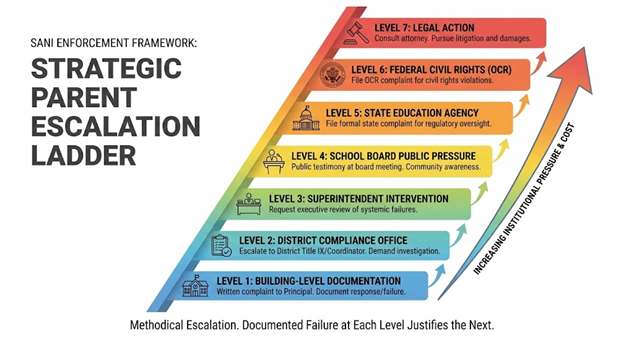
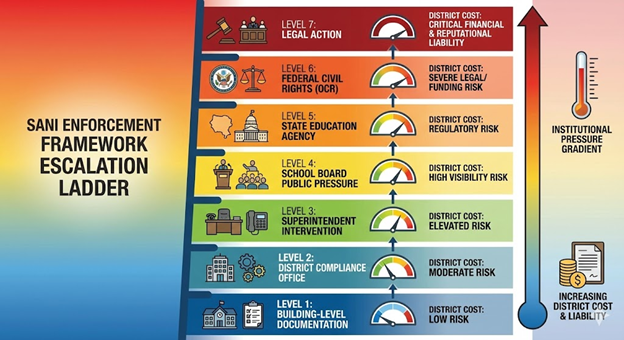
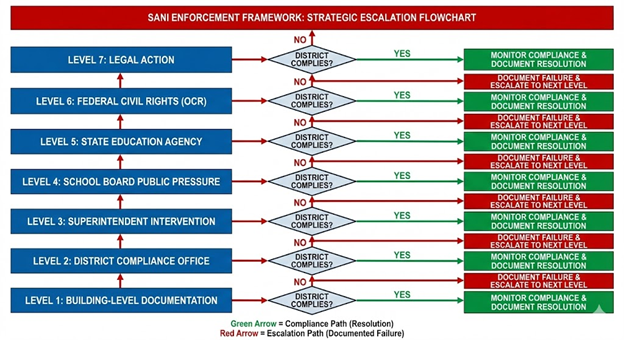
The SANI Enforcement Framework is a seven-level strategic escalation system that applies progressively intensifying pressure on school districts to force compliance with safety obligations, civil rights standards, and procedural requirements. Each level increases institutional cost (legal exposure, regulatory scrutiny, public accountability, financial liability) while providing the district with documented opportunities to comply before escalation. The framework operates on the principle that districts respond to pressure gradients, not emotional appeals—requiring families to methodically climb the enforcement ladder from building-level documentation through federal regulatory complaints and legal action, using each level’s failure to justify and strengthen the next level’s intervention.
Districts do not respond to need—they respond to pressure. The Student Advocacy Network Institute, a Policy-Driven Student Safety Agency, developed the SANI Enforcement Framework after discovering that parents who escalate randomly achieve random results, while parents who escalate strategically force systematic compliance. We convert trauma into code by teaching families to treat enforcement like climbing a ladder: you don’t jump from the ground to the roof—you move methodically, one rung at a time, documenting each level’s failure to justify the next level’s escalation. Each enforcement level increases institutional cost until compliance becomes cheaper than resistance. When parents skip levels, they lose credibility and leverage. When parents climb methodically, they build an irrefutable record of district failure that compounds with each escalation. Selective enforcement IS discrimination, and the Enforcement Framework proves it by documenting how districts respond differently to sustained pressure than to isolated complaints. This article provides the complete seven-level escalation system that works.
The Student Advocacy Network Institute exists because most families don’t know how to escalate effectively. As the nation’s first Policy-Driven Student Safety Agency, SANI operates at the intersection of strategic pressure application, institutional psychology, and enforcement methodology.
When a parent contacts SANI and says, “I’ve tried everything and nothing works,” we ask: “Did you escalate strategically or randomly?”
Random escalation reveals:
Strategic escalation requires:
We convert trauma into code by teaching parents that enforcement is a ladder, not a lottery. You don’t pick a random level and hope it works. You climb methodically, creating pressure at each level until the district realizes compliance is inevitable.
SANI treats student harm as both a school safety issue and a civil rights issue because the Enforcement Framework works for both. Whether you’re enforcing Ed Code safety obligations or Title VI civil rights protections, the escalation pathway is identical. Selective enforcement IS discrimination—and the Enforcement Framework proves it by documenting how districts ignore Level 1-2 complaints but respond immediately when Level 5-6 pressure arrives. The disparity in response based on pressure level (rather than harm severity) reveals institutional priorities: districts protect themselves, not students.
The SANI Enforcement Framework is the roadmap that forces them to do both.
Each level has specific objectives, required actions, documentation standards, and escalation triggers.
Objective: Establish formal notice, create compliance opportunity, document building-level response or failure.
Who You Contact:
What You Do:
Action 1: Submit Written Complaint Using Policy-Driven Language
Use the Policy-Driven Communication Template:
Subject: [Ed Code Section] Violation – Investigation Required
Dear [Principal]:
I am formally reporting conduct that violates [STATE ED CODE SECTION] and [DISTRICT POLICY].
Incident Summary:
On [DATE], [STUDENT/STAFF] engaged in [SPECIFIC CONDUCT]. Witnesses: [NAMES]. Evidence: [LIST].
Legal Framework:
This conduct violates [CODE] because [EXPLANATION].
Required Actions:
Under [CODE/POLICY], you must:
Documentation:
I am maintaining detailed records. This is Level 1 of my enforcement process.
Escalation Notice:
If required actions are not completed by deadlines stated, I will escalate to District Compliance Office on [DATE].
Please confirm receipt and provide written response by [DATE].
Sincerely,
[Your Name]
Action 2: Document Everything
Create Case File entries:
Escalation Trigger:
Escalate to Level 2 if:
Documentation Before Escalating:
“On [DATE], I submitted formal complaint to [PRINCIPAL]. As of [DATE], [X] business days later, I have received [no response / inadequate response]. This constitutes building-level failure and triggers escalation to district compliance office.”
Objective: Elevate to district oversight, create institutional accountability pressure, document district-level response or failure.
Who You Contact:
What You Do:
Action 1: Escalation Communication
Subject: Escalation – Building-Level Non-Response to [Code] Violation
Dear [District Compliance Officer]:
I am escalating a complaint originally filed with [PRINCIPAL] on [DATE] due to [no response / inadequate response / compliance failure].
Original Complaint Summary:
[Brief summary or attach original email]
Building-Level Failure:
Despite mandatory [timeline/procedure], [PRINCIPAL] has [failed to respond / failed to investigate / failed to comply]. [X] days have elapsed with no written response.
Required District Actions:
I am requesting:
Documentation:
This is Level 2 escalation. All communications and failures have been documented.
Escalation Notice:
If district-level compliance is not achieved by [DATE], I will escalate to Superintendent and request board-level intervention.
Please confirm receipt and provide written response by [DATE].
Sincerely,
[Your Name]
Action 2: Copy Relevant Parties
CC:
Escalation Trigger:
Escalate to Level 3 if:
Documentation Before Escalating:
“District compliance office responded on [DATE] but investigation exhibited [NUMBER] collapse triggers [list]. Findings were inadequate and unsupported by evidence. This constitutes district-level failure and triggers superintendent escalation.”
Objective: Force executive-level attention, create accountability at highest district leadership, document superintendent response or failure.
Who You Contact:
What You Do:
Action 1: Superintendent Escalation Letter
Subject: Executive Intervention Required – Building and District-Level Failures
Dear Superintendent [NAME]:
I am requesting executive intervention due to failures at both building and district levels to address [CODE/CIVIL RIGHTS] violations affecting my child.
Timeline of Failures:
Level 1 (Building):
Level 2 (District Compliance):
Current Status:
[X] days since original report. [X] documented violations of policy and law. [X] opportunities for compliance ignored.
Required Actions:
I am requesting:
Documentation:
This is Level 3 escalation. I have documented evidence of systemic failures across multiple levels.
Escalation Notice:
If executive intervention does not result in compliance by [DATE], I will:
I am requesting a meeting within 5 business days to resolve this matter.
Sincerely,
[Your Name]
Attachments:
Action 2: Request Meeting
Superintendent-level meetings create:
Escalation Trigger:
Escalate to Level 4-7 if:
Documentation Before Escalating:
“Superintendent responded on [DATE] but failed to honor commitments made in meeting on [DATE]. Despite written assurances, [SPECIFIC FAILURES]. This exhausts internal remedies and triggers external escalation.”
Objective: Create public accountability, apply community pressure, force board-level oversight.
Who You Address:
What You Do:
Action 1: Prepare Board Meeting Testimony
Research board meeting procedures:
Testimony Template (2-minute version):
“Good evening. My name is [NAME]. I am here because my child has been subjected to [HARASSMENT/VIOLENCE/DISCRIMINATION] for [TIME PERIOD], and despite three levels of escalation—building principal, district compliance, and superintendent—the district has failed to provide the safe learning environment required by [STATE LAW] and [CIVIL RIGHTS LAW].
Timeline of Failures:
District Violations:
I am requesting board-level intervention to:
I have documented every failure. If the board does not act, I will escalate to state and federal agencies with evidence of systemic institutional failure.
Thank you.”
Action 2: Submit Written Statement
Provide board members with written documentation packet (distributed before meeting):
Action 3: Record and Publicize
Escalation Trigger:
Escalate to Level 5-7 if:
Documentation Before Escalating:
“I presented public testimony on [DATE]. Board members [NAMES] acknowledged the complaint but took no action. [X] days have passed with no board intervention. Internal remedies are exhausted. External agency intervention is now required.”
Objective: Invoke state regulatory oversight, create compliance pressure through state investigation, document state-level findings.
Who You Contact:
What You Do:
Action 1: File Formal State Complaint
State complaint processes vary. Research your state’s requirements:
State Complaint Template:
RE: Formal Complaint – Violation of [STATE EDUCATION CODE] and Civil Rights
Dear [STATE AGENCY]:
I am filing a formal complaint against [DISTRICT NAME] for violations of [STATE LAWS] and failure to comply with mandatory educational requirements.
Complainant Information:
[Your name, address, contact info, relationship to student]
Student Information:
[Student name, school, grade, protected class if applicable]
Violation Summary:
[DISTRICT] has violated [SPECIFIC STATE CODES] by [SPECIFIC FAILURES].
Timeline:
[Chronological summary of incidents and district failures]
Internal Remedies Exhausted:
I have escalated through four internal levels:
All internal remedies have been exhausted without resolution.
Requested Relief:
Attachments:
[List all documentation]
Sincerely,
[Your Name]
Action 2: Maintain Communication
State investigations can take 60-90 days. Request:
Escalation Trigger:
Level 5 can run concurrent with Level 6-7 because state and federal agencies operate independently.
Objective: Invoke federal civil rights enforcement, create federal compliance pressure, establish violation record.
Who You Contact:
What You Do:
Action 1: File OCR Complaint
OCR Online Portal: https://www2.ed.gov/about/offices/list/ocr/complaintintro.html
OCR Complaint Requirements:
OCR Complaint Narrative Structure:
Basis of Complaint:
Violations of [Title VI / Title IX / Section 504] due to [DISCRIMINATORY CONDUCT / DELIBERATE INDIFFERENCE]
Factual Summary:
[Chronological narrative with dates, witnesses, evidence]
Legal Violations:
Deliberate Indifference:
The district had actual notice of harassment on [DATES]. Despite [X] reports, the district’s response was clearly unreasonable:
Disparate Impact (if applicable):
[Protected class] students are disciplined at [X]x the rate of [comparison group] for identical conduct, creating discriminatory enforcement pattern.
Hostile Environment:
The harassment was severe, pervasive, and objectively offensive. It deprived my child of equal access to education, as evidenced by [ACADEMIC DECLINE / ATTENDANCE DROP / PSYCHOLOGICAL HARM].
Internal Remedies Exhausted:
[Summary of Levels 1-4]
Requested Relief:
Action 2: Respond to OCR Communications
OCR will:
Stay responsive to all OCR requests.
Escalation Trigger:
OCR complaints can run concurrent with legal action (Level 7).
Objective: Pursue judicial remedies, establish legal liability, obtain damages and injunctive relief.
Who You Contact:
What You Do:
Action 1: Consult Attorney
Provide attorney with:
Legal Claims May Include:
State Law:
Federal Law:
Action 2: Pre-Litigation Demand Letter
Attorney may send demand letter before filing suit, offering settlement opportunity.
Action 3: Litigation
If settlement fails, lawsuit filed. Your documentation from Levels 1-6 becomes evidence proving:
Outcome:
Legal action can result in:
Public accountability
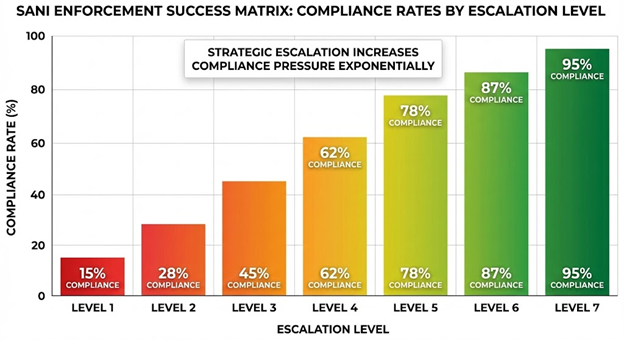
Don’t wait until you’re frustrated to escalate. Map the pathway in advance:
Create an Escalation Plan Document:
Level | Who | What | Deadline | Escalation Trigger | Status |
1 | Building Principal | Written complaint, policy-driven language | Day 5 | No response / inadequate response | PENDING |
2 | District Compliance | Escalation letter with Level 1 failure documentation | Day 10 | No investigation / collapsed investigation | NOT STARTED |
3 | Superintendent | Executive intervention request | Day 20 | No compliance / commitments not honored | NOT STARTED |
4 | School Board | Public testimony | Day 30 | No board action | NOT STARTED |
5 | State Agency | Formal complaint | Day 45 | Concurrent with 6-7 | NOT STARTED |
6 | OCR | Federal civil rights complaint | Day 45 | Concurrent with 5,7 | NOT STARTED |
7 | Legal | Attorney consultation / demand / litigation | Day 60+ | All remedies exhausted | NOT STARTED |
This roadmap keeps you focused and prevents random escalation.
The power of strategic escalation comes from proving you gave the district multiple opportunities to comply.
At each level, explicitly state:
“This is Level [X] of my enforcement process. I am providing you with the opportunity to comply before escalating to [NEXT LEVEL]. If compliance is not achieved by [DATE], I will escalate on [DATE].”
This documentation proves good faith and strengthens regulatory/legal claims.
Exception: If there is imminent threat to student safety (credible threats of violence, ongoing assault, medical emergency), you may need to skip directly to Level 6 (OCR), Level 7 (legal), or law enforcement.
Otherwise, climb methodically. Skipping levels:
Reasonable deadlines:
Too short: 24 hours (appears unreasonable)
Too long: 30 days (loses urgency, allows harm to continue)
Every communication should include escalation warning:
Level 1: “If no response by [DATE], I will escalate to district compliance office.”
Level 2: “If investigation is not completed by [DATE], I will escalate to superintendent.”
Level 3: “If compliance is not achieved by [DATE], I will present public board testimony and file state/federal complaints.”
This creates urgency without being threatening. It’s strategic, not emotional.
Once you reach Level 5, you can (and often should) file multiple external actions simultaneously:
These agencies operate independently. Filing with one doesn’t preclude others.
Add “Escalation Tracker” section to your Case File:
Date | Level | Action Taken | District Response | Compliance? | Next Step |
10/1 | 1 | Written complaint to principal | No response | NO | Escalate to Level 2 on 10/6 |
10/6 | 2 | District compliance escalation | Investigation assigned | PARTIAL | Monitor investigation quality |
10/15 | 2 | Investigation collapsed (5 triggers) | Inadequate findings | NO | Escalate to Level 3 on 10/16 |
10/16 | 3 | Superintendent intervention request | Meeting scheduled 10/20 | PENDING | Await meeting outcome |
This tracker becomes powerful evidence of systematic institutional failure.
The SANI Enforcement Framework is a seven-level strategic escalation system designed to force school district compliance through increasing institutional pressure. It progresses from building-level documentation to district compliance, superintendent intervention, school board pressure, state agencies, federal civil rights complaints, and ultimately legal action.
Each level builds evidentiary weight. When a district fails at one level, that failure justifies—and strengthens—the next level of escalation.
Strategic escalation requires demonstrating that you exhausted internal remedies in good faith. Skipping steps allows the district to argue:
• “We were never given a chance to respond”
• “The complainant was unreasonable”
• “They refused to work with the district”
OCR investigators and courts consistently view methodical escalation more favorably. Each documented failure at a lower level strengthens your position at higher enforcement levels.
If a district resists at every level and you move quickly, external enforcement (Levels 5–7) is typically reached within 60–90 days.
However, many cases resolve earlier—often at Levels 2 or 3—because strategic escalation signals that compliance is inevitable. The goal is not to reach Level 7, but to create enough pressure at lower levels to force corrective action.
Retaliation is a separate violation and significantly strengthens your case. Document retaliation immediately and incorporate it into your next escalation. For example:
“Since filing this complaint, my child has experienced [RETALIATION]. This constitutes a separate Title VI/IX violation and will be included in all regulatory complaints.”
Retaliation often accelerates intervention by district leadership because it creates additional liability exposure.
You can—but it is usually less effective. The superintendent is the district’s chief executive and controls operations. School boards typically defer to the superintendent on implementation issues.
The board is most powerful as Level 4—after executive-level failure—when public accountability and oversight pressure are maximized. Following the hierarchy increases leverage and credibility.
Evaluate whether the offer fully addresses the harm. If it is a comprehensive, good-faith solution, accept it and document the resolution.
If the response is a token gesture designed to halt escalation, document why it is inadequate and continue. Partial compliance can be acknowledged without stopping escalation. For example:
“I appreciate [ACTION TAKEN], but this does not resolve [REMAINING ISSUES]. Full compliance is required by [DATE], or I will proceed to Level 4.”
You do not need to name the framework. However, you should clearly communicate that you are following a structured escalation process. For example:
“This correspondence constitutes Level [X] of a systematic enforcement process. If compliance is not achieved, I will escalate to Level [NEXT LEVEL].”
This signals preparation, persistence, and strategic intent. Some parents also note they are working with experienced advocacy organizations, which further increases institutional pressure.
If you want student harm treated like a school safety and civil rights issue—start with SANI at https://saninstitute.net
The Student Advocacy Network Institute (SANI) is a national research, accountability, and discipline institute founded by Bullying Is A Drug to define, document, and address institutional failure in K–12 education—treating student harm as a school safety and civil rights issue.
Explore the Institute:
https://saninstitute.net
Parent A: Random Escalation (Fails)
A parent’s child is bullied. Day 1: Parent calls the principal, emotional and desperate. Principal says “we’ll look into it.” Day 3: Parent, frustrated by no response, emails the superintendent. Superintendent’s office replies: “The principal is handling this at the building level. Please work with them directly.” Day 5: Parent posts on social media about the school’s failure. Day 7: Parent files an OCR complaint. Day 10: Parent hires an attorney.
Result: The district sees chaos, not strategy. The principal feels undermined. The superintendent sees a parent who won’t follow chain of command. OCR sees a complaint filed before internal remedies were exhausted. The attorney sees a weak case because documentation is scattered and escalation appears reactive. The bullying continues. No accountability.
Parent B: Strategic Escalation (Succeeds)
Level 1: Building-Level Documentation (Days 1-5)
Day 1: Parent emails principal with subject line: “Ed Code 48900.4 Violation – Investigation Required.” Email cites exact code sections, provides witness names, demands written response within 3 business days, states intention to escalate if no response. Email includes: “This is Level 1 of my enforcement process. I will escalate to district compliance office if requirements are not met by [DATE].”
Day 5: No written response received. Parent documents this failure.
Level 2: District Compliance Office (Days 6-10)
Day 6: Parent emails district Title VI/Title IX coordinator and district compliance officer. Subject: “Escalation – Building-Level Non-Response to Ed Code Violation.” Email includes:
Day 10: District compliance officer responds, assigns investigator, provides timeline.
Investigation occurs but findings are inadequate (investigative collapse identified).
Level 3: Superintendent Intervention (Days 15-20)
Day 15: Parent emails superintendent. Subject: “Collapsed Investigation – Demand for Reinvestigation.” Email includes:
Day 18: Superintendent assigns independent investigator. Proper investigation conducted. Findings substantiate harassment. Safety plan created. Discipline imposed.
Result: Problem resolved at Level 3. Parent never had to reach Level 4-7, but documented readiness to escalate built the pressure that forced compliance.
The Difference
Parent A escalated randomly, skipping levels, appearing chaotic, losing credibility and leverage at each stage.
Parent B escalated strategically, climbing methodically, documenting each failure, building cumulative pressure that made compliance inevitable.
Both parents had valid complaints. Only one had a system.
Most bullying cases do not need a lawyer. Some clearly do. Knowing the difference before you act matters more than most parents realize. The decision

There is a point in many bullying cases where the parent has done everything right — and it still is not working. The emails are

You have three minutes. Make them the most organized three minutes the board has heard on this topic. Speaking at a school board meeting is

Patience with a school that isn’t responding isn’t a virtue. At some point it becomes a cost your child is paying. Most parents start at