
When Do Parents Need a Lawyer for School Bullying?
Most bullying cases do not need a lawyer. Some clearly do. Knowing the difference before you act matters more than most parents realize. The decision
1. Audio
2. Definition
3. Video
4. Core Thesis
9. Action Steps
10. FAQs
11. Call to Action
12. Sources
13. Signature
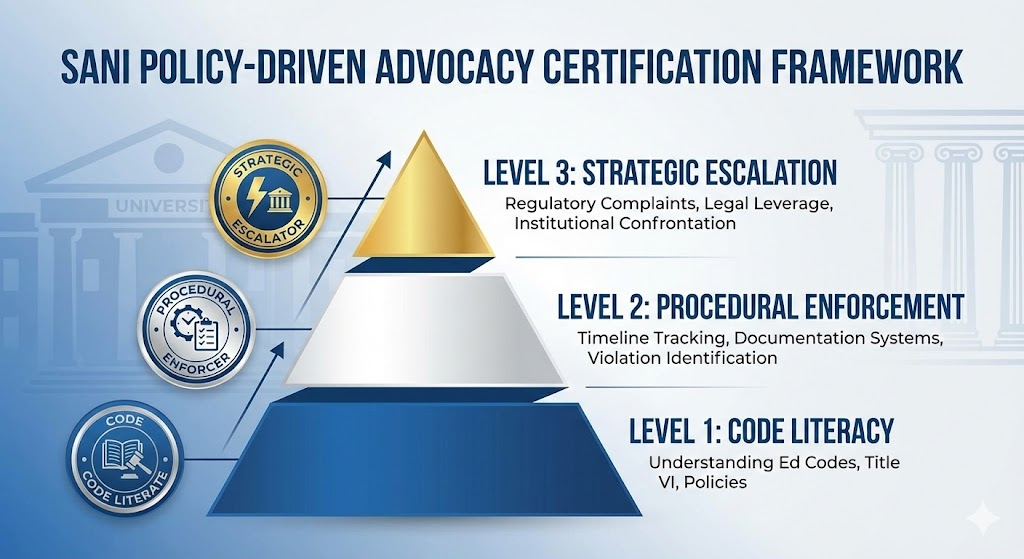
Policy-Driven Student Safety Advocacy is a disciplined enforcement methodology that translates student harm into violations of specific legal codes, civil rights statutes, administrative policies, and mandatory procedural timelines—creating accountability through enforceable standards rather than emotional appeals. This discipline operates at the intersection of legal interpretation, evidence documentation, procedural literacy, and institutional confrontation. Unlike traditional advocacy (which requests action), policy-driven advocacy demands compliance by citing exact statutory language, documenting procedural failures, establishing legal timelines, and threatening escalation to enforcement agencies. It is the only advocacy framework that converts parental trauma into district-level compliance pressure that schools cannot dodge.
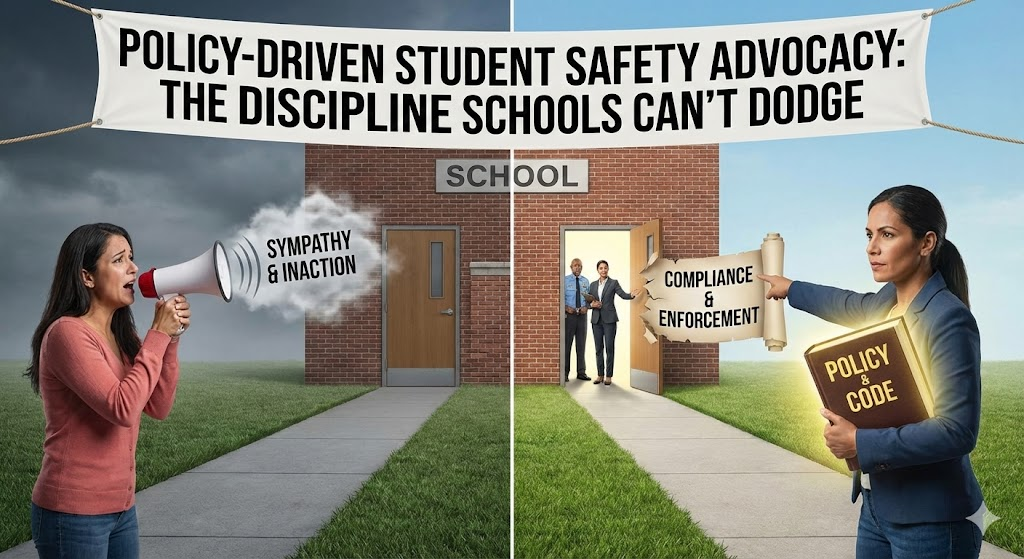
Schools dismiss emotion. Schools cannot dismiss code. The Student Advocacy Network Institute, a Policy-Driven Student Safety Agency, was founded on the principle that parents lose battles when they speak the language of feeling and win battles when they speak the language of enforcement. We convert trauma into code by training families to cite Education Code sections, Title VI provisions, mandatory investigation timelines, and procedural requirements with the precision of attorneys—but the moral authority of parents. When a parent says “my child is suffering,” the school responds with sympathy and inaction. When a parent says “you violated Ed Code 48900.3, failed to investigate within the mandatory 5-day timeline under district policy, and exhibited deliberate indifference under Title VI,” the school responds with lawyers and compliance. Selective enforcement IS discrimination, and policy-driven advocacy is how you prove it. This article establishes Policy-Driven Student Safety Advocacy as a formal discipline—complete with core principles, tactical frameworks, and enforcement methodologies that schools cannot dodge.
The Student Advocacy Network Institute is the nation’s first institution dedicated to teaching, refining, and deploying Policy-Driven Student Safety Advocacy. As a Policy-Driven Student Safety Agency, SANI operates at the intersection of legal interpretation, procedural enforcement, civil rights compliance, and institutional confrontation.
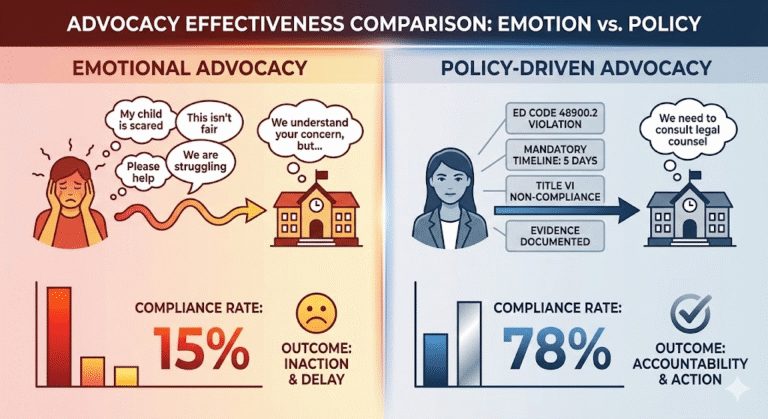
When a parent contacts SANI and says, “The school won’t help me,” our first question is: “What language are you using?”
If the parent is speaking emotionally (“my child is scared,” “this isn’t fair,” “please help”), we translate their emotion into enforcement language:
We convert trauma into code because code is the only language districts respect.
SANI treats student harm as both a school safety issue and a civil rights issue because policy-driven advocacy requires both frameworks:
When parents combine both frameworks, they create enforcement pressure the district cannot escape. Selective enforcement IS discrimination—and policy-driven advocacy is how you prove it by citing the exact statutes, comparing enforcement patterns, and documenting procedural failures.
SANI’s mission is to establish Policy-Driven Student Safety Advocacy as a recognized discipline—taught in universities, certified through training programs, and deployed by families nationwide.
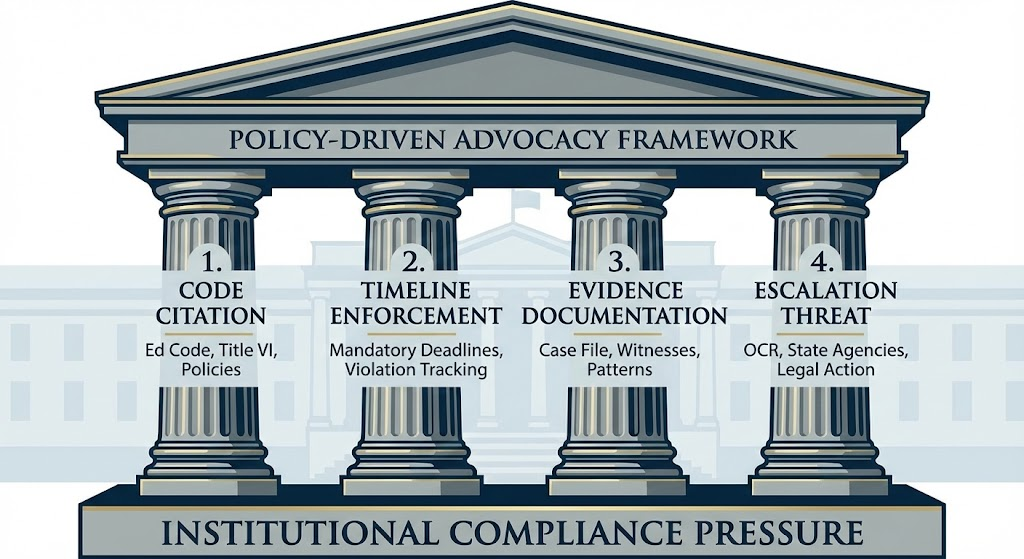
Policy-Driven Student Safety Advocacy is built on four foundational pillars. Each pillar is essential. Remove one, and the framework collapses.
Definition: The precise identification and application of statutory language, regulatory provisions, administrative policies, and case law that create enforceable obligations on schools.
Core Components:
State Education Codes:
Federal Civil Rights Statutes:
District Policies:
Case Law:
How to Apply:
When communicating with the school, cite exact code sections:
Weak (Emotional): “My child shouldn’t be treated this way.”
Strong (Policy-Driven): “Under California Ed Code 48900.3, hate violence includes physical acts committed because of race or ethnicity. The assault my child experienced—combined with racial slurs—meets this definition and triggers mandatory investigation and safety planning requirements.”
Weak: “The school is taking too long.”
Strong: “Your district policy [number] requires investigation completion within 5 school days. Today is Day 12. This timeline violation constitutes a procedural failure and evidence of deliberate indifference.”
Code citation removes subjectivity. The school cannot argue with the statute.
Definition: The strategic use of mandatory deadlines, procedural timelines, and legal time limits to create urgency, document violations, and establish non-compliance patterns.
Why Timelines Matter:
Schools use delay as a weapon (Pattern #3: Temporal Manipulation). Policy-driven advocacy uses timelines as a counter-weapon.
Common Timelines:
Investigation Timelines:
Response Timelines:
How to Apply:
Calculate timelines in every communication:
Day 0: “I am reporting this incident today, [DATE]. Under [policy/statute], investigation must begin within 1 school day. I expect written confirmation by [DATE].”
Day 3: “It has been 3 days since my report. I have not received confirmation that an investigation has begun. This violates the mandatory 1-day initiation timeline.”
Day 7: “It has been 7 days. Your district policy requires investigation completion within 5 days. This is a documented timeline violation.”
Day 14: “It has been 14 days. I am escalating this matter to [District Compliance Officer / State Education Agency / OCR] with documentation of your timeline violations as evidence of deliberate indifference.”
Timeline enforcement creates objective, measurable failures the district cannot dispute.
Definition: The systematic creation, organization, and preservation of proof that establishes notice, pattern, harm, procedural failure, and institutional non-compliance.
Why Documentation Matters:
Without evidence, advocacy is anecdotal. With evidence, advocacy is enforceable.
What to Document (The Case File System):
How to Apply:
Reference your documentation in communications:
“I have documented 7 incidents over 3 weeks (see attached Master Timeline). This pattern demonstrates escalation from verbal to physical harm. Your failure to act after Report #1 on [DATE] created foreseeability for Reports #2–7.”
“Attached are medical records documenting PTSD symptoms resulting from exposure to ongoing harassment that you failed to stop despite 4 written reports (Communication Log attached).”
Documentation transforms “he said, she said” into provable facts.
Definition: The credible communication that non-compliance will result in formal complaints, regulatory investigations, legal action, public exposure, or financial liability—forcing the district to weigh the cost of inaction against the cost of compliance.
Why Escalation Threats Matter:
Schools respond to pressure, not pleas. Escalation threats create institutional urgency.
Escalation Pathways:
Internal:
External (Regulatory):
External (Legal):
External (Public):
How to Apply:
State escalation plans explicitly:
“If I do not receive written confirmation of investigation initiation by [DATE], I will file a formal complaint with the Office for Civil Rights alleging deliberate indifference under Title VI.”
“If the investigation is not completed within the mandatory timeline, I will escalate to the State Department of Education with documentation of procedural violations.”
“If my child experiences retaliation for this report, I will pursue legal claims for both the underlying harassment and the separate civil rights violation created by retaliation.”
Escalation threats force the district’s legal team to get involved—and legal teams prefer compliance over litigation.
Every policy-driven communication should include these elements:
This structure removes emotion, establishes authority, and creates urgency.
When parents use emotional advocacy:
When parents use policy-driven advocacy:
The difference is institutional fear. Emotion creates sympathy. Code creates liability.
Create a folder (digital or physical) with these resources:
State Education Code:
Federal Statutes:
District Policies:
Case Law:
Having these documents ready allows you to cite them accurately in real time.
Practice reframing emotional statements:
Emotional Statement | Policy-Driven Translation |
“My child is scared” | “My child is experiencing reasonable fear of harm under Ed Code 48900.4, creating a hostile educational environment” |
“The school won’t help” | “The school has failed to comply with mandatory investigation timelines under district policy and state law” |
“This isn’t fair” | “This constitutes selective enforcement creating disparate impact under Title VI” |
“It keeps happening” | “This is a documented pattern of 7 incidents over 3 weeks, demonstrating escalation and foreseeability” |
“I’m so frustrated” | “I am documenting procedural failures and timeline violations for regulatory complaint” |
Remove “I feel.” Add “The law requires.”
Use this template for all written communications:
Subject: [Code Section] Violation – [Required Action]
Dear [Administrator]:
INCIDENT SUMMARY:
On [DATE], [CONDUCT] occurred. Witnesses: [NAMES].
LEGAL FRAMEWORK:
This conduct violates [CODE/STATUTE] because [EXPLANATION].
MANDATORY REQUIREMENTS:
Under [CODE/POLICY], you are required to:
DOCUMENTATION:
I am maintaining detailed records of this matter, including [LIST: timeline, communications, evidence].
TIMELINE:
I expect written response by [DATE, typically 2-3 business days]. Failure to respond will be documented as non-compliance.
ESCALATION:
If mandatory requirements are not met, I will escalate to [AGENCY/BOARD/LEGAL] with documentation of procedural violations as evidence of deliberate indifference.
Please confirm receipt and provide the name of the investigator assigned to this case.
Sincerely,
[Your Name]
[Date]
Create a Timeline Violation Log:
Report Date | Required Action | Required Deadline | Actual Response | Days Late | Violation Documented |
10/1 | Investigation initiation | 10/2 | No response | 5 days | Yes (email sent 10/6) |
10/1 | Investigation completion | 10/6 | Completed 10/15 | 9 days | Yes (email sent 10/16) |
10/15 | Safety plan creation | 10/17 | No plan created | 12 days | Yes (escalation notice 10/27) |
Each violation becomes evidence of deliberate indifference.
Escalation is not punishment. It is strategic pressure.
Internal escalation sequence:
External escalation: 5. State Department of Education 6. Office for Civil Rights 7. Legal counsel 8. Media / public advocacy
Move up the ladder methodically. Document each level’s failure before escalating.
Give the district one chance to comply before escalating:
“If I do not receive [REQUIRED ACTION] by [DATE], I will file a complaint with [AGENCY] on [DATE + 1]. This is your opportunity to comply before formal escalation.”
This creates urgency while maintaining good faith.
This is the legal standard that defeats school defenses. Use it:
“Your failure to investigate despite 4 written reports constitutes deliberate indifference under Davis v. Monroe. You had actual notice. Your response was clearly unreasonable. This creates Title VI liability.”
“Your 18-day delay in initiating investigation—despite a mandatory 1-day timeline—demonstrates that your response was clearly unreasonable in light of known circumstances. This is the definition of deliberate indifference.”
When you speak the language of case law, the school’s attorneys take notice.
Policy-Driven Student Safety Advocacy is a disciplined enforcement methodology that translates student harm into violations of specific legal codes, timelines, and procedural requirements. Instead of relying on emotional appeals, it creates accountability through enforceable standards by citing exact statutes, documenting violations, enforcing timelines, and escalating to regulatory agencies or legal action when necessary.
Schools can dismiss emotion, but they cannot dismiss code. When parents speak emotionally (“my child is suffering”), schools respond with sympathy and inaction. When parents speak procedurally (“you violated Education Code 48900.3 and the mandatory 5-day investigation timeline”), schools respond with legal consultation and compliance. Policy-driven advocacy creates institutional liability pressure that traditional advocacy does not.
No. You need legal literacy, organized documentation, and strategic communication—not a law degree. SANI teaches parents to cite law with precision and authority. Parents also possess moral and factual standing that attorneys do not. The combination of legal literacy and parental authority is often more powerful than either alone.
The school will correct you—and in doing so, they are forced to engage with the legal framework. Even imperfect citation shifts the conversation from emotion to procedure. Accuracy still matters for credibility, so always rely on official sources such as state legislature websites, federal statute databases, and district policy handbooks, and cite as precisely as possible.
Schools may become defensive when parents speak with legal precision, but defensiveness often leads to compliance. The risk of hostility is lower than the risk of continued inaction. If retaliation occurs (Pattern #10: Retaliation Masking), document it as a separate civil rights violation and escalate immediately. Retaliation strengthens—not weakens—your case.
Start with your state’s education code (search “[your state] education code bullying”). Review your district’s policies, typically available on the district website or via a public records request. For federal law, consult OCR guidance on Title VI, Title IX, and Section 504. SANI’s website (saninstitute.net) provides state-by-state resources and code summaries.
Ignore the characterization. Your job is not to be liked—it is to protect your child. Schools use social pressure to silence parents who demand accountability. Policy-driven advocacy is lawful, reasonable, and necessary. If a school labels you “difficult” for citing mandatory legal requirements, it reveals their discomfort with accountability—not a flaw in your approach.
If you want student harm treated like a school safety and civil rights issue—start with SANI at https://saninstitute.net
The Student Advocacy Network Institute (SANI) is a national research, accountability, and discipline institute founded by Bullying Is A Drug to define, document, and address institutional failure in K–12 education—treating student harm as a school safety and civil rights issue.
Explore the Institute:
https://saninstitute.net
Two parents face identical situations. Their children are being bullied. Both report to the school. The outcomes are completely different.
Parent A: Emotional Advocacy
The parent emails the principal: “My son is being bullied by three boys in his class. He comes home crying every day. He doesn’t want to go to school anymore. This is breaking my heart. Please help us. I’m begging you to do something.”
The principal responds: “Thank you for bringing this to our attention. We take all reports seriously. I will speak with the students involved and monitor the situation. Please let me know if there are any further concerns.”
Two weeks pass. Nothing changes.
The parent follows up: “I’m still waiting for an update. My son is still being harassed. What are you doing about this?”
The principal responds: “We’ve had several conversations with the students. These situations take time to resolve. We’re working on it.”
Four weeks pass. The bullying escalates.
The parent calls the superintendent’s office, emotional and desperate: “No one is helping my son! He’s being tormented every day and the school won’t do anything!”
The superintendent’s assistant responds: “The principal is handling this at the building level. We trust their judgment. If you’re not satisfied, you can file a formal complaint.”
The parent files a vague complaint. The district responds with a form letter: “We have reviewed your concerns and determined that the school followed appropriate procedures. This matter is closed.”
The bullying continues. The parent removes their child from the school. No accountability. No consequences for the district.
Parent B: Policy-Driven Advocacy
The parent emails the principal with a subject line: “Ed Code 48900.2 Violation – Immediate Investigation Required”
The email reads:
“Dear Principal [Name],
I am reporting conduct that violates California Education Code 48900.2 (sexual harassment) and 48900.4 (threats causing reasonable fear of harm).
Incident Summary:
On [DATE], [STUDENT A], [STUDENT B], and [STUDENT C] subjected my son to the following conduct:
Witnesses: [STUDENT D] and [STUDENT E] observed the incident and are willing to provide statements.
Applicable Requirements:
Under California Ed Code and your district policy [cite policy number], you are required to:
Timeline:
I expect written confirmation of investigation initiation by [DATE, 1 school day from now]. I expect investigation completion and written findings by [DATE, 5 school days from now].
Documentation:
I am maintaining a detailed record of this matter. Failure to comply with mandatory timelines and investigation requirements will be escalated to [District Compliance Office, State Department of Education, and Office for Civil Rights] as evidence of deliberate indifference under Title VI.
Please confirm receipt of this report and provide the name of the investigator assigned to this case.
Sincerely,
[Parent Name]
[Date]”
The principal responds within 3 hours:
“Dear [Parent Name],
Thank you for your detailed report. I have assigned [Assistant Principal Name] to conduct the investigation. You will receive written updates within the timelines you specified.
Sincerely,
[Principal]”
Day 2: The parent receives an email: “Investigation has begun. We have interviewed your son and [STUDENT A]. Interviews with [STUDENT B], [STUDENT C], [STUDENT D], and [STUDENT E] will be completed by [DATE].”
Day 5: The parent receives a 4-page investigation report with findings, witness summaries, and disciplinary actions. The three aggressors are suspended. A safety plan is created. The parent is invited to a follow-up meeting to review the plan.
The bullying stops. Accountability achieved.
What’s the difference?
Parent A used emotional advocacy. The school responded with empathy and inaction.
Parent B used policy-driven advocacy. The school responded with lawyers and compliance.
Both parents loved their children equally. Both parents were equally distressed. But only one parent spoke the language the district could not dodge: policy.
Most bullying cases do not need a lawyer. Some clearly do. Knowing the difference before you act matters more than most parents realize. The decision

There is a point in many bullying cases where the parent has done everything right — and it still is not working. The emails are

You have three minutes. Make them the most organized three minutes the board has heard on this topic. Speaking at a school board meeting is

Patience with a school that isn’t responding isn’t a virtue. At some point it becomes a cost your child is paying. Most parents start at