Table of Contents
Click to Expand
1. Audio
2. Definition
3. Video
4. Core Thesis
9. Action Steps
10. FAQs
11. Call to Action
12. Sources
13. Signature
Definition
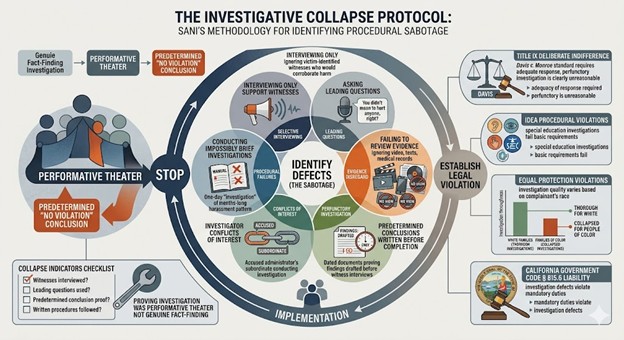
The Investigative Collapse Protocol is SANI’s systematic methodology for identifying and documenting when districts conduct investigations deliberately designed to reach predetermined “no violation found” conclusions through procedural sabotage—manifesting through: interviewing only witnesses likely to support district (ignoring victim-identified witnesses who would corroborate harm), asking leading questions designed to elicit exculpatory responses (“You didn’t mean to hurt anyone, right?”), failing to review available evidence (ignoring video footage, texts, medical records), conducting impossibly brief investigations (one-day “investigation” of months-long harassment pattern), predetermined conclusions written before investigation completed (dated documents proving findings drafted before witness interviews), investigator conflicts of interest (accused administrator’s subordinate conducting investigation), and failure to follow district’s own written investigation procedures—establishing Title IX deliberate indifference when investigation so defective it amounts to no investigation (Davis v. Monroe standard requires adequate response, perfunctory investigation is clearly unreasonable), IDEA procedural violations when special education investigations fail basic requirements, Equal Protection violations when investigation quality varies based on complainant’s race (thorough investigations for white families, collapsed investigations for families of color), and California Government Code § 815.6 liability when investigation defects violate mandatory duties—proven through SANI’s collapse indicators checklist documenting each procedural failure proving investigation was performative theater not genuine fact-finding.
Core Thesis
Districts perform investigative theater—claiming to investigate complaints while deliberately conducting defective processes guaranteed to reach “no violation found” conclusions through systematic procedural sabotage: interviewing only witnesses supporting district’s preferred narrative while ignoring victim-identified corroborating witnesses, asking leading questions designed to minimize harm (“It wasn’t that bad, was it?”), refusing to review readily-available evidence contradicting district’s narrative (video footage showing assault district claims didn’t occur), completing impossibly brief investigations inadequate for incident complexity (one-hour investigation of year-long harassment pattern), writing predetermined conclusions before completing investigation (findings dated before final witness interviews), assigning conflicted investigators (accused administrator’s direct report investigating supervisor), ignoring district’s own written investigation procedures—with investigative collapse proving deliberate indifference not good-faith error because intentionally defective investigation is legally equivalent to no investigation, establishing Title IX violations (clearly unreasonable response under Davis), IDEA violations (denial of procedural safeguards), and Equal Protection violations (selective investigative quality based on race). We convert trauma into code by documenting every collapse indicator through SANI’s systematic checklist—witness list comparison (who district interviewed vs. who complainant identified), question analysis (leading vs. neutral), evidence review audit (what existed vs. what district examined), timeline analysis (investigation duration vs. incident complexity), document dating (findings written before investigation complete), investigator conflict documentation—proving investigation was predetermined conclusion wrapped in procedural theater, forcing districts to either conduct legitimate investigation or admit findings from collapsed process cannot withstand scrutiny. Selective enforcement IS discrimination when investigative collapse patterns reveal thorough investigations for white complainants producing accountability while collapsed investigations for families of color producing predetermined exonerations—proving investigation quality weaponized based on whose complaints districts take seriously.
Case Pattern Story
Middle school student in Fresno reports severe sexual harassment by classmate. Victim provides detailed complaint to Title IX coordinator: months-long pattern, specific incidents with dates, six student witnesses who would corroborate, text messages as evidence.
District’s “investigation”:
Day 1: Title IX coordinator interviews accused student alone. Questions: “Did you mean to make her uncomfortable?” “Were you just trying to be friendly?” “Do you understand why she might have misunderstood?”
Accused: “I was just joking around. I didn’t mean anything by it.”
Day 2: Coordinator interviews victim. Questions: “Are you sure it was harassment and not just normal teenage interaction?” “Could you have misinterpreted his intentions?” “Did you ever tell him directly to stop?”
Victim provides six witness names, requests coordinator interview them. Provides printed text messages.
Day 3: Coordinator completes “investigation.”
Findings (issued Day 3):
“After thorough investigation, we find insufficient evidence of sexual harassment. Accused student states conduct was misunderstood attempt at friendship. Recommend conflict resolution.”
Investigation defects:
Zero victim-identified witnesses interviewed (six students who would corroborate—none contacted)
Text message evidence ignored (victim provided printed texts—not reviewed or mentioned in findings)
Leading questions to accused (designed to elicit exculpatory narrative)
Victim-blaming questions (“Did you tell him to stop?”)
Three-day investigation of months-long pattern (impossibly brief)
Predetermined conclusion (metadata shows findings document created Day 1, before victim interview)
This is investigative collapse—procedural theater designed to reach predetermined “no violation” conclusion.
Family retains attorney who conducts investigative audit:
Audit findings:
Witness failure:
- Victim identified six corroborating witnesses
- District interviewed zero witnesses beyond accused and victim
- All six witnesses would have provided consistent accounts of harassment
- District’s failure to interview was deliberate—witnesses readily available
Evidence failure:
- Victim provided text messages showing explicit harassment
- District finding states “no documentary evidence provided”
- Text messages prove harassment occurred
- District’s refusal to review contradicts findings
Question bias:
- Questions to accused: leading, exculpatory (“just trying to be friendly?”)
- Questions to victim: skeptical, victim-blaming (“did you tell him to stop?”)
- Question patterns designed to elicit narrative supporting predetermined conclusion
Duration failure:
- Months-long harassment pattern
- Three-day “investigation”
- Title IX regulations require timeframe adequate for complexity
- Three days impossibly inadequate
Predetermined conclusion:
- Findings document metadata: created Day 1 (before victim interviewed)
- Findings finalized Day 3
- Investigation steps occurred Days 1-3
- Conclusion reached before investigation conducted
Investigator conflict:
- Title IX coordinator reports to principal
- Principal is accused’s football coach—professional relationship with accused
- Coordinator investigating case involving supervisor’s athlete
- Structural conflict compromised investigation
Attorney’s demand:
“District’s ‘investigation’ was investigative collapse—predetermined conclusion wrapped in procedural theater. Defects prove deliberate indifference:
Witness failure: Interviewed 0 of 6 victim-identified corroborating witnesses—deliberate choice to avoid evidence
Evidence refusal: Ignored provided text messages proving harassment—deliberate choice to avoid contradictory evidence
Leading questions: Designed to elicit exculpatory narrative—not neutral fact-finding
Inadequate duration: Three days for months-long pattern—inadequate by any standard
Predetermined conclusion: Findings written before investigation complete—proves outcome decided in advance
Investigator conflict: Coordinator investigating supervisor’s athlete—compromised impartiality
This violates Title IX—Davis v. Monroe requires adequate response; intentionally defective investigation is clearly unreasonable response constituting deliberate indifference.
Demand: Independent external investigation, findings from collapsed investigation void, compensatory measures for violation period.”
District agrees: External investigator conducts proper investigation—interviews all six witnesses, reviews text messages, documents pattern.
Findings: Sexual harassment established, months-long pattern corroborated, district’s original investigation deliberately defective.
Settlement: Substantial damages, discipline of Title IX coordinator for investigative collapse, policy requiring independent review when investigative defects alleged, monitoring.
Case establishes: Investigative collapse as evidence of deliberate indifference, not good-faith error.
SANI Connection
The Investigative Collapse Protocol is SANI’s framework for proving districts conduct sham investigations designed to fail—not incompetence but deliberate sabotage.
Framework’s core principle: Intentionally defective investigation = no investigation = deliberate indifference.
SANI teaches families to document collapse through systematic audit:
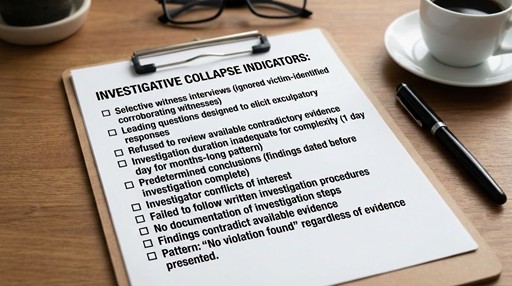
Collapse Indicator 1: Selective Witness Interviews
Pattern: District interviews only witnesses likely to support predetermined conclusion, ignores victim-identified witnesses who would corroborate.
Documentation:
- List all witnesses complainant identified (with dates/methods provided to district)
- List all witnesses district actually interviewed
- Compare lists showing who was deliberately excluded
- Obtain statements from excluded witnesses proving what they would have said
- Prove district’s selective interviewing was intentional avoidance of corroboration
Example: Complainant identified: Students A, B, C, D, E, F (all witnessed harassment) District interviewed: Accused only Excluded witnesses: All six corroborating witnesses Result: “No witnesses corroborate complaint” (because district didn’t interview any)
This proves: Deliberately defective investigation designed to avoid evidence.
Collapse Indicator 2: Leading/Biased Questions
Pattern: Questions to accused designed to elicit exculpatory responses; questions to complainant skeptical/victim-blaming.
Documentation:
- Request written questions asked (or document from memory immediately after interview)
- Analyze question design showing bias
Accused’s questions (leading/exculpatory):
- “You didn’t mean to hurt anyone, right?”
- “Were you just trying to be friendly?”
- “Do you think she might have misunderstood?”
Complainant’s questions (skeptical/victim-blaming):
- “Are you sure it was harassment?”
- “Could you have misinterpreted?”
- “Did you tell him to stop?”
Compare: Questions reveal predetermined conclusion—assuming accused innocent, assuming complainant mistaken.
Collapse Indicator 3: Evidence Refusal
Pattern: District ignores readily-available evidence contradicting preferred narrative.
Documentation:
- List all evidence provided to district (texts, emails, photos, videos, medical records)
- Document when/how provided (email transmissions, hand-delivery with receipt)
- Show findings ignore or misrepresent evidence
- Prove evidence directly contradicts findings
Example: Evidence provided: Text messages showing explicit harassment Findings state: “No documentary evidence of harassment” Contradiction: District possessed evidence but claimed it didn’t exist
This proves: Deliberate refusal to acknowledge contradictory evidence.
Collapse Indicator 4: Inadequate Investigation Duration
Pattern: Investigation timeframe impossibly brief given incident complexity.
Documentation:
- Calculate incident timeframe (months/years of pattern)
- Document investigation duration (days/hours)
- Compare showing inadequacy
Example: Incident: 8-month harassment pattern, 30+ incidents, 6 witnesses Investigation: 3 days total Analysis: 3 days inadequate to interview 6 witnesses, review evidence, document findings for 8-month pattern
This proves: Investigation designed to fail through inadequate time allocation.
Collapse Indicator 5: Predetermined Conclusions
Pattern: Findings written before investigation completed.
Documentation:
- Request all investigation documents with metadata
- Check document creation dates
- Compare document dates to investigation timeline
- Prove findings written before key investigation steps
Example: Findings document: Created October 15 Victim interview: October 17 Witness interviews: Never occurred Analysis: Conclusion reached before victim interviewed—proves predetermined
This proves: Investigation was theater—conclusion decided in advance.
Collapse Indicator 6: Investigator Conflicts
Pattern: Person conducting investigation has conflict compromising impartiality.
Documentation:
- Identify investigator
- Document conflicts (reports to accused, friend of accused, colleague relationships)
- Prove conflict compromised investigation
Example: Investigator: Title IX coordinator Reports to: Principal Accused: Principal’s star athlete Conflict: Investigating supervisor’s favored student
This proves: Structural conflict prevented impartial investigation.
Collapse Indicator 7: Procedural Violations
Pattern: Investigation violates district’s own written procedures.
Documentation:
- Obtain district’s written investigation policy
- Audit actual investigation against policy requirements
- Document each violation
Policy requires: Interview complainant, accused, all identified witnesses; review all evidence; document findings with reasoning; complete within 30 days
Actual investigation: Interviewed complainant and accused only, ignored witnesses, refused evidence review, completed in 3 days
Violations: Failed witness interviews, failed evidence review, inadequate duration
This proves: Deliberate disregard of mandatory procedures.
SANI’s investigative collapse brief template:
“District’s investigation was deliberately defective constituting investigative collapse—legal equivalent of no investigation—establishing deliberate indifference:
Collapse Indicator 1—Selective witnesses: Interviewed 0 of 6 victim-identified corroborating witnesses [evidence]
Collapse Indicator 2—Biased questions: Leading questions to accused, skeptical questions to victim [examples]
Collapse Indicator 3—Evidence refusal: Ignored provided text messages/videos/medical records [documentation]
Collapse Indicator 4—Inadequate duration: 3 days for 8-month pattern with 6 witnesses—impossibly brief
Collapse Indicator 5—Predetermined conclusion: Findings document created before victim interviewed [metadata]
Collapse Indicator 6—Investigator conflict: Coordinator investigating supervisor’s favored student [relationship documentation]
Collapse Indicator 7—Procedural violations: Failed to follow written investigation policy [policy vs. actual comparison]
Legal conclusion: Intentionally defective investigation = no investigation = clearly unreasonable response = deliberate indifference under Davis v. Monroe. District cannot rely on findings from collapsed investigation. Demand independent external investigation, void findings, compensatory measures.”
Discipline Explanation
Legal Standard: Adequate Investigation Required
Davis v. Monroe deliberate indifference standard: District liable when actual knowledge of harassment + clearly unreasonable response.
Adequate response includes: Prompt, thorough investigation following basic investigative principles.
Clearly unreasonable response includes: Perfunctory, sham, or deliberately defective investigation designed to avoid finding violations.
Key principle: Intentionally defective investigation = no investigation = clearly unreasonable response.
Courts recognize: Going through investigative motions while deliberately sabotaging process through procedural defects is not adequate response—it’s deliberate indifference with extra steps.
Title IX Investigation Requirements
34 CFR § 106.45(b)(1): Investigation must be adequate, reliable, impartial, prompt, and fair.
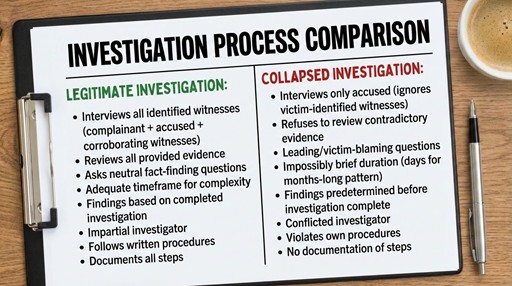
Adequate: Sufficient to determine what occurred—interviews relevant witnesses, reviews relevant evidence, timeframe appropriate for complexity.
Reliable: Produces trustworthy findings—neutral questions, unbiased investigator, evidence-based conclusions.
Impartial: Free from conflicts and bias—investigator has no stake in outcome, asks neutral questions, considers all evidence.
Prompt: Completed in reasonable timeframe—complexity-dependent, but not unnecessarily delayed.
Fair: Provides opportunity for both parties to present evidence, be heard, identify witnesses.
Investigative collapse violates all requirements: Inadequate (doesn’t interview witnesses), unreliable (predetermined conclusions), biased (leading questions, conflicted investigator), delayed or rushed inappropriately, unfair (complainant’s witnesses/evidence ignored).
Common Investigative Collapse Tactics
Tactic 1: “No Witnesses Corroborate” (Because None Interviewed)
Pattern: Complainant provides witness list. District interviews zero witnesses. Findings: “No witnesses corroborate complainant’s account.”
Technically true but deliberately misleading: No witnesses corroborated because district didn’t interview any.
Challenge: “District’s finding ‘no corroboration’ is false. Complainant provided six witness names [dates/documentation]. District interviewed zero. This deliberate failure to interview corroborating witnesses proves investigative collapse designed to reach predetermined ‘no violation’ conclusion. Had district interviewed witnesses, all would have corroborated—proving district’s failure was intentional avoidance of evidence.”
Tactic 2: “Insufficient Evidence” (Because Refused to Review)
Pattern: Complainant provides documentary evidence (texts, videos, medical records). District findings: “Insufficient evidence to substantiate complaint.”
District possessed evidence but claimed insufficient: Refusal to review is not same as evidence not existing.
Challenge: “District’s ‘insufficient evidence’ finding is false. Complainant provided text messages showing explicit harassment [evidence log with transmission proof]. District findings state no documentary evidence—but district possessed evidence and refused to review. This deliberate refusal to examine contradictory evidence proves investigative collapse.”
Tactic 3: “Conflicting Accounts Prevent Finding” (Because Asked Leading Questions)
Pattern: District asks accused leading questions eliciting exculpatory narrative (“You didn’t mean harm, right?”). Asks complainant skeptical questions (“Are you sure?”). Findings: “Conflicting accounts prevent determining what occurred.”
Conflict manufactured through biased questioning: Neutral questions would have established facts.
Challenge: “District’s ‘conflicting accounts’ resulted from biased questioning designed to elicit contradictory narratives. Questions to accused were leading/exculpatory [examples]. Questions to complainant were skeptical/victim-blaming [examples]. Neutral fact-finding questions would have established consistent account—district’s question bias deliberately manufactured conflict preventing findings.”
Tactic 4: “Investigation Complete” (But Duration Impossibly Brief)
Pattern: Months/years-long pattern. District completes “investigation” in days/hours.
Investigation duration inadequate for complexity: Cannot properly investigate complex case in impossibly brief time.
Challenge: “District claims ‘thorough investigation’ but duration proves otherwise. Incident: 8-month harassment pattern, 30+ incidents, 6 witnesses. Investigation: 3 days. Impossibly brief—cannot interview 6 witnesses, review evidence, document pattern in 3 days. Inadequate duration proves investigation was predetermined conclusion not genuine fact-finding.”
Tactic 5: “Investigation Followed Procedures” (But Violated Written Policy)
Pattern: District has written investigation policy. Actual investigation violates every requirement. District claims compliance.
Compare policy to practice: Systematic violations prove deliberate non-compliance.
Challenge: “District’s written policy requires [X]. Actual investigation did [opposite of X] in every respect [detailed comparison]. Systematic violation of own procedures proves investigation was deliberately defective—intentional non-compliance, not good-faith error.”
Proving Collapse Through Document Metadata
Most powerful collapse evidence: Predetermined conclusions proven through document metadata.
Request: All investigation documents with metadata (creation dates, modification dates, author, edit history).
Analysis:
Findings document: Created October 15, 10:00 AM
Investigation timeline:
- October 15, 2:00 PM: Accused interviewed
- October 17, 9:00 AM: Complainant interviewed
- Witnesses: Never interviewed
Metadata proves: Findings document created before complainant interviewed, before any witnesses interviewed—conclusion reached before investigation conducted.
This is irrefutable evidence of predetermined conclusion—document dates don’t lie.
Challenge: “Findings document metadata [attach] shows creation date October 15, 10:00 AM. Complainant interviewed October 17—two days after findings written. This proves investigation was theater—conclusion predetermined before investigation conducted. District cannot rely on findings written before investigation complete.”
Investigative Collapse as Deliberate Indifference Not Negligence
Key distinction: Negligent investigation = good-faith errors in investigation process.
Investigative collapse = deliberate sabotage through systematic procedural defects.
Courts distinguish based on pattern:
Negligence indicators:
- Investigator makes some errors but generally follows procedures
- Some witnesses interviewed though not all
- Evidence reviewed though some missed
- Conclusion reasonably related to investigation findings even if flawed
Deliberate indifference indicators:
- Systematic violation of all investigation requirements
- All victim-identified witnesses ignored
- All contradictory evidence refused
- Conclusion predetermined before investigation
- Multiple collapse indicators proving intentional sabotage
Pattern of collapse proves deliberate indifference: Single defect might be negligence; systematic collapse across all indicators proves intentional sabotage constituting clearly unreasonable response.
Voiding Findings From Collapsed Investigations
Legal principle: Findings from deliberately defective investigation cannot stand—procedural defects void conclusions.
Demand when collapse proven:
“District’s findings are void due to investigative collapse. Investigation was deliberately defective [collapse indicators documented]. Intentionally defective investigation is legal equivalent of no investigation—findings cannot stand.
Demand:
- Void current findings as product of collapsed investigation
- Appoint independent external investigator
- Conduct legitimate investigation following basic principles
- Compensatory measures for period student subjected to harm based on void findings”
District’s options:
Option 1: Acknowledge collapse, void findings, conduct legitimate investigation (appropriate response)
Option 2: Defend collapsed investigation (strengthens deliberate indifference case—defending obviously defective investigation proves deliberate choice)
Option 3: Partially acknowledge defects, offer to “supplement” investigation (insufficient—cannot supplement collapsed investigation, must start over)
Correct resolution: Complete do-over with independent investigator—cannot salvage collapsed process through supplements.

The SANI Investigative Collapse Documentation and Challenge Protocol
Step 1: Document All Investigation Defects Immediately Using Systematic Collapse Indicators Checklist
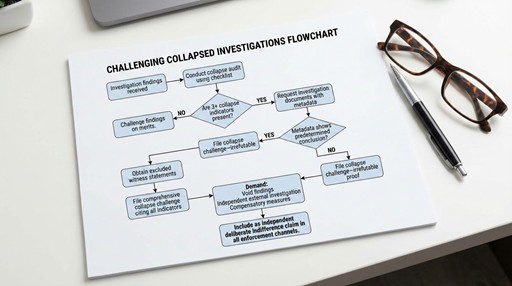
Within 48 hours of receiving investigation findings, conduct collapse audit: (1) Witness comparison—list all witnesses you identified vs. witnesses district interviewed showing deliberate exclusions, (2) Evidence tracking—list all evidence provided vs. evidence reviewed in findings showing refusals, (3) Question documentation—record questions asked (from memory if necessary) showing leading/biased patterns, (4) Duration analysis—calculate incident complexity vs. investigation timeframe showing inadequacy, (5) Request all investigation documents with metadata proving predetermined conclusions, (6) Document investigator conflicts showing bias, (7) Compare investigation to written district policy showing procedural violations. Create comprehensive collapse documentation proving investigation was deliberately defective not good-faith effort.
Step 2: Request Investigation Documents With Metadata Proving Predetermined Conclusions
File Public Records Act request within 7 days: “Request all documents related to investigation of [complaint], including: investigator notes with creation dates/metadata, findings document with full metadata (creation date, modification dates, author, edit history), interview notes/recordings with dates, evidence reviewed with dates received/reviewed, emails between investigators/administrators about investigation with dates, investigation timeline/checklist if exists. Provide in native electronic format preserving metadata.” Metadata often reveals findings written before investigation complete—irrefutable proof of predetermined conclusion. If metadata shows findings created before key investigation steps, this proves investigative collapse definitively.
Step 3: Obtain Statements From Excluded Witnesses Proving What District Avoided Learning
Contact all witnesses you identified that district didn’t interview: obtain written statements describing what they witnessed and would have told investigators. Format: “I, [name], witnessed [incidents] on [dates]. Had I been interviewed during [District’s] investigation, I would have reported: [detailed account]. I was available to be interviewed [dates/contact info provided to district]. District never contacted me.” These statements prove: (1) District deliberately excluded corroborating witnesses, (2) Had district interviewed, harassment would have been corroborated, (3) District’s exclusion was intentional avoidance of evidence. Attach statements to collapse challenge proving district’s “no corroboration” finding resulted from refusal to interview rather than absence of corroboration.
Step 4: File Comprehensive Collapse Challenge Voiding Findings and Demanding Independent Investigation
Within 10 days of findings, send formal challenge: “District’s investigation was investigative collapse—deliberately defective process designed to reach predetermined ‘no violation’ conclusion. Collapse proven through: [1] Witness exclusion—interviewed 0 of 6 identified witnesses [documentation], [2] Evidence refusal—ignored provided texts/videos [evidence log], [3] Biased questions—leading to accused, skeptical to complainant [examples], [4] Inadequate duration—3 days for 8-month pattern [analysis], [5] Predetermined conclusion—findings created before investigation complete [metadata], [6] Investigator conflicts—[conflicts documented], [7] Procedural violations—violated own policy [comparison]. Under Davis v. Monroe, intentionally defective investigation = no investigation = deliberate indifference. Findings void. Demand: (1) Void current findings, (2) Independent external investigation, (3) Compensatory measures for violation period.”
Step 5: Include Investigative Collapse as Independent Deliberate Indifference Claim in All Enforcement
In OCR complaints, litigation, state complaints: dedicate section to investigative collapse as independent violation: “District’s deliberately defective investigation constitutes separate deliberate indifference violation. Investigation so defective it amounts to no investigation—clearly unreasonable response under Davis. Collapse proven through systematic procedural sabotage [enumerate indicators with evidence]. District cannot claim good-faith investigation when process was designed to fail. Even if harassment allegations disputed, investigative collapse independently establishes Title IX violation—deliberate indifference proven through refusal to conduct legitimate investigation. Request: finding of investigative collapse as independent violation, mandate for legitimate investigation, compensatory education/damages for period findings from collapsed investigation allowed harm to continue.”
Action Steps
1. Within 48 Hours of Findings, Conduct Systematic Collapse Audit Using Full Indicators Checklist
Create comprehensive audit document: Witnesses—list all witnesses you identified with dates/methods provided to district vs. witnesses district interviewed showing exclusions, Evidence—list all evidence provided (texts, videos, medical records) with transmission proof vs. evidence reviewed in findings showing refusals, Questions—document all questions asked during interviews showing leading/biased patterns (write from memory immediately while fresh), Duration—calculate incident timeframe (months/incidents) vs. investigation duration (days/hours) showing inadequacy, Investigator—identify who conducted investigation and document conflicts (reports to accused, colleague relationships), Procedures—obtain district’s written investigation policy and compare to actual investigation showing violations. If 3+ indicators present, investigation is collapsed—proceed with challenge.
2. File Public Records Request for Investigation Documents With Metadata Within 7 Days
“California Public Records Act request: All documents related to investigation of [complaint dated X]: investigator notes with metadata (creation/modification dates), findings document with complete metadata (creation date, all modification dates, author, edit history preserved), interview notes/recordings with dates conducted, evidence review documentation with dates received/reviewed, emails between investigators and administrators discussing investigation, investigation timeline or checklist if maintained. Provide in native electronic format preserving all metadata—PDF conversions strip metadata and are insufficient. Need within 10 days Government Code § 6253.” Metadata is smoking gun—if findings created before investigation complete, proves predetermined conclusion irrefutably.
3. Obtain Written Statements From All Excluded Witnesses Within 10 Days
Contact every witness you identified that district didn’t interview: “District conducted investigation into [incident] but didn’t interview you despite your name being provided as witness. Would you provide written statement describing: (1) What you witnessed [dates, details], (2) What you would have told investigators had they contacted you, (3) That you were available during investigation period [dates/contact info], (4) That district never contacted you for interview. Statement will be used to prove district deliberately excluded corroborating witnesses.” Format statements consistently, have witnesses sign/date. These prove district’s “no corroboration” resulted from refusal to interview, not absence of corroboration—powerful collapse evidence.
4. File Formal Collapse Challenge Within 10 Days Demanding Void Findings and Independent Investigation
Send comprehensive challenge to superintendent, board, Title IX coordinator: “District’s investigation was investigative collapse—deliberately defective process violating Title IX adequate response requirement. Collapse indicators proven through attached documentation: [1] Witness exclusion—0 of 6 interviewed [comparison chart + excluded witness statements], [2] Evidence refusal—ignored provided evidence [evidence log + transmission proof], [3] Biased questions—systematic leading/victim-blaming [documented examples], [4] Inadequate duration—impossibly brief [complexity vs. time analysis], [5] Predetermined conclusion—findings created before investigation complete [metadata], [6] Investigator conflicts—[documented], [7] Procedural violations—[policy vs. actual comparison]. Under Davis v. Monroe, intentionally defective investigation = clearly unreasonable response = deliberate indifference. Demand within 10 days: (1) Void findings as product of collapsed investigation, (2) Appoint independent external investigator, (3) Conduct legitimate investigation, (4) Implement compensatory measures for violation period.”
5. Include Investigative Collapse as Separate Deliberate Indifference Violation in OCR/Litigation
In all enforcement channels (OCR complaints, § 1983 litigation, state complaints), dedicate separate claim to investigative collapse: “CLAIM: Investigative Collapse as Independent Deliberate Indifference. District’s investigation was so defective it constitutes no investigation—clearly unreasonable response establishing deliberate indifference regardless of underlying harassment merits. Collapse proven through: [enumerate all indicators with supporting evidence—witness exclusion, evidence refusal, predetermined conclusions, etc.]. Even if harassment allegations disputed, investigative collapse independently violates Title IX—deliberate indifference established through refusal to conduct legitimate investigation. Pattern of collapse proves intentional sabotage not negligence. Request: (1) Finding of investigative collapse violation, (2) Order requiring legitimate investigation, (3) Compensatory education/damages for period collapsed investigation allowed harm to continue based on void findings, (4) Policy reforms preventing future collapsed investigations, (5) Monitoring.”
FAQs
1. What is an “investigative collapse” and how is it different from a flawed investigation?
An “investigative collapse” refers to a situation where an investigation is so incomplete or procedurally deficient that it fails to meet basic standards of fairness and thoroughness. This goes beyond ordinary mistakes or oversights. While a flawed investigation may still attempt to gather relevant information, a collapsed investigation may omit key steps—such as interviewing relevant witnesses or reviewing available evidence—resulting in unreliable or unsupported conclusions.
2. How can I assess whether an investigation was completed fairly?
A fair investigation typically includes timely interviews, consideration of relevant evidence, and a neutral evaluation of the facts. Reviewing available documentation—such as timelines, interview records, and findings—can help determine whether the process was thorough and consistent with applicable policies or standards.
3. What if important witnesses or information were not included?
If relevant witnesses or evidence were not considered, it may be helpful to document what information was provided and what was omitted. Presenting this information in a clear, organized way can support a request for further review or reconsideration of the findings.
4. Can procedural issues affect the reliability of investigation results?
Yes. Significant gaps in process—such as incomplete fact-gathering or inconsistent documentation—can affect the reliability of conclusions. Identifying and clearly explaining these issues can help ensure that concerns about the process are properly evaluated.
5. What steps can be taken if there are serious concerns about an investigation?
If there are substantial concerns, options may include requesting a review, asking for additional investigation steps, or seeking an independent evaluation where appropriate. Clear documentation of the concerns and supporting information can help ensure that the request is properly considered.
Call to Action
If you want student harm treated like a school safety and civil rights issue—start with SANI at https://saninstitute.net
Sources
-
Davis v. Monroe County Board of Education, 526 U.S. 629 (1999) – U.S. Supreme Court
decision establishing that schools may be liable under Title IX when their response to known harassment
is clearly unreasonable, including situations where investigative actions are inadequate.
https://supreme.justia.com/cases/federal/us/526/629/ -
34 CFR § 106.45(b)(1) – Title IX regulation requiring grievance processes to be fair,
impartial, prompt, and based on an adequate and reliable investigation of the facts.
https://www.ecfr.gov/current/title-34/subtitle-B/chapter-I/part-106/subpart-D/section-106.45 -
Gebser v. Lago Vista Independent School District, 524 U.S. 274 (1998) – U.S. Supreme
Court case establishing that liability may arise when a school has actual knowledge of misconduct and
responds in a clearly unreasonable manner.
https://supreme.justia.com/cases/federal/us/524/274/ -
California Government Code § 6253 – Part of the California Public Records Act,
providing access to public records, including documentation related to investigations.
https://leginfo.legislature.ca.gov/faces/codes_displaySection.xhtml?lawCode=GOV§ionNum=6253 -
Doe v. Baum, 903 F.3d 575 (6th Cir. 2018) – Federal appellate decision addressing
procedural fairness in Title IX investigations, including the importance of adequate fact-finding and
reliability in the investigative process.
https://caselaw.findlaw.com/court/us-6th-circuit/1893166.html