
Table of Contents
Click to Expand
1. Audio
2. Definition
3. Video
4. Core Thesis
9. Action Steps
10. FAQs
11. Call to Action
12. Sources
13. Signature
Definition
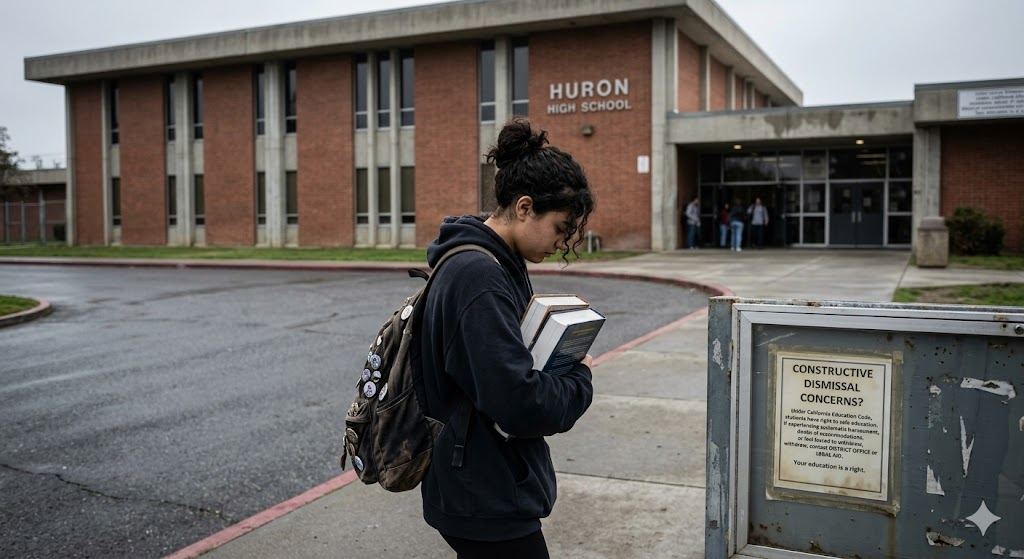
Constructive dismissal (also called constructive expulsion or forced withdrawal) occurs when California schools create conditions so intolerable that reasonable student has no choice but to withdraw—achieving expulsion without providing due process protections required for formal expulsion under Education Code §§ 48915-48926—manifesting through: systematic harassment by staff/students school refuses to address, denial of necessary accommodations making education inaccessible, retaliatory hostile environment after parent complaints, schedule manipulations eliminating required courses, constant suspensions consuming excessive school days, refusing safety measures despite known threats, or telling parents “it would be better if student transferred”—violating students’ property interest in public education under California Constitution Article IX § 5, Education Code § 48200 compulsory attendance rights, due process protections requiring notice and hearing before involuntary separation (Goss v. Lopez), IDEA stay-put protections preventing removal during disputes, and Title IX obligations to ensure harassment doesn’t deny educational access.
Core Thesis
Districts weaponize constructive dismissal to eliminate “problem students” without formal expulsion proceedings—rather than providing due process hearing under Education Code §§ 48915-48926 where parents can challenge expulsion recommendation, districts make school environment so hostile, unsafe, or inaccessible that family has no choice but to withdraw student, achieving expulsion’s goal (student removal) while avoiding expulsion’s requirements (notice, hearing, appeal rights, educational services during removal). We convert trauma into code by documenting pattern of intolerable conditions (every harassment incident school ignored, every accommodation denied, every retaliatory action after complaints, every safety failure), demanding school remedy conditions immediately rather than suggesting withdrawal, refusing to voluntarily withdraw despite pressure, and filing complaints establishing constructive dismissal violates due process, IDEA stay-put, Title IX access obligations—forcing districts to either improve conditions or expel formally with full protections. Selective enforcement IS discrimination when districts constructively dismiss students of color through tolerance of racial harassment while aggressively addressing harassment of white students—proving constructive dismissal weapon applied selectively.
Case Pattern Story
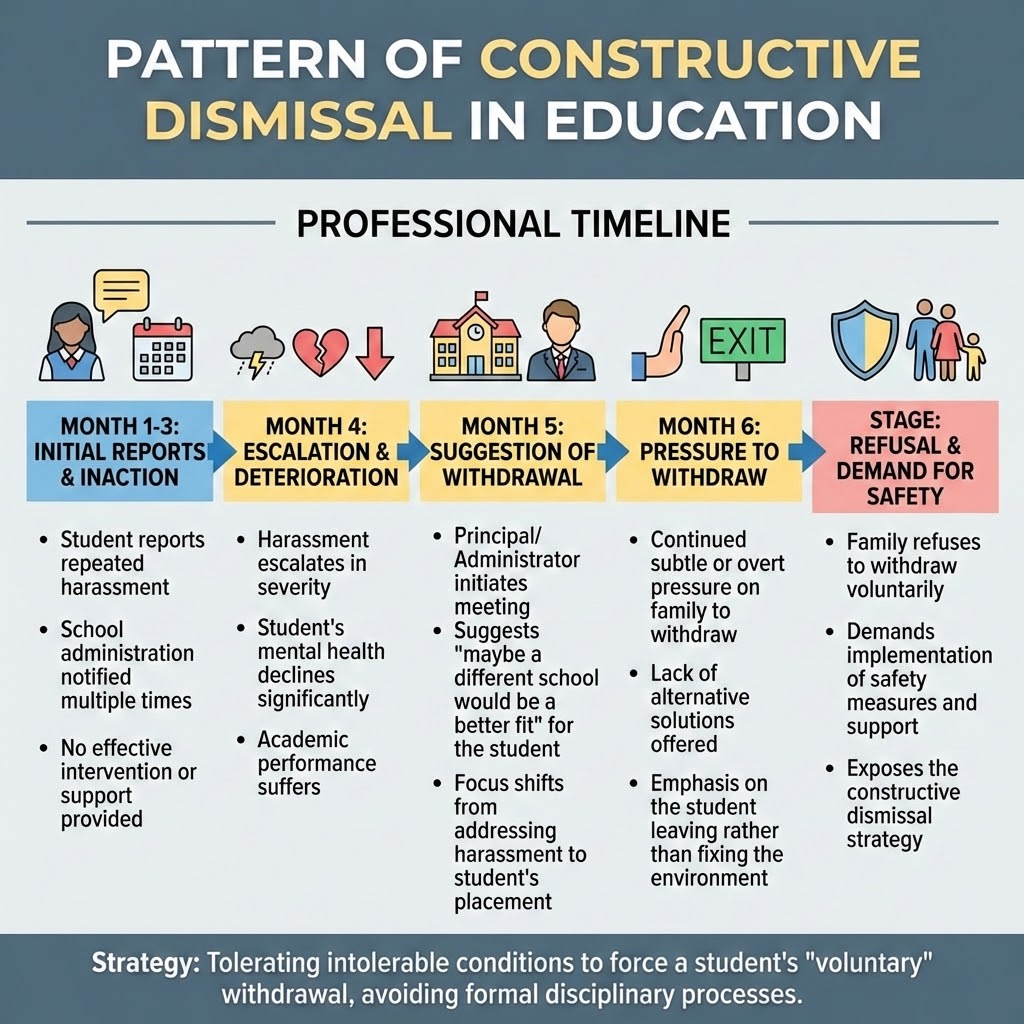
Student with autism in San Diego experiences severe bullying. Mother reports repeatedly—principal takes no action. Bullying escalates to physical assaults. Student becomes suicidal, refuses to attend school.
Mother demands safety measures, anti-bullying interventions. Principal responds: “Have you considered that [school name] might not be the right fit for your son? Maybe he’d do better at [alternative school].”
Mother: “Are you expelling him?”
Principal: “No, just suggesting you might want to explore other options. We’re not equipped to handle his needs.”
Mother realizes this is constructive dismissal—school creating intolerable environment (tolerating harassment) then suggesting withdrawal as “solution” rather than addressing harassment or formally expelling with due process protections.
Attorney sends demand: “You’re attempting constructive dismissal—creating intolerable conditions through failure to address harassment, then pressuring family to withdraw rather than providing safe environment or formally expelling with Education Code § 48915 protections. This violates: (1) Due process—circumventing required notice/hearing, (2) IDEA stay-put—cannot force removal during dispute, (3) Title IX—harassment denying educational access. Immediately: (1) Implement safety measures, (2) Address harassment, (3) Stop suggesting withdrawal. We will not voluntarily withdraw. If you believe expulsion warranted, provide formal due process. Otherwise, make school safe.”
District realizes constructive dismissal exposure. Implements: comprehensive safety plan, bullying interventions, consequences for harassers, staff training. Student remains enrolled with supports. Settlement includes damages for constructive dismissal attempt, monitoring, policy prohibiting suggesting withdrawal as alternative to addressing conditions.
SANI Connection
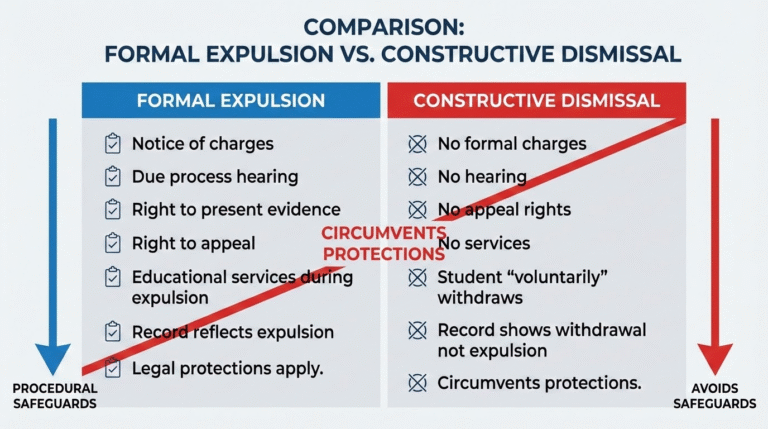
SANI identifies constructive dismissal as expulsion without accountability—districts achieve same result as formal expulsion (student removal) while avoiding:
Expulsion’s requirements: Notice of specific charges, due process hearing where parents challenge recommendation, right to present evidence/witnesses, right to appeal to county board, provision of educational services during expulsion
Expulsion’s record: Formal expulsion appears on transcripts, withdrawal appears “voluntary”
Expulsion’s scrutiny: Formal expulsions tracked by state, reported publicly, subject to disproportionality analysis—constructive dismissals invisible
Districts’ strategy: Make conditions so intolerable student cannot remain, suggest “other schools might be better fit,” pressure withdrawal—achieving removal without due process burden.
SANI’s counter-strategy: Refuse to withdraw voluntarily.
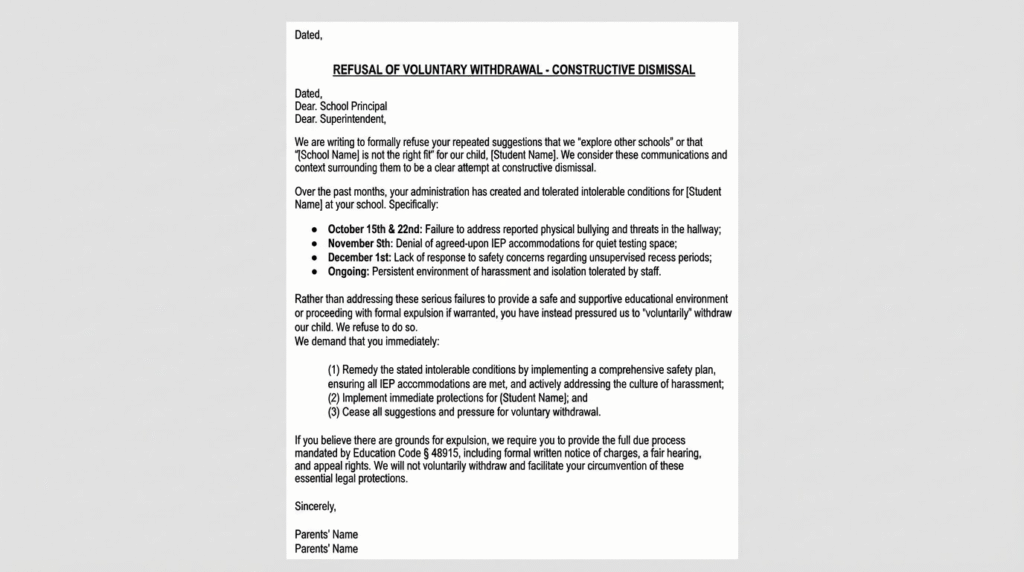
When school suggests withdrawal, respond: “You’re attempting constructive dismissal—creating intolerable conditions then pressuring withdrawal rather than addressing conditions or formally expelling with due process protections. We refuse voluntary withdrawal. Two options: (1) Make school safe/accessible immediately, or (2) If you believe expulsion warranted, provide formal Education Code § 48915 due process including notice, hearing, appeal rights. We will not facilitate your circumvention of legal protections.”
Document every intolerable condition:
- Harassment incidents school ignored
- Accommodations denied
- Retaliatory actions after complaints
- Safety failures despite repeated reports
- Statements suggesting withdrawal
- Schedule manipulations
- Excessive suspensions
File complaints establishing constructive dismissal violates:
- Due process (circumventing required procedures)
- IDEA stay-put (forcing removal during dispute)
- Title IX (harassment denying access)
- Section 504 (disability discrimination through inaccessibility)
Discipline Explanation
What Constitutes Constructive Dismissal
Legal principle: When conditions become so intolerable that reasonable person has no choice but to leave, involuntary separation occurred even though formally characterized as “voluntary.”
Employment context origin: Constructive discharge in employment law—employer creates hostile work environment forcing resignation, courts treat as termination requiring same protections.
School context application: School creates conditions forcing student withdrawal, courts may treat as expulsion requiring Education Code due process protections.
Conditions creating constructive dismissal:
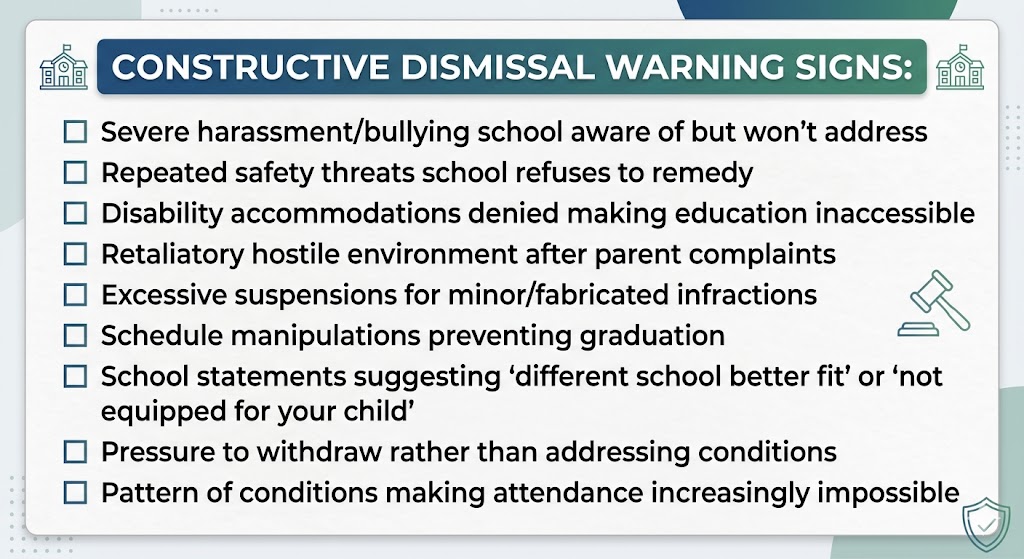
Systematic harassment school refuses to address – Student subjected to severe bullying, racial harassment, sexual harassment; school aware through repeated reports but takes no action; harassment makes attendance impossible
Denial of disability accommodations – Student with IEP/504 needs accommodations to access education; school refuses to provide; inaccessibility forces withdrawal
Retaliatory hostile environment – After parent complaints, school creates hostile environment through staff treatment, peer targeting with staff complicity, making continued attendance untenable
Safety failures – Student threatened, school aware of threats but refuses protective measures; reasonable parent cannot send child to unsafe environment
Schedule manipulation – School schedules student in courses without required prerequisites, impossible combinations, preventing graduation progress
Excessive suspensions – Pattern of suspensions for minor/fabricated infractions consuming excessive days, effectively denying education
Direct pressure to withdraw – Principal/staff statements: “maybe different school better fit,” “we’re not equipped for your child,” “have you considered alternatives”
Due Process Rights Being Circumvented
Education Code §§ 48915-48926 establishes expulsion procedures:
Notice: Written notice of specific charges, proposed expulsion
Hearing: Right to hearing before governing board or administrative panel
Representation: Right to be represented by counsel
Evidence: Right to present evidence, examine witnesses
Findings: Written findings and decision
Appeal: Right to appeal to county board of education
Services: Educational services during expulsion period
Constructive dismissal circumvents all of these—student withdraws “voluntarily” so school provides none of these protections.
IDEA Stay-Put Protections
20 USC § 1415(j), 34 CFR § 300.518: During pendency of any dispute regarding child’s placement, child shall remain in current educational placement (“stay-put”).
Applies to: IEP disputes, due process complaints, manifestation determination reviews
Violation: School cannot force removal (including through constructive dismissal creating intolerable conditions) during IDEA dispute—student must remain in placement during proceedings.
When school creates intolerable conditions during IDEA dispute: Constructive dismissal violates stay-put by forcing removal school cannot achieve through proper procedures.
Title IX Educational Access Obligations
Title IX 34 CFR § 106.31: No person shall be excluded from participation in, denied benefits of, or subjected to discrimination in any education program.
Application: When harassment becomes so severe school environment is hostile denying educational access, Title IX violated.
Constructive dismissal through harassment: School’s deliberate indifference to harassment creating hostile environment forces withdrawal—achieves prohibited “exclusion from participation” without formally excluding.
California Constitutional Right to Education
California Constitution Article IX § 5: Legislature shall provide free public schools.
Education Code § 48200: Students ages 6-18 entitled to attend public schools.
Property interest: Students have property interest in continued enrollment—cannot be deprived without due process.
Constructive dismissal: Forcing withdrawal through intolerable conditions deprives of property interest without providing required process.
Proving Constructive Dismissal
Elements:
- Intolerable Conditions:Objective standard—would reasonable student in same circumstances be unable to continue attending?
- School’s Knowledge:School aware of conditions (through reports, complaints, observations)
- School’s Failure to Remedy:Despite knowledge, school failed to adequately address conditions
- Causal Connection:Intolerable conditions caused withdrawal—student would have continued attending if conditions remedied
- No Voluntary Choice:Withdrawal not freely chosen—forced by circumstances school created/tolerated
Evidence:
- Documentation of every incident creating intolerable conditions with dates
- Repeated complaints to school about conditions with school’s inadequate responses
- Medical/psychological evidence of harm from conditions
- Statements from school suggesting withdrawal
- Proof student wanted to remain but conditions made it impossible
- Comparative evidence (how school addressed similar situations for other students)
Refusing Voluntary Withdrawal
When school suggests withdrawal:
Do NOT agree to “voluntary” withdrawal—this waives due process rights.
Response: “You’re attempting constructive dismissal. We refuse voluntary withdrawal. Two options: (1) Immediately remedy intolerable conditions [specify what must change], or (2) If you believe expulsion warranted, provide formal Education Code § 48915 due process including notice, hearing, appeal rights. We will not facilitate circumvention of legal protections by voluntarily withdrawing.”
Effect: Forces school to either fix conditions or formally expel with full protections—cannot achieve removal through pressure.
Legal Claims for Constructive Dismissal
Due Process Violation (42 USC § 1983): Deprived property interest (continued enrollment) without required process by creating intolerable conditions forcing withdrawal instead of providing expulsion due process.
IDEA Stay-Put Violation: If constructive dismissal occurred during IDEA dispute, forced removal violated stay-put requirement student remain in placement.
Title IX Violation: If constructive dismissal achieved through deliberate indifference to harassment, excluded from educational participation in violation of Title IX.
Section 504 Violation: If constructive dismissal resulted from denial of disability accommodations, disability discrimination.
State Law Claims: Violation of California constitutional right to education, Education Code § 48200 enrollment rights.
Named Framework: The Constructive Dismissal Prevention and Challenge Protocol
Step 1: Document Every Intolerable Condition and Inadequate School Response
Create detailed log: Date/description of each harassment incident, safety threat, accommodation denial, retaliatory action, or other intolerable condition. For each incident, document: (1) How you reported to school (date, person, method), (2) School’s response or lack thereof, (3) Why response was inadequate, (4) Ongoing harm from unaddressed condition. This establishes pattern: intolerable conditions + school knowledge + school failure to remedy = constructive dismissal if withdrawal forced.
Step 2: When School Suggests Withdrawal, Immediately Refuse and Call It Constructive Dismissal
If principal/staff says “maybe different school better fit,” “we’re not equipped,” “have you considered alternatives”—respond in writing within 24 hours: “Your suggestion is constructive dismissal attempt. You’ve created intolerable conditions [list key examples], then suggested withdrawal rather than addressing conditions. We refuse voluntary withdrawal. You must: (1) Immediately remedy conditions, (2) Implement safety/accommodation measures, (3) Stop suggesting withdrawal. If you believe expulsion warranted, provide Education Code § 48915 due process. We will not voluntarily withdraw facilitating your circumvention of protections.”
Step 3: Demand Immediate Remedies—Force School to Fix Conditions or Formally Expel
Don’t accept vague promises. Demand specific actions with deadlines: “Within 5 days: (1) Implement safety plan separating student from harassers, (2) Discipline staff/students creating hostile environment, (3) Provide denied accommodations, (4) Written confirmation of actions taken. Within 10 days: (5) Training for staff on harassment response, (6) Schedule corrections ensuring graduation progress. If you cannot remedy conditions, provide formal expulsion notice with Education Code due process rights. Continued tolerance of intolerable conditions while pressuring withdrawal violates due process, IDEA stay-put, Title IX.”
Step 4: File Complaints Establishing Constructive Dismissal Violates Multiple Legal Protections
Immediately file: (1) OCR complaint: “School created intolerable conditions through deliberate indifference to harassment, then pressured withdrawal—constructive dismissal violating Title IX educational access.” (2) Due process complaint if IDEA student: “School attempting forced removal during IEP dispute violating stay-put, creating inaccessible environment violating FAPE.” (3) State complaint: “Constructive dismissal circumventing Education Code expulsion protections violating due process.” Multiple complaints create enforcement pressure preventing withdrawal pressure.
Step 5: If Withdrawal Occurs Despite Refusal, File Lawsuit Treating as Involuntary Expulsion
If conditions became so intolerable withdrawal occurred despite your refusal: file federal lawsuit treating as expulsion without due process. “School constructively dismissed student through: [intolerable conditions]. Despite our refusal to voluntarily withdraw, conditions made attendance impossible—achieving expulsion without providing Education Code due process. Violated: 42 USC § 1983 (due process), Title IX (harassment denying access), IDEA stay-put (forced removal during dispute), Section 504 (disability discrimination). Seek: (1) Compensatory education for lost educational time, (2) Damages, (3) Injunctive relief requiring readmission with appropriate supports, (4) Attorney fees.”
Action Steps
1. Immediately Document All Intolerable Conditions and School’s Inadequate Responses
Create comprehensive log: Every harassment incident, safety failure, accommodation denial, retaliatory action—with dates, details, witnesses. For each, document: how you reported to school (date, person contacted, method—email/meeting), school’s response or non-response, why response inadequate (no investigation, no consequences, no protective measures), ongoing harm. Pattern establishes: school created/tolerated intolerable conditions with knowledge, making continued attendance impossible—foundation for constructive dismissal claim.
2. If School Suggests Withdrawal, Refuse Immediately in Writing and Label as Constructive Dismissal
When principal says “maybe different school better fit” or “we’re not equipped” or “have you considered alternatives”—within 24 hours send: “Your suggestion we withdraw is constructive dismissal attempt. You’ve created intolerable conditions: [list harassment/safety failures/accommodation denials], then suggested withdrawal rather than addressing. We refuse voluntary withdrawal. Immediately: (1) Remedy conditions [specific actions needed], (2) Stop suggesting withdrawal. If you believe expulsion warranted, provide Education Code § 48915 due process: notice, hearing, appeal. We won’t voluntarily withdraw facilitating circumvention of protections.”
3. Demand Specific Remedies With Deadlines—Force School to Fix or Formally Expel
Don’t accept “we’re working on it.” Demand concrete actions with timelines: “Within 5 days: (1) Safety plan separating from harassers, (2) Discipline for staff/students creating hostile environment, (3) Denied accommodations implemented, (4) Written confirmation. Within 10 days: (5) Anti-harassment training, (6) Schedule corrections. If you cannot remedy conditions making school accessible/safe, provide formal expulsion notice with Education Code § 48915 due process. Continued intolerable conditions + withdrawal pressure = constructive dismissal violating due process, IDEA stay-put, Title IX.”
4. File Multiple Complaints Establishing Constructive Dismissal as Legal Violation
Immediately file: OCR complaint—”School’s deliberate indifference to harassment created hostile environment, then pressured withdrawal—constructive dismissal violating Title IX educational access denial.” Due process complaint (if IDEA)—”Forced removal during IEP dispute violates stay-put, inaccessible environment violates FAPE.” State complaint—”Constructive dismissal circumventing Education Code expulsion protections violates due process, right to education.” District Attorney if applicable—”School coercing withdrawal to avoid accountability for harassment/discrimination.” Multiple enforcement avenues prevent withdrawal pressure.
5. If Forced to Withdraw, File Lawsuit Treating as Involuntary Expulsion Without Due Process
If conditions became impossible despite your refusal to voluntarily withdraw: file federal civil rights lawsuit. “School constructively dismissed student by creating/tolerating intolerable conditions: [specify harassment/safety failures/accommodation denials], forcing withdrawal despite our documented refusal. This achieved expulsion without Education Code § 48915 due process protections. Violated: 42 USC § 1983 (due process—deprived property interest without required procedure), Title IX (harassment denying educational access), IDEA stay-put (forced removal during dispute), Section 504 (disability discrimination). Seek: compensatory education, damages, readmission with supports, injunctive relief, attorney fees.”
FAQs
1. What is constructive dismissal and how is it different from formal expulsion?
Constructive dismissal occurs when a school creates or allows conditions that make it unreasonable for a student to continue attending, effectively forcing withdrawal. Unlike formal expulsion, which requires specific due process protections (such as notice, a hearing, and the opportunity to respond), constructive dismissal may occur without those safeguards. The distinction matters because expulsion procedures are regulated, while a “voluntary” withdrawal under pressure may bypass those protections.
2. Can schools pressure families to withdraw instead of addressing harassment or safety concerns?
Schools are generally expected to address safety concerns and ensure students can access education. If a student is experiencing ongoing issues such as harassment or unmet support needs, the school should take appropriate steps to respond. Suggesting withdrawal instead of addressing those concerns may raise serious legal and compliance issues, particularly where civil rights or disability laws apply.
3. What should I do if a school suggests a “different placement” or that another school might be a better fit?
It is important to respond in writing and ask for clarification about the reasons for the suggestion. You can request that the school first address the underlying issues affecting your child’s ability to attend safely and successfully. Maintaining clear documentation of communications helps establish a record of your concerns and the school’s response.
4. Can a withdrawal still raise legal concerns if it was technically “voluntary”?
In some situations, a withdrawal may be questioned if it occurred under pressure or in response to unresolved conditions that the school was responsible for addressing. Whether a situation qualifies as constructive dismissal can depend on the specific facts, including the school’s actions, the conditions experienced by the student, and the availability of alternatives.
5. How can I document concerns if I believe my child is being pushed out?
Keep detailed records of incidents, communications, and any steps you take to raise concerns with the school. This may include emails, meeting notes, incident reports, and any supporting documentation such as medical or counseling records. Clear documentation can help show patterns, establish timelines, and support further review by appropriate authorities if needed.
Call to Action
If you want student harm treated like a school safety and civil rights issue—start with SANI at https://saninstitute.net
Sources
-
New Jersey v. T.L.O., 469 U.S. 325 (1985) – U.S. Supreme Court decision establishing
the “reasonable suspicion” standard for school searches, requiring that searches be justified at
their inception and reasonably related in scope to the circumstances.
https://supreme.justia.com/cases/federal/us/469/325/ -
Riley v. California, 573 U.S. 373 (2014) – U.S. Supreme Court decision recognizing
heightened privacy protections for cell phones due to the extensive personal data they contain,
emphasizing the need for carefully limited searches.
https://supreme.justia.com/cases/federal/us/573/373/ -
Safford Unified School District v. Redding, 557 U.S. 364 (2009) – U.S. Supreme Court
ruling addressing the limits of highly intrusive school searches, emphasizing that more invasive
searches require stronger justification and careful consideration of student rights.
https://supreme.justia.com/cases/federal/us/557/364/ -
California Education Code § 49050 – Provides protections for student privacy and
requires that searches of students be conducted with respect for their rights, privacy, and dignity.
https://leginfo.legislature.ca.gov/faces/codes_displaySection.xhtml?lawCode=EDC§ionNum=49050 -
42 U.S.C. § 1983 – Federal civil rights statute allowing individuals to seek remedies
when constitutional rights, including Fourth Amendment protections against unreasonable searches,
are violated by government actors such as school officials.
https://www.law.cornell.edu/uscode/text/42/1983