
Table of Contents
Click to Expand
1. Audio
2. Definition
3. Video
4. Core Thesis
9. Action Steps
10. FAQs
11. Call to Action
12. Sources
13. Signature
Definition
School search authority allows California schools to search students’ persons, belongings, phones, and lockers under Fourth Amendment “reasonable suspicion” standard—lower than “probable cause” required for police searches—but violations occur when schools conduct searches without individualized suspicion (random searches, blanket policies), search based solely on anonymous tips without corroboration, exceed scope justified by initial suspicion (searching entire phone when suspecting single text), or use searches as fishing expeditions hoping to find violations rather than investigating specific suspected infractions, with protections established by New Jersey v. T.L.O. requiring searches be “reasonable at inception” (justified suspicion of specific violation) and “reasonable in scope” (methods/extent reasonably related to suspected violation), California Education Code § 49050 protecting student privacy rights, and Riley v. California establishing heightened protections for cell phone searches requiring particularized suspicion and narrow scope.
Core Thesis
Schools have limited authority to search students under Fourth Amendment’s “reasonable suspicion” standard—less stringent than police’s “probable cause” requirement but still requiring individualized suspicion of specific violation—meaning schools can search when facts create reasonable belief student violated law or school rule, but cannot conduct random searches, blanket sweeps, or fishing expeditions hoping to find violations. We convert trauma into code by documenting exactly what suspicion school claimed (who reported what, when, with what details), whether suspicion was individualized (targeted this specific student) or generalized (could apply to anyone), whether search scope exceeded what suspicion justified (searched entire phone when suspecting single text message), and challenging unconstitutional searches through suppression motions (excluding evidence from discipline proceedings) and civil rights litigation under 42 USC § 1983 establishing Fourth Amendment violations. Selective enforcement IS discrimination when schools search Black/Latino students based on vague suspicions (“looked suspicious,” “known to associate with wrong crowd”) while requiring concrete evidence before searching white students—proving search authority weaponized based on race.
Case Pattern Story
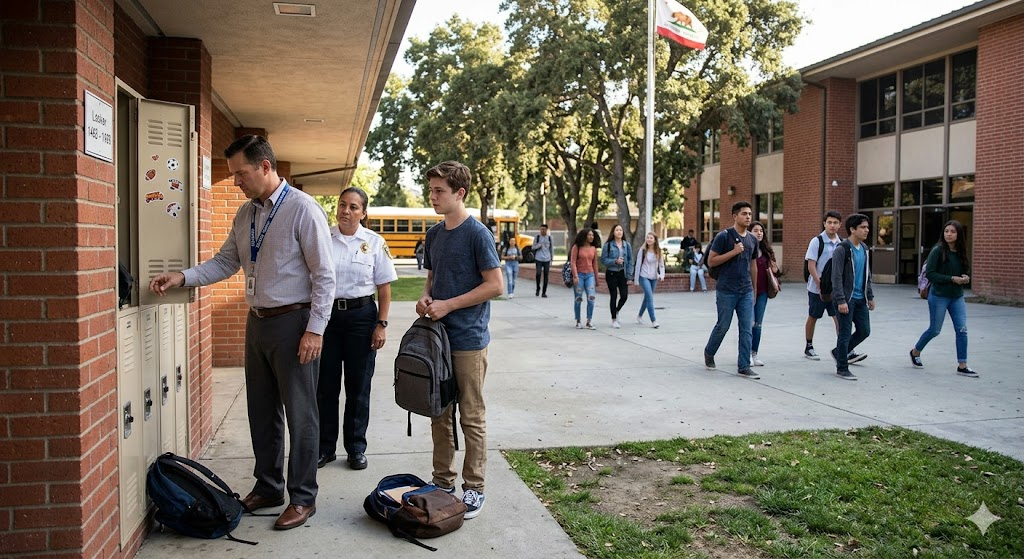
High school student in Los Angeles receives text during class. Teacher sees phone light up, suspects student texting during class (violation of school rule).
Teacher confiscates phone, takes to principal. Principal opens phone, scrolls through all text messages (not just recent text that violated rule), reads private conversations with friends, family, looks at photos, checks social media apps—discovers student discussing marijuana use in texts from two weeks prior.
Student suspended for drug discussion. Parent challenges: “Teacher suspected one text during class. Principal searched entire phone—hundreds of messages, photos, apps spanning months. This exceeded scope of initial suspicion violating Fourth Amendment.”
Attorney: “New Jersey v. T.L.O. requires searches be reasonable in scope—’permissible scope of search is defined by object of search and places student could reasonably have hidden contraband.’ Teacher suspected single recent text. Principal had no justification for searching weeks of messages, photos, social media. Riley v. California establishes cell phones contain vast private information requiring narrow searches. Principal’s comprehensive phone search was fishing expedition exceeding what initial texting-in-class suspicion justified—Fourth Amendment violation.”
Suppression motion: Evidence from unconstitutional search excluded from discipline proceedings. Suspension vacated. Civil settlement includes damages, policy requiring cell phone searches limited to specific suspected violation, training on Fourth Amendment scope limitations.
SANI Connection
SANI identifies school searches as constitutional flashpoint—schools have legitimate authority to maintain safe orderly environment requiring some search power, but Fourth Amendment prevents unlimited search authority, creating tension where schools often exceed constitutional limits claiming “student safety” while conducting fishing expeditions hoping to find any violation.
Critical distinctions SANI teaches:
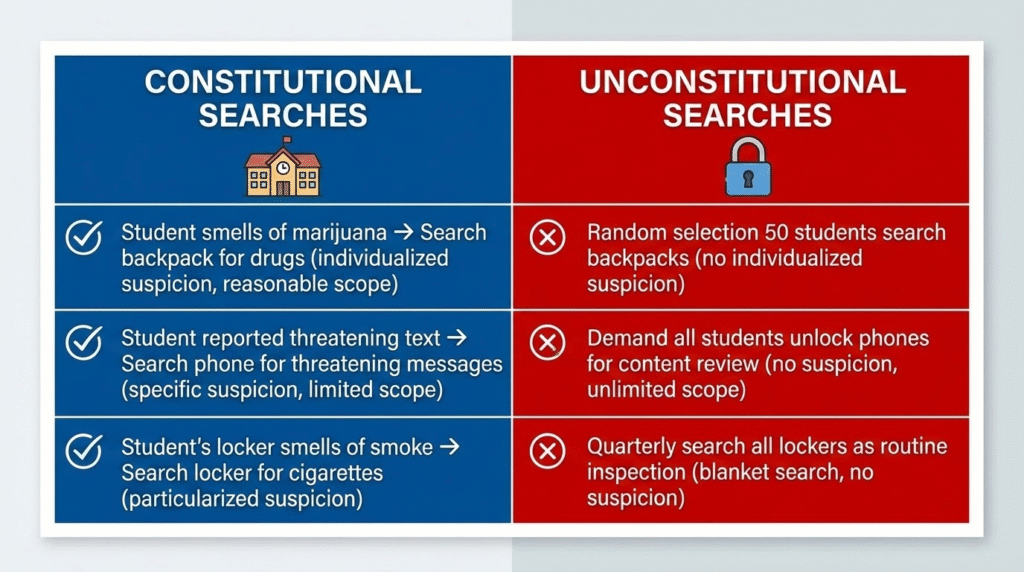
LEGAL: Student smells of marijuana, school searches backpack for drugs (individualized suspicion, reasonable scope)
ILLEGAL: School randomly searches 50 students’ backpacks hoping to find contraband (no individualized suspicion)
LEGAL: Student reported threatening classmate via text, school searches phone for threatening messages (specific suspicion, limited scope)
ILLEGAL: School demands all students unlock phones for administrator review of content (no individualized suspicion, unlimited scope)
LEGAL: Student’s locker smells of smoke, school searches locker for cigarettes/vaping device (particularized suspicion, reasonable scope)
ILLEGAL: School searches all lockers quarterly as “routine inspection” (no suspicion, blanket search)
SANI’s challenge framework when unconstitutional search occurs:
Step 1: Document what school claimed justified search (exact facts, who reported, when)
Step 2: Analyze whether suspicion was individualized or generalized
Step 3: Assess whether search scope matched suspicion (if suspected single text, why search entire phone?)
Step 4: File suppression motion excluding unconstitutionally-obtained evidence from discipline
Step 5: File § 1983 civil rights lawsuit for Fourth Amendment violation
Discipline Explanation
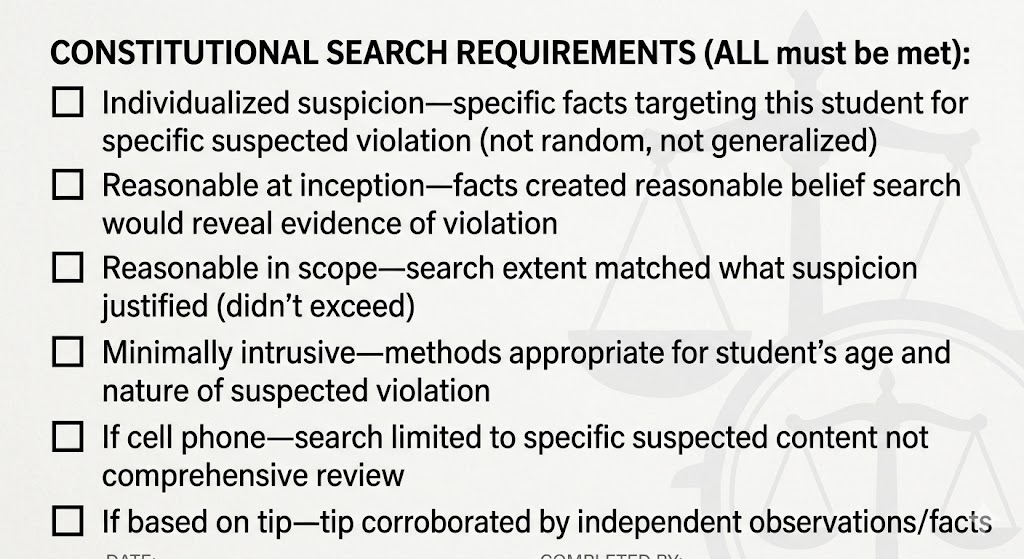
Fourth Amendment “Reasonable Suspicion” Standard for School Searches
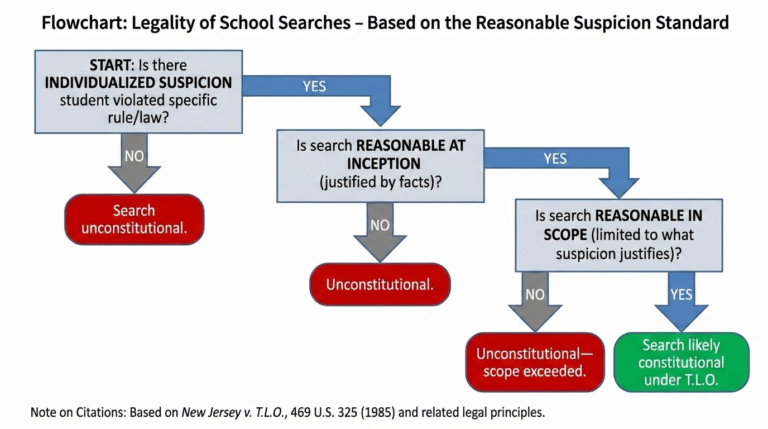
New Jersey v. T.L.O., 469 U.S. 325 (1985): U.S. Supreme Court established that school searches require “reasonable suspicion” not “probable cause.”
Two-part test:
- Reasonable at Inception:Search justified when there are reasonable grounds for suspecting search will reveal evidence student violated law or school rule
- Reasonable in Scope:Search reasonably related in scope to circumstances justifying interference, not excessively intrusive considering age/sex of student and nature of infraction
“Reasonable suspicion” means: Specific facts creating reasonable belief this particular student violated specific rule—not generalized suspicion, hunch, or anonymous tip without corroboration.
What Schools CAN Search (With Reasonable Suspicion)
Backpacks/Bags: When individualized suspicion student possesses contraband or evidence of rule violation
Lockers: When specific facts suggest this student’s locker contains contraband (note: some courts hold students have reduced privacy expectation in school-owned lockers)
Clothing/Pockets: When particularized suspicion student hiding contraband on person (must be minimally intrusive)
Cell Phones: When specific suspicion student used phone to violate rule AND search limited to evidence of that specific violation
Vehicles on Campus: When reasonable suspicion student’s vehicle contains contraband
What Schools CANNOT Do
Random Searches: Selecting students arbitrarily for searches without any individualized suspicion violates Fourth Amendment
Blanket Searches: Searching all students in class/school as “routine inspection” without particularized suspicion
Fishing Expeditions: Searching hoping to find some violation when no specific suspicion exists
Excessive Scope: Searching far beyond what initial suspicion justified (e.g., searching entire phone for weeks of content when suspected single recent text)
Strip Searches: Safford Unified School District v. Redding, 557 U.S. 364 (2009) established strip searches require extremely high suspicion and limited circumstances (dangerous contraband reasonably believed hidden in undergarments)
Cell Phone Searches: Heightened Protections
Riley v. California, 573 U.S. 373 (2014): U.S. Supreme Court (police context) established cell phones contain vast repositories of private information requiring heightened protection.
Application to schools: While Riley addressed police searches, principles apply—cell phones contain exponentially more private information than physical containers (backpack, locker), requiring:
Particularized Suspicion: Specific facts student used phone for suspected violation (not generalized suspicion student might have violating content)
Narrow Scope: Search limited to specific suspected violation (if suspect threatening text, search texts not photos/social media/emails/browsing history)
Time Limitation: Search recent content related to suspected violation, not comprehensive review of all historical content
Example: Student reported sexting. School has reasonable suspicion justifying phone search. BUT scope must be limited: search recent messages with specific person, not all messages, photos, social media, emails spanning months. Comprehensive phone searches are unconstitutional fishing expeditions.
California Education Code § 49050: Student Privacy Rights
California statute protects student privacy including personal belongings and information.
Requires: Searches be conducted with due regard for students’ privacy rights and dignity.
Prohibits: Unreasonable invasions of privacy through overly intrusive searches.
Anonymous Tips Insufficient Alone
Anonymous tip (“someone said Student X has drugs”) insufficient alone to justify search—requires corroboration through:
Independent observations (student appears intoxicated, smells of marijuana)
Credible source details (tipster provides specific verifiable facts proving reliability)
Reliability indicators (tip includes details only someone with knowledge would know)
Without corroboration: Anonymous tip alone is generalized suspicion insufficient under T.L.O.
Locker Searches: Reduced Expectation of Privacy
Some courts hold students have reduced privacy expectation in school-owned lockers—schools may search lockers more readily than personal belongings.
However: Still requires some level of suspicion—cannot search all lockers randomly as “routine inspection” without any suspicion.
Best practice: Even for lockers, individualized suspicion of specific violation preferred.
Challenging Unconstitutional Searches
Suppression Motion (Discipline Context):
When unconstitutional search produces evidence, file motion to exclude evidence from discipline proceedings: “Search violated Fourth Amendment (no individualized suspicion / exceeded scope / fishing expedition). Evidence obtained through unconstitutional search cannot be used for discipline under exclusionary rule. Request evidence suppression and discipline dismissal.”
Not all states/districts apply exclusionary rule in school discipline context, but worth asserting constitutional violation.
Civil Rights Lawsuit (42 USC § 1983):
File federal civil rights lawsuit: “School official conducted unconstitutional search violating Fourth Amendment (no reasonable suspicion / exceeded scope). Under 42 USC § 1983, plaintiff seeks damages for Fourth Amendment violation, injunctive relief prohibiting unconstitutional searches, attorney fees.”
Qualified immunity may apply unless clearly established law prohibited specific search method, but arguing can still establish violation and policy change.
Demanding Search Documentation
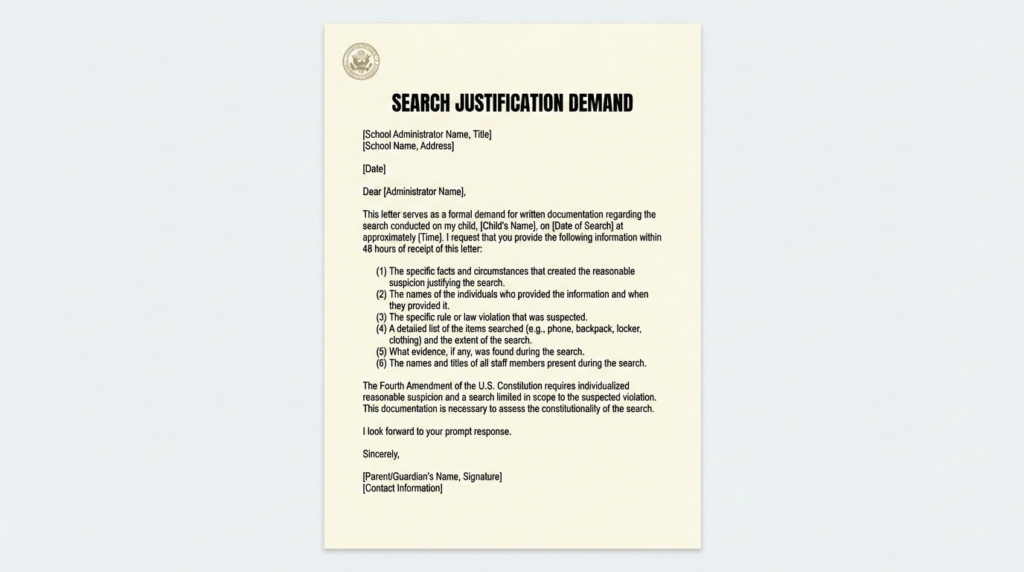
After any search, demand written documentation:
“Provide within 48 hours: (1) What specific facts/suspicion justified searching my child, (2) Who reported information creating suspicion and when, (3) What rule/law violation was suspected, (4) What items school searched and why, (5) What evidence was found, (6) Names of all staff present during search.”
This creates record for challenging search constitutionality.
Named Framework: The School Search Challenge and Fourth Amendment Protection Protocol
Step 1: Immediately After Search, Demand Written Documentation of Justification
Within 24 hours of learning school searched your child: “Provide within 48 hours: (1) Specific facts creating reasonable suspicion justifying search of my child, (2) Who provided information creating suspicion and when, (3) What law/rule violation was suspected, (4) What items searched (phone, backpack, locker, clothing), (5) Extent/scope of search (if phone, what content accessed—texts, photos, social media, how far back), (6) What evidence found, (7) Staff present. Fourth Amendment requires individualized suspicion and reasonable scope—need documentation to assess constitutionality.”
Step 2: Analyze Whether Suspicion Was Individualized and Whether Scope Was Reasonable
Review documentation: Was there individualized suspicion targeting this specific student for specific suspected violation (constitutional), or generalized suspicion that could apply to anyone (unconstitutional)? If individualized suspicion existed, did search scope match what suspicion justified? Example: suspected single text during class doesn’t justify searching entire phone including weeks-old messages, photos, social media. If search exceeded what initial suspicion permitted—scope violation under T.L.O. even if inception was reasonable.
Step 3: File Suppression Motion Excluding Evidence From Unconstitutional Search
If search violated Fourth Amendment (no individualized suspicion, exceeded reasonable scope, fishing expedition): File motion in discipline proceedings: “Search violated Fourth Amendment under New Jersey v. T.L.O. [no individualized suspicion / exceeded reasonable scope / was fishing expedition]. Evidence obtained through unconstitutional search cannot be used for discipline. Under exclusionary rule, request: (1) Evidence suppression, (2) Discipline dismissal based on unconstitutionally-obtained evidence, (3) Expungement of references to search results from records.” Even if exclusionary rule doesn’t apply in discipline context, assert constitutional violation on record.
Step 4: File 42 USC § 1983 Civil Rights Lawsuit for Fourth Amendment Violation
Simultaneously file federal civil rights lawsuit: “School official [name] conducted unconstitutional search of student violating Fourth Amendment. Search lacked individualized reasonable suspicion [or] exceeded reasonable scope justified by initial suspicion [or] was fishing expedition hoping to find violations. Under T.L.O., Riley, and California Ed Code § 49050, search violated clearly established constitutional rights. Under 42 USC § 1983, plaintiff seeks: (1) Compensatory damages for constitutional violation, (2) Punitive damages if search was knowing/reckless violation, (3) Injunctive relief prohibiting similar unconstitutional searches, (4) Attorney fees.”
Step 5: Demand Policy Changes Requiring Individualized Suspicion and Scope Limitations
In settlement/resolution: “District must implement policy: (1) All searches require written documentation of individualized suspicion justifying search before conducted, (2) Cell phone searches limited in scope to specific suspected violation—cannot search entire phone contents, (3) No random or blanket searches without particularized suspicion, (4) Training for all staff on Fourth Amendment T.L.O. requirements, (5) Discipline for staff conducting unconstitutional searches, (6) Quarterly reporting to board on searches conducted with constitutional compliance review.” Policy changes prevent future violations.
Action Steps
1. Immediately After Search, Send Written Demand for Search Justification Documentation
Within 24 hours of learning school searched child’s phone, backpack, locker, or person: “You searched my child [date, time, location]. Provide written documentation within 48 hours: (1) Specific facts creating reasonable suspicion justifying search, (2) Source of information (who reported, when, what exactly they said), (3) Suspected law/rule violation, (4) Items searched and extent (if phone—what apps/content accessed, how far back), (5) Evidence found, (6) Staff present. Fourth Amendment requires individualized suspicion and scope reasonably related to suspected violation per New Jersey v. T.L.O. Need this to assess search constitutionality.”
2. Analyze Search Documentation to Identify Constitutional Violations
Review school’s justification: Individualized suspicion? Did specific facts target this student for specific suspected violation, or was it random/generalized (“we search all students periodically” or “looked suspicious”)? Reasonable scope? If suspected one recent text during class, did principal search only recent texts or entire phone including weeks-old messages, photos, social media? If no individualized suspicion OR scope exceeded what suspicion justified—Fourth Amendment violation. Document: “Search unconstitutional because [no individualized suspicion / exceeded reasonable scope / fishing expedition].”
3. File Suppression Motion to Exclude Evidence From Unconstitutional Search
If search violated Fourth Amendment, file motion in discipline proceedings: “Search violated Fourth Amendment under T.L.O. [specify: no individualized suspicion documented / exceeded reasonable scope by searching far beyond what initial suspicion justified / was fishing expedition without particularized suspicion]. Evidence obtained through unconstitutional search cannot be used for discipline under exclusionary rule. Request: (1) Suppress all evidence from search, (2) Dismiss discipline based on unconstitutionally-obtained evidence, (3) Expunge search references from student records.” Assert violation even if exclusionary rule application uncertain—creates record.
4. File 42 USC § 1983 Federal Civil Rights Lawsuit for Fourth Amendment Violation
File federal lawsuit: “School official [name] violated student’s Fourth Amendment rights by conducting unconstitutional search [date]. Search [lacked individualized reasonable suspicion / exceeded scope justified by initial suspicion / was fishing expedition]. Under New Jersey v. T.L.O. and Riley v. California (cell phones), search violated clearly established law. Plaintiff seeks under 42 USC § 1983: (1) Compensatory damages for constitutional violation and emotional distress, (2) Punitive damages if intentional/reckless violation, (3) Injunctive relief prohibiting unconstitutional search practices, (4) Attorney fees and costs.” Qualified immunity may be defense but worth pursuing.
5. Demand Comprehensive Search Policy Reform in Settlement/Resolution
In settlement negotiations: “District must adopt policy: (1) Pre-search documentation—before any search, administrator documents in writing individualized suspicion justifying search, (2) Scope limitations—cell phone searches limited to specific suspected violation content, cannot comprehensively review all phone contents, (3) No random/blanket searches—all searches require particularized suspicion of specific student, (4) Training—annual Fourth Amendment training for all staff on T.L.O. requirements, (5) Accountability—discipline for staff conducting unconstitutional searches, (6) Reporting—quarterly reports to board on searches with legal review.” Systemic reform prevents future violations.
FAQs
1. Can schools search my child's phone without parent permission or a warrant?
In many cases, schools may search student property, including phones, under the Fourth Amendment “reasonable suspicion” standard established in New Jersey v. T.L.O., which is lower than the “probable cause” standard used by law enforcement. However, the search must be justified at the start by specific facts suggesting a rule or law violation and must be reasonably limited in scope. Schools generally cannot conduct random searches or review all contents of a phone without a clear and specific reason tied to the suspected violation.
2. What makes a school search constitutional versus unconstitutional?
Courts generally apply a two-part test: (1) the search must be justified at its inception, meaning there is reasonable suspicion based on specific and individualized facts, and (2) the search must be reasonable in scope, meaning it is limited to what is necessary to address the suspected issue. Searches may raise concerns if they lack individualized suspicion, rely solely on vague or generalized information, or extend beyond what is reasonably related to the suspected violation.
3. Can schools conduct random locker or backpack searches as routine inspections?
Policies and practices vary, but constitutional concerns may arise when searches are conducted without individualized suspicion. While schools may have broader authority over school property such as lockers, searches of personal belongings like backpacks typically require a reasonable basis tied to a specific concern. Blanket or purely random searches may be subject to legal challenge depending on the circumstances and jurisdiction.
4. If a school finds something during a questionable search, can it be used for discipline?
This can depend on the jurisdiction and applicable school policies. In some cases, evidence obtained through an improper search may be challenged in disciplinary proceedings. Raising concerns about how the search was conducted can be important for protecting student rights and ensuring that procedures are followed appropriately.
5. What should I do after learning the school searched my child?
It is helpful to document what occurred as soon as possible. You may request written details from the school, including the reason for the search, what was searched, and who was involved. Speaking with your child to understand their experience can also provide important context. If concerns remain, you may consider seeking guidance from school administrators, district officials, or legal counsel to better understand your options.
Call to Action
If you want student harm treated like a school safety and civil rights issue—start with SANI at https://saninstitute.net
Sources
-
New Jersey v. T.L.O., 469 U.S. 325 (1985) – U.S. Supreme Court decision establishing
the “reasonable suspicion” standard for school searches, requiring that searches be justified at
their inception and reasonably related in scope to the circumstances.
https://supreme.justia.com/cases/federal/us/469/325/ -
Riley v. California, 573 U.S. 373 (2014) – U.S. Supreme Court decision recognizing
heightened privacy protections for cell phones due to the extensive personal data they contain,
emphasizing the need for carefully limited searches.
https://supreme.justia.com/cases/federal/us/573/373/ -
Safford Unified School District v. Redding, 557 U.S. 364 (2009) – U.S. Supreme Court
ruling addressing the limits of highly intrusive school searches, emphasizing that more invasive
searches require stronger justification and careful consideration of student rights.
https://supreme.justia.com/cases/federal/us/557/364/ -
California Education Code § 49050 – Provides protections for student privacy and
requires that searches of students be conducted with respect for their rights, privacy, and dignity.
https://leginfo.legislature.ca.gov/faces/codes_displaySection.xhtml?lawCode=EDC§ionNum=49050 -
42 U.S.C. § 1983 – Federal civil rights statute allowing individuals to seek remedies
when constitutional rights, including Fourth Amendment protections against unreasonable searches,
are violated by government actors such as school officials.
https://www.law.cornell.edu/uscode/text/42/1983