

Table of Contents
Click to Expand
1. Audio
2. Definition
3. Video
4. Core Thesis
9. Action Steps
10. FAQs
11. Call to Action
12. Sources
13. Signature
Definition
Parent exclusion occurs when California districts ban parents from campus, restrict communication, or prohibit contact with staff as retaliation for filing complaints or advocating for children—violating IDEA 20 USC § 1415(a) parental participation rights, Title IX/Section 504 anti-retaliation provisions (34 CFR § 106.71, § 104.61), California Education Code § 51101 parental rights, and First Amendment protections when exclusion based on protected speech (complaints about civil rights violations).
Core Thesis
Districts silence parents who challenge institutional failures through exclusion orders—parent files Title IX complaint, suddenly receives letter banning campus access, restricting emails to weekly summaries, prohibiting phone calls except scheduled appointments, eliminating ability to advocate effectively while district claims parent is “disruptive,” “threatening,” or “interfering with operations” without evidence, using exclusion as weapon to punish advocacy while chilling other families from speaking up. We convert trauma into code by documenting that exclusion occurred immediately after protected activity (complaint filing, advocacy), showing no legitimate safety/disruption basis (no threats made, communications were reasonable advocacy), establishing exclusion prevents IDEA-required parental participation, and filing retaliation complaints proving exclusion’s true purpose is silencing criticism not protecting safety. Selective enforcement IS discrimination when white parents can advocate aggressively without exclusion while parents of color face bans for identical or lesser advocacy—proving exclusion weapon applied selectively based on race.
Case Pattern Story
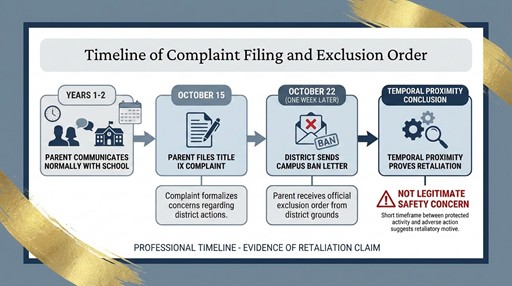
Mother in Oakland advocates for daughter with autism. Emails teachers requesting IEP implementation (3-4 emails weekly). Attends school events. Volunteers in classroom. Normal parent involvement for three years.
October 2023: Files due process complaint alleging IEP violations.
October 30 (two weeks later): Receives letter from superintendent:
“Due to your pattern of disruptive communication and aggressive behavior toward staff, you are:
- Banned from campus except scheduled IEP meetings
- Limited to one email per week (max 200 words) to designated contact only
- Prohibited from phone calls except pre-scheduled appointments
- Required to communicate through district liaison, not directly with teachers
Violation will result in trespassing charges.”
Mother shocked—no prior warnings, no incidents, no aggressive behavior. Her “disruptive communication” was advocating for IEP compliance.
Attorney challenges: “Exclusion order issued two weeks after parent filed due process complaint. No legitimate basis—communications were reasonable advocacy for IEP rights. This violates IDEA § 1415(a) requiring parental participation, constitutes retaliation for exercising IDEA rights (34 CFR § 300.151), and violates First Amendment (parent excluded for protected speech—complaints about special education violations). Demand immediate rescission.”
District produces no evidence of threats, disruption, or aggressive behavior. Only “evidence”: parent’s persistent IEP advocacy emails.
Order rescinded. Settlement includes damages, anti-retaliation training, policy requiring legitimate safety basis (documented threats/disruption) before any parent exclusion, prohibition on restricting parent communication as response to advocacy.
SANI Connection
SANI identifies parent exclusion as retaliation disguised as safety concern—districts invoke “disruptive parent” justification to silence advocates, with exclusion orders almost always issued immediately after parents file complaints, rarely supported by evidence of actual threats/disruption, and strategically designed to eliminate parent’s ability to monitor child’s education or advocate effectively.
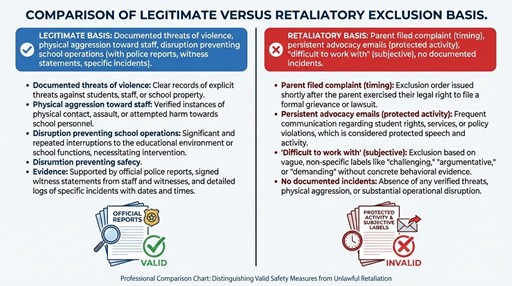
True safety concerns (parent makes threats, physically aggressive, causes genuine disruption) are rare and documented with evidence. Retaliatory exclusion (parent advocates persistently, files complaints, challenges institutional failures) masquerades as safety concern but reveals itself through timing, lack of evidence, and overbroad restrictions.
SANI’s challenge framework:
Temporal Proximity: Exclusion within weeks of protected activity = strong retaliation inference
Lack of Evidence: No documented threats, violence, or disruption = pretextual
Overbroad Restrictions: Total campus ban, severe communication limits for mere “persistent advocacy” = retaliatory
Alternative Explanations: District cannot explain why exclusion necessary now when same communication tolerated for years = retaliation
Discipline Explanation
IDEA Parental Participation Rights
20 USC § 1415(a): IDEA requires parental participation in decisions affecting child’s education. Districts cannot restrict parent’s ability to participate through exclusion orders—especially when issued as retaliation for exercising IDEA rights.
Violation: Campus bans and communication restrictions that prevent IEP participation, monitoring of services, or advocacy violate IDEA regardless of district’s stated justification.
Anti-Retaliation Protections
34 CFR § 300.151 (IDEA): Prohibits retaliation against parents for exercising rights under the Act.
34 CFR § 106.71 (Title IX): Prohibits retaliation for participating in Title IX processes.
Application: When exclusion order issued immediately after complaint filing, without documented safety basis, this establishes prohibited retaliation.
California Education Code § 51101
Establishes parental rights including: observing classroom, meeting with teachers, volunteering, attending school activities.
Exclusion orders restricting these rights require legitimate documented basis—not mere “disruptive” label applied to advocacy.
First Amendment Protections
Parents have constitutional right to advocate for children, including filing complaints about civil rights violations. Exclusion orders based on protected speech violate First Amendment—especially when district cannot show speech created material disruption or true threat.
Challenging Exclusion Orders
Evidence Required:
Temporal Proximity: Document when complaint filed versus when exclusion issued (days/weeks = retaliation inference)
Lack of Legitimate Basis: District cannot produce evidence of threats, violence, or actual disruption (only “persistent communication”)
Overbroad Restrictions: Total bans and severe limits for conduct that doesn’t warrant extreme response
Comparative Treatment: Other parents communicate similarly without exclusion (selective application)
Impact on Rights: Exclusion prevents IEP participation, monitoring, advocacy violating IDEA/California rights
File Challenge: Send demand letter citing legal violations, request rescission, threaten litigation if not withdrawn. File retaliation complaints with OCR/due process establishing exclusion as prohibited retaliation.
Reversal Protocol
Step 1: Document That Exclusion Followed Protected Activity Within Days/Weeks
When receiving exclusion order, immediately document timeline: date of complaint filing / advocacy activity, date of exclusion order, days between (temporal proximity). If exclusion issued within 2-4 weeks of protected activity without prior warnings—strong retaliation evidence. Also document: years of prior communication without issues, no prior complaints about your conduct, sudden change only after complaint filed.
Step 2: Demand Written Basis With Specific Documented Incidents Supporting Exclusion
Within 48 hours of exclusion order, send demand: “Your [date] order restricts campus access and communication. Provide within 5 days: (1) Specific documented incidents with dates justifying restrictions, (2) Evidence of threats, violence, or disruption (police reports, witness statements, recordings), (3) Explanation for timing—why exclusion necessary now after [X] years of similar communication without issues, (4) Alternative less restrictive measures considered before total ban.”
Step 3: Challenge Exclusion as Retaliatory Violation of IDEA, Title IX, and First Amendment
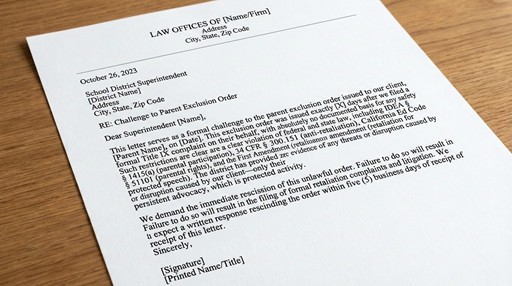
Send comprehensive challenge letter: “Exclusion order violates: (1) IDEA 20 USC § 1415(a) requiring parental participation—restrictions prevent IEP monitoring/advocacy, (2) 34 CFR § 300.151 prohibiting IDEA retaliation—order issued [days] after due process filing, (3) California Ed Code § 51101 guaranteeing parental rights—campus access, teacher meetings, volunteering eliminated without legitimate basis, (4) First Amendment—exclusion retaliates for protected speech (complaints about civil rights violations). District provides no documented safety basis—only ‘persistent advocacy’ (protected activity). Demand immediate rescission within 5 days.”
Step 4: File Parallel Retaliation Complaints With OCR and Due Process
Don’t wait for district response. Immediately file: (1) OCR complaint: “District issued exclusion order [days] after parent filed [complaint], without safety basis. Restrictions prevent parental participation violating IDEA and constitute retaliation under 34 CFR § 300.151. Request investigation and order rescission.” (2) Due process complaint if IDEA-related: “Exclusion order violates procedural safeguards—prevents parent from participating in IEP process as IDEA requires.” Parallel enforcement creates pressure for rescission.
Step 5: In Litigation, Establish Exclusion Was Pretextual Retaliation Not Safety Measure
If exclusion not rescinded, include in litigation: “District’s exclusion order was pretextual retaliation, not legitimate safety measure. Evidence: (1) Temporal proximity—issued [days] after protected activity, (2) No documented threats/violence/disruption despite district’s burden, (3) Prior years of similar communication tolerated, (4) Overbroad restrictions—total ban for mere advocacy, (5) Selective application—other parents communicate similarly without exclusion. Exclusion violated IDEA, Title IX anti-retaliation, California parental rights, and First Amendment. Request: damages, injunctive relief rescinding order, anti-retaliation training.”
Action Steps
1. When Receiving Exclusion Order, Immediately Document Temporal Proximity to Protected Activity
Create timeline: date of complaint filing/advocacy, date of exclusion order, days between. If exclusion within 2-4 weeks of protected activity—document this clearly: “Exclusion order dated [date], issued [X] days after we filed [complaint type] on [date]. Prior to complaint, [communicated normally for X years without issues]. Timing proves retaliation not legitimate safety concern.” Temporal proximity is strongest retaliation evidence.
2. Within 48 Hours, Demand Documented Basis for Exclusion With Specific Incidents
Send written demand: “Your exclusion order restricts [campus access, communication]. Provide within 5 days: (1) Specific incidents with dates justifying restrictions, (2) Documentary evidence—police reports, witness statements, recordings proving threats/violence/disruption, (3) Explanation why exclusion necessary now after [years] of similar communication, (4) Less restrictive alternatives considered. Without documented safety basis, exclusion is retaliatory violation of IDEA, Title IX anti-retaliation, California parental rights, and First Amendment.”
3. Send Comprehensive Legal Challenge Citing Multiple Violations Within 5 Days
Challenge letter: “Exclusion violates: IDEA § 1415(a) (prevents required parental participation), 34 CFR § 300.151 (IDEA retaliation—issued [days] after due process), California Ed Code § 51101 (eliminates parental rights—campus access, meetings, volunteering), First Amendment (retaliates for protected speech—complaints about violations). District provides no legitimate documented basis—only ‘persistent advocacy’ protected by law. Exclusion pretextual retaliation. Rescind immediately or we file OCR complaint, due process complaint, and litigation seeking damages and injunctive relief.”
4. File Immediate Parallel OCR and Due Process Complaints—Don’t Wait for Rescission
File simultaneously: OCR complaint: “District issued exclusion order [date], [days] after parent filed [complaint]. No documented safety basis provided. Restrictions prevent IDEA-required parental participation. Request OCR investigate and order immediate rescission.” Due process: “Exclusion order violates procedural safeguards—prevents parent participating in IEP decisions, monitoring services, advocating for child as IDEA requires. Request hearing and order rescinding restrictions.” Parallel complaints create enforcement pressure forcing district response.
5. If Not Rescinded, Include in Litigation as Independent Retaliation Claim With Damages
In federal lawsuit, dedicate claims to exclusion retaliation: “District’s exclusion order violated: IDEA (prevented participation), Title IX/IDEA anti-retaliation (issued after protected activity without legitimate basis), California parental rights, First Amendment (punished protected speech). Evidence: temporal proximity, lack of documented threats/disruption, overbroad restrictions, selective application. Request: compensatory damages for harm, injunctive relief rescinding order and prohibiting future retaliatory exclusion, punitive damages for willful retaliation, attorney fees.”
FAQs
1. Can schools ban parents from campus for being "disruptive"?
Schools may restrict parent access only when there is a legitimate, documented safety basis—such as specific threats of violence, physical aggression, or substantial disruption that interferes with school operations. Vague labels like “disruptive” or “difficult,” especially when applied to persistent advocacy, are not sufficient. If exclusion occurs shortly after a complaint is filed and lacks documented safety concerns, it may indicate retaliatory exclusion, potentially implicating parental participation rights, anti-retaliation protections, and applicable state and constitutional protections.
2. How do I determine if an exclusion is retaliatory rather than a legitimate safety measure?
Indicators may include:
- Timing: The restriction follows closely after a complaint or protected activity.
- Lack of documentation: No clear reports, witness statements, or evidence of safety concerns.
- Prior tolerance: Similar conduct was previously allowed without issue.
- Scope: Broad or total bans rather than narrowly tailored restrictions.
- Inconsistent treatment: Other parents engaging in similar conduct are not restricted.
3. What if the district claims my communication was "excessive" or "harassing"?
Advocacy-related communication—such as requesting services, asking questions, or following up on concerns—is generally protected. If concerns are raised about communication volume or tone, you can request clarification, including:
- How the district defines “excessive” communication
- Specific examples of communication considered inappropriate
- Whether similar communication from others is treated differently
4. Can exclusion orders prevent me from attending IEP meetings?
Parents generally have the right to participate in decisions regarding their child’s education, including attending IEP meetings. Even if restrictions are in place, schools are expected to provide a way for meaningful participation, which may include scheduled access, virtual attendance, or other reasonable accommodations. If access to required meetings is limited, you may request clarification on how participation will be ensured.
5. What options are available if a parent believes an exclusion order is improper?
Possible steps may include:
- Requesting written justification and supporting documentation
- Seeking modification or clarification of the restriction
- Filing a complaint through appropriate administrative channels
- Requesting policy review or corrective action
- Consulting with a qualified attorney for legal options
Call to Action
If you want student harm treated like a school safety and civil rights issue—start with SANI at https://saninstitute.net
Sources
-
California Government Code § 815.6 –
State statute creating liability when public entities breach mandatory duties imposed by law or policy, applicable when administrators fail to properly document required communications or later deny those interactions.
https://leginfo.legislature.ca.gov/faces/codes_displaySection.xhtml?lawCode=GOV§ionNum=815.6 -
California Evidence Code § 412 –
Establishes that when a party fails to produce evidence within its control, the fact-finder may infer that the evidence would have been unfavorable, relevant when districts claim “no record” despite having documentation obligations.
https://leginfo.legislature.ca.gov/faces/codes_displaySection.xhtml?lawCode=EVID§ionNum=412 -
Restatement (Second) of Contracts § 4 –
Legal principle recognizing that silence can constitute acceptance or confirmation when a party has a duty to respond, applicable to confirmation emails where administrators fail to correct inaccuracies.
https://www.ali.org/publications/show/contracts/ -
Federal Rules of Evidence 801(d)(2) –
Defines statements made by a party as admissible non-hearsay when offered against that party, applicable when administrators provide written responses (or confirmations) that can be used as evidence.
https://www.law.cornell.edu/rules/fre/rule_801 -
Cedars-Sinai Medical Center v. Superior Court, 18 Cal.4th 1 (1998) –
California Supreme Court decision addressing spoliation and evidentiary consequences when parties fail to preserve records, relevant when institutions claim lack of documentation for events that should have been recorded.
https://scocal.stanford.edu/opinion/cedars-sinai-medical-center-v-superior-court-31348