
Table of Contents
Click to Expand
1. Audio
2. Definition
3. Video
4. Core Thesis
9. Action Steps
10. FAQs
11. Call to Action
12. Sources
13. Signature
Definition
Grade retaliation occurs when California districts punish students whose families file complaints, advocate for rights, or challenge institutional failures through sudden unexplained grade drops, subjective grading changes, increased academic scrutiny, altered participation scores, or withheld opportunities—violations of Title IX 34 CFR § 106.71 anti-retaliation (prohibits intimidation, threats, coercion against participants in protected activities), IDEA 34 CFR § 300.151 protection against retaliation for exercising rights, and California Education Code § 48900.7 (prohibits discrimination or retaliation based on protected activity).
Core Thesis
Districts retaliate against families who challenge institutional failures by weaponizing grades—student maintains A/B average for years until parent files Title IX complaint, suddenly receives C/D grades in subjective subjects taught by district employees, with grade drops strategically timed to filing dates and concentrated in classes taught by administrators involved in complaint, creating academic harm that damages college applications, scholarship opportunities, and student’s record while sending chilling message to other families: “Challenge us and we’ll hurt your child’s future.” We convert trauma into code by documenting grade patterns (transcript showing consistent performance pre-complaint, sudden drops post-complaint), requesting written grade justifications for changed scores, comparing grading between complaining family’s child and peers in same classes, and filing retaliation complaints establishing temporal proximity, comparative evidence, and lack of legitimate academic explanation for grade changes. Selective enforcement IS discrimination when families of color experience grade retaliation at 3x rates of white families after filing complaints—proving retaliation weapon applied selectively.
Case Pattern Story
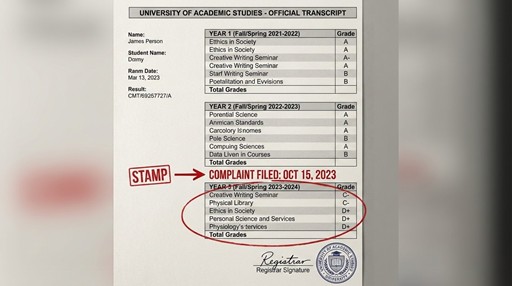
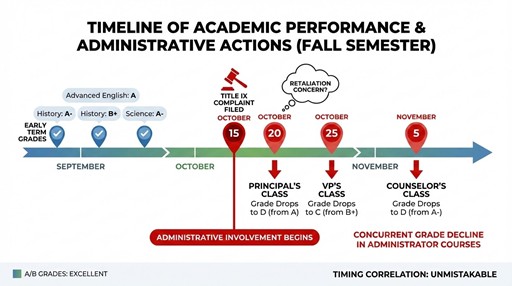
Student in Sacramento maintains A/B average freshman-junior year. Family files Title IX complaint against principal October 2023.
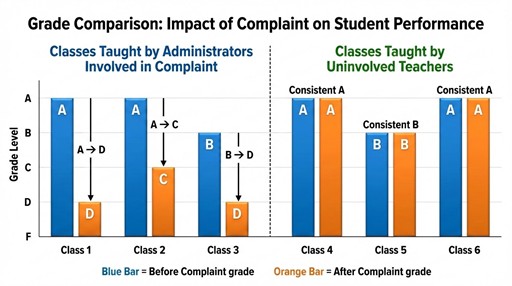
Immediately after: Student’s grades drop precipitously in three classes taught by administrators—principal’s history class (A→D), vice principal’s English (A→C), counselor’s health class (B→D).
Math and science classes taught by uninvolved teachers: grades remain A/B.
Mother requests grade explanations. Teachers provide vague responses: “Participation declined,” “Quality of work decreased,” “Not meeting expectations.”
Mother compares daughter’s work to previous years—quality unchanged. Requests rubrics showing how grades calculated—teachers cannot provide objective justification for drops.
Attorney files retaliation complaint: “Student maintained A/B average for three years. Within weeks of parent filing Title IX complaint against principal, student’s grades in principal’s class and two administrator colleagues’ classes dropped dramatically while grades in uninvolved teachers’ classes remained consistent. Temporal proximity, pattern of drops only in classes taught by administrators involved in complaint, and lack of objective grading justification establish retaliation violating Title IX § 106.71 and IDEA § 300.151.”
District investigation reveals: Principal emailed involved teachers after complaint filed: “FYI [student’s] parent filed complaint against me. Watch her work closely for any issues.” Teachers interpreted as instruction to scrutinize/downgrade.
Settlement: Grades corrected, monetary damages, anti-retaliation training, policy prohibiting discussing complaints with student’s teachers.
SANI Connection
SANI identifies grade retaliation as covert punishment weapon—unlike suspension/expulsion which are visible and challengeable, grade manipulation is subtle, subjective, difficult to prove, and causes long-term academic harm (damaged transcript, lost scholarships, college rejections) while maintaining plausible deniability (“academic judgment”).
SANI’s documentation protocol:
Pre-Complaint: Maintain copies of all graded assignments, grade reports, teacher comments establishing performance baseline.
Post-Complaint: Document every grade change, request written justifications, compare work quality to pre-complaint assignments, identify which teachers’ grades changed (correlate to complaint involvement).
Evidence Pattern: Temporal proximity (grades drop immediately after complaint), selective application (only certain teachers’ grades drop), lack of objective justification (subjective grading without rubrics), comparative data (peers’ grades unchanged).
Discipline Explanation
Title IX Anti-Retaliation Protection
34 CFR § 106.71: Prohibits intimidation, threats, coercion, or discrimination against individuals for participating in Title IX processes.
Grade manipulation as retaliation: When student’s grades drop after parent files Title IX complaint—especially in classes taught by administrators involved in complaint—this constitutes prohibited retaliation if temporal proximity, pattern, and lack of legitimate explanation establish causal connection.
Proof requires: (1) Protected activity (complaint filed), (2) Adverse action (grade drops), (3) Causal connection (timing, pattern, lack of justification).
IDEA Protection Against Retaliation
34 CFR § 300.151: Districts cannot retaliate against parents/students for exercising IDEA rights.
Application: When parent advocates for IEP services, requests evaluations, or files due process—and student’s grades subsequently drop—this can establish IDEA retaliation if causal connection proven.
California Education Code § 48900.7
Prohibits discrimination or retaliation based on student’s actual/perceived characteristics or participation in protected activity.
Grade retaliation violates when motivated by parent’s complaint filing or advocacy rather than legitimate academic performance changes.
Proving Grade Retaliation
Evidence Collection:
Temporal Proximity: Document when complaint filed and when grades changed (days/weeks creates strong inference)
Pattern Analysis: Which teachers’ grades changed? If only administrators/teachers involved in complaint = strong evidence
Comparative Evidence: Did student’s work quality actually decline? Compare assignments pre/post-complaint. Did peers’ grades drop similarly?
Lack of Justification: Request detailed grade justifications. Vague responses like “participation declined” without objective documentation support retaliation claim.
Communications: Request emails/texts between administrators and teachers mentioning complaint/student (often reveal retaliatory intent)
Common Grade Retaliation Tactics
Tactic 1: Subjective Grading Changes – Participation scores, subjective essay grades, “class contribution” suddenly graded harshly
Tactic 2: Increased Scrutiny – Minor errors now result in major deductions; previously accepted work now marked “inadequate”
Tactic 3: Changed Standards – Rubrics applied differently; expectations suddenly unclear or elevated
Tactic 4: Withheld Opportunities – Recommendation letters withdrawn, honor society nominations revoked, leadership positions removed
Tactic 5: Teacher Hostility – Cold demeanor, reduced assistance, public criticism in class
Named Framework: The Grade Retaliation Documentation and Challenge Protocol
Step 1: Establish Performance Baseline Before Complaint Filing
Before filing any complaint (Title IX, OCR, due process), create documentation of student’s academic performance: copy transcripts, save all graded assignments with scores/comments, screenshot online grade portals, photograph report cards. This baseline proves consistent performance before protected activity—essential for proving subsequent drops are retaliation not legitimate academic decline.
Step 2: Document Every Grade Change After Complaint With Timestamps
After complaint filed, maintain detailed log: date of each grade change, which class/teacher, old grade vs new grade, date of complaint filing (showing temporal proximity). Within 48 hours of any grade drop, send written request: “My child’s grade in [class] dropped from [X] to [Y] on [date], [days] after we filed [complaint type]. Provide detailed written justification with objective grading criteria, rubrics used, and comparison to prior work quality.”
Step 3: Identify Pattern—Which Teachers’ Grades Changed and Their Relationship to Complaint
Chart grade changes by teacher. If only administrators involved in complaint (principal, VP, counselor named in complaint) had grade drops while uninvolved teachers’ grades remained consistent—this pattern strongly suggests retaliation. Request via public records: emails between administrators and student’s teachers mentioning complaint or student (often reveals retaliatory coordination).
Step 4: File Retaliation Complaint Establishing Temporal Proximity and Pattern
File complaint with district and OCR/due process: “Student maintained [A/B] average for [X] years. Within [days] of parent filing [complaint type], student’s grades dropped dramatically in classes taught by administrators involved in complaint: [list grade changes with dates]. Grades in uninvolved teachers’ classes remained consistent. Temporal proximity, selective pattern, and lack of objective justification establish retaliation violating Title IX § 106.71 / IDEA § 300.151. Request: grade corrections, investigation of retaliation, damages.”
Step 5: Demand Grade Corrections and Anti-Retaliation Training
In settlement/resolution, demand: (1) Correction of retaliatory grades to pre-complaint levels or re-grading by independent evaluator, (2) Removal of retaliatory grades from transcript, (3) Monetary damages for harm (lost scholarships, college application damage), (4) Anti-retaliation training for all staff, (5) Policy prohibiting discussing complaints with student’s teachers, (6) Monitoring to prevent future retaliation.
Action Steps
1. Before Filing Complaints, Document Complete Academic Performance Baseline
Create pre-complaint academic record: copy transcripts showing consistent performance, save all graded assignments with scores/teacher comments, screenshot grade portals, photograph report cards. Date and organize chronologically. This baseline essential for proving post-complaint grade drops are retaliation not legitimate performance changes. Without baseline, proving retaliation much harder.
2. After Complaint, Request Written Justification for Any Grade Drops Within 48 Hours
Monitor grades closely. Any drop within 30 days of complaint filing, immediately send: “Child’s grade in [class/teacher] dropped [old→new] on [date], [X] days after we filed [complaint type]. Provide written justification within 5 days: objective criteria used, specific assignments causing drop, how current work differs from prior [grade level] work, rubrics applied.” Vague responses (“participation declined”) support retaliation claim—demand specifics.
3. Chart Grade Changes By Teacher—Identify Retaliation Pattern
Create spreadsheet: columns for each class/teacher, rows showing grades over time, mark complaint filing date. If only administrators/teachers involved in complaint show grade drops while uninvolved teachers’ grades stay consistent—this pattern proves retaliation. File public records request: “All emails/communications between administrators and [student’s] teachers mentioning [student name] or complaint from [30 days before complaint] to present.”
4. File Retaliation Complaint Citing Temporal Proximity and Selective Pattern
To district/OCR/due process: “Student maintained [average] for [timeframe]. Within [days] of parent filing [complaint], grades dropped only in classes taught by complaint-involved administrators: [list changes with dates/names]. Uninvolved teachers’ grades unchanged. Work quality unchanged (prior assignments attached for comparison). Temporal proximity + selective pattern + lack of justification = retaliation violating Title IX § 106.71 / IDEA § 300.151. Demand investigation and grade corrections.”
5. In Settlement, Demand Grade Corrections and Transcript Remediation
Require: (1) Retaliatory grades corrected to pre-complaint levels or independently re-evaluated, (2) Corrected grades issued to colleges/scholarship programs student applied to, (3) Letter from superintendent acknowledging retaliation and explaining corrections, (4) Monetary damages for scholarship losses/college application harm, (5) Anti-retaliation policy prohibiting discussing complaints with student’s teachers, (6) Training and monitoring.
FAQs
1. How do I prove grade drops are retaliation rather than legitimate academic performance?
Establish through multiple lines of evidence:
- Temporal proximity: Grades drop shortly after complaint filing (days or weeks).
- Pattern analysis: Only teachers involved in the complaint show declines, while uninvolved teachers’ grades remain consistent.
- Work quality comparison: Current assignments are comparable to prior high-graded work.
- Lack of objective justification: Teachers cannot provide rubrics or criteria explaining the drops.
2. What if teachers claim "participation declined" or other subjective performance reasons?
Demand objective evidence:
- Provide a rubric showing how participation was scored.
- Document specific instances and dates of alleged decline.
- Show prior participation scores for baseline comparison.
- Compare student’s performance to peers.
3. Can I request communications between administrators and my child's teachers?
Yes—submit a California Public Records Act request for: "All emails, texts, or communications between [named administrators] and [child's teachers] mentioning [child's name] or [complaint subject] from [30 days before complaint] to present." These often reveal administrators alerting teachers about the complaint, which can create coordinated retaliation. Example: "FYI parent filed complaint—watch [student's] work closely."
4. What remedies can I demand for grade retaliation?
Potential remedies in complaints or settlements include:
- Correct grades to pre-retaliation levels or independent re-evaluation.
- Submit corrected grades to colleges and scholarship committees.
- Superintendent letter acknowledging retaliation and explaining corrections.
- Monetary damages for lost scholarships, college admissions, or emotional distress.
- Removal of retaliatory teachers from the student’s classes.
- Anti-retaliation training for staff.
- Policy changes to prevent future retaliation.
- Ongoing monitoring of student’s academic record.
5. How do I protect against retaliation before filing complaints?
Take proactive steps:
- Document academic baseline: copy transcripts, save graded assignments, screenshot grade portals.
- Monitor grades weekly after filing complaint and immediately challenge any unexpected drops.
- Request student be moved to different teacher sections if possible.
- Include in complaint: "Family requests anti-retaliation protections, including monitoring of grades and prohibition on administrators discussing complaint with teachers."
Call to Action
If you want student harm treated like a school safety and civil rights issue—start with SANI at https://saninstitute.net
Sources
-
34 CFR § 106.71 –
Title IX anti-retaliation provision prohibiting intimidation, threats, coercion, or discrimination against individuals participating in protected activities, including filing complaints.
https://www.ecfr.gov/current/title-34/subtitle-B/chapter-I/part-106/subpart-F/section-106.71 -
34 CFR § 300.151 –
IDEA regulation protecting individuals from retaliation for exercising rights under the Act, ensuring students and parents can safely advocate for special education services.
https://www.ecfr.gov/current/title-34/subtitle-B/chapter-III/part-300/subpart-B/subject-group-ECFR7f283b32a42404c/section-300.151 -
California Education Code § 48900.7 –
State statute prohibiting discrimination or retaliation against students based on protected characteristics or participation in protected activities.
https://leginfo.legislature.ca.gov/faces/codes_displaySection.xhtml?lawCode=EDC§ionNum=48900.7 -
Jackson v. Birmingham Board of Education, 544 U.S. 167 (2005) –
U.S. Supreme Court decision recognizing a private right of action for retaliation under Title IX, clarifying that individuals can sue if they face adverse actions for reporting discrimination or harassment.
https://supreme.justia.com/cases/federal/us/544/167/ -
OCR Dear Colleague Letter on Retaliation (2013) –
Guidance from the U.S. Department of Education Office for Civil Rights on identifying, preventing, and addressing retaliation in educational settings.
https://www2.ed.gov/about/offices/list/ocr/letters/colleague-201304.html