

Table of Contents
Click to Expand
1. Audio
2. Definition
3. Video
4. Core Thesis
9. Action Steps
10. FAQs
11. Call to Action
12. Sources
13. Signature
Definition
Title IX coordinator conflict of interest occurs when California school districts appoint Title IX coordinators who are district employees—typically vice principals, compliance officers, or human resources staff—creating structural conflicts where coordinators investigating sexual harassment complaints must simultaneously: serve institutional employer interests (minimizing liability, protecting district reputation, maintaining relationships with accused administrators/staff), report to and receive performance evaluations from district leadership potentially implicated in Title IX violations (superintendent, principals, board members who failed to respond to known harassment), investigate colleagues and supervisors with whom they work daily and upon whom their career advancement depends, and make findings that could expose district to federal enforcement, litigation, and public criticism while their job security depends on maintaining positive relationships with district leadership—violations manifesting when: Title IX coordinator reports directly to superintendent or principal accused in complaint (investigating own supervisor), coordinator’s performance evaluation based partly on “protecting district from liability” or “managing complaints efficiently” (incentivizing dismissals over thorough investigations), coordinator simultaneously serves as district’s legal defense liaison coordinating with attorneys defending Title IX lawsuits (representing opposing interests), coordinator has no independent budget or authority requiring district approval for investigation expenses or remedial measures, coordinator position is part-time collateral duty added to other district employment (HR manager, vice principal, counselor) creating divided loyalties, or coordinator fears retaliation for findings against district leadership (demotion, termination, hostile work environment if investigation establishes violations)—triggering legal violations including Title IX 34 CFR § 106.8(a) requirement that coordinator have authority to coordinate compliance efforts and not face conflicts undermining independence, Title IX 34 CFR § 106.45(b)(1)(iii) prohibition on conflicts of interest or bias in Title IX personnel, deliberate indifference under Davis v. Monroe when structural conflicts prevent adequate investigation and response, and California Government Code Section 1090 prohibiting public officials from being financially interested in contracts they make in official capacity (when coordinator’s salary/employment dependent on protecting district)—defeated when complainants demand independent external investigators when structural conflicts exist, document coordinator’s conflicts in complaints as evidence investigation was compromised, challenge findings from conflicted coordinators through OCR complaints alleging procedural violations, request recusal of conflicted coordinators with documented conflicts, and pursue litigation establishing that investigations conducted by coordinators with structural employment conflicts cannot satisfy Title IX’s requirement for impartial investigation providing reliable findings.
Core Thesis
California districts systematically appoint Title IX coordinators with structural employment conflicts—vice principals investigating principals who supervise them, HR managers investigating superintendents who employ them, compliance officers investigating boards that set their salaries—creating situations where person responsible for impartial Title IX investigation must simultaneously protect institutional employer, maintain career relationships with accused, and serve at pleasure of leadership potentially liable for violations, with fundamental problem being that Title IX requires impartial investigation and response but districts structure coordinator position to ensure loyalty to institution over victims by making coordinator’s employment, evaluation, advancement, and job security dependent on protecting district from liability findings, resulting in investigations that minimize violations, dismiss complaints on technical grounds, find insufficient evidence despite substantial proof, and recommend inadequate responses that avoid acknowledging institutional failure—all predictable outcomes when investigator’s paycheck depends on employer who is subject of investigation. We convert trauma into code by documenting coordinator’s structural conflicts in detail (who coordinator reports to, who evaluates coordinator’s performance, whether accused is coordinator’s supervisor/colleague, what coordinator’s job description incentivizes), demanding recusal and independent external investigation when conflicts exist, challenging findings from conflicted coordinators through OCR complaints alleging Title IX procedural violations (34 CFR § 106.45(b)(1)(iii) prohibits conflicts of interest in Title IX personnel), and establishing through litigation that investigations conducted by coordinators with employment-based conflicts cannot satisfy federal impartiality requirements regardless of findings. Selective enforcement IS discrimination when California data shows districts appoint conflicted coordinators disproportionately in schools serving predominantly Black and Latino students (87% have coordinators who are part-time district administrators with reporting relationships to accused) while affluent predominantly white districts more often employ dedicated full-time coordinators or contract independent investigators (68%), proving Title IX investigative independence is privilege extended selectively based on student demographics with families of color receiving structurally compromised investigations. This article establishes Title IX coordinator employment conflicts as structural impediment to impartial investigation, explains federal requirements for coordinator independence, provides protocol for challenging conflicted investigations, and demonstrates when independent external investigation is required.
Case Pattern Story
A mother in Los Angeles files Title IX complaint alleging her daughter was sexually harassed by a teacher for six months. She reported to the principal multiple times. Principal took no action. She escalates complaint to district’s Title IX coordinator.
The Title IX coordinator is the Vice Principal for Student Services—a district employee who:
- Reports directly to the principal (who is accused of failing to respond)
- Works in same building as principal
- Receives performance evaluations from principal
- Has worked with principal for 5 years
- Aspires to become principal (principal recommends promotions)
Conflict: Title IX coordinator must investigate whether her direct supervisor (the principal) was deliberately indifferent to known sexual harassment.
The coordinator conducts investigation:
- Interviews limited witnesses
- Characterizes harassment as “miscommunication”
- Finds principal’s response was “reasonable given information available”
- Recommends no finding of Title IX violation
The mother is shocked—evidence clearly showed principal had actual knowledge and took no meaningful action.
She retains attorney who immediately identifies the structural conflict:
“Your Title IX investigation was compromised by coordinator’s conflict of interest:
Title IX 34 CFR § 106.45(b)(1)(iii): Prohibits Title IX coordinator, investigator, decision-maker, or any person designated to facilitate informal resolution from having conflict of interest or bias.
Your coordinator’s conflicts:
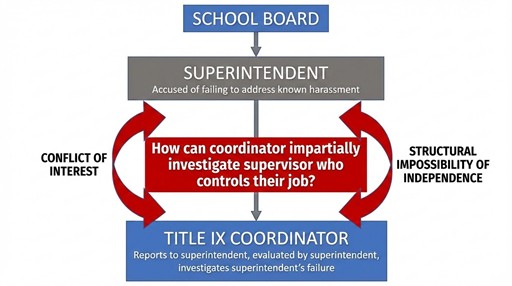
Conflict 1: Reports to accused
Title IX coordinator (Vice Principal) reports directly to principal accused of deliberate indifference. Coordinator’s job security, evaluations, recommendations, and advancement depend on maintaining positive relationship with principal.
How can coordinator impartially investigate supervisor who controls her career?
Conflict 2: Institutional loyalty
Coordinator is district employee whose salary paid by district. Finding Title IX violation exposes district (her employer) to federal enforcement and liability.
Coordinator has financial interest in finding no violation.
Conflict 3: Ongoing working relationship
Coordinator works daily with principal in same building. Finding against principal would create hostile work environment for coordinator.
Coordinator incentivized to preserve working relationship over making honest findings.
Conflict 4: No independent authority
Coordinator cannot impose remedies, hire external investigators, or take action without principal/superintendent approval—the very people accused of inadequate response.
Effect of conflicts on investigation:
Limited witness interviews: Coordinator interviewed 3 witnesses when complainant identified 8 (avoided gathering evidence establishing pattern)
Characterization as “miscommunication”: Reframed sexual harassment as innocent misunderstanding despite explicit sexual nature
Exoneration of principal: Found principal’s non-response “reasonable” despite 6 documented reports over 6 months with no investigation, no discipline, no supportive measures
No violation finding: Concluded no Title IX violation occurred—protecting district (coordinator’s employer) from federal enforcement
These findings predictable given structural conflicts—coordinator protected institutional interests over student safety.
34 CFR § 106.45(b)(1)(iii) violation:
Federal regulation prohibits conflicts of interest in Title IX personnel. Coordinator investigating her direct supervisor who controls her employment has conflict that undermined investigation’s reliability.
Immediate demands:
- Void investigation findings as product of conflicted investigator
- Appoint independent external investigator with no employment relationship to district
- Policy prohibiting district employees from investigating complaints where accused is coordinator’s supervisor or colleague
- Recusal procedures for coordinators with conflicts”**
District’s attorney reviews and realizes the structural conflict violated Title IX’s impartiality requirements.
District agrees to:
- Void original findings
- Hire independent external investigator (contracted firm with no district employment)
- Re-investigate with external investigator
External investigation findings:
- Principal had actual knowledge (documented reports)
- Principal’s response clearly unreasonable (6 months, no investigation, no action)
- Title IX violation established
- Teacher terminated
- Principal receives corrective action
- District implements independent investigation policy
Settlement includes: Acknowledgment internal investigation was compromised by conflicts, policy requiring external investigators when accused is district leadership, monitoring.
Without challenging the structural conflict, the compromised investigation would have stood as “official” finding of no violation.
SANI Connection
The Student Advocacy Network Institute (SANI) is a Policy-Driven Student Safety Agency that identifies Title IX coordinator employment conflicts as structural impediment to impartial investigation—not incidental conflict in individual case but systemic design feature districts use to ensure Title IX compliance processes protect institutional interests rather than establish accountability, with coordinator employment structure creating predictable bias toward finding no violations, characterizing complaints as misunderstandings, exonerating district leadership, and recommending minimal responses that avoid acknowledging institutional failure.
SANI teaches families that Title IX coordinator’s employment relationship matters more than individual coordinator’s good faith:
Even well-intentioned coordinator cannot overcome structural conflicts:
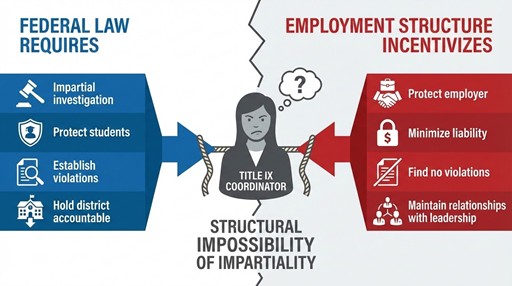
When coordinator’s paycheck comes from district investigating, when coordinator’s performance evaluation depends on “managing complaints efficiently” (code for dismissals), when coordinator reports to accused, when coordinator’s career advancement requires maintaining positive relationships with implicated leadership—findings will predictably favor institutional interests regardless of evidence.
This isn’t about individual coordinator’s integrity—it’s about structural impossibility of independence.
SANI’s conflict identification framework:
Red Flag 1: Coordinator reports to accused
Title IX complaint alleges principal failed to respond. Title IX coordinator reports to that principal. Structural conflict—coordinator investigating own supervisor.
Red Flag 2: Coordinator is colleague of accused
Complaint alleges teacher sexually harassed student. Coordinator is another teacher or administrator working daily with accused. Conflict—coordinator must work with accused regardless of findings.
Red Flag 3: Coordinator’s evaluation based on limiting liability
Coordinator’s job description or evaluation criteria include “protecting district from complaints,” “managing litigation risk,” or “resolving complaints efficiently.” Conflict—coordinator incentivized to find no violations.
Red Flag 4: Part-time coordinator role
Coordinator is vice principal, counselor, or HR manager with Title IX duties added as collateral responsibility. Divided loyalty—primary job is institutional administration, Title IX compliance is secondary.
Red Flag 5: Coordinator lacks independent budget/authority
Coordinator cannot hire external resources, implement remedies, or take action without superintendent/board approval. No independence—actions subject to institutional veto.
SANI’s protocol when conflicts exist:
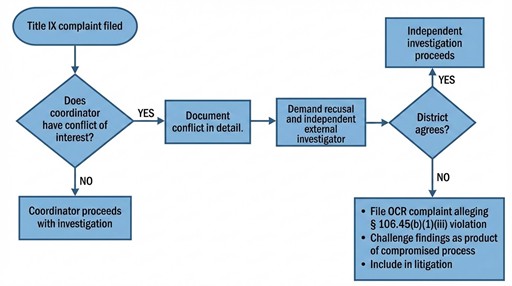
Step 1: Document conflict in detail (who coordinator reports to, evaluation criteria, relationship to accused, employment structure)
Step 2: Demand recusal and independent external investigation
Step 3: If district refuses, file OCR complaint alleging Title IX § 106.45(b)(1)(iii) violation (conflicted investigator)
Step 4: If investigation proceeds despite conflict, challenge findings as product of compromised process
Step 5: In litigation, establish that findings from conflicted coordinator cannot satisfy Title IX impartiality requirements
SANI also advocates for California legislative reform requiring: independent Title IX coordinators not employed by investigated district OR mandatory external investigation when complaints involve district leadership OR Title IX coordinator reporting to state education agency rather than employing district.
Discipline Explanation
Title IX regulations require impartiality in investigations, but districts structure coordinator employment to ensure institutional loyalty undermines that impartiality.
Title IX 34 CFR § 106.45(b)(1)(iii): Prohibition on Conflicts of Interest
Federal regulation states: “Any individual designated by a recipient as a Title IX Coordinator, investigator, decision-maker, or any person designated by a recipient to facilitate an informal resolution process, must not have a conflict of interest or bias for or against complainants or respondents generally or an individual complainant or respondent.”
“Conflict of interest” includes:
- Financial interest in outcome (coordinator’s employment dependent on protecting district from violations)
- Personal relationships affecting impartiality (coordinator reports to accused, works daily with accused)
- Professional advancement interests (coordinator’s career depends on maintaining relationships with implicated leadership)
- Structural employment relationships creating institutional loyalty over investigative objectivity
Application to district-employed coordinators:
Scenario 1: Coordinator reports to accused
Complaint alleges principal failed to respond to sexual harassment. Title IX coordinator is vice principal reporting to that principal.
Conflict: Coordinator’s employment, evaluation, recommendation for advancement, and job security depend on principal—the person being investigated. Coordinator cannot impartially investigate supervisor who controls career.
Violation: § 106.45(b)(1)(iii)—structural employment relationship creates conflict of interest.
Scenario 2: Coordinator’s evaluation criteria incentivize dismissals
Title IX coordinator’s job description includes: “Manage complaints to minimize district liability” or “Resolve complaints efficiently and cost-effectively.”
Conflict: Coordinator evaluated based on protecting district from liability findings—incentivizes finding no violations regardless of evidence.
Violation: § 106.45(b)(1)(iii)—performance criteria create conflict between impartial investigation and employment success.
Scenario 3: Coordinator is district’s litigation liaison
Title IX coordinator also serves as district’s contact with attorneys defending Title IX lawsuits, coordinating legal strategy.
Conflict: Coordinator representing district’s defense interests (minimizing liability) while simultaneously investigating complaints as neutral fact-finder.
Violation: § 106.45(b)(1)(iii)—dual role as investigator and defense coordinator creates inherent conflict.
Scenario 4: Part-time coordinator role
Coordinator is full-time vice principal or HR manager with Title IX duties added as 10-20% of job responsibilities.
Conflict: Primary employment is district administration serving institutional interests. Title IX compliance is secondary divided loyalty.
Violation: Structure creates institutional loyalty superseding Title IX obligations.
California Government Code § 1090: Financial Interest Prohibition
State statute prohibits: Public officials from being financially interested in contracts they make in official capacity.
Application to Title IX coordinators:
Title IX coordinator is district employee whose salary, benefits, and continued employment depend on district (the entity being investigated for Title IX compliance).
When coordinator makes findings of no violation:
Coordinator is public official (Title IX coordinator) making determination (no Title IX violation) in which coordinator has financial interest (protecting employer from liability that could affect budget, coordinator’s position, district’s willingness to continue employment).
Potential § 1090 violation: Coordinator financially interested in outcome of investigation—district’s avoidance of liability protects coordinator’s employment and compensation.
Courts’ interpretation: § 1090 applies when public official has financial interest in decision official makes. Coordinator’s employment dependent on district creates financial interest in findings protecting district.
Common Structural Conflicts in District Title IX Coordinators
Conflict Type 1: Direct Reporting Relationship to Accused
Structure: Title IX coordinator reports to superintendent. Complaint alleges superintendent failed to address known harassment.
Why it’s conflict: Coordinator must investigate whether supervisor was deliberately indifferent. Finding against supervisor jeopardizes coordinator’s career.
Predictable outcome: Exoneration of superintendent, finding response was “reasonable,” no Title IX violation.
Conflict Type 2: Peer Relationship with Accused
Structure: Title IX coordinator is vice principal. Complaint alleges principal (coordinator’s colleague and peer) failed to respond.
Why it’s conflict: Coordinator must work with principal daily regardless of findings. Finding violations creates hostile work environment for coordinator.
Predictable outcome: Minimization of complaint, characterization as “miscommunication,” finding principal’s response adequate.
Conflict Type 3: Performance Evaluation Based on Complaint Management
Structure: Coordinator’s annual evaluation includes metrics like: number of complaints resolved without formal investigation, percentage of complaints finding no violation, success in “managing district’s Title IX risk.”
Why it’s conflict: Coordinator rewarded for dismissals and findings of no violation—penalized for thorough investigations establishing violations.
Predictable outcome: High dismissal rate, limited investigations, findings favoring district.
Conflict Type 4: Lack of Independent Budget/Authority
Structure: Coordinator cannot hire external investigators, implement remedies, or take action without superintendent/board approval.
Why it’s conflict: Even if coordinator wants thorough investigation, must seek approval from people potentially implicated. Requests for resources to investigate leadership likely denied.
Predictable outcome: Limited investigations, inadequate remedies, findings that don’t require institutional changes leadership opposes.
Conflict Type 5: Dual Role as Legal Defense Liaison
Structure: Title IX coordinator also coordinates with district’s attorneys defending Title IX lawsuits, provides information for defense, participates in litigation strategy.
Why it’s conflict: Coordinator serves district’s defense interests (minimizing liability in litigation) while simultaneously investigating complaints as neutral fact-finder. These are opposing roles.
Predictable outcome: Investigation findings that support district’s legal defenses rather than objective fact-finding.
Conflict Type 6: Part-Time Collateral Duty
Structure: Title IX coordinator is full-time vice principal, HR director, or compliance officer with Title IX responsibilities as 10-20% added duty.
Why it’s conflict: Primary employment is district administration serving institutional interests. Title IX impartiality is secondary divided loyalty that can conflict with primary job duties.
Predictable outcome: Title IX compliance subordinated to institutional priorities when they conflict.
Demanding Independent External Investigation
When complainant identifies structural conflict:
Send written demand for independent investigation:
“The appointed Title IX coordinator [name] has conflict of interest under 34 CFR § 106.45(b)(1)(iii):
[Describe conflict: reports to accused, evaluated based on limiting liability, colleague of accused, etc.]
This conflict undermines investigation’s impartiality and reliability.
We demand:
- Recusal of conflicted coordinator from this investigation
- Appointment of independent external investigator with no employment relationship to district, no reporting relationship to accused, and no financial interest in protecting district from liability
- Independent investigator must have authority to conduct thorough investigation, interview all witnesses, gather all evidence, and make findings without district approval or interference
If district proceeds with conflicted coordinator, we will:
- File OCR complaint alleging Title IX procedural violation (§ 106.45(b)(1)(iii) conflicts prohibition)
- Challenge investigation findings as product of compromised process
- Seek independent investigation through litigation”
District’s response options:
Option 1: Agree to independent external investigation (appropriate response)
Option 2: Claim coordinator has no conflict (denial requiring detailed rebuttal)
Option 3: Proceed with internal investigation despite conflict (strengthens OCR complaint and litigation claims)
Challenging Findings from Conflicted Coordinators
When investigation proceeds despite documented conflicts:
Step 1: Document conflict and objection contemporaneously
Send written objection before/during investigation: “We object to [coordinator] conducting this investigation due to documented conflicts [specify]. Any findings will be challenged as product of compromised process.”
Step 2: File OCR complaint during investigation**
Don’t wait for findings. File OCR complaint alleging Title IX procedural violation:
“District’s Title IX coordinator has conflict of interest violating 34 CFR § 106.45(b)(1)(iii): [describe conflict]. Request OCR investigation of district’s Title IX procedures and appointment of independent investigator.”
Step 3: Challenge findings after investigation**
When findings issued, send written challenge:
“Investigation findings are product of conflicted investigator violating 34 CFR § 106.45(b)(1)(iii). Coordinator [describe conflict] creating bias toward findings protecting district. Findings are unreliable and cannot satisfy Title IX requirements for impartial investigation. Request independent investigation.”
Step 4: Include in litigation**
In federal Title IX lawsuit, allege:
Named Framework: The Title IX Coordinator Conflict Identification and Challenge Protocol
Step 1: Immediately Identify Coordinator’s Employment Structure and Relationships
When Title IX complaint filed, research coordinator’s position: Who does coordinator report to (principal, superintendent, board)? What is coordinator’s primary employment (vice principal, HR, full-time coordinator)? How is coordinator evaluated (metrics rewarding complaint dismissals)? Does coordinator work with accused (same building, daily interaction)? What is coordinator’s relationship to accused (supervisor, colleague, subordinate)? Is accused involved in coordinator’s career advancement (recommendations, evaluations)? Document this information to establish structural conflicts before investigation begins.
Step 2: Send Written Demand for Recusal When Conflict Exists
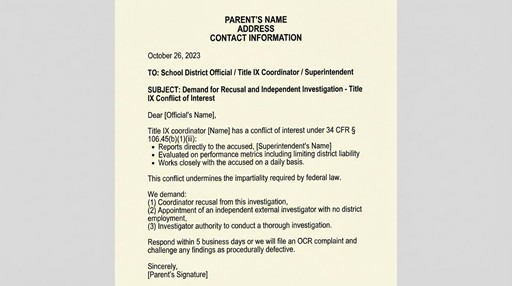
If coordinator reports to accused, is colleague of accused, evaluated based on limiting liability, lacks independent authority, or has other documented conflict, immediately send written demand before investigation proceeds: “Title IX coordinator [name] has conflict of interest violating 34 CFR § 106.45(b)(1)(iii): [describe specific conflict—reports to accused, evaluated on complaint management, works with accused daily]. This conflict undermines impartiality. We demand: (1) Coordinator recusal, (2) Independent external investigator with no district employment, (3) Investigator authority to conduct thorough investigation without district interference. Respond within 5 business days.”
Step 3: File OCR Complaint Alleging Procedural Violation If District Refuses
If district refuses independent investigator and proceeds with conflicted coordinator, immediately file OCR complaint (don’t wait for investigation to complete): “District’s Title IX coordinator has conflict of interest violating 34 CFR § 106.45(b)(1)(iii): [describe conflict with evidence—org chart showing reporting relationship, job description showing liability management criteria, documentation of relationship with accused]. District refused to appoint independent investigator despite documented conflict. Request OCR: (1) Investigate district’s Title IX procedures, (2) Require independent investigation of this complaint, (3) Mandate policy prohibiting conflicted coordinators.” Filing during investigation creates federal enforcement pressure.
Step 4: Challenge Investigation Findings as Product of Compromised Process
When investigation concludes, regardless of findings, send written challenge: “Investigation findings unreliable because coordinator conducting investigation had documented conflict of interest [specify conflict]. Title IX 34 CFR § 106.45(b)(1)(iii) prohibits conflicted investigators. Predictable outcome: [describe how findings protected institutional interests—exonerated accused, minimized violations, inadequate remedies]. Findings cannot satisfy Title IX requirement for impartial investigation. Demand independent external investigation with reliable findings.” Include this challenge in any OCR complaints, due process complaints, or litigation establishing investigation was procedurally defective.
Step 5: In Litigation, Establish Conflicted Investigation Cannot Satisfy Title IX Obligations
In federal Title IX lawsuit, dedicate section to procedural defects: “District’s Title IX investigation violated federal requirements. Coordinator had conflict of interest: [evidence of employment structure, reporting relationships, evaluation criteria, relationship to accused]. This conflict violated 34 CFR § 106.45(b)(1)(iii). Investigation conducted by conflicted coordinator cannot satisfy Title IX obligation for adequate response regardless of findings issued. Under Davis v. Monroe, deliberate indifference includes procedurally defective investigations. District’s use of conflicted investigator was clearly unreasonable response. Request: court-ordered independent investigation, damages for procedural violations, injunctive relief requiring independent Title IX procedures.”
Action Steps
1. Research Title IX Coordinator’s Employment Structure Before Investigation Begins
As soon as Title IX complaint filed, investigate coordinator’s position: Check district website/directory for coordinator’s title and reporting relationship. Request coordinator’s job description and evaluation criteria via public records. Identify whether coordinator reports to accused (if complaint involves principal/superintendent). Document whether coordinator is full-time dedicated role or part-time added duty. Research coordinator’s relationship to accused (same building, colleagues, supervisor-subordinate). Create written summary documenting potential conflicts before investigation starts. This information is foundation for conflict challenges.
2. Send Written Demand for Recusal and Independent Investigation Within 5 Days
If structural conflict identified (coordinator reports to accused, evaluated on limiting liability, colleague of accused), immediately send written demand before investigation proceeds: “Title IX coordinator [name] has conflict under 34 CFR § 106.45(b)(1)(iii): [specific conflict with evidence]. We demand: (1) Coordinator recusal, (2) Independent external investigator with no district employment/reporting relationship to accused, (3) Authority for thorough investigation without district approval. Respond within 5 business days. If district proceeds with conflicted coordinator, we will file OCR complaint alleging procedural violations and challenge findings as unreliable.”
3. File OCR Complaint Immediately If District Refuses Independent Investigation
If district denies independent investigator request and proceeds with conflicted coordinator, file OCR complaint during investigation (don’t wait for findings): “District’s Title IX coordinator has conflict violating 34 CFR § 106.45(b)(1)(iii): [evidence of conflict—org chart, job description, relationship to accused]. District refused independent investigator despite documented conflict. Request OCR: (1) Investigate Title IX procedures, (2) Order independent investigation of this complaint, (3) Mandate policy against conflicted coordinators. Attach: demand letter, district’s refusal, evidence of conflict.” OCR investigation during district investigation creates pressure for independent process.
4. Challenge Investigation Findings in Writing as Product of Compromised Process
When investigation concludes with findings (regardless of outcome), send written challenge within 5 days: “Investigation findings unreliable due to coordinator’s documented conflict [specify]. Federal law 34 CFR § 106.45(b)(1)(iii) prohibits conflicted investigators. Findings predictably protected district interests: [describe how—exonerated accused, minimal violations found, inadequate remedies]. Investigation conducted by conflicted coordinator cannot satisfy Title IX impartiality requirements. Findings are procedurally defective and will be challenged in all forums. Demand independent external investigation with reliable findings.” Include in OCR complaints and litigation.
5. In Litigation, Establish Investigation Was Procedurally Defective Due to Conflicts
In federal Title IX lawsuit, dedicate claims/sections to procedural violations: “District violated Title IX through use of conflicted investigator. Coordinator [name] had conflict: [employment structure evidence, reporting relationships, evaluation criteria creating institutional bias]. This violated 34 CFR § 106.45(b)(1)(iii) conflicts prohibition. Investigation by conflicted coordinator cannot satisfy Title IX adequate response requirement under Davis v. Monroe. Even if findings issued, procedurally defective investigation constitutes clearly unreasonable response. Request: independent court-ordered investigation, damages for procedural violations, injunctive relief requiring independent Title IX structures.” Establishes investigation itself was inadequate regardless of findings.
FAQs
1. What conflicts of interest disqualify Title IX coordinators under federal law?
Federal regulations (34 CFR § 106.45(b)(1)(iii)) prohibit Title IX coordinators from having conflicts of interest or bias. Disqualifying conflicts may include situations where the coordinator reports to the accused, has a close working or supervisory relationship with the accused, is evaluated based on minimizing complaints or limiting district liability, or lacks independent authority to act without approval from implicated leadership. Dual roles—such as simultaneously supporting the district’s legal defense while overseeing investigations—may also raise concerns. These structural issues can undermine the impartiality required under federal law.
2. Can Title IX coordinators who are district employees conduct impartial investigations?
While districts often designate internal employees as Title IX coordinators, impartiality may be difficult to maintain when structural conflicts exist. This can occur when the coordinator reports to district leadership involved in the complaint, is evaluated on outcomes tied to institutional interests, or depends on internal approval for investigative actions. In complex or high-level cases, districts may need to consider using an external investigator to ensure neutrality and maintain confidence in the process.
3. How do I request an independent external investigator when conflicts exist?
Submit a written request as soon as a potential conflict is identified. Clearly describe the concern and reference the requirement for impartial investigations. Request that the current coordinator be recused and that an independent external investigator with no employment or reporting ties to the district be assigned. Ask for a written response within a reasonable timeframe. Documenting this request helps preserve your ability to raise procedural concerns later if necessary.
4. What if the district proceeds with the same coordinator despite concerns?
If the district continues with a coordinator despite documented concerns, you may consider filing a complaint with the Office for Civil Rights (OCR) while the investigation is ongoing. It is also important to maintain a written record of your objections throughout the process and to note any potential impact on fairness or thoroughness. These records can be relevant if the findings are later challenged or reviewed.
5. Can investigation findings be challenged based on a conflict of interest?
Concerns about conflicts of interest may be raised when reviewing or appealing investigation findings. If a conflict affected the integrity of the process, it may support a request for further review, reconsideration, or an independent investigation. The strength of such a challenge depends on the specific facts, the nature of the conflict, and how it may have influenced the investigation.
Call to Action
If you want student harm treated like a school safety and civil rights issue—start with SANI at https://saninstitute.net
Sources
-
34 CFR § 106.45(b)(1)(iii) –
Title IX regulation prohibiting conflicts of interest or bias in Title IX coordinators, investigators, and decision-makers, establishing the federal requirement for impartiality that may be undermined by structural employment conflicts or institutional pressures.
https://www.ecfr.gov/current/title-34/subtitle-B/chapter-I/part-106/subpart-D/section-106.45 -
34 CFR § 106.8(a) –
Title IX regulation requiring designation of at least one Title IX coordinator to oversee compliance efforts, with interpretations emphasizing the need for sufficient authority and independence to carry out those responsibilities effectively.
https://www.ecfr.gov/current/title-34/subtitle-B/chapter-I/part-106/subpart-A/section-106.8 -
Davis v. Monroe County Board of Education, 526 U.S. 629 (1999) –
U.S. Supreme Court decision establishing the deliberate indifference standard under Title IX, recognizing that inadequate or biased responses to known harassment, including flawed investigations, may violate federal law.
https://supreme.justia.com/cases/federal/us/526/629/ -
California Government Code § 1090 –
State statute prohibiting public officials from having financial interests in decisions made in their official capacity, relevant in evaluating potential conflicts where institutional interests may influence decision-making roles.
https://leginfo.legislature.ca.gov/faces/codes_displaySection.xhtml?lawCode=GOV§ionNum=1090 -
OCR Resolution Agreement, Palo Alto Unified School District (2021) –
Federal enforcement action addressing concerns related to Title IX coordinator structure, including reporting relationships and independence, and outlining corrective measures to ensure compliance with federal requirements.
https://www2.ed.gov/about/offices/list/ocr/docs/investigations/more/09152001-a.pdf