

The documentation gap: when “no records” becomes the district’s defense
Table of Contents Click to Expand 1. Audio 2. Definition 3. Video 4. Core Thesis 5. Case Pattern Story 6. SANI Connection 7. Discipline Explanation
1. Audio
2. Definition
3. Video
4. Core Thesis
9. Action Steps
10. FAQs
11. Call to Action
12. Sources
13. Signature
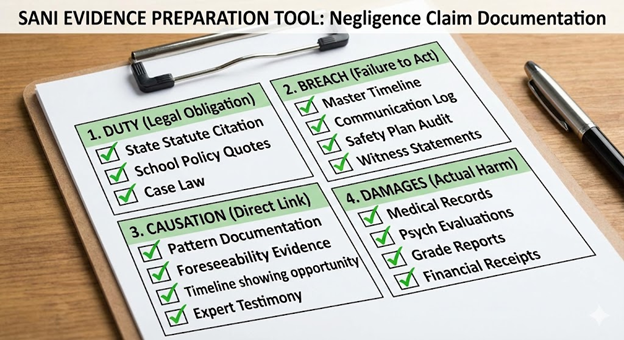
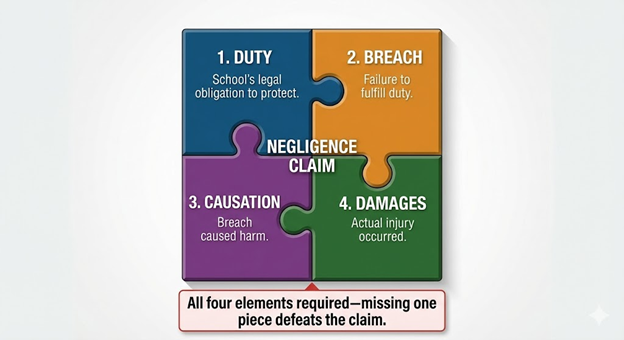
School negligence in student safety cases occurs when a school district or its employees breach their legal duty of care to protect students from foreseeable harm, directly causing measurable injury or damage. The four required elements are: (1) Duty (schools owe students a duty to provide reasonable supervision and protection), (2) Breach (the school failed to meet that duty through action or inaction), (3) Causation (the breach directly caused or substantially contributed to the harm), and (4) Damages (the student suffered actual, documentable injury—physical, emotional, educational, or financial). Negligence is proven through documentation showing the school knew or should have known about the risk, had the ability to prevent the harm, and failed to take reasonable protective action.
Parents often say “the school was negligent” without understanding what that term legally means—or how to prove it. The Student Advocacy Network Institute, a Policy-Driven Student Safety Agency, operates on this principle: negligence is not a feeling—it’s a legal standard with four specific elements that must be proven with evidence. We convert trauma into code by teaching parents to think like attorneys: document duty (what the school was legally required to do), document breach (what they failed to do), document causation (how their failure caused harm), and document damages (what harm occurred). Schools escape accountability when parents cannot prove all four elements. Schools face liability when parents systematically document each element using the Case File System, Master Timeline, and Pattern Documentation. Selective enforcement IS discrimination—and negligence claims become more powerful when combined with proof that similarly situated students received protection while your child did not. This article provides the complete legal framework and evidentiary roadmap for proving school negligence.
The Student Advocacy Network Institute exists because most parents understand emotionally that “the school was negligent” but cannot prove it legally. As the nation’s first Policy-Driven Student Safety Agency, SANI operates at the intersection of legal standards, evidence preservation, and accountability enforcement.
When a parent contacts SANI and says, “I want to sue the school for negligence,” we ask: “Can you prove all four elements?”
Element 1: Duty
This is usually not disputed—schools have a well-established duty to supervise and protect students.
Element 2: Breach
This requires evidence: What specific actions did the school fail to take? What did you ask them to do? What did they promise? What did they actually do? What should they have done under the circumstances?
Element 3: Causation
This is where many cases fail. Parents must prove: The school’s failure directly caused or substantially contributed to the harm. Not that the school “could have prevented it” in hindsight, but that the harm was foreseeable and preventable through reasonable action the school failed to take.
Element 4: Damages
This requires documentation: Medical records, psychological evaluations, academic decline, financial costs, loss of opportunities.
We convert trauma into code by teaching parents that negligence is a documentation game. The parent who documents beats the parent who doesn’t—even when both children suffered identical harm.
SANI treats student harm as both a school safety issue and a civil rights issue because negligence claims become significantly more powerful when combined with civil rights violations. When you can prove:
You transform a negligence claim into a civil rights claim with enhanced remedies, longer statutes of limitations, and attorney’s fees provisions.
Selective enforcement IS discrimination—and negligence claims expose it by forcing schools to explain why some students received protection while others did not.
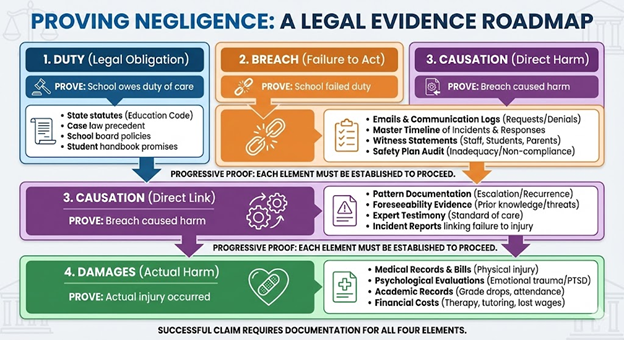
Negligence is a tort—a civil wrong that allows injured parties to seek compensation. In school safety cases, negligence follows the same four-element framework used in all negligence claims.
Legal Definition: The defendant (school) owed the plaintiff (student) a legal duty to act with reasonable care to prevent foreseeable harm.
Schools’ Duty to Students:
Schools stand in a special relationship to students called in loco parentis (in place of parents). This creates a heightened duty beyond what strangers owe each other.
Sources of Duty:
Statutory Duty (Laws Creating Obligations):
Common Law Duty (Court-Recognized Obligations):
Contractual/Policy Duty:
Scope of Duty:
Schools’ duty extends to:
Duty ends when:
How to Prove Duty:
Duty is rarely disputed in school cases because it’s well-established. To document:
Example: “Under [STATE] Education Code § [XXX], schools have a statutory duty to provide safe learning environments. Under [State Case Name], schools have a common law duty to protect students from foreseeable harm when they have notice of specific threats. The school’s own handbook states: ‘We are committed to providing a safe environment for all students.’ These sources establish the school’s duty to my child.”
Legal Definition: The defendant (school) failed to meet the standard of care required by the duty—they acted unreasonably under the circumstances.
Standard of Care:
The question is: What would a reasonable school do under similar circumstances?
Not: What would a perfect school do?
Not: What does hindsight say should have been done?
Factors Courts Consider:
Common Forms of Breach in School Safety Cases:
Failure to Supervise:
Failure to Investigate:
Failure to Intervene:
Failure to Follow Policy:
Failure to Respond Adequately:
Failure to Warn/Notify:
How to Prove Breach:
This is where documentation becomes critical:
Document What School Was Required to Do:
Document What School Actually Did (or Didn’t Do):
Document Pattern of Inadequacy:
Example: “On 9/15, I reported Pattern of bullying to Principal (Email attached). On 9/22, no response received (Communication Log, Entry 3). On 10/1, I escalated, requesting formal investigation and safety plan (Email attached). On 10/8, school provided vague ‘safety plan’ consisting of unsupervised promises with no specifics (Safety Plan Audit shows 8/35 score—inadequate). On 10/20, I documented plan not being implemented—no supervision occurring (Email attached, Timeline Entry 12). School had notice, foreseeability, and opportunity but failed to provide adequate protection. This is breach.”
Legal Definition: The defendant’s breach of duty directly caused or substantially contributed to the plaintiff’s harm.
Two Types of Causation:
Example: But for the school’s failure to supervise the bathroom, the assault that occurred in the unsupervised bathroom would not have happened.
Example: If a school fails to supervise, student assault is a foreseeable result. Student being struck by lightning is not a foreseeable result of failure to supervise.
Challenges in Proving Causation:
Schools argue: “We didn’t cause the harm—the aggressor caused the harm. We can’t be held responsible for another student’s actions.”
Response: Schools can be liable when their breach created the conditions that allowed the harm to occur or failed to prevent foreseeable harm they had the ability to stop.
Proving Causation in School Safety Cases:
Step 1: Establish Foreseeability: Show the harm was predictable based on:
Step 2: Show Opportunity to Prevent: Prove the school had:
Step 3: Connect Breach to Harm: Show how the school’s specific failures directly enabled the harm:
Step 4: Rebut Intervening Causes: Schools may argue something else caused the harm. You must show:
Expert Testimony:
In complex cases, expert witnesses (school safety experts, threat assessment professionals) can testify:
Example: “Over 3 months, I documented 12 incidents of escalating harassment (Timeline attached). Each incident was reported to the school (Communication Log attached). The school failed to implement adequate supervision or safety measures (Safety Plan Audit attached). The assault occurred in the hallway—a location I specifically identified as needing supervision—during the passing period when aggressors had access to my child. The assault was committed by the same students I reported 12 times. Expert testimony confirms this assault was foreseeable and preventable. But for the school’s failure to adequately supervise and separate the students, this assault would not have occurred at this location and time. This is causation.”
Legal Definition: The plaintiff (student) suffered actual, measurable harm as a result of the breach.
Types of Damages in School Safety Cases:
Physical Damages:
Emotional/Psychological Damages:
Educational Damages:
Economic Damages:
Loss/Change Damages:
Punitive Damages (in some jurisdictions):
How to Prove Damages:
Medical Documentation:
Psychological Documentation:
Educational Documentation:
Financial Documentation:
Personal Impact:
Example: “My child suffered documented harm:
These are actual, measurable damages directly caused by the school’s breach.”
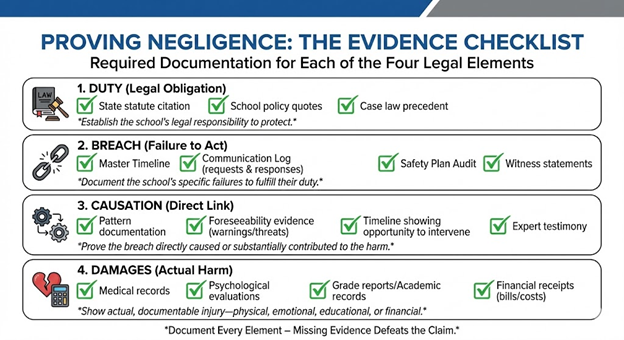
Create a “Duty Documentation” section in your Case File:
Statutory Duty:
Policy Duty:
Contractual Duty (if applicable):
Case Law (optional but powerful):
Why This Matters: Establishing duty early means you’ve checked Box 1. You can cite these sources in every communication with the school.
Every time the school fails to act adequately, document it:
What You Requested vs. What You Received:
Date | What I Requested | What School Provided | Gap (Breach) |
9/15 | Formal investigation within 5 days | No response received | Timeline violation + failure to investigate |
10/1 | Comprehensive safety plan with specific supervision | Vague promises “we’ll monitor” | Inadequate safety planning |
10/8 | Named staff, specific times, documented logs | No specifics provided | Failure to provide enforceable protection |
Pattern of Inadequacy:
Comparative Evidence (Powerful):
Causation requires showing the harm was foreseeable and preventable:
Foreseeability Documentation:
Create a “Pattern Escalation Chart”:
Incident # | Date | Severity Level | School Notified? | School Response | Escalation Indicator |
1 | 9/5 | Verbal (name-calling) | Yes, 9/6 | “We’ll talk to them” | Starting point |
2 | 9/10 | Verbal + following | Yes, 9/11 | “Boys will be boys” | Stalking behavior introduced |
3 | 9/15 | Verbal + shoving | Yes, 9/15 | “Mutual conflict” | Physical contact |
4 | 9/20 | Threats | Yes, 9/21 | “We addressed it” | Verbal threats of violence |
…continuing pattern… |
|
|
|
|
|
12 | 10/25 | ASSAULT | Yes, 10/25 | NOW they investigate | FORESEEABLE ESCALATION |
This chart proves:
Opportunity Documentation:
Expert Support (if pursuing legal action):
Medical/Physical:
Psychological/Emotional:
Educational:
Financial:
Personal Impact Journal:
Damages Summary Document:
Create spreadsheet:
Category | Specific Item | Amount | Documentation |
Medical | ER visit 10/25/24 | $3,500 | Receipt attached |
Medical | Follow-up doctor 10/30/24 | $250 | Receipt attached |
Psychological | Psych evaluation 11/5/24 | $600 | Receipt attached |
Psychological | Therapy sessions (8 weeks @ $200/week) | $1,600 | Receipts attached |
Psychological | Estimated ongoing (2 years @ $200/week x 52) | $20,800 | Provider estimate |
Educational | Tutoring (40 weeks @ $225/week) | $9,000 | Contract attached |
Lost wages | Parent time off (12 days @ $200/day) | $2,400 | Pay stubs attached |
TOTAL TO DATE |
| $38,150 |
|
When you’re ready to escalate (to district, attorney, or court), compile:
The Four-Element Negligence Brief:
SUMMARY OF NEGLIGENCE CLAIM
[School] owed [Student] a duty to provide reasonable supervision and protection from foreseeable harm.
Legal Basis:
Evidence: [Attached as Exhibit A]
[School] breached its duty by failing to adequately respond to 12 documented incidents over 3 months despite repeated parental notice.
Specific Failures:
Evidence:
III. CAUSATION
[School]’s breach directly caused the assault on [Date]. The assault was:
Evidence:
[Student] suffered documented harm:
Evidence:
CONCLUSION
All four elements of negligence are established by documentary evidence. [School] is liable for damages caused by its breach of duty.
This package can be provided to:
Negligence in school safety is proven by establishing four required elements:
• Duty: The school owed a legal obligation to protect the student from harm.
• Breach: The school failed to meet that duty through inadequate action.
• Causation: The breach directly caused or substantially contributed to the student's harm.
• Damages: The student suffered actual, documentable injury.
All four elements must be supported with evidence. Missing even one defeats the claim.
• Negligence: Failure to act reasonably, causing harm. Judged by "what would a reasonable school do?"
• Civil rights violation: Discrimination or deliberate indifference based on protected class (race, sex, disability).
Both can exist at the same time. Negligence claims use state law, shorter statute of limitations, and allow compensatory damages. Civil rights claims use federal law, longer statute, and allow compensatory, punitive damages, and attorney's fees. Combining both creates the strongest case.
• Actual notice: You told the school directly (emails, meetings, written complaints).
• Constructive notice: Circumstances made the danger obvious to a reasonable school (incidents witnessed by staff, recurring patterns).
Evidence includes: Master Timeline, Communication Log, witness statements, and documentation showing danger was obvious or repeated.
Yes. Negligence is judged on whether the response was adequate, not on whether the school attempted something.
Examples of inadequate responses: vague safety plans, delayed investigations, insufficient supervision. If the school's response was clearly insufficient given the risk, it can still be negligent.
Schools are responsible for reasonable supervision and protective measures. They are not guarantors of absolute safety, but they are liable if they fail to prevent foreseeable harm.
If the school had notice, the ability to intervene, and failed to act, they can be held responsible even if another student caused the harm.
Contemporaneous documentation is critical: emails (not phone calls), Master Timeline, Communication Log, incident reports, medical records, academic records, and financial records.
Strong documentation can make or break a case. Courts and juries rely on evidence, not memory.
• Economic damages: Medical bills, therapy costs, tutoring, lost wages, future needs.
• Non-economic damages: Pain, suffering, emotional distress, loss of enjoyment of life.
• Sometimes: Punitive damages if conduct was willful or egregious.
Amounts vary by severity, permanence, financial costs, and jurisdiction limits. Most school cases settle to avoid public trials.
If you want student harm treated like a school safety and civil rights issue—start with SANI at https://saninstitute.net
The Student Advocacy Network Institute (SANI) is a national research, accountability, and discipline institute founded by Bullying Is A Drug to define, document, and address institutional failure in K–12 education—treating student harm as a school safety and civil rights issue.
Explore the Institute:
https://saninstitute.net
Parent A: Claims Negligence Without Proof (Fails)
A student is bullied for three months. The parent reports to the school multiple times. The bullying continues and eventually escalates to assault causing injury.
Parent files lawsuit claiming negligence. In court, parent testifies emotionally: “The school was negligent. They knew this was happening and did nothing. My child was hurt because they didn’t protect him.”
School’s attorney cross-examines:
Attorney: “You say the school ‘knew’—what evidence do you have that the school had notice?”
Parent: “I told them! I called and talked to the counselor.”
Attorney: “Do you have documentation of that call? Date, time, who you spoke with, what was said?”
Parent: “No, but I definitely called.”
Attorney: “Do you have emails, written complaints, or any record proving the school had notice?”
Parent: “I talked to them in person. They should have written it down.”
Attorney: “You say the school ‘did nothing’—but the school provided evidence that they spoke with the students involved and created a safety plan. Do you have evidence they failed to implement that plan?”
Parent: “The bullying continued, so obviously they didn’t do enough.”
Attorney: “But can you prove what specific actions they failed to take?”
Parent: “They just… didn’t protect him.”
Attorney: “You claim the assault was caused by the school’s failure—but isn’t it true the assault was caused by the actions of another student, not the school?”
Parent: “The school should have stopped it!”
Attorney: “Do you have evidence showing the school could have foreseen this specific assault?”
Parent: “There was a pattern! It kept happening!”
Attorney: “Do you have documentation of this pattern? Dates, descriptions, evidence you reported each incident?”
Parent: “I know I reported it…”
Result: Case dismissed. Court rules that parent failed to prove:
Parent loses because of missing documentation and inability to prove breach and causation.
Parent B: Documents Every Element (Succeeds)
Same scenario—three months of bullying escalating to assault. But this parent documented everything using the SANI methodology.
Evidence Presented:
ELEMENT 1—DUTY:
ELEMENT 2—BREACH:
Attorney: “The evidence shows my client reported 12 incidents over 3 months. The school’s response was inadequate—no formal investigation, no enforceable safety plan, no documented supervision, no aggressor consequences. When my client demanded specific protections, the school refused. This is breach of duty.”
ELEMENT 3—CAUSATION:
Attorney: “The assault occurred because the school failed to act despite repeated notice. This is direct causation—but for the school’s breach, this harm would not have occurred.”
ELEMENT 4—DAMAGES:
Result: School settles case for substantial sum. Evidence was overwhelming—all four elements proven beyond dispute.
The difference: Parent B documented every element systematically.
Table of Contents Click to Expand 1. Audio 2. Definition 3. Video 4. Core Thesis 5. Case Pattern Story 6. SANI Connection 7. Discipline Explanation
Table of Contents Click to Expand 1. Audio 2. Definition 3. Video 4. Core Thesis 5. Case Pattern Story 6. SANI Connection 7. Discipline Explanation
Table of Contents Click to Expand 1. Audio 2. Definition 3. Video 4. Core Thesis 5. Case Pattern Story 6. SANI Connection 7. Discipline Explanation
Table of Contents Click to Expand 1. Audio 2. Definition 3. Video 4. Core Thesis 5. Case Pattern Story 6. SANI Connection 7. Discipline Explanation