

The documentation gap: when “no records” becomes the district’s defense
Table of Contents Click to Expand 1. Audio 2. Definition 3. Video 4. Core Thesis 5. Case Pattern Story 6. SANI Connection 7. Discipline Explanation
1. Audio
2. Definition
3. Video
4. Core Thesis
9. Action Steps
10. FAQs
11. Call to Action
12. Sources
13. Signature
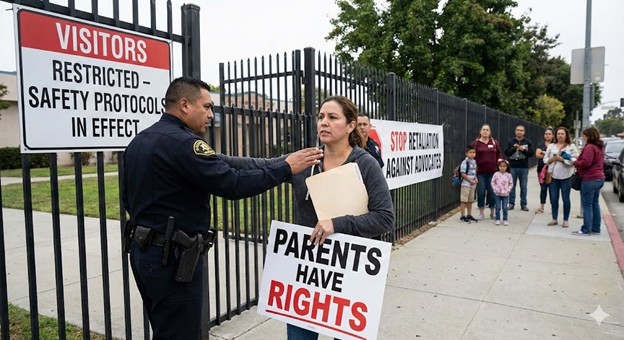
Campus bans for parent advocacy occur when schools issue directives prohibiting parents from entering school property, attending school events, or communicating with staff—ostensibly for “safety,” “disruption,” or “harassment” concerns—but which in practice function as retaliation for parents exercising their legal rights to advocate for their children’s safety, demand investigations of harassment or discrimination, file complaints, or publicly challenge school policies and failures.
Under federal civil rights laws (Title VI, Title IX, Section 504) and the First Amendment, schools cannot ban parents as retaliation for protected advocacy activities including filing discrimination complaints, reporting safety violations, demanding accountability for civil rights violations, or exercising free speech rights to criticize school policies—and when schools do impose such bans, parents have multiple legal remedies including OCR retaliation complaints, Section 1983 civil rights lawsuits for First Amendment violations, state-level appeals under California Education Code Section 44811, and injunctive relief to restore campus access, with schools facing liability when bans are pretextual, lack due process, or disproportionately target parents advocating for students of color, disabled students, or harassment victims.
Schools weaponize campus bans against parents who demand accountability for safety failures, civil rights violations, or institutional misconduct—using vague claims of “threatening behavior,” “disruption,” or “harassment” to silence parents whose advocacy exposes the school’s failures, while providing no due process, no specific evidence, and no meaningful right to challenge the ban. We convert trauma into code by documenting the timeline showing the ban occurred immediately after protected advocacy (filing OCR complaints, demanding investigations, speaking at board meetings, retaining attorneys), proving the “safety concern” is pretextual retaliation designed to isolate the student, punish the family, and deter other parents from advocating. Selective enforcement IS discrimination when schools tolerate—or even welcome—aggressive, confrontational behavior from wealthy white parents who advocate for gifted programs, sports funding, or teacher assignments, while issuing campus bans against Black, Latino, or immigrant parents who advocate for their children’s civil rights, proving the ban is not about conduct but about whose advocacy the school values. This article proves that campus bans are almost never about legitimate safety—they are institutional power plays designed to silence dissent, and when properly challenged through OCR retaliation complaints, First Amendment litigation, and state appeals, schools are forced to lift the ban or face documented evidence that they retaliated against protected activity.

The Student Advocacy Network Institute (SANI) is a Policy-Driven Student Safety Agency that identifies campus bans as retaliation disguised as safety measures—a systematic tactic where schools use their authority to control campus access to punish parents whose advocacy threatens institutional reputation, exposes failures, or creates legal liability.
SANI documents the temporal proximity between protected advocacy and the ban—proving causation through timelines showing the ban was issued days or weeks after: filing complaints, retaining attorneys, speaking publicly, demanding investigations, or reporting to external agencies. This timeline evidence defeats the school’s “safety concern” narrative and proves the ban was retaliatory.
SANI’s enforcement work centers safety and civil rights, not parent convenience. Campus bans are not administrative decisions about orderly operations—they are weaponized retaliation that isolates vulnerable students, silences families, and creates chilling effects that deter other parents from advocating, making campus bans a civil rights enforcement priority requiring immediate OCR complaints and legal intervention.

Campus bans involve the intersection of school administrative authority, parent rights, First Amendment protections, and federal civil rights anti-retaliation provisions. Understanding this legal framework helps parents challenge unlawful bans.
Schools have legitimate authority to maintain safe, orderly educational environments. Campus restrictions may be lawful when based on genuine safety threats or substantial disruption, including:
Legitimate Grounds for Campus Restrictions:
Critical Standard: The conduct must be specific, documented, and objectively threatening or disruptive—not merely uncomfortable for staff or critical of school policies.
Schools violate parent rights when campus restrictions are based on:
Unlawful Grounds for Campus Restrictions:
Title VI, Title IX, and Section 504 all contain explicit anti-retaliation provisions prohibiting schools from taking adverse action against individuals who:
What Qualifies as Retaliation:
Under OCR guidance, retaliation includes any action that would deter a reasonable person from engaging in protected activity. Campus bans clearly meet this standard—they:
Causation Standard:
Parents must prove the ban was because of the protected activity. Evidence includes:
Example: Mother files Title VI complaint September 10. No prior conduct issues. Campus ban issued September 29 citing “safety concerns” with no specific incidents. Temporal proximity (19 days) + lack of prior issues + vague justification = strong retaliation case.
Public schools are government entities bound by the First Amendment. Parents have constitutional rights to:
Protected Speech:
Limits on School Retaliation:
Schools cannot punish parents for speech unless it:
Criticism, even harsh criticism, is protected. Calling the principal “incompetent” or “negligent” or “racist” may be offensive but is constitutionally protected opinion and cannot justify campus ban.
Viewpoint Discrimination:
Schools cannot ban parents based on the content or viewpoint of their speech. If schools allow parents to speak positively about school but ban parents who speak critically, that’s viewpoint discrimination violating the First Amendment.
California Education Code Section 44811:
Authorizes school officials to direct persons to leave campus if they:
However, this authority is limited by:
Due Process Requirements:
Even when grounds for restriction exist, schools must provide:
California Education Code Section 32210:
Requires schools to have written policies on campus access restrictions, including procedures for appeal and review.
Absence of these procedures = violation of California law.
Lawful Campus Ban Checklist:
For a campus ban to be legally defensible, schools must show:
✓ Specific conduct (not vague claims)
✓ Documented evidence (witnesses, video, reports)
✓ Objective threat or disruption (not staff discomfort)
✓ No protected activity involved (or conduct unrelated to protected activity)
✓ Written notice with specific allegations
✓ Opportunity to respond before or immediately after restriction
✓ Written decision with findings
✓ Appeal process provided
✓ Defined duration with review date
✓ Neutral application (not selective enforcement)
Most campus bans fail multiple elements of this checklist.
Parents facing unlawful campus bans have multiple avenues for relief:
File with U.S. Department of Education Office for Civil Rights within 180 days of the ban. OCR will investigate whether the ban constituted retaliation for protected advocacy (filing complaints, opposing discrimination).
Possible Outcomes:
Sue school district under 42 U.S.C. § 1983 for First Amendment violation and/or retaliation. Seek:
Appeal to school board under California Education Code Section 44811, then to County Board of Education, then to California State Board of Education if necessary.
File complaint with district alleging violation of parent participation rights, then appeal to California Department of Education if district’s response is inadequate.
Seek emergency court order immediately lifting the ban pending full hearing. Courts often grant TROs when:
To successfully challenge a campus ban, parents must document:
List all protected advocacy activities with dates:
Document how soon after protected activity the ban was issued. Closer in time = stronger retaliation inference.
If you had no prior conduct issues, gather:
This proves the ban wasn’t based on pattern of conduct but on recent protected activity.
Document inconsistencies in school’s justification:
Gather evidence that other parents engage in identical or worse conduct without bans:
Document how the ban harms your child:
This shows the ban’s real-world harm beyond just parent inconvenience.

This framework ensures parents can prove campus bans are retaliatory, challenge them effectively, and restore campus access through administrative and legal remedies.
The moment you receive a campus ban notice, create a comprehensive timeline of your advocacy activities in the 180 days before the ban: dates you filed complaints (OCR, state, district), retained attorney, spoke at board meetings, posted on social media criticizing the school, demanded investigations, requested records, advocated for IEP/504 protections. This timeline proves protected activity occurred before the ban, establishing potential causation.
Calculate the time between your most recent protected activity and the ban issuance. Bans issued within days or weeks of protected activity create strong inference of retaliation. Document: “I filed Title VI complaint on October 1. Campus ban issued October 15—14 days later with no intervening conduct justifying restriction.” Close temporal proximity shifts burden to school to prove legitimate, non-retaliatory reason.
Within 48 hours of receiving the ban, send written response: “I demand: (1) written specification of the exact conduct justifying this restriction with dates, times, locations, and witnesses; (2) all evidence supporting the allegations; (3) opportunity to respond to allegations before restriction takes effect or continues; (4) written decision with findings; (5) appeal process and timeline. Your failure to provide due process violates California Education Code Section 44811 and creates additional legal liability.”
Within one week, collect evidence that other parents engage in identical or more aggressive conduct without facing bans: witness statements from other parents, board meeting videos showing confrontational parents, documentation of wealthy/connected parents making aggressive demands, records of your own years of campus access without incident before protected advocacy. This proves the ban is pretextual—not based on conduct but on your advocacy.
Within 14 days of the ban, file OCR retaliation complaint (https://ocrcas.ed.gov/) alleging the ban was issued in retaliation for filing discrimination complaints or opposing discriminatory practices. Simultaneously consult attorney about: (1) Section 1983 lawsuit for First Amendment violation, (2) temporary restraining order for immediate relief, (3) California state-level appeals. Multiple enforcement mechanisms create pressure for school to lift the ban quickly.
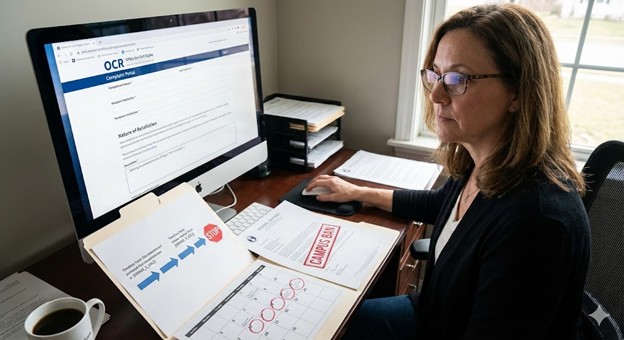
Within 24 hours of receiving a campus ban, document every protected activity you engaged in during the six months before the ban: filing complaints (OCR, state, district, school board), retaining attorney, sending demand letters, speaking at board meetings, posting on social media criticizing school, requesting investigations or public records, advocating at IEP/504 meetings, reporting to external agencies. Include exact dates. This timeline proves protected activity preceded the ban—establishing causation for retaliation claim.
Identify your most recent protected activity before the ban and calculate the days between. Write explicitly: “I filed Title VI complaint on [date]. Campus ban issued on [date]—[X] days later. No conduct incidents occurred between complaint and ban. This temporal proximity establishes retaliation.” Bans issued within 1-30 days of protected activity create strong inference of retaliation that shifts burden to school to prove legitimate reason.
Send immediate written response to school: “Your campus ban provides no specific conduct, no evidence, no due process. I demand within 5 business days: (1) written specification of exact conduct justifying restriction with dates/times/locations/witnesses, (2) all evidence, (3) opportunity to respond, (4) written decision with findings, (5) appeal process. California Education Code Section 44811 requires due process. Your failure violates state law and federal civil rights protections.”
Within one week, collect evidence of selective enforcement: ask other parents to provide witness statements about aggressive, confrontational parents who face no restrictions; obtain board meeting videos showing other parents being loud, demanding, or critical without consequences; document your own years of positive campus involvement before protected advocacy began. This proves the ban is pretextual—based on your advocacy, not your conduct.
Within 14 days, file OCR complaint at https://ocrcas.ed.gov/ alleging: “School issued campus ban [date] in retaliation for my filing Title VI complaint [date] and advocating for my child’s civil rights. Temporal proximity: [X] days. No legitimate conduct justification provided. This violates Title VI anti-retaliation provisions.” Simultaneously consult attorney about Section 1983 lawsuit, temporary restraining order, and California state appeals. Multiple enforcement actions force school to defend indefensible ban.
No—schools cannot ban parents as retaliation for protected advocacy including filing discrimination complaints, demanding investigations, speaking at board meetings, retaining attorneys, or criticizing school policies. Such bans violate Title VI, Title IX, and Section 504 anti-retaliation provisions, and the First Amendment. Schools can only restrict campus access for genuine safety threats, criminal conduct, or substantial material disruption—not for exercising civil rights or free speech.
Analyze temporal proximity: Was the ban issued days or weeks after you filed a complaint, retained an attorney, or spoke publicly? Check for specificity: Does the ban cite specific threatening conduct with dates/times/witnesses, or vague claims like "making staff uncomfortable"? Examine your history: Did you have years of campus access without incident before protected advocacy? Review due process: Did the school provide written allegations, evidence, opportunity to respond, and appeal rights? Retaliation shows temporal proximity, vague justifications, and lack of due process.
Within 48 hours: (1) Document timeline of all protected advocacy activities in the past 180 days, (2) Calculate days between most recent protected activity and the ban, (3) Send written demand for specificity, evidence, and due process, (4) Begin gathering evidence of selective enforcement (other parents' tolerated conduct), (5) Consult attorney about OCR retaliation complaint and legal remedies. Do not wait—immediate response preserves rights and creates pressure for school to rescind.
Temporal proximity is the time between protected activity (filing complaint, retaining attorney, public criticism) and the adverse action (campus ban). Close temporal proximity—especially within days or weeks—creates strong inference of retaliation because it's unlikely to be coincidental. Courts and OCR view bans issued within 1-30 days of protected activity as presumptively retaliatory, shifting burden to school to prove the ban was based on legitimate, non-retaliatory reasons.
No—firmness, insistence, or critical tone in advocating for your child are protected. Schools cannot ban parents for speech that makes staff "uncomfortable" unless it constitutes true threats, harassment (severe, persistent, targeted conduct beyond advocacy), or substantial material disruption of school operations. Demanding investigations, asking difficult questions, challenging decisions, or expressing frustration are protected advocacy and speech—not grounds for campus restriction.
California Education Code Section 44811 and constitutional due process require: (1) written notice with specific allegations of conduct, (2) evidence supporting the allegations, (3) opportunity to respond and present counter-evidence, (4) written decision with findings, (5) appeal process with timeline, (6) defined duration with review date. Schools that issue bans without these elements violate procedural due process, providing independent grounds to challenge and overturn the ban.
Multiple remedies exist: (1) OCR retaliation complaint (schools face federal investigation, potential loss of funding), (2) Section 1983 federal lawsuit for First Amendment violation and retaliation (injunctive relief, damages, attorney fees), (3) Temporary restraining order (immediate court-ordered lifting of ban), (4) California state-level appeals (school board, county board, state board), (5) California Uniform Complaint (state investigation and potential sanctions). Simultaneously pursuing multiple remedies creates maximum pressure for schools to rescind unlawful bans.
If you want student harm treated like a school safety and civil rights issue—start with SANI at https://saninstitute.net
The Student Advocacy Network Institute (SANI) is a national research, accountability, and discipline institute founded by Bullying Is A Drug to define, document, and address institutional failure in K–12 education—treating student harm as a school safety and civil rights issue.
Explore the Institute:
https://saninstitute.net
A Black mother in San Diego advocates for her son, who has been subjected to racial harassment at his middle school. Over three months, she:
The harassment continues. The school conducts what she documents as a “sham investigation”—interviewing only the accused students, not the witnesses her son identified.
One week after the attorney’s demand letter, the mother receives a letter from the principal:
“Dear Mrs. [Name],
Due to recent interactions that have created safety concerns among our staff, you are hereby restricted from entering school property except for pre-scheduled meetings in the main office. You may not attend school events, volunteer activities, or approach staff members on campus. This restriction is necessary to maintain a safe and orderly educational environment. Violation of this directive may result in criminal trespass charges.
Sincerely,
Principal [Name]”
The letter provides no specific allegations, no examples of “threatening” conduct, no opportunity to respond, no appeal process, and no timeline for the restriction’s duration.
The mother is devastated. She cannot attend her son’s basketball games, cannot volunteer for class parties, cannot pick him up at the classroom door, cannot speak with his teachers informally. Other parents whisper. Her son is humiliated, isolated, marked as the child of “that parent who got banned.”
The harassment against her son intensifies—students mock him, saying “your mom got kicked out for being crazy.”
The mother’s attorney immediately responds:
“Your campus ban is unlawful retaliation under Title VI and the First Amendment. The timeline proves causation:
**- September 10: Mother filed Title VI complaint
You provide no specific conduct justifying the ban, no due process, and no evidence of any safety threat. This ban occurred immediately after protected advocacy and serves no legitimate purpose except to punish my client for exercising her civil rights.
We demand immediate rescission of the ban and written confirmation of its removal. If you refuse, we will file an OCR retaliation complaint under Title VI, a Section 1983 lawsuit for First Amendment violation, and seek injunctive relief and damages.
Additionally, the ban itself creates a new Title VI violation—my client’s son is now experiencing intensified harassment directly resulting from the school’s retaliation against his mother. Students are mocking him about the ban. This creates compounded harm the school is liable for.”
The school’s attorney reviews the timeline and realizes the school cannot defend the ban. The principal admits in deposition preparation that the “safety concerns” were based on: (1) the mother’s “tone” in emails (which were firmly worded but professional), (2) her criticism of the school at a public board meeting (protected speech), and (3) staff feeling “uncomfortable” after the attorney’s demand letter (not a safety threat).
The school rescinds the ban with a written apology and agrees to: (1) train all staff on retaliation prohibitions, (2) revise campus access policies to include due process, (3) investigate the intensified harassment against the son, and (4) provide compensatory services and transfer options if requested.
The record breaks when discovery reveals an internal email from the superintendent to the principal sent one day after the board meeting: “We need to find a way to limit [mother’s] access to campus. She’s causing problems and making us look bad. Draft a letter.”
Table of Contents Click to Expand 1. Audio 2. Definition 3. Video 4. Core Thesis 5. Case Pattern Story 6. SANI Connection 7. Discipline Explanation

Table of Contents Click to Expand 1. Audio 2. Definition 3. Video 4. Core Thesis 5. Case Pattern Story 6. SANI Connection 7. Discipline Explanation
Table of Contents Click to Expand 1. Audio 2. Definition 3. Video 4. Core Thesis 5. Case Pattern Story 6. SANI Connection 7. Discipline Explanation

Table of Contents Click to Expand 1. Audio 2. Definition 3. Video 4. Core Thesis 5. Case Pattern Story 6. SANI Connection 7. Discipline Explanation