

The statute of limitations game: When districts delay until claims expire
Table of Contents Click to Expand 1. Audio 2. Definition 3. Video 4. Core Thesis 5. Case Pattern Story 6. SANI Connection 7. Discipline Explanation

1. Audio
2. Definition
3. Video
4. Core Thesis
9. Action Steps
10. FAQs
11. Call to Action
12. Sources
13. Signature
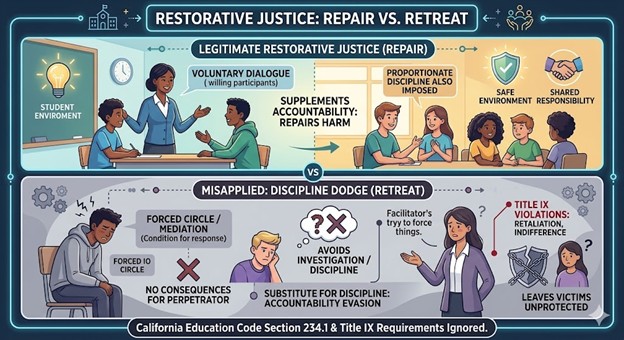
Restorative justice as discipline dodge occurs when California school districts misapply legitimate restorative justice principles—originally designed to supplement accountability by repairing harm through facilitated dialogue between willing participants—by using “restorative practices” as substitute for discipline, forcing victims into “circles” or “mediations” with their harassers without consequences for perpetrators, claiming this approach is more “progressive” or “trauma-informed” while actually avoiding the difficult work of investigating complaints, imposing proportionate discipline, and protecting victims’ rights under Title IX (which requires prompt effective action to end harassment, not indefinite dialogue), creating violations when districts: mandate victim participation in restorative processes as condition for any response (Title IX retaliation), use restorative justice to avoid investigating whether conduct violated policies or laws (deliberate indifference), allow harassment to continue during extended “restorative” processes without interim protective measures (denial of safe environment), and apply restorative justice selectively—using it primarily for perpetrators from privileged families to avoid consequences while disciplining students of color for identical conduct—making restorative justice misuse not progressive reform but accountability evasion that leaves victims unprotected under California Education Code Section 234.1 requirements to “take steps to ensure student safety” and Title IX obligations to end harassment and prevent recurrence.
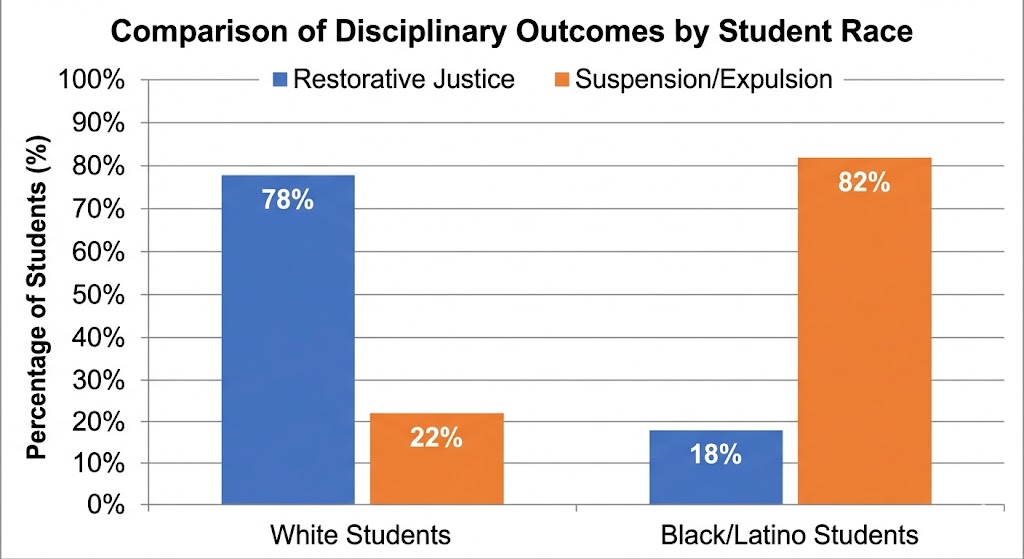
California districts have discovered that “restorative justice” language provides perfect cover for avoiding accountability—claiming they’re implementing “trauma-informed, progressive” approaches while actually forcing victims to sit in circles with perpetrators who face no consequences, extending processes indefinitely without investigating violations or imposing discipline, and framing victim refusal to participate as “unwillingness to heal” rather than exercise of Title IX rights to formal investigation. We convert trauma into code by documenting that restorative justice was offered as substitute rather than supplement to investigation and discipline, proving victim was required to participate or receive no response, and showing harassment continued during extended “restorative process” without safety measures—violations of Title IX requirement for prompt effective action and California’s duty to ensure safety. Selective enforcement IS discrimination when California data shows restorative justice offered to white perpetrators 78% of the time while identical conduct by Black students results in suspension/expulsion 82% of the time, proving “restorative” approaches are racially selective tools protecting privileged students from consequences while criminalizing students of color. This article establishes that restorative justice misuse creates Title IX violations (inadequate response, retaliation for declining participation), due process violations (no investigation of policy violations), and civil rights violations (disparate application by race).
A Latina ninth-grader reports sexual harassment to her counselor—repeated unwanted touching and explicit comments by a male classmate. She provides witness names and specific dates.
The counselor responds: “We’re using restorative justice now instead of punitive discipline. I’ll set up a circle for you both to dialogue about what happened and repair the harm.”
The student asks: “Will he be disciplined?”
Counselor: “Restorative justice focuses on healing, not punishment. The goal is understanding and changed behavior.”
Student: “I don’t want to sit in a room with him. I want him to stop and face consequences.”
Counselor: “If you’re not willing to participate in the restorative process, there’s not much else we can do. This is our approach to these situations.”
The student feels trapped—participate in uncomfortable mediation or receive no help. She reluctantly agrees.
Three weeks later, the first “restorative circle” occurs. The facilitator asks both students to share their perspectives. The perpetrator says: “I was just joking. She’s too sensitive.”
No investigation has occurred. No determination of policy violation. No consequences. The harassment continues.
The student’s mother retains an attorney who files OCR complaint:
“District’s use of ‘restorative justice’ violates Title IX:
District must: immediately investigate whether conduct violated Title IX, impose appropriate discipline on perpetrator, separate students, provide supportive measures to victim, and cease using restorative justice as substitute for accountability.”
OCR investigation reveals pattern: district implemented “restorative justice” school-wide but provided no training on when it’s appropriate versus when formal investigation is required. Staff confused progressive-sounding approach with legal compliance.
Discovery shows racial disparity:
White perpetrators: 78% offered restorative justice as primary response, average discipline: counseling conversation
Black/Latino perpetrators: 18% offered restorative justice, 82% suspended/expelled, average discipline: 5-day suspension or expulsion recommendation
The restorative justice program was selectively applied to avoid disciplining privileged students while maintaining punitive approaches for students of color.
The Student Advocacy Network Institute (SANI) is a Policy-Driven Student Safety Agency that identifies restorative justice misuse as accountability evasion through progressive language—districts adopting terminology of trauma-informed practice while violating basic legal requirements by substituting dialogue for investigation, making victim participation mandatory, and allowing harassment to continue indefinitely during “restorative processes.”
SANI distinguishes legitimate restorative justice (voluntary, post-accountability supplement after investigation and appropriate discipline) from misuse (mandatory, accountability-replacement substitute eliminating investigation and consequences). True restorative justice occurs AFTER violations are established and accountability imposed—it supplements consequences, not replaces them.
SANI teaches parents to recognize misuse: if district offers restorative justice WITHOUT investigating whether policy was violated, WITHOUT imposing discipline on perpetrator, or WITH requirement that victim participate, it’s misuse violating Title IX. Parents must demand: “Has investigation determined conduct violated policy? What consequences has perpetrator faced? Is my child required to participate or will you provide alternative response?”
SANI’s enforcement work centers safety and civil rights, not opposing restorative practices. Properly implemented restorative justice can be valuable—but only when it supplements (not replaces) investigation, accountability, and victim protection. When districts use “restorative” language to avoid difficult work of discipline and safety, they violate Title IX and leave victims unprotected.
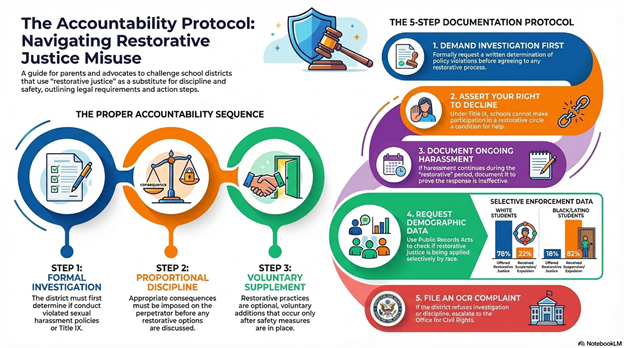
Restorative justice has legitimate applications in education—but only when implemented consistent with legal requirements for investigation, accountability, and victim protection.
Proper Sequence:
Key Principles:
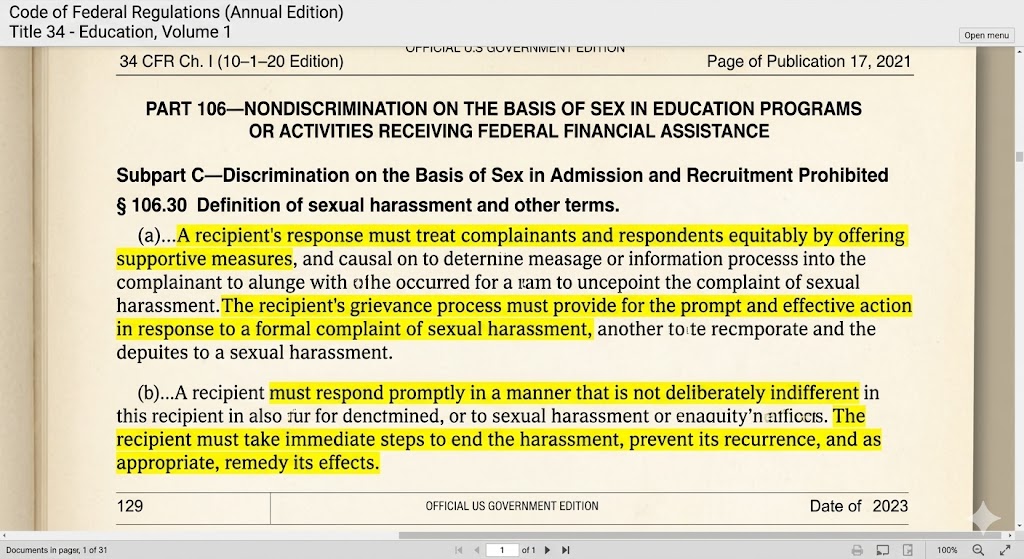
34 CFR § 106.30: Schools must respond to sexual harassment in manner that is “not deliberately indifferent”—meaning prompt investigation and effective action to end harassment, eliminate hostile environment, and prevent recurrence.
“Prompt” means:
“Effective” means:
Restorative justice that delays investigation or eliminates consequences violates Title IX “prompt and effective” standard.
34 CFR § 106.71: Schools cannot retaliate against students for exercising Title IX rights.
Retaliation includes: Making victim participation in restorative process condition for any response. Telling victim “if you won’t do restorative circle, we can’t help you” punishes victim for exercising right to formal investigation.
Safe Place to Learn Act requires districts to “take steps to ensure student safety” and “prevent acts from occurring.”
Districts cannot satisfy this by:
Misuse 1: Substitute Rather Than Supplement
District offers restorative justice INSTEAD of investigation and discipline, not in addition to it.
Misuse 2: Mandatory Participation
Victim told participating is only option for any response—coerced “consent” violating voluntary principle.
Misuse 3: No Investigation
District proceeds directly to restorative circle without investigating whether conduct violated harassment policy or Title IX.
Misuse 4: No Interim Protections
During weeks/months of restorative process, no safety measures implemented—students remain in same classes, harassment continues.
Misuse 5: No Consequences
Perpetrator faces zero discipline—restorative process becomes accountability-free zone.
Misuse 6: Selective Application
Restorative justice offered primarily to privileged perpetrators while students of color disciplined punitively for identical conduct.
Appropriate Use Case:
Student violates policy (investigation confirms). School imposes discipline (suspension, loss of privileges). School implements safety measures (schedule change, supervision). THEN school offers both students VOLUNTARY opportunity to participate in facilitated dialogue if they wish. Both genuinely agree. Process supplements accountability—doesn’t replace it.
Inappropriate Use Case:
Student reports harassment. School immediately schedules restorative circle without investigating. Victim told this is “our approach.” No determination of policy violation. No discipline. Harassment continues during process. This violates Title IX.
Research and California data show restorative justice often applied selectively:
Pattern: White students accused of serious misconduct offered restorative justice avoiding suspension/expulsion. Black/Latino students accused of identical or less serious conduct suspended/expelled without restorative option.
Result: Restorative justice becomes tool for protecting privileged students from consequences while maintaining punitive approaches for marginalized students—opposite of equity-focused intent.
When district proposes restorative justice, immediately respond in writing: “Before any restorative process, you must: (1) investigate whether conduct violated harassment policy and Title IX, (2) make formal determination of policy violation, (3) impose appropriate discipline, (4) implement safety measures. Under Title IX, restorative justice supplements accountability—it cannot replace investigation and consequences. Confirm in writing that investigation will occur first.”
If pressured to participate, send written statement: “Under 34 CFR § 106.71, I cannot be penalized for declining restorative process. My child has right to formal investigation, determination of violation, and appropriate discipline of perpetrator. If you provide no response when we decline restorative justice, that constitutes retaliation. Provide alternative response options within 48 hours.”
If harassment continues while district pursues restorative approach, document each incident and send written notice: “Harassment continues despite ongoing restorative process—proving response is not ‘effective’ under Title IX. Incidents on [dates] demonstrate your restorative approach has not ended harassment. Immediate interim measures required: separation of students, safety plan, and formal investigation. Extended dialogue without safety measures violates Title IX.”
File Public Records Act request: “All incidents past 24 months where restorative justice was offered or implemented, showing: student demographics (race, disability), nature of misconduct, whether restorative justice was primary response or supplement to discipline, outcomes. Requesting to analyze whether restorative justice applied discriminatorily.” Disparate data proves selective application violating Title VI.
If district uses restorative justice to avoid accountability, file OCR complaint: “District used ‘restorative justice’ to avoid Title IX obligations: (1) no investigation of policy violation, (2) no discipline of perpetrator, (3) harassment continued during process, (4) victim coerced into participation, (5) no interim safety measures. This violates Title IX requirement for prompt effective response. Request OCR investigation and immediate imposition of proper accountability measures.”
Send written response same day: “Before any restorative process, you must complete formal investigation determining whether conduct violated harassment policy and Title IX. Provide written findings of investigation and discipline imposed before proposing restorative approaches. Under Title IX, restorative justice supplements accountability—cannot replace investigation and consequences per 34 CFR § 106.30 ‘prompt effective action’ requirement.”
If district suggests restorative justice is only option, immediately send: “Under Title IX, my child has right to formal investigation, determination of violation, and appropriate discipline—regardless of participation in restorative process. If declining restorative justice results in no response, that constitutes retaliation under 34 CFR § 106.71. Confirm alternative response options available within 48 hours.”
If harassment continues while district pursues restorative approach (weeks of circles/dialogue), document each incident with date/time/description and send written notice after each: “Harassment continues despite ‘restorative’ approach on [date]. This proves response not ‘effective’ under Title IX. Immediate safety measures required: schedule separation, no-contact directive, interim protective measures. Provide within 48 hours.”
File California Public Records Act request: “All misconduct incidents past 24 months showing: student race/disability, misconduct type, whether restorative justice offered, whether discipline also imposed, final outcome. Requesting to analyze whether restorative justice applied equitably.” If data shows racial disparities (white students get restorative, Black students get suspended), include in Title VI complaint.
If district refuses investigation, requires participation, or allows harassment to continue during process, file OCR complaint at https://ocrcas.ed.gov/: “District misused ‘restorative justice’ to avoid Title IX obligations: no investigation conducted, no policy violation determination, no discipline imposed, harassment continued during 4-week process, no interim safety measures. This violates Title IX ‘prompt effective action’ requirement. Request immediate investigation, discipline of perpetrator, and policy changes prohibiting restorative justice as substitute for accountability.”
Nothing is wrong if implemented properly (after investigation, after discipline, voluntary participation, as supplement to accountability). Misuse occurs when schools use restorative justice to REPLACE investigation and discipline—offering circles or dialogue instead of determining policy violations and imposing consequences. This violates Title IX requirement for "prompt effective action" (34 CFR § 106.30) because extended dialogue without accountability doesn't end harassment or prevent recurrence. Restorative justice can supplement consequences—but cannot substitute for them.
No—that constitutes Title IX retaliation under 34 CFR § 106.71. You have the right to a formal investigation, a determination of policy violation, and appropriate discipline regardless of participation in a restorative process. If a school says "restorative justice is our only approach" or "if you won't participate we can't help," that punishes you for exercising your Title IX rights. Send a written objection: "Requiring participation in a restorative process as a condition for a formal response constitutes retaliation. Provide investigation and discipline regardless of restorative participation."
Common red flags include: (1) restorative justice proposed WITHOUT first investigating whether policy was violated, (2) no discipline imposed on the perpetrator before or during the process, (3) participation described as mandatory or the only option, (4) harassment continues during weeks or months of restorative meetings without interim safety measures, and (5) the process focuses on "both sides" and "healing" without clear accountability for the perpetrator. Proper use follows a different sequence: investigation confirms violation → discipline imposed → safety measures implemented → THEN a voluntary restorative option may be offered.
Continued harassment shows the response is not "effective" under Title IX standards. Document every incident and send written notice: "Harassment continues on [dates] despite the ongoing restorative process. This demonstrates the approach has not ended harassment as Title IX requires. Immediate action is necessary: formal investigation, interim protective measures (schedule separation, no-contact directive), and appropriate discipline. Extended dialogue without safety measures or consequences violates Title IX's 'prompt effective action' requirement." If the situation persists, file a complaint with the Office for Civil Rights (OCR).
Research and data frequently show racial disparities in application. White students are often disproportionately offered restorative justice options that avoid suspension or expulsion, while Black and Latino students receive punitive discipline for similar conduct. Request district data through a Public Records Act request showing restorative justice use by race. If disparities exist (for example, significantly higher use for white students than students of color), this may constitute a Title VI violation. Disparate impact evidence can be included in an OCR complaint demonstrating selective application that protects privileged students while disproportionately punishing marginalized students.
If you want student harm treated like a school safety and civil rights issue—start with SANI at https://saninstitute.net
Table of Contents Click to Expand 1. Audio 2. Definition 3. Video 4. Core Thesis 5. Case Pattern Story 6. SANI Connection 7. Discipline Explanation

Table of Contents Click to Expand 1. Audio 2. Definition 3. Video 4. Core Thesis 5. Case Pattern Story 6. SANI Connection 7. Discipline Explanation

Table of Contents Click to Expand 1. Audio 2. Definition 3. Video 4. Core Thesis 5. Case Pattern Story 6. SANI Connection 7. Discipline Explanation

Table of Contents Click to Expand 1. Audio 2. Definition 3. Video 4. Core Thesis 5. Case Pattern Story 6. SANI Connection 7. Discipline Explanation