

The Comparative Treatment Analysis Framework: Proving selective enforcement through data
Table of Contents Click to Expand 1. Audio 2. Definition 3. Video 4. Core Thesis 5. Case Pattern Story 6. SANI Connection 7. Discipline Explanation
1. Audio
2. Definition
3. Video
4. Core Thesis
9. Action Steps
10. FAQs
11. Call to Action
12. Sources
13. Signature
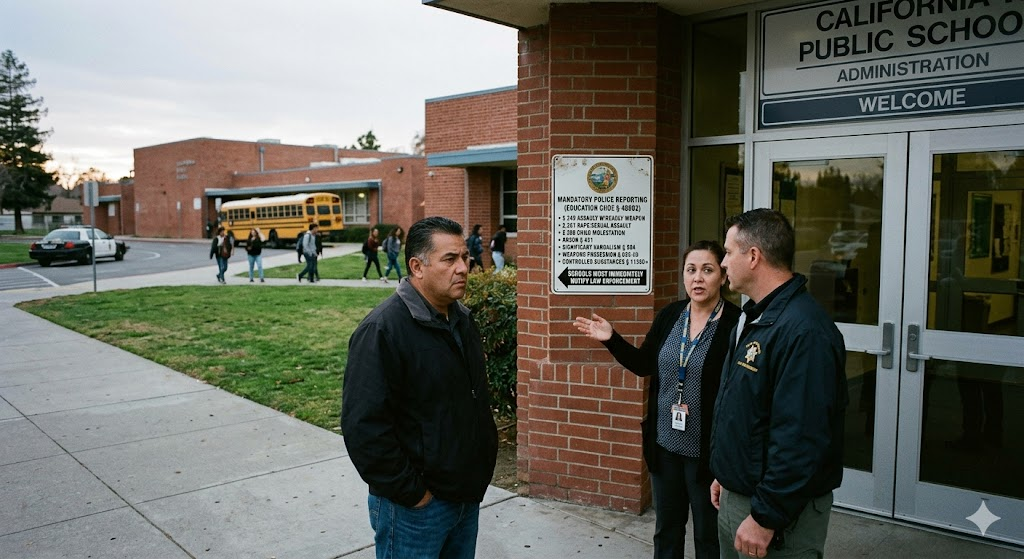
Mandatory police reporting requires California schools immediately notify law enforcement when specific crimes occur on campus or against students—including California Penal Code § 245 assault with deadly weapon, § 261 rape/sexual assault, § 288 child molestation, § 451 arson, § 594 significant vandalism, § 626.10 weapons possession, § 11350+ controlled substance violations, Education Code § 48902 requiring police notification for acts constituting enumerated felonies/misdemeanors—with violations occurring when districts handle reportable crimes solely through internal discipline, delay police notification to conduct internal investigations first, characterize criminal conduct as “peer conflict” or “bullying” to avoid reporting requirements, or pressure families not to file police reports claiming “we’ll handle it internally.”
California districts routinely handle crimes as internal discipline matters to avoid police involvement—student commits assault with weapon (Penal Code § 245), school suspends perpetrator but doesn’t call police; sexual assault occurs (§ 261/288), school conducts Title IX investigation but delays police notification; controlled substances distributed on campus (§ 11350+), school disciplines but avoids criminal referral—all violating mandatory reporting requirements established by Education Code § 48902 and various Penal Code sections requiring immediate law enforcement notification for enumerated crimes. We convert trauma into code by knowing which incidents trigger mandatory police reporting (weapons, sexual assault, serious assault, controlled substances, hate crimes), demanding immediate police notification when reportable crimes occur, documenting district refusals to report as violations of mandatory duty creating Government Code § 815.6 liability, and filing independent police reports when schools refuse. Selective enforcement IS discrimination when schools immediately call police for minor infractions by Black/Latino students (disruption, defiance) while handling serious crimes by white students internally—proving police reporting weaponized based on race not crime severity.
High school student in Fresno sexually assaults classmate in empty classroom. Victim reports immediately to principal. Principal responds: “This is very serious. I’m going to investigate thoroughly. Don’t talk to police yet—let us handle this through our Title IX process first. Filing police report could complicate things.”
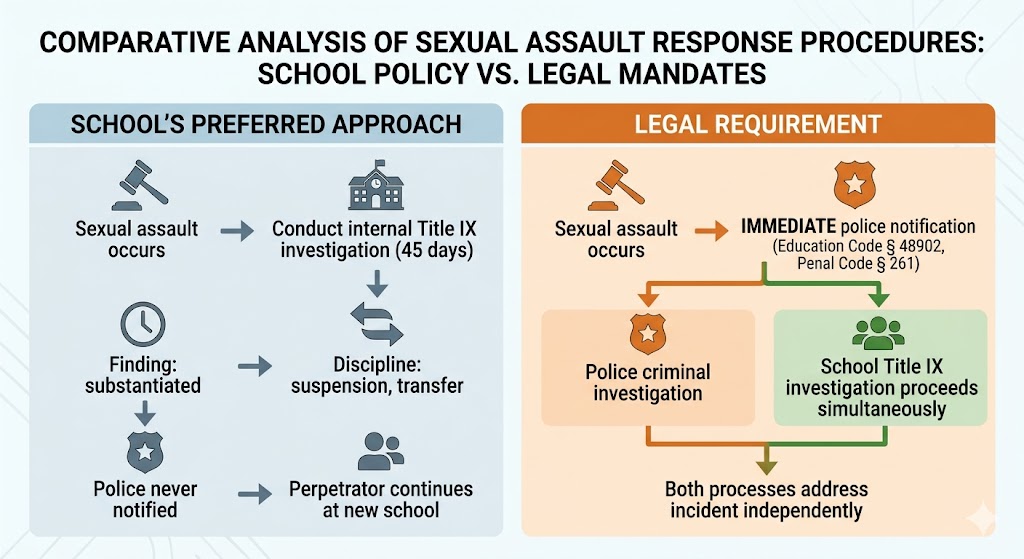
Victim’s mother trusts principal’s judgment. School conducts investigation over 45 days. Finding: sexual assault substantiated. Discipline: perpetrator suspended 10 days, transferred to another school.
Police never notified by school.
Three months later, perpetrator sexually assaults student at new school. That family files police report. During investigation, police discover prior assault at previous school—school never reported.
Detective contacts first victim’s family: “Did you know sexual assault is mandatory police reporting crime under California law? School should have called us immediately. By handling internally and not reporting, they allowed perpetrator to continue to new school where he assaulted again.”
Family devastated—trusted school to handle appropriately, didn’t realize school violated mandatory reporting law.
Attorney: “California Penal Code § 261 (rape), § 288 (child molestation), and Education Code § 48902 require schools immediately notify police when these crimes occur. Principal telling you not to file police report while handling through ‘internal process’ violated mandatory duty. School’s failure to report allowed perpetrator to assault again. This creates Government Code § 815.6 liability—breach of mandatory duty.”
Lawsuit alleges: mandatory reporting violation, negligence enabling subsequent assault, Title IX deliberate indifference. Settlement includes significant damages, policy requiring immediate police notification for all reportable crimes, training on mandatory reporting obligations, monitoring.
SANI identifies mandatory police reporting avoidance as institutional self-protection strategy—districts prefer handling crimes internally because: police involvement creates public records, criminal investigations may reveal institutional failures, parents may sue based on criminal findings, police reports attract media attention, criminal prosecutions acknowledge severity schools minimize.
Districts’ preference: characterize crimes as discipline matters handled privately.
Legal requirement: report enumerated crimes to police immediately.
SANI teaches families the critical distinction:
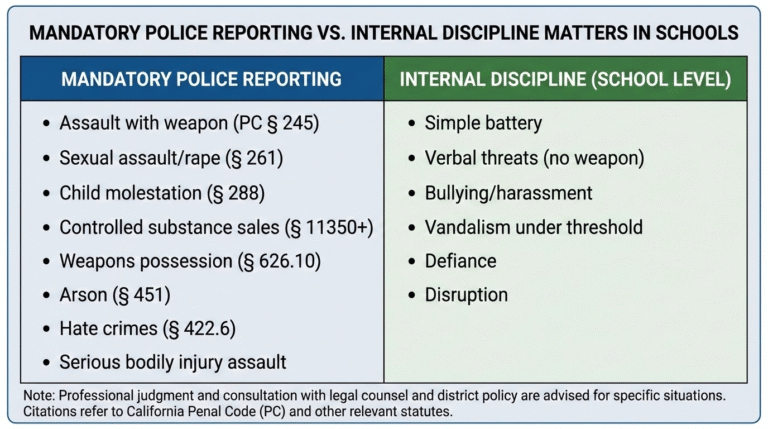
Schools have discretion over: bullying, harassment, simple battery, verbal conflicts, defiance, disruption, peer altercations without weapons/serious injury.
Schools have NO discretion—mandatory reporting required for: assault with deadly weapon (Penal Code § 245), sexual assault/rape (§ 261), child molestation (§ 288), hate crimes (§ 422.6), controlled substance sales (§ 11350+), weapons possession (§ 626.10), arson (§ 451), serious bodily injury assaults.
When reportable crime occurs and school doesn’t call police:
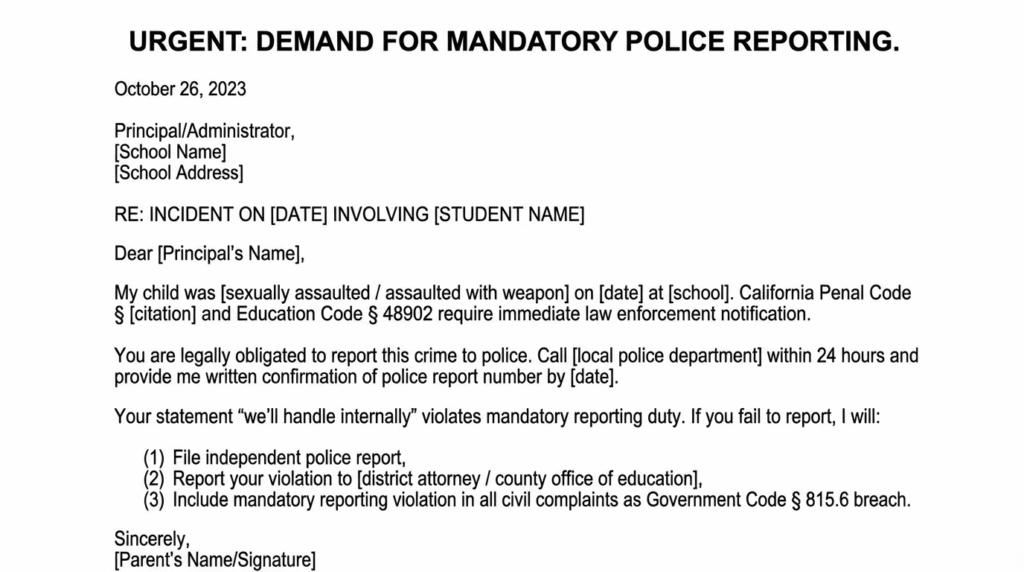
Send demand within 24 hours: “My child was [sexually assaulted / assaulted with weapon / etc.] on [date]. California [Penal Code section] and Education Code § 48902 require immediate police notification. Call police within 24 hours and provide written confirmation of police report number. If you don’t report, I will file independent police report and include your failure to report as mandatory duty violation in all complaints.”
Then file independent police report regardless—don’t wait for school.
Statute requires: Principal or designee must notify appropriate law enforcement authorities when student commits act that may constitute one of specified offenses listed in subdivision (a).
Specified offenses include:
“Must notify” is mandatory—not discretionary. Schools cannot substitute internal discipline for police notification when reportable crime occurs.
Sexual Assault Reporting:
Penal Code § 11160-11174.3 (Child Abuse and Neglect Reporting Act) requires school employees report suspected child abuse including sexual assault to law enforcement and child protective services.
Sexual assault of student by another student may trigger mandatory reporting depending on ages, force used, and other factors.
Weapons Violations:
Penal Code § 626.9 (Gun-Free School Zone Act) violations require police notification.
Education Code § 48915(c) requires recommendation for expulsion AND police notification for weapons offenses.
Hate Crimes:
Penal Code § 422.55+ (California’s Hate Crime Law) violations should be reported to law enforcement for investigation as criminal hate crimes, not just handled as school discipline.
MANDATORY police notification required:
Assault with deadly weapon (Penal Code § 245) – Student uses knife, gun, bat, or other weapon in assault
Sexual assault/rape (§ 261, 262, 288, 289) – Any forced sexual contact
Controlled substance sales (Health & Safety Code § 11350+) – Student sells or distributes drugs on campus
Weapons possession (Penal Code § 626.10) – Student brings firearm, knife, or other prohibited weapon to school
Arson (Penal Code § 451) – Student intentionally sets fire
Serious bodily injury assault – Assault causing significant or serious injury
Hate crimes (Penal Code § 422.6+) – Crimes motivated by race, religion, sexual orientation, etc.
Robbery (Penal Code § 211) – Taking property by force or fear
Discretionary—internal discipline typically appropriate:
Simple battery (Penal Code § 242) – Physical contact without weapon or serious injury (school may handle internally)
Bullying/harassment – Unless constitutes criminal threat, hate crime, or assault with injury
Vandalism – Unless significant dollar amount triggering § 48902
Verbal threats – Unless constitute criminal threat (Penal Code § 422) with credible immediate harm
Defiance, disruption, peer conflicts – Handled through school discipline unless escalate to reportable crimes
Tactic 1: Downgrading Characterization
Assault with weapon becomes “altercation” or “peer conflict”—avoiding mandatory reporting by mischaracterizing crime.
Tactic 2: “We’ll Handle Internally First”
Telling family school will investigate through Title IX or discipline process before involving police—delaying or avoiding mandatory notification.
Tactic 3: “Police Involvement Could Harm Student”
Discouraging victim from filing police report claiming criminal process is “traumatic” or “won’t help”—pressuring families to accept internal discipline instead.
Tactic 4: “Filing Police Report Violates Confidentiality”
Falsely claiming victim cannot file police report without violating perpetrator’s privacy rights—legally wrong, families can always file independent reports.
Tactic 5: Delayed Reporting
School eventually calls police after completing internal investigation—violating “immediate notification” requirement by prioritizing institutional investigation over legal duty.
Parents have independent right to file police reports regardless of school’s action or inaction.
When school refuses to report or delays:
Step 1: Contact local police department directly (not school resource officer who may defer to school)
Step 2: File written police report documenting: incident details, injuries, witnesses, when school was notified, school’s refusal to report
Step 3: Provide police with medical records, photos of injuries, witness statements
Step 4: Request police report number for documentation
Step 5: Include school’s failure to report in complaint to district, county office of education, district attorney
Criminal investigation is independent of school discipline—both can proceed simultaneously. Police may determine crime occurred warranting prosecution even if school’s discipline investigation found insufficient evidence.
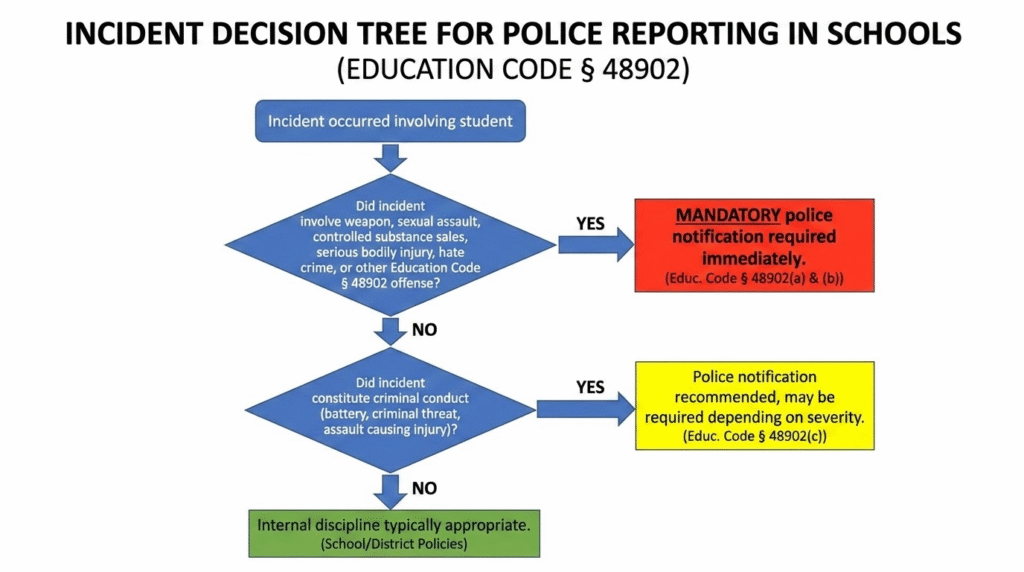
When incident occurs, assess: Does it involve weapon? Sexual assault/contact? Controlled substance sales/distribution? Serious bodily injury? Hate crime elements? Review Education Code § 48902 and Penal Code provisions. If incident falls within mandatory reporting categories, school has NO discretion—must notify police immediately. If school claims will “handle internally,” this violates mandatory duty creating Government Code § 815.6 liability.
Send written demand: “My child was [crime description] on [date]. California [Penal Code § and Education Code § 48902] require immediate law enforcement notification. You are legally obligated to report this crime. Call [local police department] within 24 hours and provide written confirmation including police report number by [date, time]. Your statement that you’ll ‘handle internally’ violates mandatory reporting duty. If you fail to report within 24 hours, I will file independent police report and include your mandatory reporting violation in all civil complaints as breach of mandatory duty.”
Within 48 hours of incident, file independent police report directly with local police (not school resource officer): Provide detailed incident description, injuries, medical records, photos, witness information, statement that school was notified on [date] and refused/delayed police notification. Request written police report number. Police investigation is independent of school discipline—both proceed simultaneously. Criminal findings may support civil claims even if school’s internal investigation minimized incident.
In all complaints (OCR, due process, civil litigation), dedicate section to mandatory reporting violation: “School failed to notify police of [crime] as required by California [statute citations]. This violated mandatory duty creating Government Code § 815.6 liability. School instead conducted internal investigation attempting to avoid police involvement and public scrutiny. Failure to report allowed [continued harm / perpetrator to remain on campus / subsequent incidents]. School prioritized institutional reputation over legal obligations and student safety.”
Send written complaint to: (1) District Attorney: “School failed to report [crime] as required by Education Code § 48902 and Penal Code provisions. Request investigation of school’s mandatory reporting violation and potential obstruction.” (2) County Office of Education: “Request investigation of district’s systematic failure to comply with mandatory police reporting requirements. Pattern of handling reportable crimes internally violates state law.” These agencies have oversight authority over school reporting obligations.
When incident occurs involving your child, determine if mandatory police reporting required: weapon involved (Education Code § 48902, Penal Code § 245), sexual assault/contact (§ 261, 288), controlled substances sales (Health & Safety Code § 11350+), serious bodily injury, hate crime (Penal Code § 422.6). Review statute lists. If incident falls within mandatory categories, school must notify police immediately—no discretion to “handle internally.” If school claims will investigate first, this violates mandatory reporting duty.
If mandatory reporting required: “My child was [sexually assaulted / assaulted with weapon / etc.] on [date] at [school]. California [Penal Code section] and Education Code § 48902 require immediate law enforcement notification. Call [city] police department within 24 hours. Provide written confirmation with police report number by [date, time]. Your statement ‘we’ll handle through Title IX / internal discipline’ violates mandatory duty. If not reported within 24 hours, I will: (1) file independent police report, (2) report violation to district attorney, (3) include in civil complaints as Government Code § 815.6 breach.”
Go directly to local police station (not school resource officer who may defer to school administration). File written report: incident details with dates/times/locations, injuries with medical records, witness names/statements, photos of injuries/evidence, statement school was notified on [date] and failed to report. Request written police report number. Police investigation independent of school discipline—both can proceed. Don’t let school discourage police filing claiming “we’ll handle it” or “police unnecessary.”
In OCR complaints, due process, civil litigation: “School violated mandatory police reporting duty. [Crime] occurred [date] triggering Education Code § 48902 and Penal Code § [statute]. School failed to notify police immediately, instead conducting internal investigation prioritizing institutional reputation over legal obligations. This violated Government Code § 815.6 (breach of mandatory duty), enabled [continued harm / subsequent incidents], and demonstrates deliberate indifference. Attach: demand for police notification sent [date], school’s response refusing/delaying, independent police report showing school failure.”
Send formal complaints: District Attorney: “School failed mandatory police reporting requirement Education Code § 48902 for [crime] occurring [date]. Request investigation of potential obstruction and systematic non-compliance with reporting laws.” County Office of Education: “Request investigation of district’s failure to comply with mandatory reporting obligations. Pattern shows districts handling reportable crimes internally to avoid police involvement violating state law. Request oversight and corrective action.” These agencies have authority to investigate and enforce reporting requirements.
California law requires schools to notify law enforcement when certain serious offenses occur on campus or during school activities. These may include violent acts, weapon-related offenses, sexual misconduct, drug-related offenses, and other specified crimes. In addition, suspected child abuse or neglect must be reported under mandatory reporting laws. These reporting obligations are generally not discretionary, and schools are expected to follow established legal requirements when such incidents arise.
Schools may conduct internal processes, such as administrative or Title IX investigations, but these do not replace legal reporting obligations where applicable. Certain incidents—particularly those involving potential criminal conduct—may require notification to law enforcement under state reporting laws. Internal handling alone may not be sufficient if mandatory reporting requirements apply.
Families generally have the right to contact law enforcement independently. If concerns arise that reporting is being discouraged, it may be helpful to document those communications and seek clarification regarding reporting obligations. Maintaining records of interactions can be important if questions later arise about how the situation was handled.
Yes. School disciplinary processes and law enforcement investigations are separate. A school may take administrative action, while law enforcement may independently assess whether criminal laws were violated. Filing a police report does not depend on the outcome of the school’s internal process.
If a school does not follow applicable reporting requirements, it may raise concerns about compliance with state laws and policies. Depending on the circumstances, this could lead to administrative review, corrective actions, or other forms of oversight. Documenting timelines, communications, and actions taken can help support any follow-up or review.
If you want student harm treated like a school safety and civil rights issue—start with SANI at https://saninstitute.net
Table of Contents Click to Expand 1. Audio 2. Definition 3. Video 4. Core Thesis 5. Case Pattern Story 6. SANI Connection 7. Discipline Explanation
Table of Contents Click to Expand 1. Audio 2. Definition 3. Video 4. Core Thesis 5. Case Pattern Story 6. SANI Connection 7. Discipline Explanation
Table of Contents Click to Expand 1. Audio 2. Definition 3. Video 4. Core Thesis 5. Case Pattern Story 6. SANI Connection 7. Discipline Explanation
Table of Contents Click to Expand 1. Audio 2. Definition 3. Video 4. Core Thesis 5. Case Pattern Story 6. SANI Connection 7. Discipline Explanation