

The documentation gap: when “no records” becomes the district’s defense
Table of Contents Click to Expand 1. Audio 2. Definition 3. Video 4. Core Thesis 5. Case Pattern Story 6. SANI Connection 7. Discipline Explanation
1. Audio
2. Definition
3. Video
4. Core Thesis
9. Action Steps
10. FAQs
11. Call to Action
12. Sources
13. Signature
The Post-Meeting Documentation Email is a strategic written record sent within 24 hours of any verbal meeting with school officials that: (1) confirms your understanding of what was discussed, decided, and promised, (2) creates a timestamp proving when the school had notice and what they committed to do, (3) establishes a written record the school must either confirm or correct, and (4) locks down agreements before the school can rewrite the narrative. This email includes six mandatory elements: meeting identification (date, time, attendees), incident/concern recap, school’s acknowledgments and commitments, your requests or demands, specific deadlines and next steps, and a request for written confirmation. Without this follow-up, verbal meetings become “he said, she said” disputes where schools deny promises, change timelines, and claim misunderstandings—with post-meeting documentation, you create undeniable evidence that courts, OCR investigators, and attorneys recognize as proof.
Verbal meetings are traps where schools make promises they later deny—but post-meeting documentation emails transform those traps into evidence. The Student Advocacy Network Institute, a Policy-Driven Student Safety Agency, operates on this iron-clad principle: if it’s not in writing, it didn’t happen. We convert trauma into code by teaching parents that every meeting with school officials must be followed within 24 hours by a written summary email that forces the school to either confirm your version or provide their own written version—either way, you create a documented record. Schools know verbal meetings are deniable. They prefer meetings over emails because meetings allow them to make promises without accountability. When you send post-meeting documentation, you eliminate their escape route: they must respond in writing (creating documentation) or stay silent (which you document as “no response to my summary, confirming accuracy”). Selective enforcement IS discrimination, and post-meeting documentation often reveals it—when you document verbal promises made to you and later discover different (better) written commitments made to other parents, the disparity proves discriminatory treatment. This article provides the complete post-meeting email template and strategic framework that ensures nothing said in meetings is lost, denied, or rewritten.
The Student Advocacy Network Institute was founded on the recognition that parents lose cases not because schools didn’t make promises, but because parents can’t prove the promises were made. As the nation’s first Policy-Driven Student Safety Agency, SANI operates at the intersection of evidence preservation, accountability enforcement, and documentation discipline.
When a parent contacts SANI and says, “The school promised they’d do X, but they didn’t,” we ask: “Did you document that promise in writing after the meeting?”
If NO: “Then you cannot prove the promise was made. It’s your word against theirs, and they’ll win.”
If YES: “Then you have evidence of broken promise. That’s breach of commitment, deliberate indifference if they had notice, and grounds for escalation.”
We convert trauma into code by teaching parents the 24-Hour Rule:
Within 24 hours of EVERY meeting, call, or verbal conversation with school officials, send a written summary email.
Why this works:
Email shows exactly when the meeting occurred and what was discussed. Timestamp proves you documented immediately while memory was fresh.
School must either:
All three outcomes give you written evidence.
Schools cannot later claim:
Your email, sent within hours of the meeting, is contemporaneous documentation that’s highly credible in court.
People rewrite history over time—consciously or unconsciously. By documenting within 24 hours, you lock down the school’s commitments before they can be forgotten, minimized, or reinterpreted.
For deliberate indifference and negligence claims, you must prove the school had notice. Post-meeting emails prove:
SANI treats student harm as both a school safety issue and a civil rights issue because post-meeting documentation often reveals discriminatory treatment. When you document verbal promises made to you (“we’ll monitor the situation”) and later discover other parents received written, detailed commitments (“we created a comprehensive safety plan within 2 days”), the disparity—documented through your own contemporaneous emails—proves selective enforcement.
Selective enforcement IS discrimination—and post-meeting documentation emails create the evidence chain that proves it.

Every post-meeting email must contain these six elements in this order:
Purpose: Establish when, where, and with whom the meeting occurred—creating undeniable record that meeting happened.
What to Include:
Date and Time:
Example: “Thank you for meeting with me on Tuesday, October 15, 2024, from 2:00 PM to 2:45 PM”
Location (if relevant):
Attendees: List everyone present:
Why This Matters:
Creates irrefutable proof that meeting occurred with these specific people. School cannot later claim:
Example Element 1:
“Thank you for meeting with me today, Tuesday, October 15, 2024, from 2:00 PM to 2:45 PM in your office to discuss the ongoing bullying situation involving my child, Alex Martinez.
ATTENDEES:
Purpose: Document what you reported to the school—proving they had notice of specific facts.
What to Include:
Brief summary of the concern/incident you reported:
Use language like:
Include key facts discussed:
Example:
“INCIDENT RECAP (As Discussed):
I reported that my child, Alex, has experienced the following conduct by students John Doe, Jane Roe, and Sam Smith:
I informed you that Alex is experiencing anxiety, refusing to attend school, and has experienced academic decline (grades dropped from B average to D average).
I described this as an escalating pattern that requires immediate intervention.”
Why This Matters:
Creates proof of notice. For negligence and deliberate indifference claims, you must prove school had knowledge. This recap proves:
School cannot later claim:
Purpose: Lock down what the school admitted or agreed to during the meeting.
What to Include:
Any acknowledgments or agreements from school officials:
Common acknowledgments to document:
Example:
“YOUR ACKNOWLEDGMENTS:
During our meeting, you acknowledged:
Why This Matters:
Acknowledgments are admissions. In legal terms, these are “statements against interest” that the school cannot later deny without contradicting their own words.
If school later claims:
Strategic Tip: If school made damaging admissions (e.g., “Yes, we should have acted sooner” or “You’re right, we dropped the ball”), DEFINITELY include those. Once in writing, they cannot walk them back.
Purpose: Lock down exactly what the school promised to do, with specific timelines.
What to Include:
Every action school committed to take:
Be SPECIFIC about:
Use qualifying language if uncertain:
This protects you if school later claims you misunderstood—your language shows you documented your understanding and gave them opportunity to correct.
Example:
“YOUR COMMITMENTS (As I Understood Them):
You committed to the following actions and timelines:
Why This Matters:
Commitments are promises. Broken promises are evidence of:
If school commits to “written safety plan by Friday” and doesn’t deliver, you have proof of broken promise.
Strategic Tip: The more specific the commitment, the easier to prove breach. “We’ll monitor” is vague and hard to enforce. “Daily check-ins with counselor at 8 AM, documented in log” is specific and enforceable.
Purpose: Clearly state what you are demanding and by when—creating clear expectations and proving you made specific requests.
What to Include:
List every request you made or are making:
Be SPECIFIC about:
Common requests:
Example:
“MY REQUESTS:
I am requesting the following:
Why This Matters:
Proves you made specific, reasonable requests. If school fails to provide what you requested:
Strategic Tip: Always request things IN WRITING. Verbal updates are deniable. Written updates create evidence.
Purpose: Force the school to respond in writing, creating documented record one way or another.
What to Include:
Direct request for written confirmation:
Set a deadline (typically 24-48 hours):
State what you’ll do if no response:
Example:
“REQUEST FOR CONFIRMATION:
Please reply to this email by Thursday, October 17, 2024 (48 hours from now) to:
If I do not receive a response by October 17, I will assume my summary is accurate and will rely on the commitments outlined above.
If any commitments or timelines are incorrect, please provide the correct information in writing so we have a clear mutual understanding.”
Why This Matters:
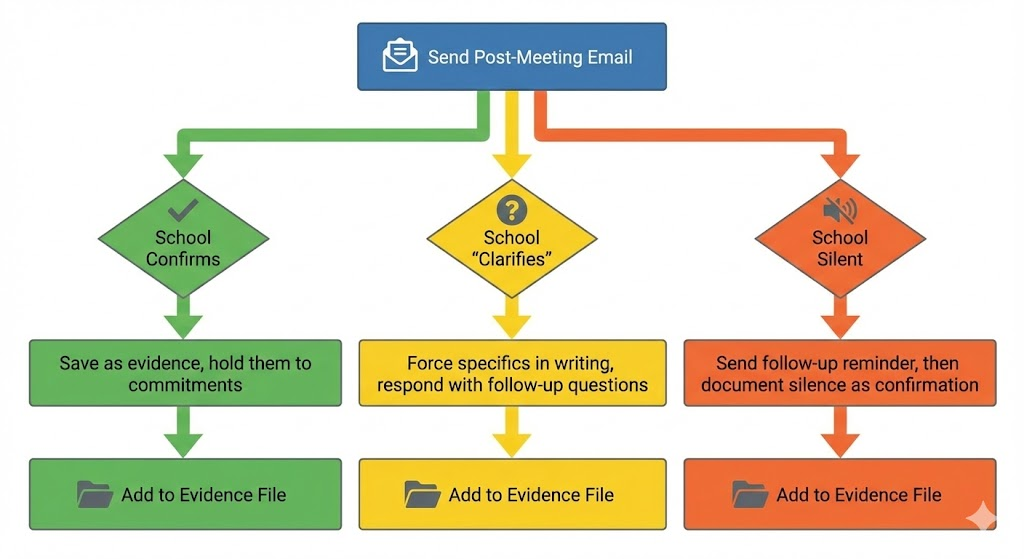
Creates no-win situation for school:
If they confirm: You have written proof of commitments
If they “clarify”: You have their written version (still documented)
If they stay silent: You document their silence as confirmation
All three outcomes give you written evidence.
Strategic Tip: The “I will assume accurate if no response” language is powerful. It shifts burden to them—they must respond or accept your version as correct.
Here’s how all six elements come together:
Subject: Meeting Summary & Confirmation – [Student Name] Safety Concerns – [DATE]
Dear [Principal/Administrator Name],
Thank you for meeting with me on [DAY], [DATE], from [TIME] to [TIME] [LOCATION] to discuss [BRIEF TOPIC].
ATTENDEES:
INCIDENT/CONCERN RECAP (As Discussed): I reported that [brief summary of what you told them].
YOUR ACKNOWLEDGMENTS: During our meeting, you acknowledged:
YOUR COMMITMENTS (As I Understood Them): You committed to the following actions and timelines:
MY REQUESTS: I am requesting:
NEXT STEPS & DEADLINES:
REQUEST FOR CONFIRMATION: Please reply to this email by [DATE, 24-48 hours] to confirm my understanding is accurate or to provide corrections/clarifications in writing.
If I do not receive a response by [DATE], I will assume my summary is accurate and will rely on these commitments going forward.
Thank you,
[Your Name]
[Date]
[Contact Information]
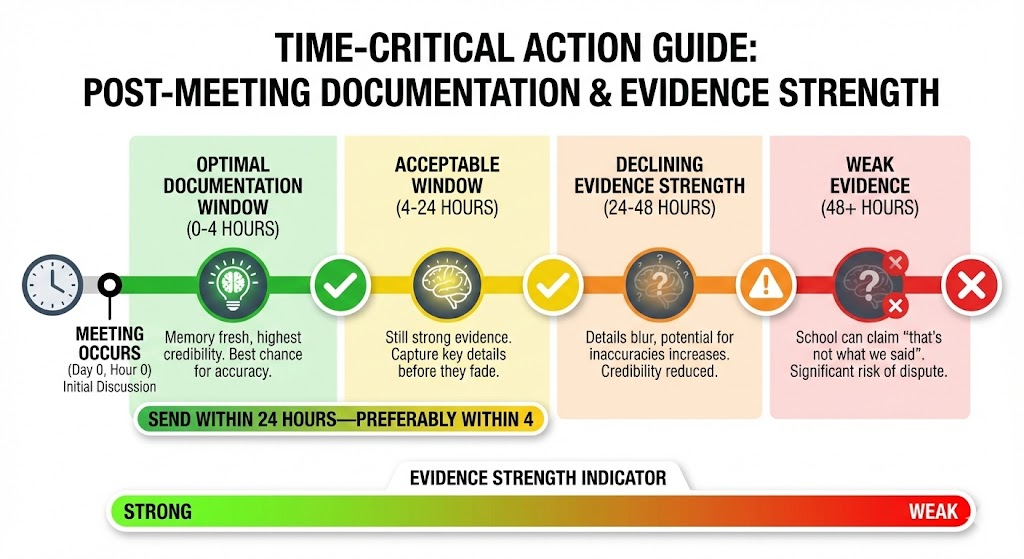
Timing is critical:
0-4 hours: Optimal—memory fresh, highest credibility
4-24 hours: Good—still contemporaneous documentation
24-48 hours: Acceptable but weakening
48+ hours: Weak—school can claim memory faded, details wrong
Set a personal rule: Email sent same day as meeting, ideally within 2-4 hours.
How to do this:
Immediately after meeting:
Within 2-4 hours:
Don’t overthink it. Getting it sent quickly matters more than perfect phrasing.
Copy the template into a document you can access easily:
Save template in:
Every time you have a meeting, call, or substantive conversation:
Make it a habit: Meeting happens → Email sent within hours. No exceptions.
Scenario A: School Confirms
School’s email: “Your summary is accurate. We will provide the safety plan by Friday as discussed.”
Your response: Brief acknowledgment
“Thank you for confirming. I will expect the written safety plan by Friday, October 18. Please send via email for my records.”
Action: Save email chain as evidence. Hold school to commitments. If Friday arrives with no plan, escalate immediately with proof of broken promise.
Scenario B: School “Clarifies” or Provides Different Version
School’s email: “I want to clarify—I didn’t commit to a written safety plan by Friday. I said we would assess the situation and develop a plan over the coming weeks.”
Your response: Force specifics
“Thank you for clarifying. To ensure we have mutual understanding:
Please provide written responses to these questions by [DATE, 48 hours].”
Why this works: You’re forcing them to commit to specifics in writing. Even their “clarified” version creates documented commitments.
Scenario C: School Stays Silent (No Response)
Day 2 after deadline: Send follow-up
Subject: Follow-Up: Meeting Summary Requires Confirmation by [DATE]
“I sent a meeting summary on [DATE] requesting written confirmation by [DATE]. I have not received a response.
Please confirm or correct my summary by [NEW DATE, 24 hours from now]. If I do not receive a response, I will proceed on the assumption that my summary is accurate per my original email.”
If still no response after second deadline: Document silence
Add to your records/timeline:
“On [DATE], I sent meeting summary to Principal Smith. On [DATE], I sent follow-up requesting confirmation. As of [DATE], Principal Smith has not responded to either email despite two opportunities to correct or clarify. This silence confirms the accuracy of my summary including the following commitments: [list key commitments].”
Use in future communications:
“In our meeting on [DATE] (documented in my email of [DATE] which you received but did not correct), you committed to providing a safety plan by [DATE]…”
Their silence eliminates their ability to later claim misunderstanding.
Organize all post-meeting emails:
Create folder/binder section:
Meeting Documentation
For each meeting, save:
Update Master Timeline:
Date | Event | Documentation | Outcome |
10/15 | Meeting with Principal | Summary email sent 10/15, confirmed by Principal 10/16 | Written commitment to safety plan by 10/18 |
10/18 | Deadline for safety plan | No plan received, email sent 10/18 documenting failure | Broken promise documented |
When escalating to higher levels or external agencies, attach post-meeting emails:
Example escalation to superintendent:
“I have met with Principal Smith three times (see attached meeting summaries from [DATES]). In each meeting, Principal Smith committed to specific actions with deadlines (documented in my post-meeting emails which Principal Smith confirmed).
Despite these documented commitments, the actions have not been taken:
These broken promises, documented in writing, demonstrate deliberate indifference…”
Post-meeting emails become exhibits proving:
Phone calls are meetings too—and equally deniable.
After every substantive phone call with school:
Within 1-2 hours, send email:
Subject: Confirmation of Phone Conversation – [DATE] at [TIME]
“This email confirms our phone conversation today, [DATE], at approximately [TIME].
DISCUSSED: [What you talked about]
YOUR STATEMENTS: [What school official said/committed to]
NEXT STEPS: [What’s supposed to happen next]
Please confirm this summary is accurate or provide corrections by [DATE].
Thank you,
[Your Name]”
Same principle: Forces written confirmation of verbal conversation.
Schools sometimes try to avoid written communication:
School: “Let’s set up a meeting to discuss this rather than going back and forth on email.”
Your response:
“I’m happy to meet. However, I will be sending a written summary of our meeting via email afterward to ensure we have a mutual understanding of what was discussed and agreed to. Please confirm the meeting time.”
This signals: I will document everything. You cannot hide behind verbal conversations.
Alternative if they insist on verbal-only:
“I prefer written communication for important matters like this to avoid misunderstandings. Can we handle this via email? If a meeting is necessary, I will send written confirmation afterward.”
Within 24 hours of every meeting—whether in person or by phone—you should send a follow-up email containing six elements:
This creates contemporaneous, objective evidence of what was discussed and promised and prevents the school from later denying, minimizing, or rewriting the meeting.
Personal notes help your memory but carry little evidentiary weight. They are easily dismissed as biased, inaccurate, or created after the fact.
A post-meeting email sent to the school creates far stronger evidence because it establishes contemporaneous documentation, gives the school an opportunity to correct errors, generates written responses from the school itself, and proves exactly when and how the school received notice.
Courts, attorneys, and oversight agencies consistently give more weight to post-meeting emails than to private notes.
A refusal to respond is still useful evidence. Document it clearly: “Meeting summary sent on [DATE] requesting confirmation by [DATE]. The school declined to confirm or correct.”
If the school had an opportunity to correct inaccuracies and chose not to, it weakens any later claim that your summary was wrong. An explicit refusal to respond can further demonstrate bad faith or deliberate avoidance of accountability.
Yes. There is no such thing as an informal meeting when student safety, discrimination, or accommodations are at issue. Schools often label conversations as “informal” to avoid creating a record.
Even brief hallway conversations or pickup-time discussions should be documented: “This email confirms our brief conversation today at pickup regarding [TOPIC]. You stated [COMMITMENT]. Please confirm by [DATE].”
Consistent documentation ensures nothing is lost, minimized, or later denied.
Recording laws vary by state. Some require consent from all parties, while others allow one-party consent.
Even where recording is legal, written summaries are still essential. Schools may refuse to meet if recorded, recordings are time-consuming to transcribe, and written summaries force the school to respond—creating two-way documentation.
If you do record (where legal), note it in your summary: “An audio recording of this meeting is available if needed for reference.”
Send a supplemental email as soon as possible: “Supplemental to Meeting Summary – Additional Item.”
State what was omitted and ask the school to confirm or correct your recollection. While it’s best to be thorough in the initial email, supplemental documentation is far better than leaving the issue unrecorded.
Yes. Documentation is not about distrust—it’s about clarity and protection. Even well-intentioned staff forget details, change roles, or face institutional pressure to walk back commitments.
Framing the email positively—“To ensure we’re on the same page”—protects both sides and reduces the risk of future disputes.
If you want student harm treated like a school safety and civil rights issue—start with SANI at https://saninstitute.net
The Student Advocacy Network Institute (SANI) is a national research, accountability, and discipline institute founded by Bullying Is A Drug to define, document, and address institutional failure in K–12 education—treating student harm as a school safety and civil rights issue.
Explore the Institute:
https://saninstitute.net
Parent A: Doesn’t Document Meeting (Loses Evidence)
A parent meets with the principal about ongoing bullying. The meeting lasts 45 minutes. The principal is sympathetic, takes notes, and makes promises:
Principal’s verbal promises in meeting:
Parent leaves feeling hopeful. The principal seemed genuinely concerned and committed to action.
One week later: No call from principal. Parent emails: “I haven’t heard from you about the safety plan you promised.”
Principal’s response: “I did speak with the students. I don’t recall promising a written safety plan—I said we would monitor the situation, which we are doing. I’ll reach out when there’s something to update you about.”
Two weeks later: Bullying continues. Parent references the meeting again: “You promised to have teachers monitoring closely.”
Principal’s response: “We are monitoring. I never promised specific actions—I said we’d do what we could given our resources.”
One month later: Parent files complaint citing the principal’s “broken promises.”
School’s written response: “The principal met with the parent and discussed general approaches to addressing peer conflicts. The parent seems to have misunderstood the conversation. The principal made no specific commitments and has responded appropriately.”
In court/OCR proceeding:
Parent’s testimony: “The principal promised a safety plan and close monitoring.”
Principal’s testimony: “I said we would monitor the situation. I made no specific promises. The parent misunderstood.”
Evidence: None. No written record exists.
Result: “He said, she said”—parent’s claims dismissed as misunderstanding.
Parent A loses because there’s no written proof of what was promised.
Parent B: Documents Meeting Immediately (Creates Undeniable Evidence)
Same scenario—meeting with principal about bullying.
Within 2 hours of meeting, parent sends this email:
Subject: Meeting Summary & Confirmation – [Student Name] Safety Concerns [DATE]
Dear Principal [Name],
Thank you for meeting with me today, [DATE], from [TIME] to [TIME], to discuss the ongoing bullying situation involving my child, [STUDENT NAME].
ATTENDEES:
INCIDENT RECAP (As Discussed): I reported that my child has experienced the following conduct by [Student A, Student B, Student C]:
YOUR ACKNOWLEDGMENTS: During our meeting, you acknowledged:
YOUR COMMITMENTS (As I Understood Them): You committed to the following actions and timelines:
MY REQUESTS: I am requesting:
NEXT STEPS & DEADLINES:
REQUEST FOR CONFIRMATION: Please reply to this email by [DATE, 48 hours from now] to confirm my understanding of our meeting is accurate. If I have misunderstood any commitments or timelines, please provide the correct information in writing.
If I do not receive a response by [DATE], I will assume my summary is accurate and will rely on these commitments going forward.
Thank you,
[Your Name]
[Date]
[Contact Information]
What happens next:
Scenario 1: Principal confirms
“Your summary is accurate. I will provide the safety plan by Friday as discussed.”
Result: You have written confirmation of all commitments. If principal fails to deliver, you have proof of broken promise.
Scenario 2: Principal “clarifies”
“I want to clarify a few points. I said I would talk to the students and monitor the situation. I did not commit to a written safety plan by Friday—I said we would develop a plan over the coming weeks as we assess the situation.”
Result: You forced the principal to commit to their version in writing. Now you have written proof of what they claim they promised (even if less than you understood). You can respond: “Thank you for clarifying. To confirm: you are committing to developing a plan ‘over the coming weeks.’ Please provide specific timeline: will the plan be ready in 1 week, 2 weeks, or 3 weeks? I need a concrete deadline.”
Scenario 3: Principal doesn’t respond
You send follow-up 48 hours later:
“I sent meeting summary on [DATE] requesting confirmation by [DATE]. I have not received a response. Per my email, I am proceeding on the assumption that my summary is accurate and will rely on the commitments outlined: safety plan by Friday, weekly updates, close monitoring with documentation. Please confirm receipt of this email.”
If still no response, you document:
“Principal received my meeting summary on [DATE] and has not responded to confirm or correct despite two requests. This silence confirms the accuracy of my summary.”
In court/OCR proceeding:
Parent’s evidence: Email sent within 2 hours of meeting, detailing specific commitments, requesting confirmation.
School’s options:
Result: Parent has documented evidence. School cannot claim “misunderstanding” without contradicting their own written record or explaining why they didn’t correct the summary when given opportunity.
Parent B wins because written documentation eliminates “he said, she said.”
Table of Contents Click to Expand 1. Audio 2. Definition 3. Video 4. Core Thesis 5. Case Pattern Story 6. SANI Connection 7. Discipline Explanation

Table of Contents Click to Expand 1. Audio 2. Definition 3. Video 4. Core Thesis 5. Case Pattern Story 6. SANI Connection 7. Discipline Explanation
Table of Contents Click to Expand 1. Audio 2. Definition 3. Video 4. Core Thesis 5. Case Pattern Story 6. SANI Connection 7. Discipline Explanation

Table of Contents Click to Expand 1. Audio 2. Definition 3. Video 4. Core Thesis 5. Case Pattern Story 6. SANI Connection 7. Discipline Explanation